Key takeaway
- How a cloud VoIP platform with SIP, video calling and real-time analytics is built, and where AI agents help monitor call quality and server load.
A cloud VoIP solution is a calling and messaging platform that carries voice and video over the internet from servers in the cloud, with analytics that track call load, quality and user activity in real time. It replaces conventional phone lines with software that runs on infrastructure the business controls or rents.
This page is for engineering and IT leaders planning a custom VoIP and video calling platform. It covers the problem, the architecture, the real-time analytics layer, where AI agents fit and what to check before you build.
What problem does a cloud VoIP solution solve?
Businesses that review the cost of conventional phone services for staff often move to VoIP. A generic, off-the-shelf product may not fit their data and reporting needs, so some build a customised system instead. The scenario here is a calling and chat platform for mobile users on iOS and Android that can reach any phone number worldwide. The platform also needs analytics to watch the load and performance of the call server and the chat server, and to track user activity as it happens.
Typical features include instant messaging, online meetings, call monitoring, recording and transfer, remote support, text-to-speech, voicemail and do-not-disturb.
How does a cloud VoIP platform work?
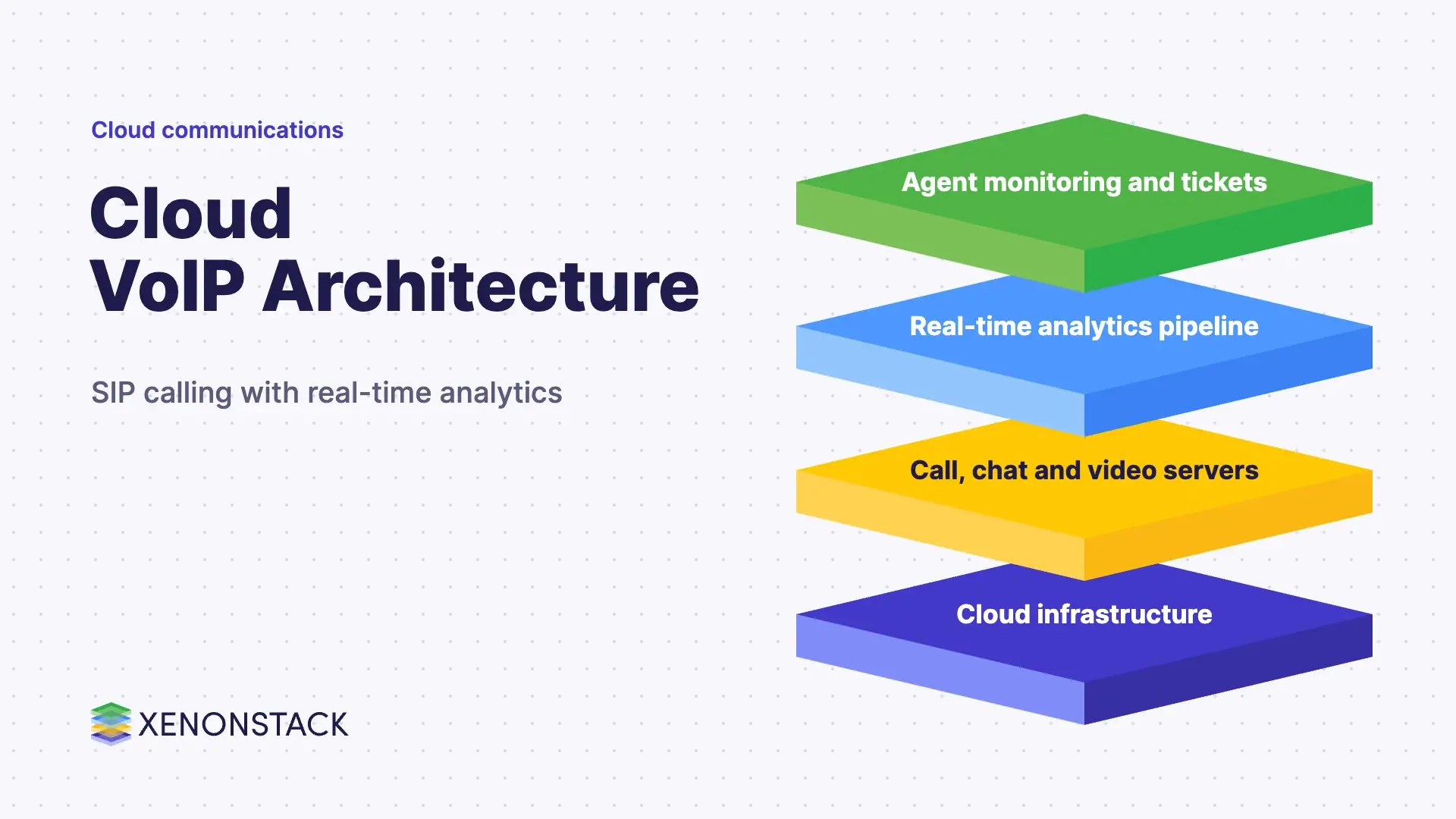
Calls are set up with a signalling protocol. The SIP specification (RFC 3261) describes SIP as an application-layer control protocol that creates, modifies and ends sessions such as internet phone calls and conferences. For browser and mobile video, WebRTC is an open framework that lets apps send audio, video and data between peers through standard APIs. The reference build for this use case layers the following components.
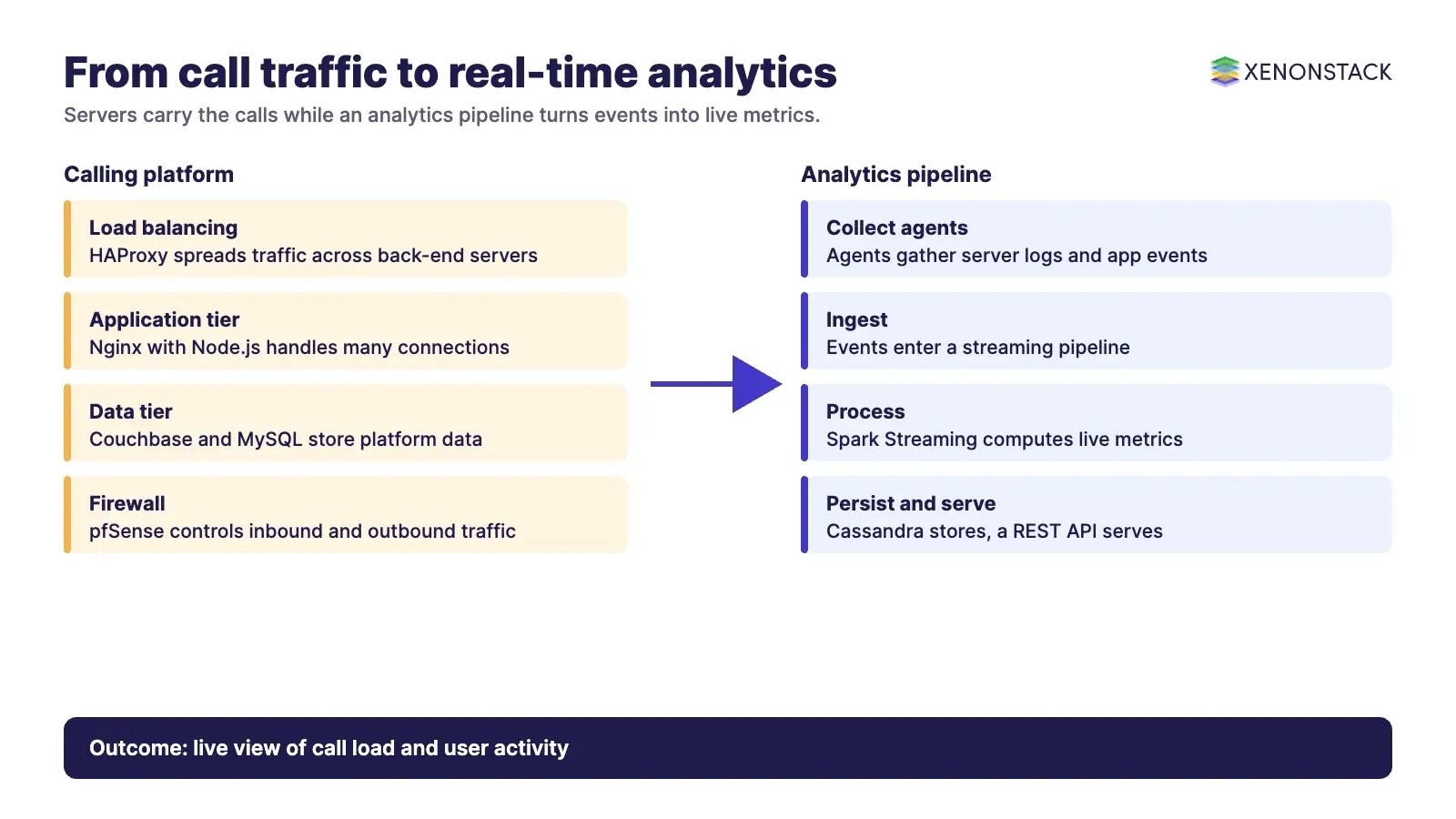
- Infrastructure: dedicated servers with virtualisation, and each node on its own virtual machine.
- Security: a pfSense firewall controls inbound and outbound connections.
- Load balancing: HAProxy spreads traffic across back-end servers so they stay stable under heavy load.
- Application tier: Nginx with a Node.js API handles many simultaneous connections without blocking, and PHP servers run in multiples for high availability.
- Data tier: Couchbase, a distributed NoSQL document database, alongside MySQL.
- Monitoring and mail: Zabbix monitors firewalls and virtual machines, and an internal mail cluster of more than two nodes keeps mail available.
How is the real-time analytics layer built?
The analytics platform watches the Asterisk call server logs, the chat server and user events from the Android and iOS apps. The build follows five steps.
- Deploy agents on the servers and in the apps to collect events.
- Ingest the data through a streaming pipeline.
- Process it with Apache Spark Streaming.
- Persist it in Apache Cassandra.
- Expose it through a REST API built with the Play Framework and the actor model in Scala.
The video calling application itself takes requests in real time, uses non-blocking input and output to handle many requests at once, and passes HTTP requests to a thread pool before storing results in the database. Its functions include group calling, end-to-end encryption, file and media sharing, push notifications, presence indication, location tracking and HD video.
Where do AI agents fit in a VoIP platform?
AI agents sit on top of the analytics layer. An agent can read call-server load, chat metrics and quality signals, flag a degrading node, open a ticket with the evidence attached and propose a fix for an engineer to approve. Agents can also summarise recordings and route support requests. ElixirClaw is XenonStack's AI agents computing platform for running agents like these. Each agent action should be tied to the data and policy it depends on, so a person can review what it did and why.
How does a custom build compare with an off-the-shelf service?
The right choice depends on how specific your data and reporting needs are.
| Factor | Off-the-shelf VoIP | Custom cloud VoIP |
|---|---|---|
| Fit to your needs | Generic, one size for all | Built around your own requirements |
| Analytics | Fixed reports | Real-time metrics on servers and users |
| Control of data | Held by the provider | Held in your own environment |
| Effort to launch | Low | Higher, needs engineering |
| Integration | Vendor connectors | Any system you can reach by API |
What should you check before building one?
Start with these checks.
- List the features users need and the call volumes you expect.
- Decide which signals you must monitor: server load, call quality, chat delivery and user events.
- Confirm encryption and data location requirements for calls and recordings.
- Plan for high availability in the application, data and mail tiers.
- Define who approves any action an AI agent proposes.
To map one decision your agents make on your communications platform, and the data and policy it depends on, book a Context Workshop. See what happens in the workshop.
Frequently asked questions
What is a cloud VoIP solution?
It is a calling and messaging platform that carries voice and video over the internet from cloud servers, with tools to monitor performance and usage.
What is SIP in VoIP?
SIP is an application-layer control protocol that sets up, changes and ends sessions such as internet phone calls and conferences.
Why build real-time analytics for a VoIP platform?
Real-time analytics show the load and performance of the call and chat servers and the activity of users, so engineers can act before callers notice a problem.
Which technologies suit a high-load VoIP back end?
A common stack uses HAProxy for load balancing, Nginx with Node.js for many simultaneous connections, a NoSQL database such as Couchbase, and Spark Streaming with Cassandra for analytics.
How can AI agents help run a VoIP platform?
Agents can watch server and call metrics, flag problems early, open tickets with evidence and propose fixes for a person to approve.
Ready to put AI agents to work? See an ElixirClaw demo: the agentic OS to build, orchestrate and govern AI agents across your enterprise systems.
Explore the XenonStack platform family: ElixirData · ElixirClaw · ElixirHub · NexaStack · MetaSecure · Neural AI · AgentGRC · AgentSRE · AgentAnalyst · AgentInstruct · AgentRAI · AgentScrum · AgentSearch · AgentForce · AI Aviator · SAIF Aviator · CohortIQ · XenonStack AI · XenonStack UAE