What does agentic AI change in managed services?
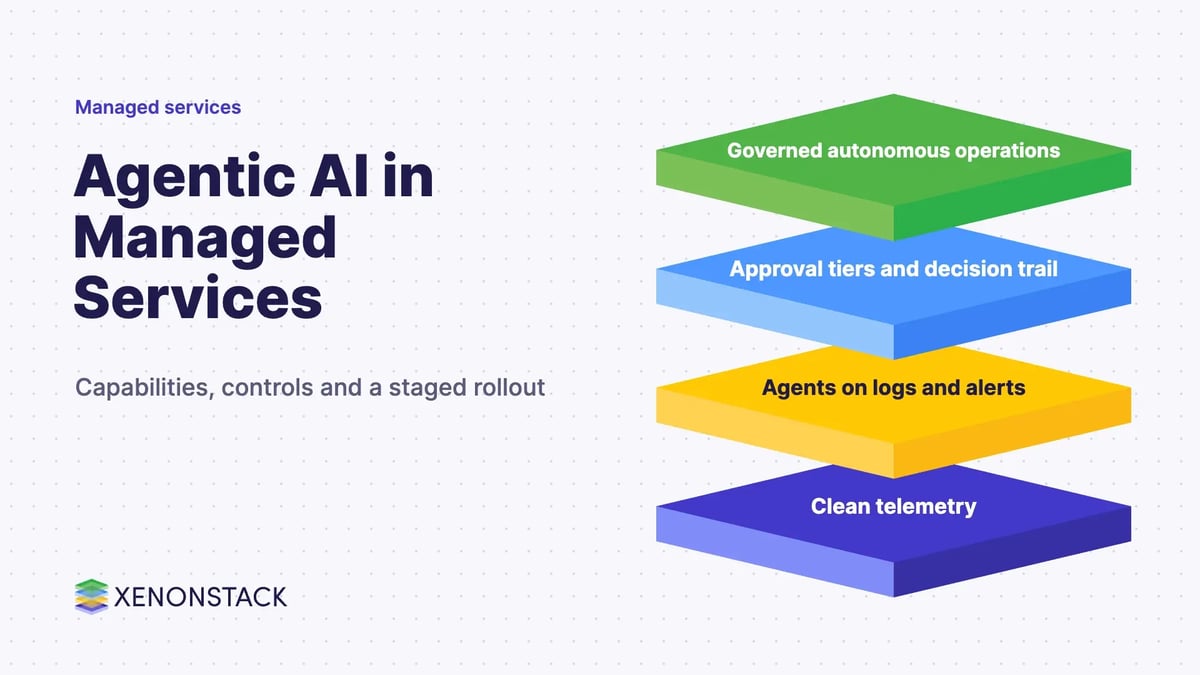
Agentic AI lets a managed service provider hand bounded operational goals, such as triaging an alert or restarting a failed service, to software that reasons over logs, metrics and tickets, acts through approved tools and escalates when it should. It differs from scripted automation because the agent chooses its next step from context. The commercial question for a provider or an internal IT team is which actions the agent may take alone, and what record proves it stayed inside policy. For the wider service model, see AI managed services and our overview of agentic AI.
You do not need mature automation to start. A team at Level 0, where monitoring is manual and health checks and patching are run by hand, can begin with agents that read, summarise and recommend, then widen what they may do as trust and evidence build.
Key Takeaways
Start in read-only mode: log analysis, alert triage and report drafting carry little risk and show where the data is weak.
Autonomy is a permission, not a feature: each action the agent may take alone should be listed, approved and logged.
Governance decides scale: least privilege, human approval for high-impact actions and a decision trail matter more than the choice of model.
Measure toil, not hype: the Google SRE book defines toil and sets a target for how much of each engineer's time it should take, which gives a fair baseline.
How does agentic AI differ from traditional infrastructure automation?
Traditional automation executes a rule when a trigger fires. An agent receives a goal, gathers context, picks tools, acts and checks the result. Both have a place in a managed service.
| Dimension | Rule-based automation | Agentic AI |
|---|---|---|
| Decision logic | If/then conditions written in advance | Reasons over context and chooses among approved tools |
| Scope | Single task, such as restarting a service | Multi-step: diagnose, act, verify, document |
| Context | Only the trigger payload | Logs, metrics, topology and past tickets |
| Change | Rules updated by hand | Behaviour changes with prompts, tools and policy, and must be re-tested |
| Risk profile | Predictable, narrow failures | Wider failure modes, so permissions and review matter more |
| Best fit | Stable, well-understood runbooks | Variable triage, correlation and drafting work |
What does Level 0 mean in infrastructure operations?
Level 0 is the most basic tier of infrastructure management: teams check logs, metrics and alerts by hand, run health checks and patching manually, and have basic dashboards at best. Agents can step in as assistants that handle repetitive checks, triage incidents and recommend fixes, while people keep the approval role.
Which agent capabilities should a managed service adopt first?
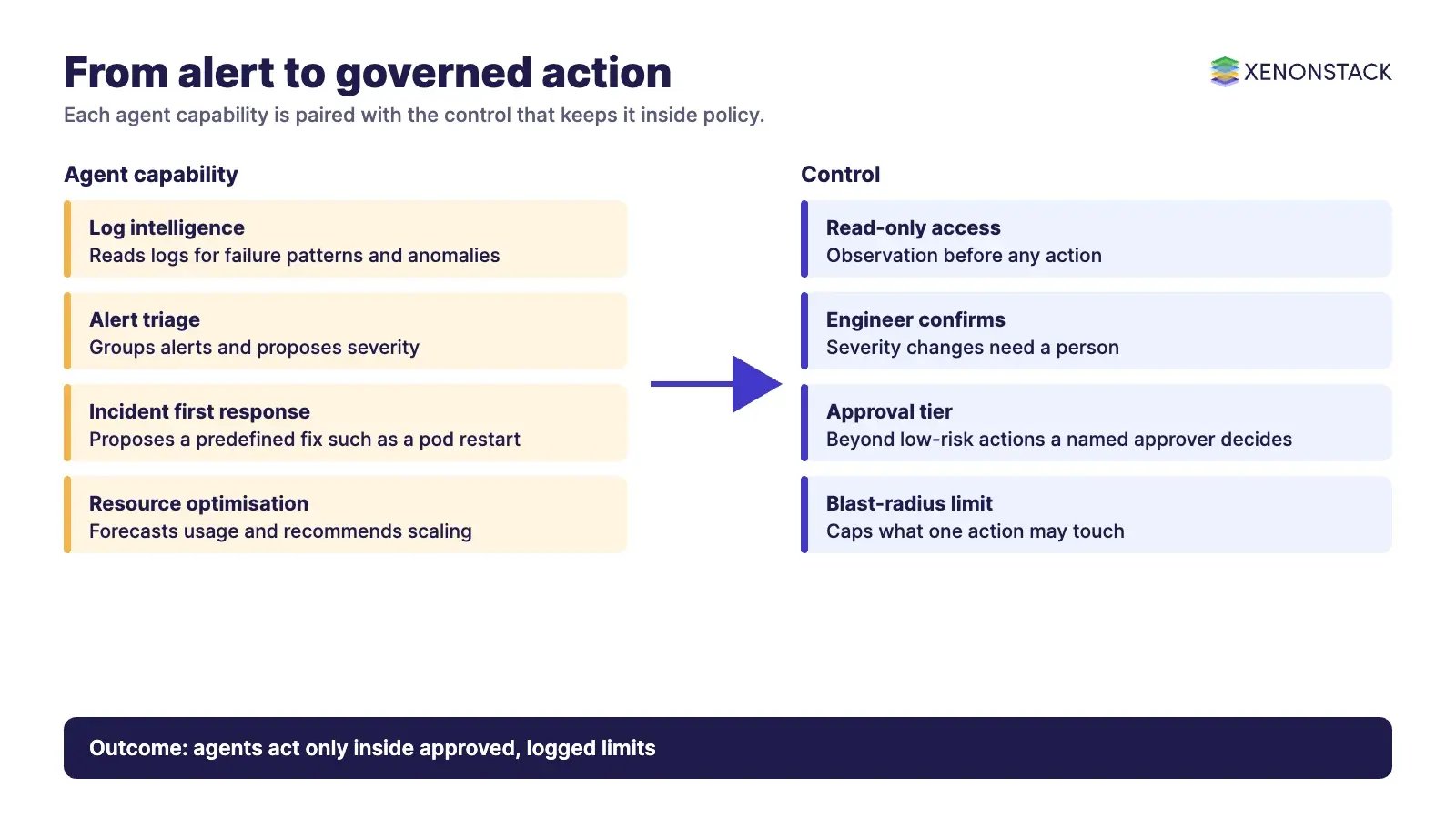
The order below runs from lowest to highest risk. The human gate column states who decides before the agent acts.
| Capability | What the agent does | Human gate |
|---|---|---|
| Log intelligence | Reads logs for failure patterns and anomalies, opens tickets, notifies the on-call engineer | None for reading; approval before any restart |
| Alert triage | Groups related alerts, compares them with baseline behaviour and proposes severity | Engineer confirms severity changes |
| Reports and documentation | Drafts status reports, root-cause summaries and compliance summaries from metrics, logs and tickets | Owner reviews before sharing with a client |
| Incident first response | Collects error details, correlates metrics and proposes a predefined fix such as a pod restart | Approval for anything beyond a pre-approved, low-risk action |
| Resource optimisation | Forecasts usage and recommends scaling or rightsizing | Approval before changes to production capacity |
| Infrastructure chat | Answers questions such as which node is low on disk or why a service is down, using live telemetry | Read-only access |
Telemetry quality sets the ceiling for all of this. OpenTelemetry describes itself as an open-source, vendor-neutral toolkit for generating, exporting and collecting traces, metrics and logs, which gives agents a consistent input. Our guide to cloud-native observability tools covers the options.
Where else do agents help in managed services?
| Service area | What the agent does | When it fits | Watch for |
|---|---|---|---|
| IT support | Handles routine requests such as password resets and software requests; see building chatbots with agentic AI | High volume, well-documented requests | Identity checks before any account change |
| Security incident response | Alerts teams, enriches alerts and proposes containment; see threat intelligence for incident response | Clear playbooks and a trained responder | Containment actions need human approval |
| Service management | Drafts and routes tickets inside the service desk; see ServiceNow AI agents for ITSM | A single system of record | Agent access limited to the ticket workflow |
| Employee onboarding | Prepares access requests and start-up information | Standard role templates | Access granted only after manager approval |
| Predictive maintenance | Flags failing devices from telemetry, logs and anomaly detection | Reliable sensor and log history | False positives while the baseline is thin |
How do you govern agents that act on client systems?
Governance is what separates a pilot from a service you can sell. The NIST AI Risk Management Framework, released on 26 January 2023 for voluntary use, organises AI risk work into Govern, Map, Measure and Manage, and NIST published a Generative AI Profile (NIST-AI-600-1) on 26 July 2024. It is a useful vocabulary for the controls below. Our post on agentic AI risk management goes deeper.
| Control | What it means in practice | Why it matters |
|---|---|---|
| Least privilege | Separate agent identities per client and per risk level, with only the permissions each task needs | A compromised or mistaken agent reaches less |
| Approval tiers | Low-risk actions pre-approved; high-impact actions wait for a named approver | Keeps humans in control of change |
| Blast-radius limits | Caps on how many systems or how much capacity one action may touch | Contains errors before they spread |
| Decision trail | Every observation, tool call and action logged with the policy in force, kept tamper-evident | Evidence for clients, auditors and post-incident review |
| Tenant isolation | Client data and credentials kept apart in a multi-tenant provider | Prevents cross-client leakage |
| Review and rollback | Regular review of overrides and a tested way to undo agent actions | Catches drift and builds trust |
For the decision layer, ElixirData Context OS keeps governed context, versioned policy and decision traces in one decision layer above AI agents, and ElixirClaw is an agentic OS platform to build, orchestrate and govern AI agents and automation workflows while keeping humans in control. AgentGRC keeps autonomous agent actions inside policy, with the audit trail risk teams need, and the ElixirData Audit Agent assembles decision lineage, policy versions, approvals and authority chains for compliance teams, according to its site.
What are the main implementation challenges?
| Challenge | Problem | Mitigation |
|---|---|---|
| Data quality and observability gaps | Incomplete logs and inconsistent labels reduce accuracy and raise false positives | Unify logging and metrics first, standardise formats and test agents on cleaned historical data before production |
| Legacy integration | Mainframes and proprietary tools may expose no programmable interface | Put an abstraction layer or API gateway in front; let agents recommend and people execute on legacy systems |
| Team adoption and trust | Operators may distrust autonomous decisions | Show reasoning traces for every action, start in observation mode and train the team on how the agent works |
| Security and compliance | Agents with infrastructure access widen the attack surface; actions must be auditable against client and regulatory requirements | Least privilege, rate limits, blast-radius limits and immutable audit logs |
How should you sequence adoption?
| Stage | Agent role | Exit test |
|---|---|---|
| 1. Observe | Reads telemetry and drafts findings; takes no action | Engineers accept most recommendations and can see why each was made |
| 2. Assist | Proposes fixes and prepares changes; a person approves | Approval requests are rarely rejected, and overrides are understood |
| 3. Act within limits | Runs pre-approved low-risk actions; escalates the rest | Audit trail complete and rollback tested |
| 4. Extend | Adds new services or clients one at a time | Each new scope passes the same review |
The Google SRE book defines toil as work that tends to be manual, repetitive, automatable, tactical, devoid of enduring value and that scales linearly as a service grows, and sets a target of keeping operational work below 50% of each SRE's time, according to its site. Use that definition to choose which tasks to hand to agents first, and see our comparison of SRE and DevOps and agentic workflows for how the work is organised.
When is agentic AI not the right choice?
Stable, narrow runbooks: a plain script is cheaper to test and easier to audit.
Weak telemetry: fix logging and metrics first, or the agent will reason over gaps.
No named approver: if nobody owns the decision, do not let an agent take it.
Contracts that forbid automated change: confirm client terms before agents touch their systems.
What should leaders do next?
Pick one service with clean telemetry, run an agent in observation mode, and write down the actions it may take alone and the approver for the rest. Measure toil and resolution time against your own baseline before widening scope. Results vary with data quality, tooling and scope, so set targets from your own data.
To map one managed-service decision your agents should make, and the context and policy it depends on, book a Context Workshop. See what happens in the workshop.
Related on XenonStack
- ServiceNow consulting and AI agents: ITSM, ITOM and customer workflows.
- Agentic ITSM: AI agents for IT service management.
- ElixirClaw: run governed AI agents with decision boundaries and human approvals.
FAQ: Agentic AI in Managed Services
Can agentic AI help if our operations are still manual?
Yes. Start with read-only work such as log analysis, alert triage and report drafting, and keep a person approving every action until the data and the controls are in place.
How is an agent different from an automation script?
A script runs a fixed rule. An agent is given a goal, gathers context, chooses among approved tools and checks the result, so it needs permissions, review and a decision trail.
Which framework helps govern AI in managed services?
The NIST AI Risk Management Framework, released on 26 January 2023 for voluntary use, organises risk work into Govern, Map, Measure and Manage. NIST also published a Generative AI Profile on 26 July 2024.
What is toil and why does it matter here?
The Google SRE book defines toil as manual, repetitive, automatable, tactical work with no enduring value that grows with the service, and sets a target of below 50% of each SRE's time. It is a fair measure for choosing agent tasks.
What controls should every agent have?
Least privilege, approval tiers for high-impact actions, blast-radius limits, tenant isolation, an immutable decision trail and a tested rollback.
When should we avoid agents?
When a stable script does the job, when telemetry is poor, when nobody owns the approval, or when a client contract forbids automated change.
Follow XenonStack on LinkedIn: XenonStack on LinkedIn for new guides on agentic AI, data and platform engineering.
Explore the XenonStack platform family: ElixirData · ElixirClaw · ElixirHub · NexaStack · MetaSecure · Neural AI · AgentGRC · AgentSRE · AgentAnalyst · AgentInstruct · AgentRAI · AgentScrum · AgentSearch · AgentForce · AI Aviator · SAIF Aviator · CohortIQ · XenonStack AI · XenonStack UAE