Key takeaway
- AI managed services explained for CIOs and CTOs: what is in scope, which controls to demand, how to choose a provider and a safe order of adoption.
AI managed services are IT operations delivered by a provider that uses machine learning, natural language processing and automation to monitor, secure and support your estate. The decision for a CIO or CTO is not whether to use AI, but which operational decisions the provider may automate, which need a named human approver, and how every automated action is logged and reviewed.
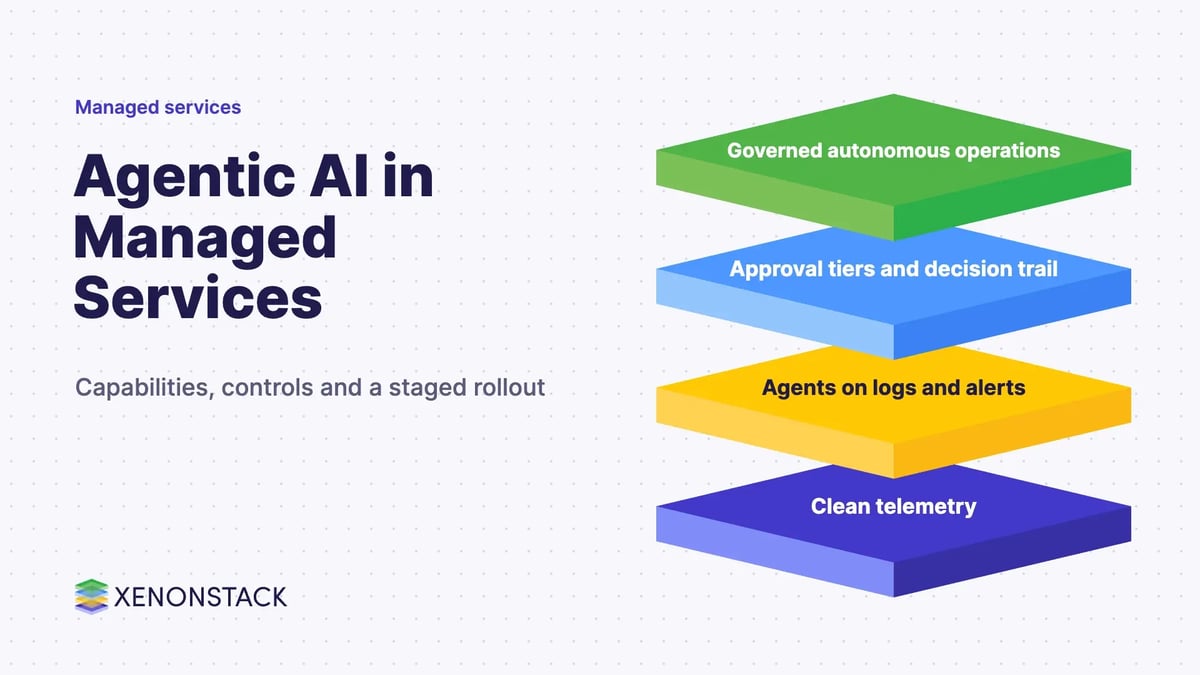
This guide sets out what is in scope, where AI changes the work, the governance controls to ask for, how to choose a provider and a sensible adoption order. For the generative AI angle see Agentic AI in Managed Services, and for the service itself see our managed AI services page.
What are AI managed services and what do they cover?
Under a typical model, an organisation works with a managed service provider (MSP) that applies AI to run IT systems. The provider combines machine learning, natural language processing, analytics and workflow automation to take on work that would otherwise need people at every step.
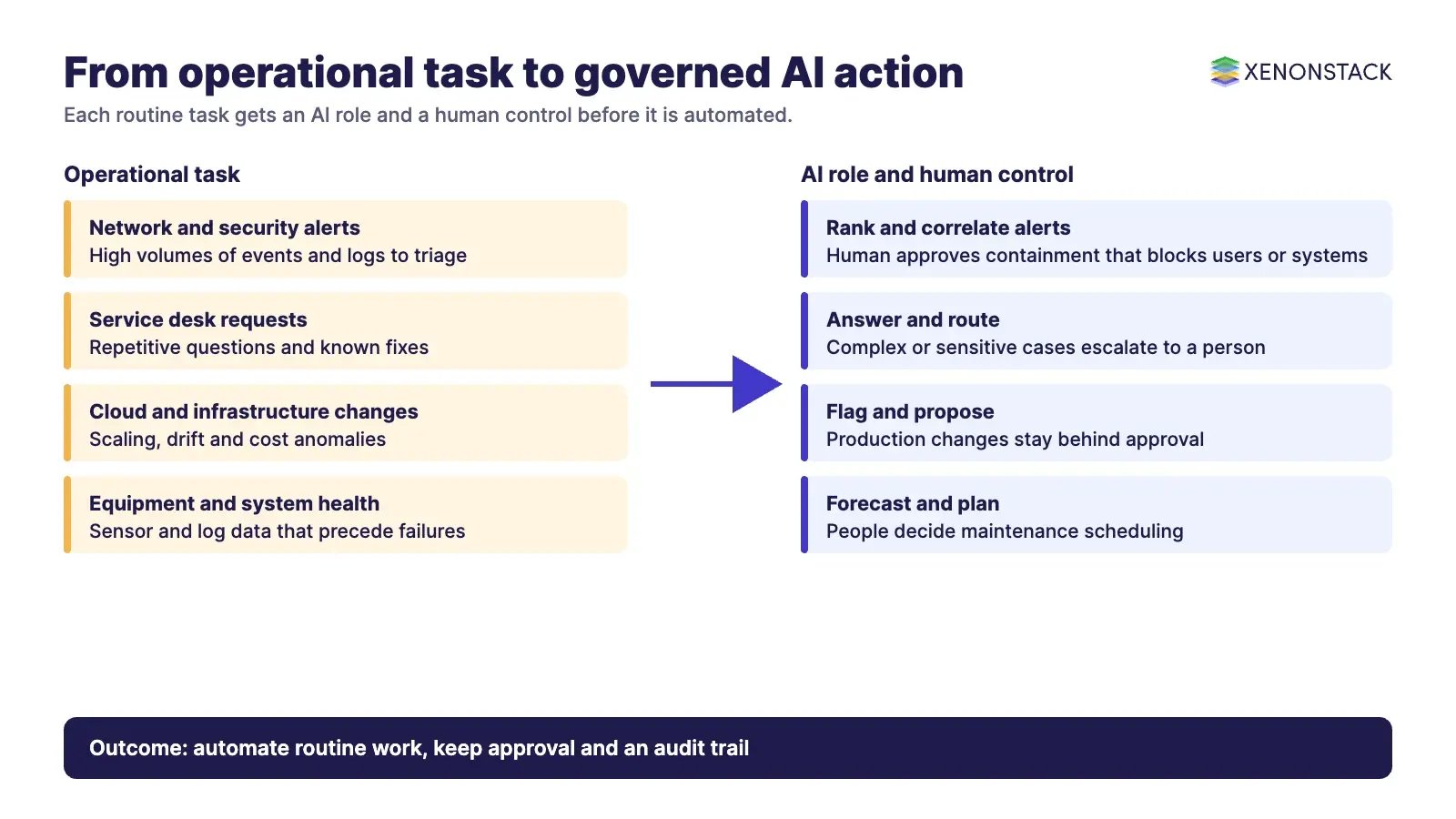
| Service area | What AI does | Where it fits | Human control to keep |
|---|---|---|---|
| Network and security monitoring | Finds unusual traffic and access patterns, ranks alerts | Estates with high alert volumes | Approval for containment that blocks users or systems |
| Data and information management | Classifies, backs up and checks data quality | Regulated or data-heavy workloads | Retention and access policy owned by you |
| Cloud and infrastructure operations | Scales resources, flags drift and cost anomalies | Multi-cloud or fast-changing estates | Change approval for production |
| Service desk and customer support | Answers common requests, routes the rest to people | High-volume, repetitive requests | Escalation path for complex or sensitive cases |
| Predictive maintenance | Reads sensor and log data to forecast failures | Equipment and infrastructure with rich telemetry | Maintenance scheduling decisions |
| Process and workflow operations | Automates routine, rule-based steps | Stable, well-documented processes | Exception handling and sign-off |
The aim is faster resolution, fewer manual errors and more consistent operations, with people kept for judgement. Anything beyond that, such as a specific saving or uptime figure, should come from a baseline measured in your own estate rather than from a general claim.
Where does AI change the way an MSP works?
Faster, more consistent operations
AI can read network and application signals, decide whether an event is a threat or noise, and start a standard fix without waiting for an engineer. Google's SRE book defines toil as operational work that is manual, repetitive, reactive and automatable, and sets a target of keeping it below half of each engineer's time. That is a useful test for what to hand to automation first. Our SRE vs DevOps guide covers the operating model behind it.
Security operations
AI helps sift large volumes of logs, spot suspicious patterns and prioritise incidents so analysts spend time on the cases that matter. Containment that changes access or takes a system offline should stay behind approval until the provider has shown the rules work in your environment. See our cyber security services and eBPF for secure managed services.
Service desk and knowledge
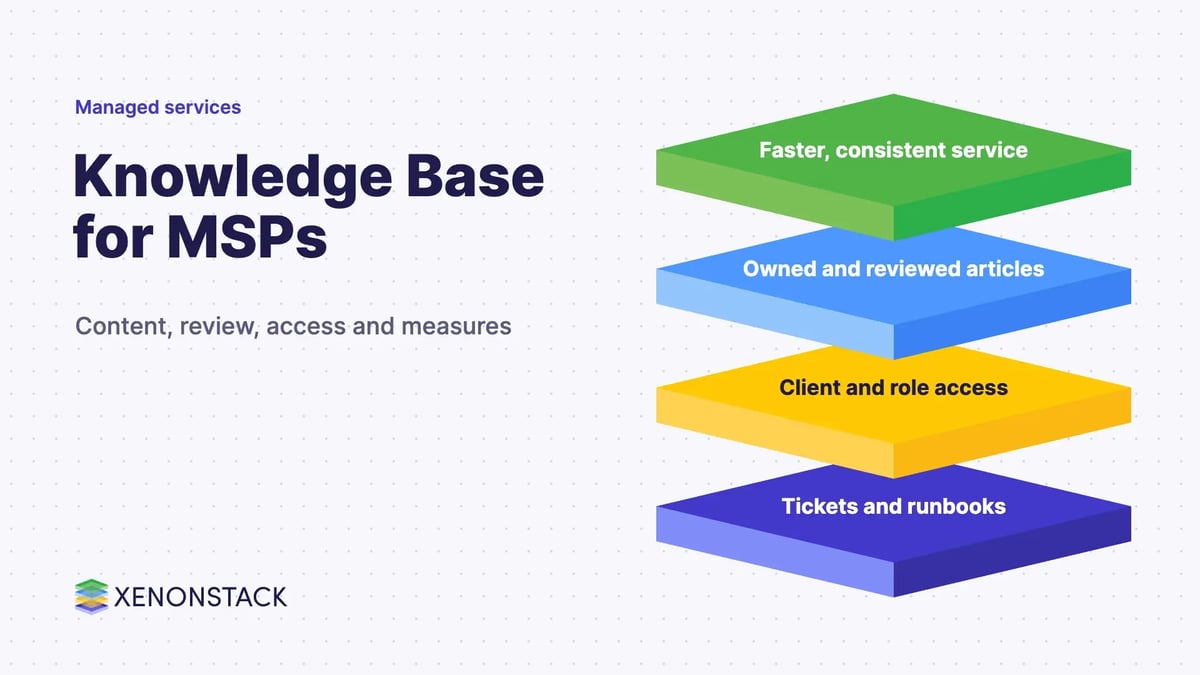
AI assistants and chatbots can answer routine questions, guide users through known fixes and hand complex cases to a person. Their quality depends on the knowledge behind them, which is why a governed knowledge base matters. AgentSearch lets people and AI agents pull relevant information from unstructured company knowledge while staying within access rules and governance controls, according to its site.
Predictive maintenance
Where equipment and infrastructure produce sensor and log data, models can look for patterns that precede failure so work is planned before a breakdown. This applies in manufacturing as in data centres; see predictive maintenance to prevent downtime.
How should you govern AI inside a managed service?
When a provider lets AI act on your systems, the risk sits with you as well as with them. Two reference points help. The NIST AI Risk Management Framework is a voluntary framework, released as version 1.0 on 26 January 2023, organised around four functions: Govern, Map, Measure and Manage. NIST also published a Generative AI Profile (NIST-AI-600-1) on 26 July 2024. The EU AI Act takes a risk-based approach; according to the European Commission page, it entered into force on 1 August 2024 and became applicable on 2 August 2026, with some exceptions and later dates for certain high-risk categories. Check with counsel which rules apply to you.
| Control | What to ask the provider | Why it matters |
|---|---|---|
| Action scope | Which actions are automated and which need approval | Limits the blast radius of a wrong decision |
| Audit trail | Is every automated action logged with its inputs and reason | Lets you review and evidence decisions |
| Data handling | Where your data is processed and who can access it | Protects sensitive and regulated data |
| Model monitoring | How the provider tests and monitors its models over time | Catches drift and false positives |
| Exit terms | How you retrieve runbooks, logs and configuration | Avoids lock-in |
A decision layer above the agents can hold this policy and the trace of each action in one place. ElixirData Context OS keeps governed context, versioned policy and decision traces in one decision layer above AI agents, and AgentGRC keeps autonomous agent actions inside policy, with the audit trail risk teams need, according to their sites. Our guide to agentic AI risk management covers the controls in more depth.
How do you choose an AI managed service provider?
| Criterion | What good looks like | Red flag |
|---|---|---|
| AI and IT operations experience | Shows live deployments in your industry and technology stack | Only demos or generic claims |
| Fit and flexibility | Tools and scope can be adjusted as your estate changes | One fixed package for every client |
| Security and compliance | Clear controls, certifications you can check, data-protection terms such as GDPR | Vague answers on where data goes |
| Transparency | Reports on automated actions, accuracy and exceptions | Black-box results |
| Training and integration | Helps your team work with the tooling and takes part in handover | Tooling delivered without enablement |
What are the trade-offs and when should you not automate?
Automation reduces repetitive work, but it also moves risk. Do not automate a workflow that is poorly documented, changes often, or has a high cost of error without an approval step. A provider that cannot show how a decision was reached is a risk even if the average outcome is good. In-house staff are still needed to own policy, architecture and the provider relationship, so treat savings as something to measure against your own baseline, not assume.
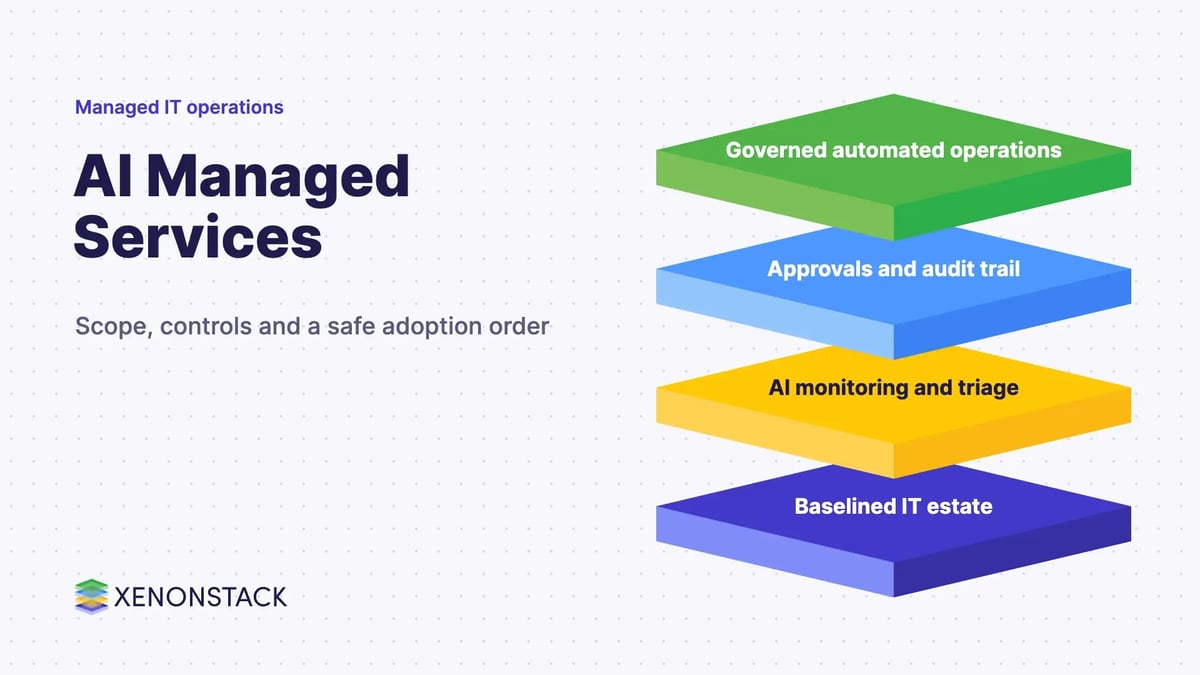
What is a sensible adoption sequence?
| Step | What happens | Exit check |
|---|---|---|
| 1. Baseline | Record current ticket volume, time to resolve and incident causes | Numbers agreed with the provider |
| 2. Pilot | Automate one high-volume, low-risk workflow such as triage | Accuracy and exceptions reviewed weekly |
| 3. Add approvals | Define which actions run alone and which need a named approver | Policy written and logged |
| 4. Widen scope | Extend to security, cloud and knowledge workflows | Audit trail covers every automated action |
| 5. Review | Quarterly review of results, cost and risk | Scope kept, widened or reduced |
Many of these steps follow the pattern in our guide to agentic workflows, and ElixirClaw is an agentic OS platform to build, orchestrate and govern AI agents and automation workflows while keeping humans in control, according to its site.
Video: SLA management with AI agents, where breaches are predicted instead of reported.
How does XenonStack help?
XenonStack combines AI, cloud and analytics work to help organisations run IT operations with governed automation. For provider-side detail see our generative agents for incident response and ServiceNow AI agents for IT service management guides.
To map one operational decision your managed service should automate, and the context and policy it depends on, book a Context Workshop. See what happens in the workshop.
FAQs
What are AI managed services?
They are managed IT services in which a provider runs your infrastructure, security, support and operations using machine learning, natural language processing and automation, under an agreed scope, service levels and review rights.
How do AI managed services differ from traditional managed services?
Traditional services rely on people working tickets and runbooks. AI managed services let software detect, triage and in some cases fix routine events, while people keep approval of high-impact actions.
What should the contract cover?
Scope of automated actions, which actions need human approval, data handling, audit logs, service levels, exit terms and how the provider tests and monitors its models.
Which frameworks help govern an AI managed service?
The NIST AI Risk Management Framework (Govern, Map, Measure, Manage) is a voluntary starting point, and the EU AI Act applies risk-based obligations where AI systems fall in its scope.
Does AI remove the need for in-house IT?
No. Someone inside the business still owns policy, approvals, architecture and the relationship with the provider. AI reduces repetitive operational work, not accountability.
Where should an organisation start?
With one high-volume, low-risk workflow such as ticket triage or alert correlation, measured against a baseline before widening the scope.
Follow XenonStack on LinkedIn: XenonStack on LinkedIn for new guides on agentic AI, data and platform engineering.
Explore the XenonStack platform family: ElixirData · ElixirClaw · ElixirHub · NexaStack · MetaSecure · Neural AI · AgentGRC · AgentSRE · AgentAnalyst · AgentInstruct · AgentRAI · AgentScrum · AgentSearch · AgentForce · AI Aviator · SAIF Aviator · CohortIQ · XenonStack AI · XenonStack UAE