Key takeaway
- AI anomaly detection for enterprise data: how agentic AI triages and remediates issues, which Azure detectors are retired, and what to govern.
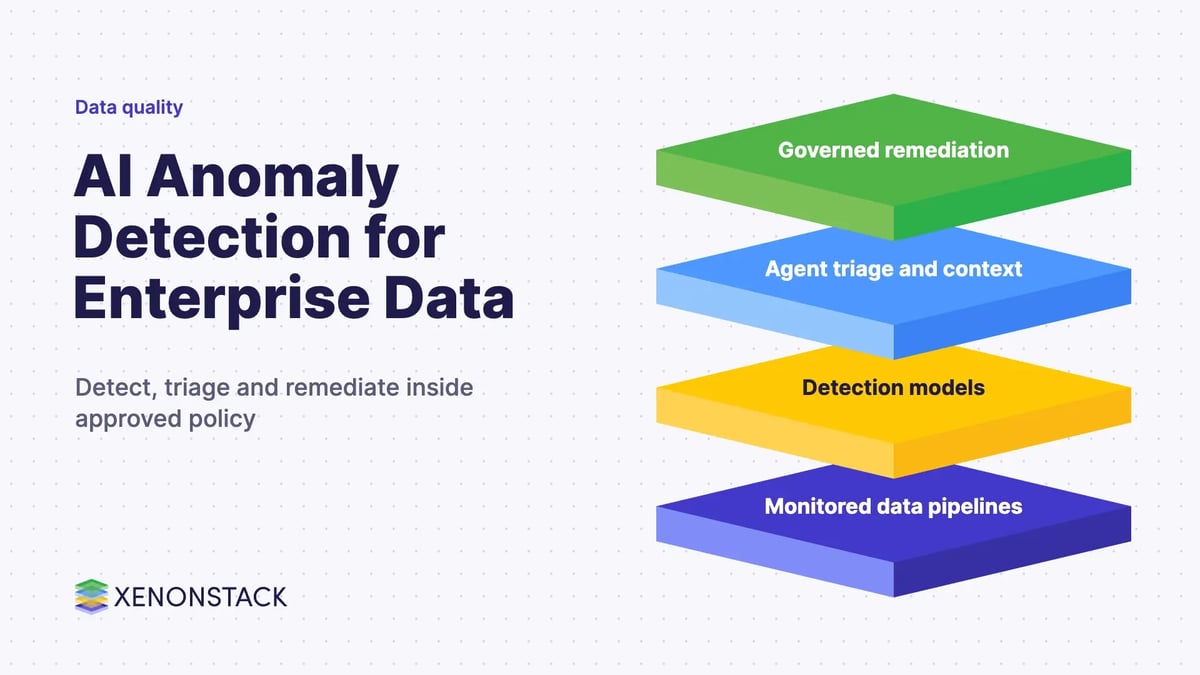
AI anomaly detection for enterprise data now has three jobs, not one: finding the unusual record or event, deciding whether it matters, and acting on it safely. Statistical and machine learning detectors still do the finding. What an agentic layer adds is triage, context and controlled remediation, so that a flagged duplicate, a broken feed or a suspicious transaction reaches the right owner with evidence, or is corrected inside rules you have approved. The risk is automation that fixes the wrong thing quietly, so governance matters as much as detection.
The market has also moved. Microsoft retired the Azure AI Anomaly Detector service on 1 October 2026, and its suggested alternative, anomaly detection in Microsoft Fabric Real-Time Intelligence, is a preview feature that is itself being withdrawn. This guide explains the anomaly types, a decision table for detection approaches, a remediation model with approval tiers, and how to adopt it. For a related view of agents on the monitoring side, read our post on how AI agents transform anomaly detection.
What counts as a data anomaly in enterprise systems?
IBM defines anomaly detection as identifying observations, events or data points that deviate from what is usual, standard or expected. It describes three types in time-series data: point anomalies (a single value far outside the rest), contextual anomalies (a value that is normal overall but unusual for its circumstances) and collective anomalies (a group of values that look abnormal together although each looks normal alone). IBM also names three learning approaches: supervised, which needs labelled examples and is rarely used because labelled anomalies are scarce; unsupervised, the most common, which needs large data sets and significant compute; and semi-supervised, which starts from a small labelled set. Source: IBM, What is anomaly detection?
In data operations the same ideas show up as familiar quality problems: values outside expected ranges, missing or incomplete records, duplicates across connected systems, conflicting sources for one entity, and patterns that signal fraud or a security event. Each needs a different response, which is why detection alone is not enough.
Why do rules and static thresholds fall short?
- Static thresholds do not adapt when seasonality, product mix or volume changes, so they either miss real events or raise alerts on normal variation.
- Alert volume grows faster than reviewer capacity, so teams start ignoring alerts.
- No context: a rule sees a number, not the business process, the owner or the last change that explains it.
- Detection stops at the alert, so correction, reconciliation and escalation stay manual.
What does an agentic approach add to anomaly detection?
An agentic workflow treats detection as one step in a loop: detect, add context, decide, act within policy, and learn from the outcome. Detection models stay in place and are exposed to agents as tools; our own engineering teams use the pattern of publishing models such as anomaly detection to agents through the Model Context Protocol (source: Teams). The agent then adds the parts a detector lacks.
- Triage: group related alerts, check lineage and recent changes, and rank by business impact.
- Explanation: attach the evidence and the likely cause, such as a schema change or an integration failure.
- Action: propose or perform a correction, open a ticket or notify the owner.
- Learning: record the reviewer's decision so the same pattern is handled better next time.
The agent infrastructure behind this is covered in our guide to the AI agent infrastructure stack. For plain-language questions about the data behind an alert, AgentAnalyst lets teams ask questions of enterprise data in plain language and get real-time insights.
Which detection approach fits, and what is its status in 2026?
| Approach | What it does | When it fits | Current status |
|---|---|---|---|
| Rules and thresholds | Fixed checks such as ranges, null counts and duplicate keys | Known, stable constraints and regulatory checks | Still needed as a baseline |
| Statistical and ML detectors | Learn normal behaviour and flag deviations (for example isolation forest) | Time series and tabular data without clear rules | Mature; you choose and tune the models |
| Azure AI Anomaly Detector | Managed time-series anomaly detection API | Existing users only | Retired on 1 October 2026; no new resources since 20 September 2023 |
| Anomaly detection in Fabric Real-Time Intelligence | Detectors on Eventhouse tables with model recommendation and alerts | Short-term evaluation on Fabric eventhouse data | Preview; no new items from 1 December 2026, events stop after 1 January 2027 |
| Agent layer | Triage, context, remediation and escalation around any detector | When alerts must become governed actions | Your own design; keep detectors replaceable |
The status column matters for architecture. If your design depended on a managed Microsoft detector, plan to move detection to models you control, or to another supported service, and keep the agent layer independent of any single detector. Sources: Microsoft Learn, multivariate anomaly detection with isolation forest (retirement notice) and Microsoft Learn, Anomaly detection in Real-Time Intelligence.
Which remediation actions should an agent take on its own?
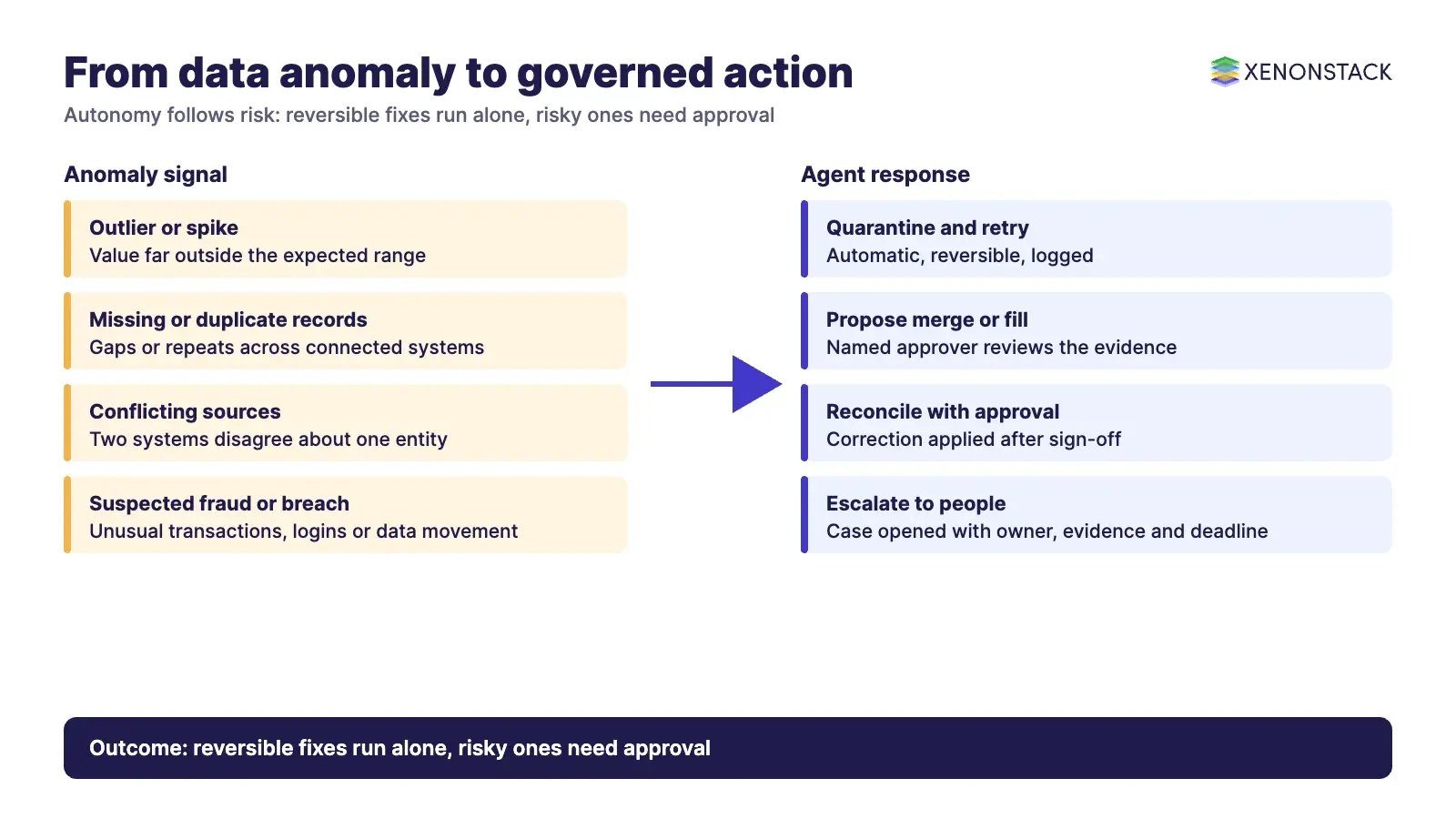
Autonomy should follow risk. The tiers below are our recommendation, not a vendor feature.
| Tier | Example actions | Control |
|---|---|---|
| Automatic, reversible | Quarantine a bad batch, pause a feed, tag a record, retry a failed load | Logged and easy to undo |
| Propose, then approve | Correct values, merge duplicates, reconcile mismatched records | Named approver sees the evidence and the proposed change |
| Escalate to people | Suspected fraud, security events, regulatory reporting data | Case opened with owner, evidence and deadline |
To keep agent actions inside policy with an audit trail, AgentGRC keeps autonomous agent actions inside policy, with the audit trail risk teams need. For the wider decision layer, ElixirData Context OS keeps governed context, versioned policy and decision traces in one decision layer above AI agents.
Where does this apply across industries and pipelines?
| Domain | Typical anomaly | Agent response to design for |
|---|---|---|
| Financial services | Unusual transactions, mismatched ledgers | Reconcile, flag and escalate to compliance with evidence |
| Healthcare and life sciences | Gaps or conflicts in patient and trial records | Hold the record, notify the data steward, log for audit |
| Manufacturing and IoT | Faulty or missing sensor readings | Mark readings unreliable, trigger a maintenance check |
| Retail and e-commerce | Inventory mismatches, duplicate customers, price errors | Reconcile across CRM, ERP and supply chain systems |
| Cybersecurity | Unusual logins or data movement | Correlate events and hand over to the security team |
In streaming and warehouse environments, agents watch pipeline health, schema changes and event flows so that bad data is caught before it reaches analytics or models. Where decisions must be made close to the source, see our view of agentic AI in edge computing.
How should you govern, secure and budget for it?
- Least privilege: give agents read access to what they monitor and write access only to the narrow actions in the approved tiers. See our primer on data governance.
- Audit trail: record the anomaly, evidence, decision, approver and outcome for every action.
- False positive budget: agree an acceptable alert volume with reviewers, and measure precision, not only detections.
- Drift and cost: continuous monitoring consumes compute and model calls, so monitor the cost per resolved anomaly and retrain or retune when behaviour drifts.
What is a sensible adoption sequence?
- List the five datasets whose errors cost most, with an owner for each.
- Keep rules for known constraints and add a detector for the rest, evaluated on historical incidents.
- Run in shadow mode: agents propose, people act, and you record agreement.
- Automate the reversible tier first, then widen only where agreement is consistently high.
- Replace any retired or preview-only detector dependency before it becomes a risk.
- Review precision, time to resolution and policy exceptions every month.
What are the trade-offs, and when should you not automate remediation?
- Do not auto-correct data that feeds regulatory reporting or financial statements without human approval.
- Do not add agents where simple rules already catch the problem at low cost.
- Be cautious with sparse history: unsupervised detectors need enough data to learn normal behaviour.
- Expect an ownership problem before a technology problem: an alert nobody owns will not be resolved by an agent.
To map one data-quality decision your agents should make, and the context and policy it depends on, book a Context Workshop. See what happens in the workshop.
Frequently asked questions
What are the main types of anomalies?
IBM describes point anomalies, contextual anomalies and collective anomalies. Point anomalies are single outlying values, contextual anomalies are unusual only in their context, and collective anomalies are groups of values that look abnormal together.
Is Azure AI Anomaly Detector still available?
No. Microsoft retired the service on 1 October 2026 and had stopped new resource creation on 20 September 2023.
Is anomaly detection in Microsoft Fabric a long-term replacement?
Not on current documentation. It is a preview feature, you cannot create new items on or after 1 December 2026, and anomaly detection events stop after 1 January 2027.
What does an agent add to an anomaly detector?
Triage, context, explanation and controlled remediation. The detector finds the deviation, and the agent decides who should act, what evidence to attach and which approved action to take.
Which anomaly fixes should stay under human approval?
Our recommendation is that value corrections, record merges and anything touching fraud, security or regulatory reporting data should be proposed by the agent and approved by a named person.
Disclosure: XenonStack builds ElixirClaw, ElixirData and the ElixirData agents mentioned in this article.
Follow XenonStack on LinkedIn: XenonStack on LinkedIn for new guides on agentic AI, data and platform engineering.
Explore the XenonStack platform family: ElixirData · ElixirClaw · ElixirHub · NexaStack · MetaSecure · Neural AI · AgentGRC · AgentSRE · AgentAnalyst · AgentInstruct · AgentRAI · AgentScrum · AgentSearch · AgentForce · AI Aviator · SAIF Aviator · CohortIQ · XenonStack AI · XenonStack UAE