Key takeaway
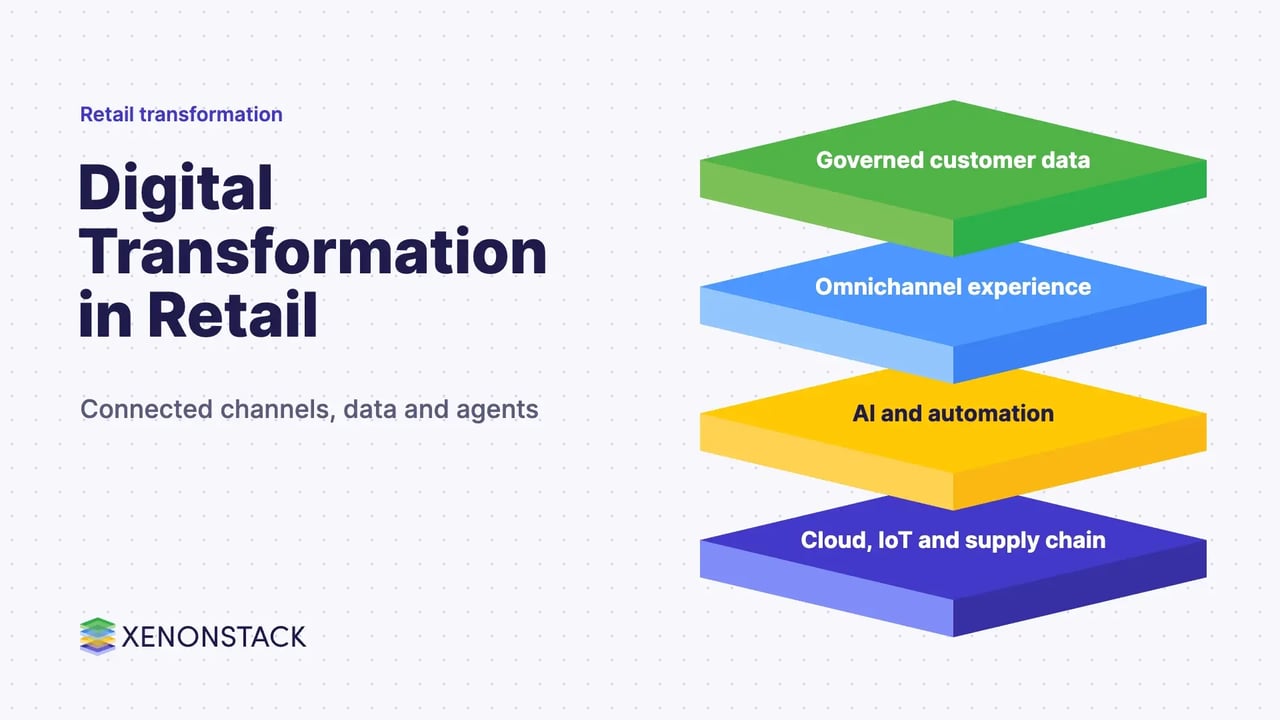
- Digital transformation in retail joins cloud, AI, IoT and data to serve customers across channels. See the technologies, privacy rules and first steps.
Digital transformation in retail is the use of digital technology across every part of a retail business, from stores and e-commerce to supply chain and customer service, to change how it operates and serves shoppers. The retail industry is moving from separate stores and websites towards connected operations built on data.
This guide is for retail executives and technology leads deciding where to invest. It covers the technologies involved, what omnichannel needs, the privacy rules that apply to shopper data, how AI agents change store and supply chain work, and what to do first.
What is digital transformation in retail?
The IBM guide to digital transformation describes digital transformation as a business strategy that "incorporates digital technology across all areas of an organization", evaluating and modernising processes, products, operations and technology stacks to enable "continual, rapid, customer-driven innovation". It stresses that the work is as much about business change as about technology, and that organisations should track KPIs to see whether it produces results.
For retail, that means shoppers expect convenience and a consistent experience across channels, while back-end systems for stock, orders and payments have to keep pace.
Which technologies drive retail transformation?
IBM lists cloud, mobile, the Internet of Things, AI and machine learning, automation, blockchain, APIs and digital twins among the core technologies. The table links each to a retail use. The uses are common examples, not guaranteed outcomes.
| Technology | What it does (per IBM) | Common retail use |
|---|---|---|
| Cloud computing | Provides current IT tools and scales with demand | Running e-commerce and order systems that flex with traffic |
| AI and machine learning | Supports generative AI for customer service, content and personalisation | Product recommendations, demand forecasting and chatbots |
| Internet of Things | Connected sensors that generate real-time data | Stock visibility on shelves and in warehouses |
| Blockchain | A distributed, immutable ledger for transparency and resilient supply chains | Product traceability across suppliers |
| Automation (RPA) | Handles repetitive tasks by following predefined rules | Invoicing, returns processing and reconciliation |
What does omnichannel retail require?
The Salesforce omni-channel retail guide says omni-channel retail "strives to unify several separate channels", while multichannel runs each as a siloed operation. It names the difference plainly: "omni-channel retail involves integration, while multichannel retail does not". To get there, it says retailers need an integrated system across online and in-store operations, shopper information that moves with the customer, and a consistent experience, which it calls a tall order.
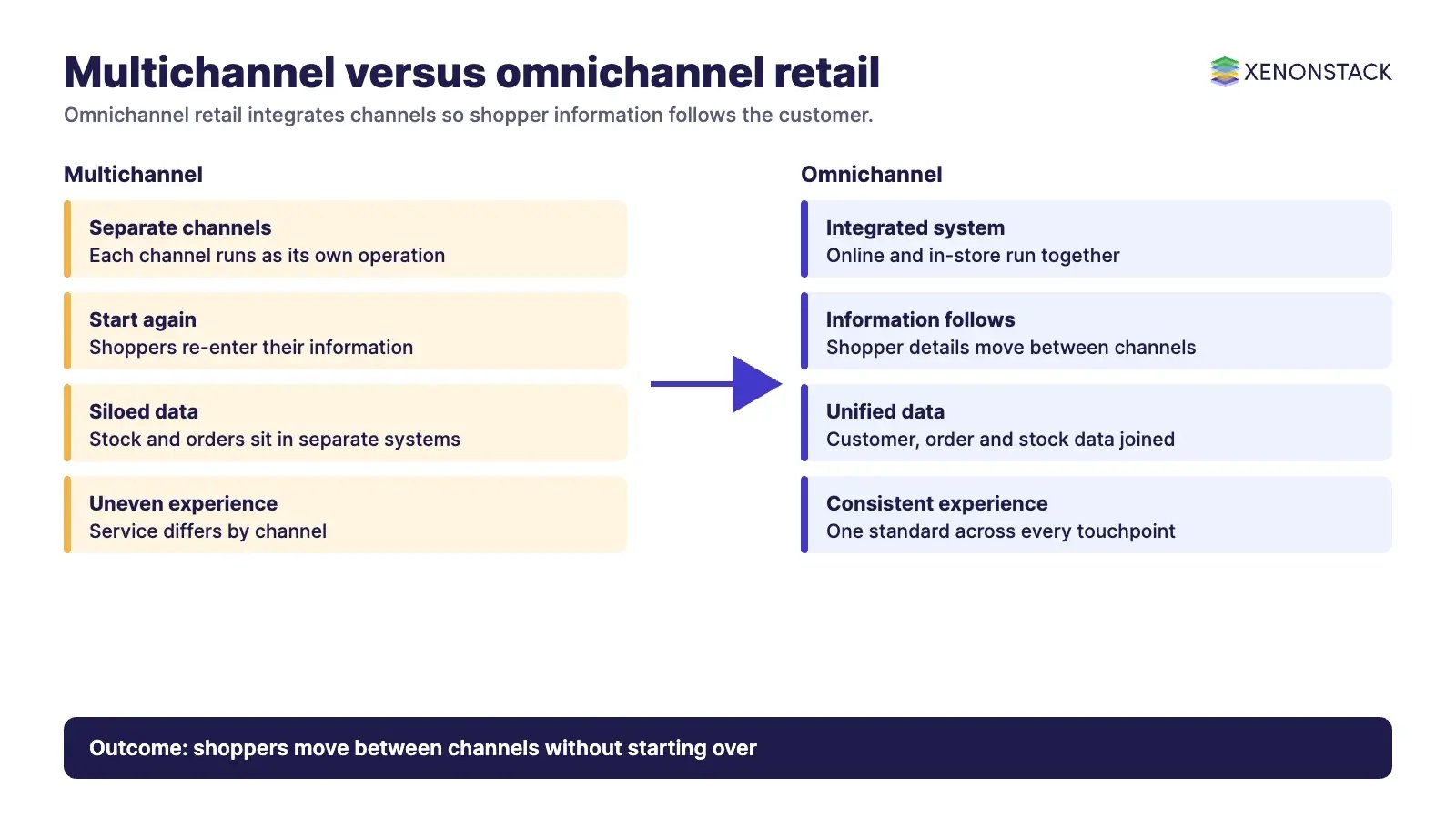
| Question | Multichannel | Omnichannel |
|---|---|---|
| How are channels run? | Separately, each with its own operations | Integrated into one system |
| What happens when a shopper switches channel? | They start again and re-enter information | Their information follows them |
| What does it depend on? | Little shared data | Unified customer, order and stock data |
Where should a retailer invest first?
Five areas recur in retail programmes. Customer experience comes first: personalised recommendations and responsive service, built on shopper data you are permitted to use. Second is a joined-up journey across web, app and store, including click-and-collect. Third is the supply chain, where better stock visibility reduces delays. Fourth is analytics for pricing, marketing and demand. Fifth is security and privacy, which underpins the other four. Underneath all of them sits your application architecture, which decides how quickly you can change.
Which privacy rules apply to shopper data?
The European Commission data protection overview says the GDPR applies to organisations that offer goods or services to people in the EU, even if established outside it, and sets seven principles: lawfulness, fairness and transparency, purpose limitation, data minimisation, storage limitation, accuracy, integrity and confidentiality, and accountability. The California Attorney General CCPA page lists rights for California consumers.
| CCPA right | What it means for a retailer |
|---|---|
| Right to know | Disclose what personal information you collect, use and share |
| Right to delete | Delete information on request, subject to exceptions |
| Right to opt out | Stop selling or sharing information, including honouring a global privacy control |
| Right to correct | Fix inaccurate information you hold |
| Right to limit | Restrict use of sensitive personal information |
| Right to non-discrimination | Do not penalise shoppers for exercising their rights |
How do AI agents change retail?
The IBM guide to AI agents defines an AI agent as "a system that autonomously performs tasks by designing workflows with available tools". In retail, an agent can take a goal such as resolving an order query, check stock and order systems through APIs, and respond, escalating to a person when it cannot. The same page recommends activity logs, the ability to interrupt an agent and human approval before highly impactful actions, which matters when agents touch payments or customer records.
Building and running such agents under shared controls is the role of an agent platform such as ElixirClaw, the AI agents computing platform. To see how this fits your sector, read about accelerating digital transformation with AI.
What should you do first?
- Define the customer problem you are solving and the KPI that will show progress.
- Map the data behind it: which systems hold stock, orders and shopper records, and who owns each.
- Fix the legacy and security gaps that would block the first use case.
- Pick one journey, such as order status or click-and-collect, and unify its data across channels.
- Add automation or an agent to that journey with logging and human approval, then widen scope.
To map one decision your agents make, and the data and policy it depends on, book a Context Workshop. See what happens in the workshop.
Frequently asked questions
What is digital transformation in retail?
It is the use of digital technology across all areas of a retail business to change its processes, operations and customer experience.
What is the difference between omnichannel and multichannel retail?
Salesforce says omni-channel retail involves integration of channels, while multichannel retail runs each channel as a separate operation.
Which technologies matter most for retail transformation?
IBM lists cloud, mobile, the Internet of Things, AI and machine learning, automation and blockchain among the key technologies. The right mix depends on the problem you are solving.
Which privacy laws affect retail data?
The GDPR applies to organisations that offer goods or services to people in the EU, and the CCPA gives California consumers rights such as knowing, deleting and opting out.
How can AI agents help a retailer?
An agent can take a goal such as resolving an order query, use stock and order systems through APIs, and escalate to a person when needed, with logs and human approval for impactful actions.
Ready to put AI agents to work? See an ElixirClaw demo: the agentic OS to build, orchestrate and govern AI agents across your enterprise systems.
Explore the XenonStack platform family: ElixirData · ElixirClaw · ElixirHub · NexaStack · MetaSecure · Neural AI · AgentGRC · AgentSRE · AgentAnalyst · AgentInstruct · AgentRAI · AgentScrum · AgentSearch · AgentForce · AI Aviator · SAIF Aviator · CohortIQ · XenonStack AI · XenonStack UAE