Key takeaway
- Stateful vs stateless applications explained: how they differ, when to use each, how Kubernetes runs them, and best practices for architects.
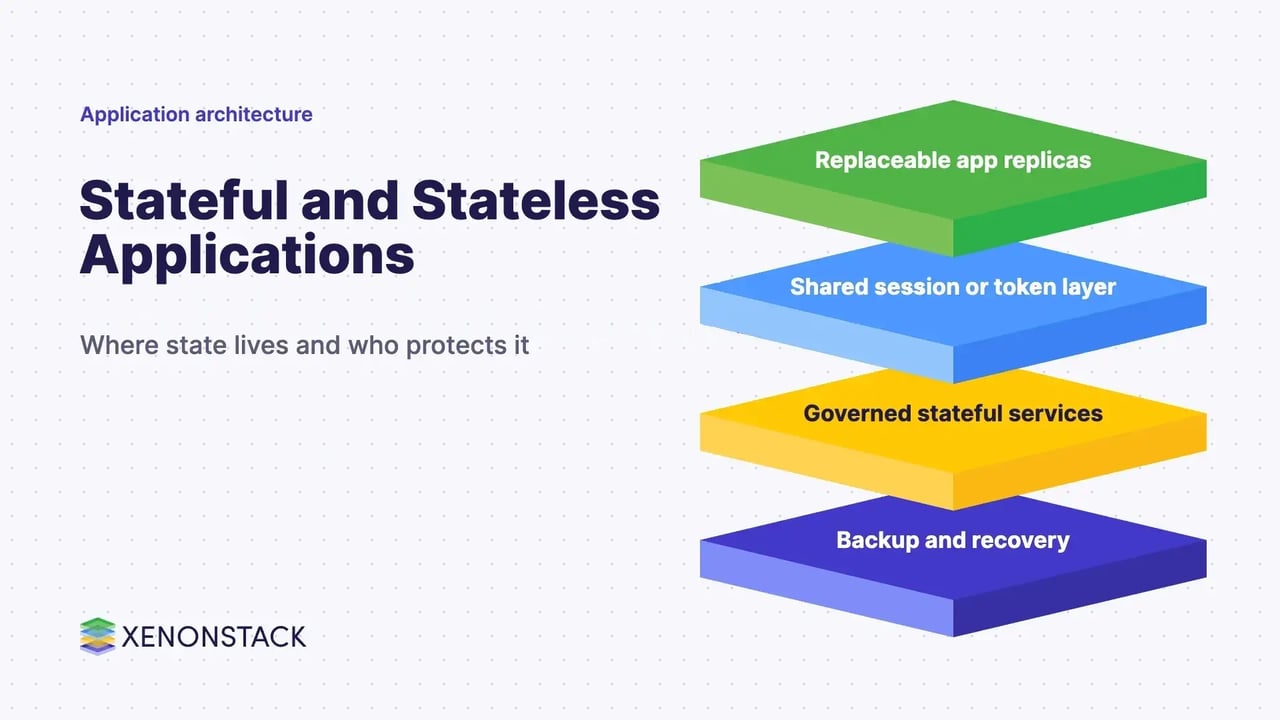
A stateless application keeps no memory of earlier requests: every request carries what the server needs, so any replica can answer it. A stateful application remembers a user, session or transaction between requests, so the state has to live somewhere and the system has to protect it. Neither is better in general. The decision is where state lives and who is responsible for it.
For enterprise architects the practical pattern is to keep the application tier stateless and push state into a small number of governed stateful services such as databases, caches and queues. This guide explains the difference, how Kubernetes runs each kind of workload, when to choose which, and what changes when the workload is an AI agent. It sits alongside our guides to microservices architecture and service-oriented architecture versus microservices.
What are stateful and stateless applications?
State is any information the system must remember to handle the next request correctly: a login, a shopping basket, a half-finished upload or a conversation. The two terms describe where that information is kept.
Stateless application
A stateless application treats each request as new. It does not rely on anything it stored in memory or on local disk during an earlier request. The twelve-factor method puts it this way: processes are "stateless and share-nothing", and any data that must persist belongs in a stateful backing service, typically a database (12factor.net, Processes). HTTP itself is defined as a stateless protocol, meaning each request message's semantics can be understood in isolation (RFC 9110, section 3.3).
Stateful application
A stateful application keeps information about a client or process between requests, for example a user's session held in server memory, an open database transaction or a message broker tracking what each consumer has read. State makes some work simpler and faster, but it ties requests to the place the state sits, and it must survive restarts, failures and scaling events.
How do stateful and stateless applications differ?
The table compares the two on the points that matter for architecture and operations. It describes the general pattern; individual products can sit anywhere between the two.
| Aspect | Stateful application | Stateless application |
|---|---|---|
| Where state lives | In the process, on its disk or in a store bound to that instance | Outside the process: in a database, cache or queue, or carried in each request |
| What a request needs | The right instance, or access to the same state | Only the request itself plus access to shared services |
| Load balancing | Often needs sticky routing so a user returns to the same instance | Any healthy replica can serve any request |
| Scaling out | Needs state to be moved, replicated or partitioned | Add or remove replicas freely |
| Failure and restart | State can be lost unless it is persisted and recoverable | A replica can be replaced with no loss, because it holds nothing unique |
| Debugging | Behaviour depends on history, so bugs can be hard to reproduce | Same input gives the same behaviour, so replay is easier |
| Typical examples | Databases, message brokers, shopping sessions held in server memory | REST APIs, web front ends, token-checking gateways, most microservices |
How does a login work across several servers?
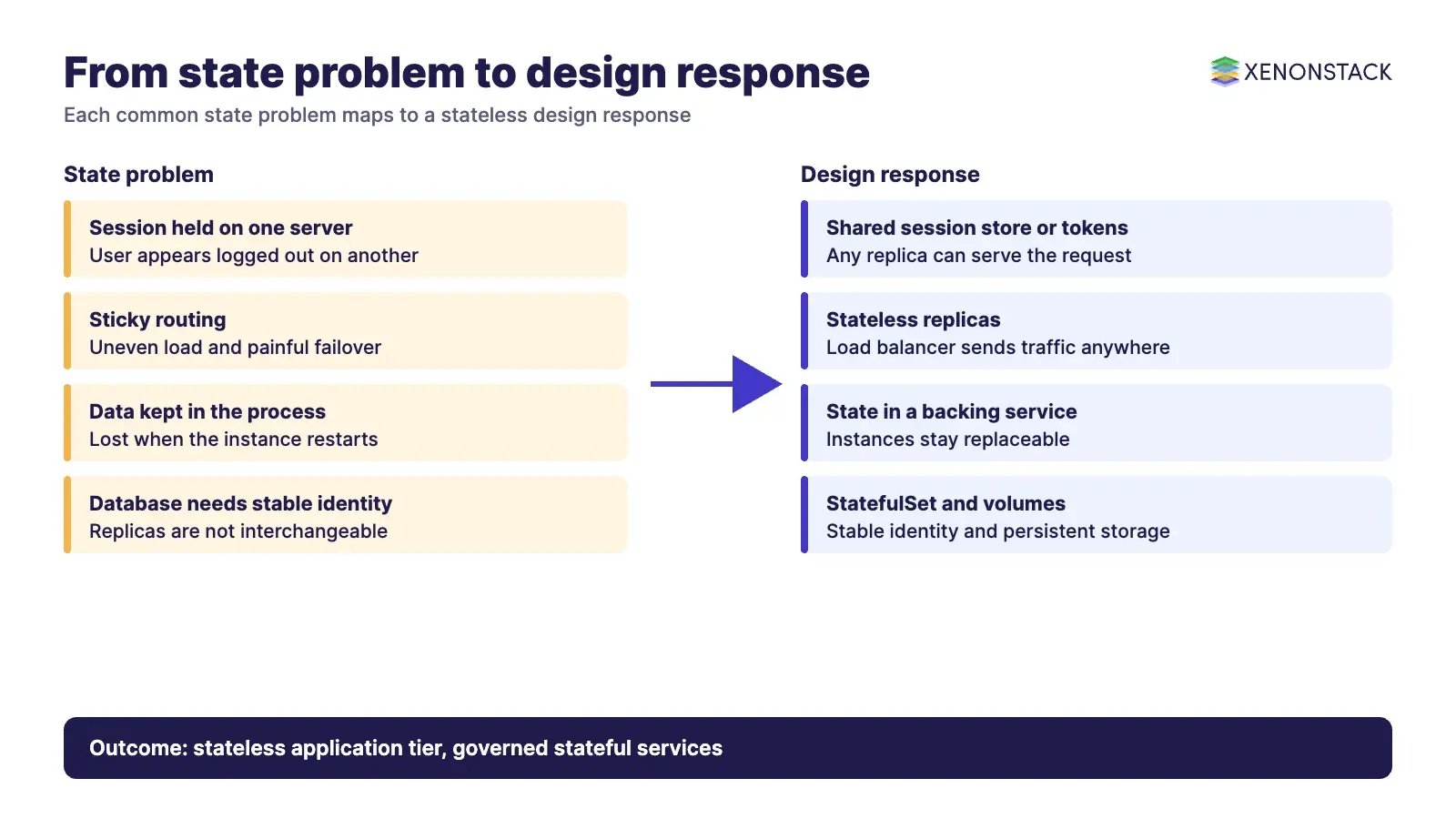
This is the example that makes the difference concrete. Suppose a load balancer sits in front of two servers. In a stateful design, Server 1 records that the user has logged in. If the next request reaches Server 2, the user appears logged out. The usual workaround is sticky routing, which sends each user back to the same server, but that undermines even load distribution and makes failover painful. The twelve-factor guidance is blunt: sticky sessions "are a violation of twelve-factor and should never be used or relied upon" (12factor.net).
There are two common stateless alternatives.
- Shared session store. Servers hold nothing; the session lives in a store every server can reach. The twelve-factor page notes that session data suits a datastore with time-expiration. The state still exists, but it is now in one governed place and the application servers stay replaceable.
- Signed tokens. The client sends a token with every request and the server validates it. A JSON Web Token (JWT) is "a compact, URL-safe means of representing claims to be transferred between two parties" (RFC 7519). Tokens can carry an expiry (
exp) after which they must not be accepted, but a token already issued cannot simply be recalled, so teams that need instant revocation end up keeping a deny list, which is state again.
Whichever you choose, the OWASP Session Management Cheat Sheet is the reference for the controls: mark session cookies Secure and HttpOnly, set SameSite explicitly, enforce idle and absolute timeouts on the server, invalidate sessions on the server at logout, and do not keep session IDs or tokens in localStorage or sessionStorage (OWASP). Our application security best practices guide covers the wider picture, and API development best practices covers token handling at the API edge.
How does Kubernetes run stateless and stateful workloads?
Kubernetes has a separate workload type for each. According to its documentation, a Deployment manages a set of Pods to run an application workload, usually one that does not maintain state (Kubernetes, Deployments). A StatefulSet is for applications that need stable, unique network identifiers, stable persistent storage, and ordered, graceful deployment, scaling and rolling updates (Kubernetes, StatefulSets).
| Need | Workload type | What the documentation says to watch |
|---|---|---|
| Interchangeable replicas, no local state | Deployment | Suited to workloads that do not maintain state; any replica can serve traffic |
| Stable identity and per-Pod storage | StatefulSet | Needs a Headless Service for network identity; storage must come from a PersistentVolume provisioner or be set up in advance |
| Data kept after scale-down | StatefulSet | Deleting or scaling down a StatefulSet does not delete its volumes, so plan clean-up and backup |
| Predictable rolling updates | StatefulSet | With the default OrderedReady policy a rolling update can reach a broken state that needs manual repair |
The same documentation advises that if an application does not need stable identifiers or ordered operations, you should use a workload that provides a set of stateless replicas. For client affinity, a Kubernetes Service can be configured for session affinity based on the client IP address, but that is a routing convenience and not a substitute for a stateless design. Our service mesh guide and Docker container architecture guide cover the surrounding platform.
When should you choose stateless, and when is state justified?
Treat statelessness as the default for the application tier, and accept state deliberately where the workload demands it.
| Situation | Lean towards | Trade-off to accept |
|---|---|---|
| Public APIs and web front ends that must scale out | Stateless | Each request may need a call to a shared store or token validation |
| Short-lived services behind a load balancer | Stateless | State is externalised, so the store becomes a dependency to protect |
| Databases, queues and brokers | Stateful, run as a managed service or StatefulSet | You own persistence, backup, failover and upgrade planning |
| Long-running transactions or editing sessions | Stateful session, with the state saved to a durable store | Define timeout, recovery and rollback rules explicitly |
| Strict low-latency local caching | Stateful cache, treated as disposable | Cache loss must be survivable; never make it the only copy |
What are the best practices for stateless and stateful design?
- Keep the application tier stateless. Use local memory or disk only as a short, single-request cache, as the twelve-factor guidance describes.
- Concentrate state in a few services. Databases, caches and queues should be explicit, owned and monitored, not hidden inside application instances.
- Avoid sticky sessions. If a design needs them, treat that as a signal that state is in the wrong place.
- Pick a session model deliberately. Shared store or signed tokens, and follow the OWASP controls for cookies, timeouts and invalidation either way.
- Run stateful services on the right primitive. Use StatefulSets, persistent volumes and a tested backup and restore path, or use a managed database.
- Make requests idempotent where you can. If a request is retried on another replica, the outcome should be the same.
- Design for replacement. Any stateless instance should be safe to kill at any time; test that with deliberate restarts.
- Observe state. Track the health, size and latency of the stores your stateless tier depends on, not only the application itself. See cloud-native tools and solutions for the wider toolchain.
What does state mean for AI agents?
Agent systems raise the same question in a new form. A single model call is stateless, but a useful agent is not: it needs the task so far, what it has already tried, the data it is allowed to use and the policy that applies. That is state, and it has to live somewhere. The same rule applies as for any application: keep the agent runtime replaceable and put its state in a governed store you can inspect, version and audit. Our guide to agentic workflows covers the patterns.
In XenonStack and ElixirData products this is the design intent. ElixirData Context OS keeps governed context, versioned policy and decision traces in one decision layer above AI agents; AgentGRC keeps autonomous agent actions inside policy, with the audit trail risk teams need; and ElixirClaw is an agentic OS platform to build, orchestrate and govern AI agents and automation workflows while keeping humans in control. These are our own products, named here as examples of where agent state and policy can be held.
Video: stateful and stateless applications
XenonStack video: a short walkthrough of stateful and stateless applications.
To map one decision your agents should make, and the state and policy it depends on, book a Context Workshop. See what happens in the workshop.
Frequently asked questions
What is the difference between stateful and stateless applications?
A stateless application keeps nothing about earlier requests, so each request carries what the server needs and any replica can answer it. A stateful application remembers a user, session or transaction between requests, so the state must be stored, protected and recovered.
Is HTTP stateful or stateless?
HTTP is defined as a stateless protocol: each request message's semantics can be understood in isolation (RFC 9110, section 3.3). Applications add state on top, for example with cookies, sessions or tokens.
Are stateless applications better than stateful ones?
Not in every case. Stateless tiers scale and recover more easily, but state still has to live somewhere. The usual pattern is a stateless application tier backed by a small number of governed stateful services such as databases, caches and queues.
How does Kubernetes handle stateful and stateless applications?
Deployments are intended for workloads that usually do not maintain state. StatefulSets are for workloads that need stable network identity, stable persistent storage and ordered deployment, scaling and updates, and they require a Headless Service.
Does a JWT make an application stateless?
A JWT lets the server validate a request without a session lookup, and it can carry an expiry claim. But a token already issued cannot simply be recalled, so teams that need instant revocation add a deny list, which reintroduces state.
Do AI agents need state?
Usually yes. A single model call is stateless, but an agent needs task history, permitted data and applicable policy. Keep the runtime replaceable and hold that state in a governed store you can inspect and audit.
Explore the XenonStack platform family: ElixirData · ElixirClaw · ElixirHub · NexaStack · MetaSecure · Neural AI · AgentGRC · AgentSRE · AgentAnalyst · AgentInstruct · AgentRAI · AgentScrum · AgentSearch · AgentForce · AI Aviator · SAIF Aviator · CohortIQ · XenonStack AI · XenonStack UAE