Key takeaway
- Managed analytics services explained: what a provider runs, how to test it with the APMM, GDPR Article 28 contract points and tool choices for enterprises.
Managed analytics services are an arrangement in which a specialist provider runs part or all of an organisation's analytics work, from data ingestion and engineering to reporting and advanced analytics, under agreed service levels. The enterprise keeps ownership of its data, its decisions and its policies, and buys the running of the pipeline.
This guide is for CIOs, CDOs and data platform leads weighing the model. It covers when the model fits, what a provider should run, how to test a provider with the Analytic Process Maturity Model, how to handle security and personal data, and how governed analytics feeds AI agents. Related reading: DataOps principles, tools and best practices.
When does an enterprise need managed analytics?
The usual triggers are operational rather than technical. If two or more of these describe your estate, a managed model is worth pricing.
- Data sits in silos across departments, so assembling evidence for compliance, audit and security reviews takes weeks.
- Change requests for BI and data warehouse applications cross IT and business units, and service levels slip.
- A few key people carry the critical projects, so delivery stops when they are unavailable.
- Cloud migrations and platform upgrades delay reporting. A planned move is covered in data centre migration strategy, phases and controls.
What does a managed analytics service cover?
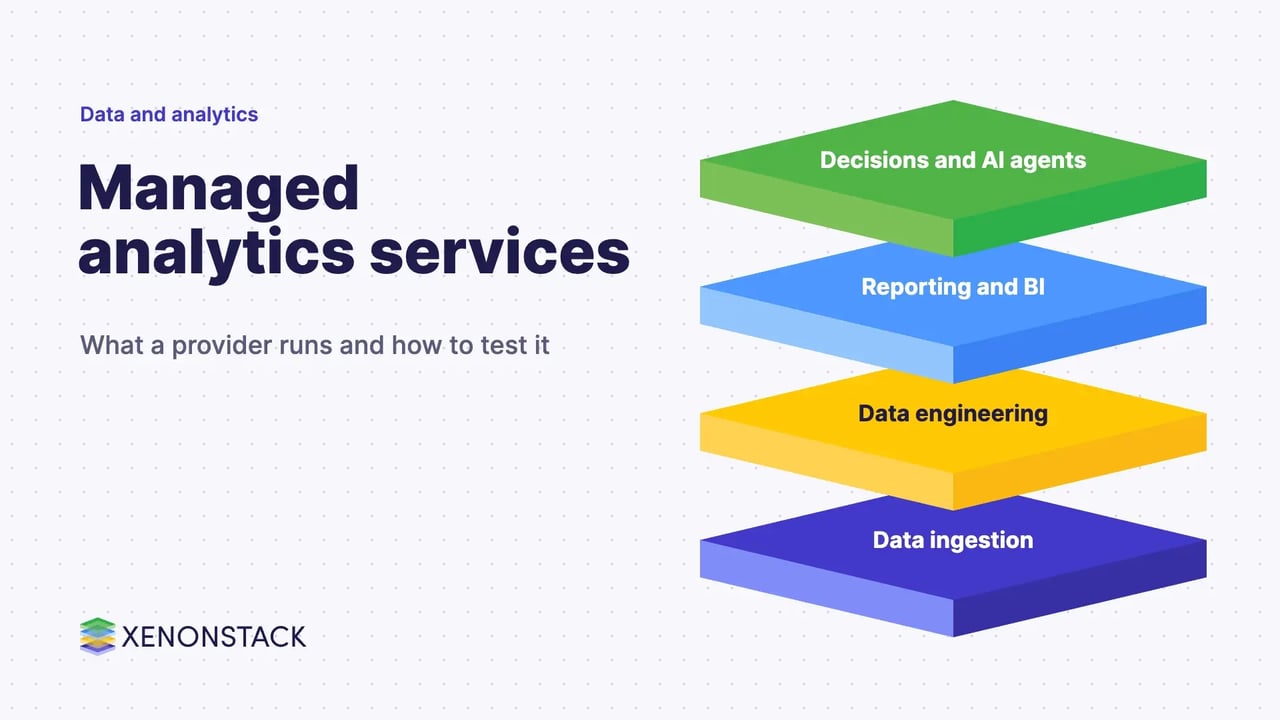
Analytics needs data engineering and operations skills as well as analysis. Define the boundary in the contract by layer, so you know what the provider runs and what you keep.
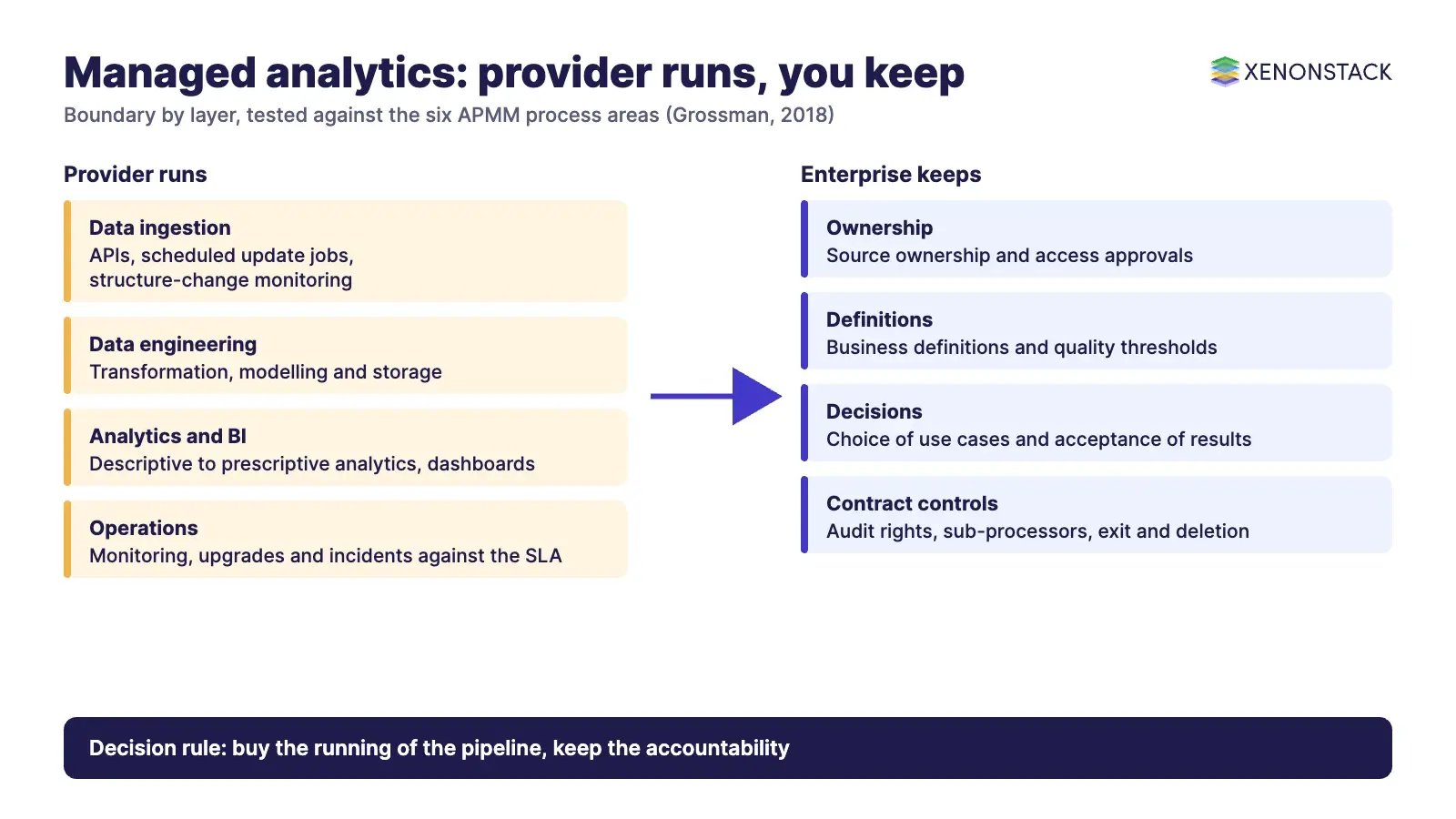
| Layer | What the provider runs | What the enterprise keeps |
|---|---|---|
| Data ingestion | Collecting data from sources through APIs and scheduled update jobs, and monitoring for changes in data structure | Source ownership, access approvals |
| Data engineering | Transformation, modelling and storage for the analytics store | Business definitions, data quality thresholds |
| Analytics | Descriptive, diagnostic, predictive and prescriptive analytics against agreed business requirements | Choice of use cases, acceptance of results |
| Reporting and BI | Dashboards, reports, BI implementation and architecture | Report owners, audience, decisions taken |
| Operations | Monitoring, upgrades, incident handling against the SLA | Service review and escalation |
Ingestion is not a one-time job. It needs regular updates and monitoring, which is why the pipeline is usually the first thing placed under an SLA. For the database layer, see database managed services and solutions.
How do you assess a provider with the Analytic Process Maturity Model?
The Analytic Processes Maturity Model (APMM) was introduced by Robert L. Grossman in "A framework for evaluating the analytic maturity of an organization", International Journal of Information Management, vol. 38(1), 2018. According to its abstract, it identifies analytic-related processes across six key process areas and places organisations into five maturity levels, from building reports at the lowest level to strategy-driven analytics at the highest. It is broadly based on the Capability Maturity Model used for software development processes. Use the six areas as a checklist when you question a provider or assess your own team.
| Process area | Question to put to a provider |
|---|---|
| Building analytic models | How are business requirements and data turned into a model, and who signs it off? |
| Deploying analytic models | How does a finished model reach products, services and operations? |
| Managing and operating analytic infrastructure | Who runs the systems, and how is provisioning handled as data volumes grow? |
| Protecting analytic assets | Which policies and procedures protect data, models and outputs? |
| Operating an analytic governance structure | Who decides, who approves, and how is the process repeated? |
| Identifying analytic opportunities and allocating resources | How are use cases chosen against short and long-term strategy? |
Source: Grossman (2018), via RePEc, read 13 November 2026. A provider that is strong on building models but silent on governance and protection is a risk to weigh.
Which reporting tools fit a managed analytics service?
Reporting tools let analysts spend their time on business logic instead of building visuals. The tool is usually decided by the audience, the data estate and existing licences. Check current capabilities and pricing on each vendor's own page.
| Tool | Where it fits | What to check |
|---|---|---|
| Excel | Individual analysis with pivot tables and charts | Governance of shared workbooks and macros |
| Power BI | Self-service reporting across many sources | Connector availability and DirectQuery support per source: each connector article on Microsoft Learn lists its capabilities |
| Tableau | Visual analytics. According to its site, the portfolio lists Tableau Desktop, Tableau Server and Tableau Cloud (tableau.com) | Licence model and capacity limits, for example Tableau Cloud capacity per its help pages |
| SSRS and Power BI Report Server | On-premises paginated reports. According to Microsoft Learn, Power BI Report Server features are a superset of Reporting Services (source) | Which edition and use rights your SQL Server licence gives; confirm on the Microsoft page |
Which managed analytics service models does XenonStack offer?
XenonStack offers managed services as consulting, managed solutions and subscription-based services, including Data as a Service and Metadata Platform as a Service. The service areas are:
| Service area | What it covers |
|---|---|
| Search-based analytics | Enterprise search applications assessment, search-based analytics application development, search relevancy improvement and cloud-based search |
| AI-driven analytics | Model design and development, managed AI workloads, machine learning governance and managed cognitive analytics |
| Data discovery and metadata platform | Self-service discovery of important data, data quality and governance, master data management, DataOps and data visibility |
| Business intelligence and visualisation | BI consulting, dashboard implementation, BI architecture and real-time visualisation for actionable insights |
For the wider managed estate, read about managed security services. For an industry example of analytics at work, see data analytics in insurance and big data analytics trends.
How should security and personal data be handled?
A managed provider that touches personal data is normally a processor under the GDPR. Article 28 of Regulation (EU) 2016/679 sets what the arrangement must contain. Per the text of Article 28 (reproduced on gdpr-info.eu; the authoritative text is on EUR-Lex), the contract should cover the points below. This is a checklist, not legal advice; confirm with counsel and the official text.
| Contract point | What Article 28 says |
|---|---|
| Written contract | Subject-matter, duration, nature, purpose, data types and categories of data subjects, with the controller's rights and obligations |
| Documented instructions | The processor acts only on the controller's documented instructions, including for transfers to third countries |
| Sub-processors | Prior written authorisation, specific or general, with the same obligations passed down and the first processor remaining liable |
| Security and assistance | Article 32 measures, plus help with data subject requests, breach notification and impact assessments |
| Exit | Deletion or return of personal data at the end of the services, at the controller's choice |
| Audit | Information to show compliance, and allowing audits and inspections |
What are the trade-offs, and when is managed analytics not the right choice?
The model moves effort to a provider. It does not move accountability. Judge each claimed benefit by how you can test it in the contract.
| Expected benefit | How to test it | When it may not fit |
|---|---|---|
| Faster delivery of insights | SLA on change requests and refresh times | Few, stable reports that an internal team already runs |
| Less operational load on IT | Named runbooks, monitoring and incident handling | Data too sensitive to leave your boundary |
| Scalability and cost control | Pricing against volume tiers, with exit terms | Heavy, steady workloads where unit cost matters most |
| Governance and security | Audit rights, sub-processor list, deletion on exit | No internal owner for definitions and policy |
How do managed analytics services support AI agents?
Agents are only as reliable as the data and definitions behind them. Managed analytics that keeps definitions, lineage and quality under control gives agents a trusted base. ElixirData Context OS keeps governed context, versioned policy and decision traces in one decision layer above AI agents. ElixirClaw is an agentic OS platform to build, orchestrate and govern AI agents and automation workflows while keeping humans in control. AgentAnalyst lets teams ask questions of enterprise data in plain language and get real-time insights.
What is a sensible adoption sequence?
- Score your current state against the six APMM areas and pick the two weakest.
- Start with ingestion and reporting for one domain under an SLA, and keep definitions in-house.
- Agree the Article 28 style contract points, audit rights and exit terms before data moves.
- Extend to predictive and prescriptive analytics once the pipeline meets its service levels.
- Review quarterly against the SLA and the maturity scorecard.
To map one analytics decision your agents should make, and the data, context and policy it depends on, book a Context Workshop. See what happens in the workshop.
Frequently Asked Questions
What are managed analytics services?
A specialist provider runs ingestion, engineering, reporting and advanced analytics under agreed service levels, while the enterprise keeps ownership of data, decisions and policy.
How do I assess a managed analytics provider?
Use the six process areas of the Analytic Processes Maturity Model: building models, deploying models, running infrastructure, protecting assets, governance, and choosing opportunities against strategy.
What should the contract say about personal data?
Under GDPR Article 28 it should cover processing on documented instructions, sub-processor authorisation, security and assistance duties, deletion or return at exit, and audit rights. Confirm with counsel.
Which reporting tools are used?
Excel, Power BI, Tableau and SSRS or Power BI Report Server are common. Choose by audience, sources and licences, and check each vendor's current documentation.
When is managed analytics not the right choice?
When reporting is small and stable, when data cannot leave your boundary, or when nobody internally owns definitions and policy.
How do managed analytics services support AI agents?
They keep data, definitions and quality under control, so agents act on trusted inputs that a context and policy layer can govern.
Explore the XenonStack platform family: ElixirData · ElixirClaw · ElixirHub · NexaStack · MetaSecure · Neural AI · AgentGRC · AgentSRE · AgentAnalyst · AgentInstruct · AgentRAI · AgentScrum · AgentSearch · AgentForce · AI Aviator · SAIF Aviator · CohortIQ · XenonStack AI · XenonStack UAE