Key takeaway
- Big data managed services explained: what providers run, how they compare with cloud-managed options, how AI agents change operations and what to ask.
Big data managed services are an arrangement in which an outside team runs the storage, processing, security and day-to-day operation of your big data platform, while your organisation keeps ownership of the data and the decisions made from it. The provider handles monitoring, patching, backup and recovery, and support so that internal teams can focus on analysis.
This guide is for data, platform and IT leaders deciding whether to run a big data environment themselves or hand its operation to a specialist. It covers what big data is, what a managed service includes, how it compares with other models, how AI agents change operations, and what to settle first. For the strategy side, see big data strategies with advanced analytics.
What is big data, and why is it hard to run?
NIST describes big data as extensive datasets, characterised mainly by volume, velocity, variety and variability, that require a scalable architecture for efficient storage, manipulation and analysis (NIST SP 1500-1). Amazon Web Services frames it in similar terms: its What is big data? page describes data that cannot be handled with traditional databases as volume, variety and velocity grow.
The same AWS page names the first practical hurdles: collecting raw data from many sources, scaling systems when volume surges, and the cost and productivity loss when those problems go unsolved. It also outlines the usual flow: store data in a secure, scalable and durable repository, process and analyse it into a consumable form, then deliver insight through business intelligence and visualisation tools. Each stage needs people and tooling to keep it running, which is where managed services come in. Related reading: big data ingestion and the big data platform.
What do big data managed services cover?
Scope differs between providers, so agree it in writing. The table shows the areas most agreements address and where responsibility usually sits.
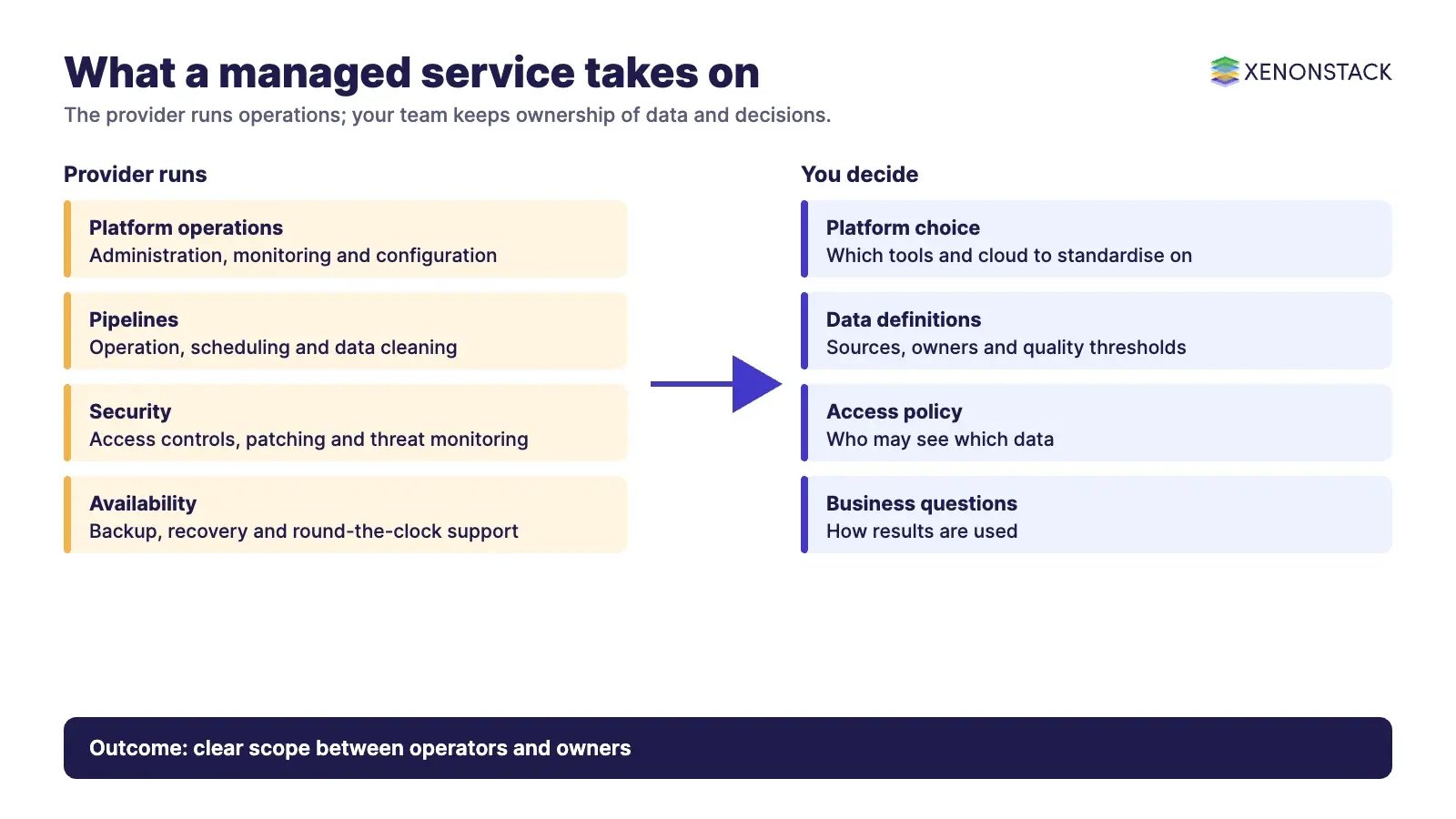
| Area | What the provider typically runs | What your organisation still decides |
|---|---|---|
| Platform operations | Cluster and storage administration, monitoring, configuration and asset management | Which platform and tools to standardise on |
| Data acquisition and processing | Pipeline operation, scheduling, data cleaning, NoSQL and Hadoop-style administration | Source systems, data definitions, quality thresholds |
| Security | Access controls, patching, threat monitoring (see big data security) | Classification, who may see what, regulatory duties |
| Availability | Backup, disaster recovery, network and workload management, round-the-clock support | Recovery objectives and acceptable downtime |
| Analytics support | Predictive and reporting workloads, expert advice | Business questions and how results are used |
Why do organisations use managed services?
Six pressures come up repeatedly. Skilled people are hard to hire and keep for specialised platforms. Data arrives from many sources, which widens the security surface. The tool landscape keeps shifting, so staying current is a job in itself. Continuous operation can be interrupted by network faults, full storage or pending patches. Real-time insight depends on a stable platform. Finally, moving large datasets to a third party raises compliance and data-location questions that must be settled before any contract.
None of these is an argument for outsourcing everything. They are a checklist for deciding which operational duties are worth handing to a specialist and which belong in-house. Keep an eye on new tooling too: the latest trends in big data analytics tracks how the field is moving.
How does a managed service compare with other operating models?
| Model | Who operates the platform | Typical fit | Watch for |
|---|---|---|---|
| Self-run | Your own platform team | Organisations with deep in-house skills and stable needs | Hiring, on-call load, tool churn |
| Cloud-managed service | The cloud vendor runs the underlying service. For example, Amazon EMR is described by AWS as a managed cluster platform that simplifies running frameworks such as Apache Hadoop and Apache Spark | Teams happy to build on one cloud | You still design, secure and tune your own workloads |
| Managed service provider | A specialist team that works as an extended team on your platform | Teams that need operations cover across tools or clouds | Clear scope, SLA and exit terms |
Cloud-managed services reduce infrastructure work, but they do not by themselves cover your pipelines, access policies or business logic. A managed service provider can fill that gap, which is why contract scope matters more than the label. XenonStack describes its own approach on the managed services and big data analytics pages.
How do AI agents change big data operations?
Traditional runbooks rely on fixed alerts and human triage. AI agents can read logs and metrics, correlate a failing job with recent changes, propose a fix and, where policy allows, apply it, handing off to a person when a decision carries risk. The value depends on the quality of the context the agent works from: which dataset feeds which report, who owns it, and which policy applies.
That context layer is what ElixirData, XenonStack's Context OS, is built to organise. Agents that act on data platforms need the same governance as people: scoped access, an audit trail and clear escalation rules. Treat any agent that touches production data as a new operator, and write its permissions into the service scope.
What should you do first?
- List the platform components, data sources and owners you run today.
- Mark which duties (monitoring, patching, backup, support) you want to hand over and which you keep.
- Write down recovery, security and data-location requirements before talking to providers.
- Ask each provider for scope, escalation paths, exit terms and how they treat agent-driven changes.
- Start with one workload as a pilot and review the results before widening scope.
To map one decision your agents make, and the data and policy it depends on, book a Context Workshop. See what happens in the workshop.
Frequently asked questions
What are big data managed services?
They are services in which a specialist provider operates your big data platform, including monitoring, patching, backup, security and support, while you keep ownership of the data.
How is a managed service different from a cloud-managed service?
A cloud-managed service such as Amazon EMR removes much infrastructure work, but you still build and secure your workloads. A managed service provider can also operate pipelines, security and support across tools.
What should a big data managed services contract include?
Scope of duties, service levels, security and access rules, backup and recovery targets, data-location terms, escalation paths and exit arrangements.
Do managed services remove the need for an in-house data team?
No. The business questions, data definitions, quality thresholds and use of results stay with your organisation.
How do AI agents fit into managed big data operations?
Agents can triage incidents, correlate failures with changes and propose fixes, but they need scoped permissions, an audit trail and human escalation for risky actions.
Ready to put AI agents to work? See an ElixirClaw demo: the agentic OS to build, orchestrate and govern AI agents across your enterprise systems.
Explore the XenonStack platform family: ElixirData · ElixirClaw · ElixirHub · NexaStack · MetaSecure · Neural AI · AgentGRC · AgentSRE · AgentAnalyst · AgentInstruct · AgentRAI · AgentScrum · AgentSearch · AgentForce · AI Aviator · SAIF Aviator · CohortIQ · XenonStack AI · XenonStack UAE