Key takeaway
- Application release engineering explained: branching, pipelines, rolling, blue/green and canary releases, tooling and DORA metrics for enterprise teams.
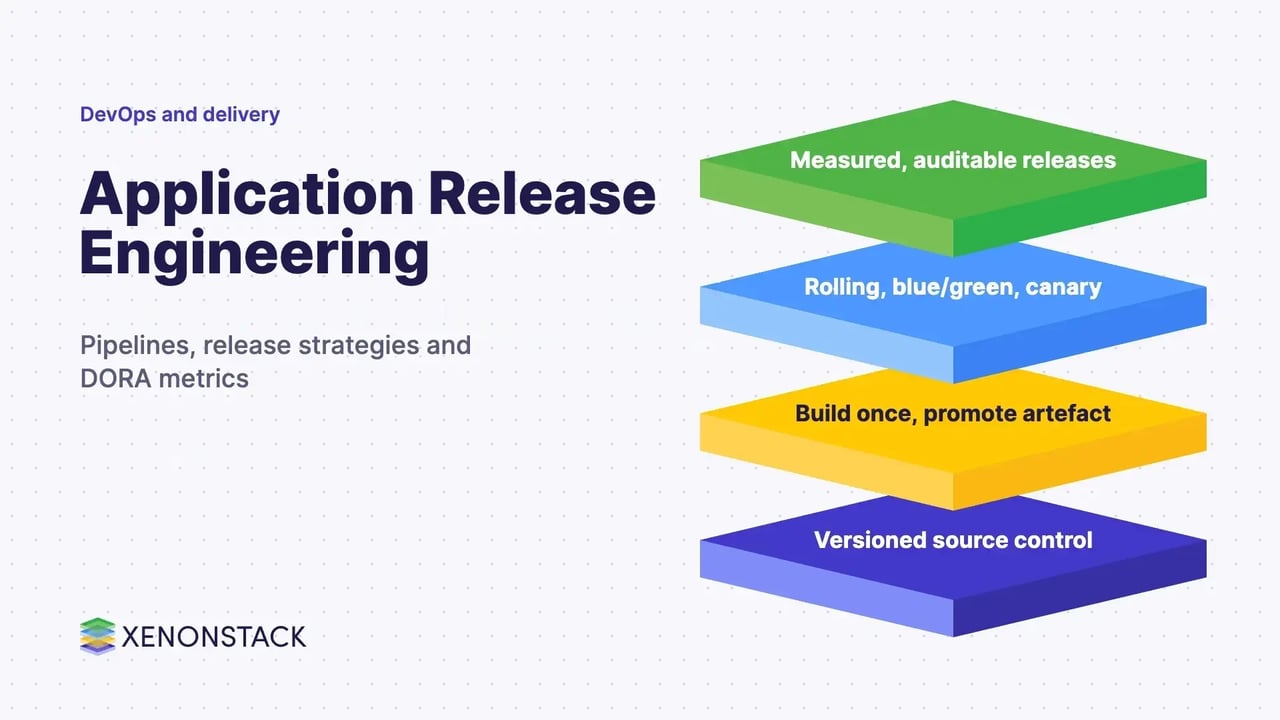
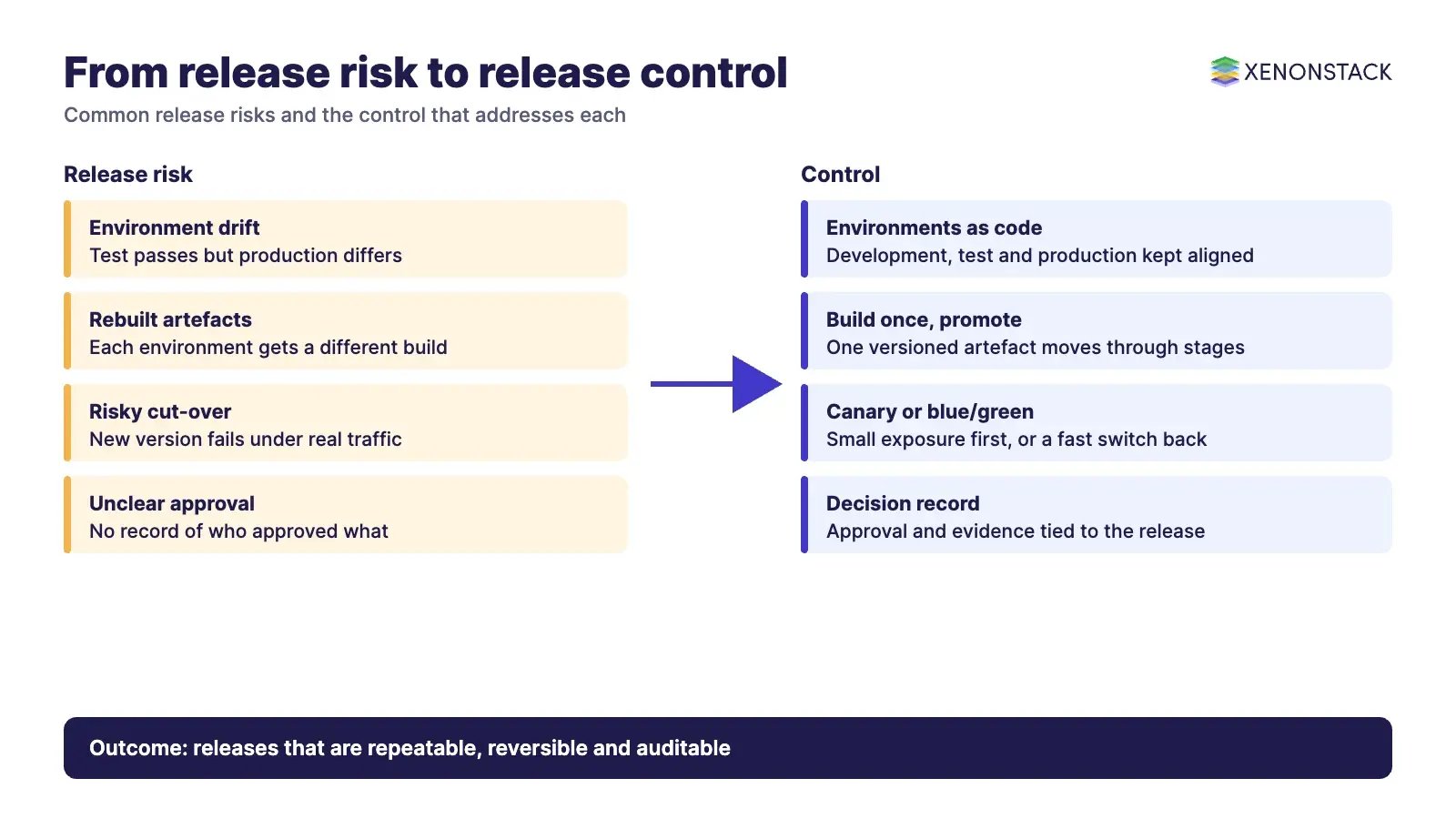
Application release engineering is the discipline of turning source code into a versioned, tested, deployable artefact and getting it to production in a repeatable, auditable way. For enterprise leaders the practical question is not which tool to buy but which controls make a release safe to repeat: one build per commit, promotion of the same artefact through environments, a defined way to roll back, and a record of who approved what. Teams usually judge the result with the DORA software delivery metrics.
This guide covers what release engineers do, how to structure branching and pipelines, how to choose between rolling, blue/green and canary releases and feature toggles, what a release checklist should contain, and how to measure the outcome. It also covers where AI agents can help with release work without taking approval decisions away from people. For the pipeline tooling itself see our guide to CI/CD tools.
What is application release engineering?
It is the work that sits between development and operations: managing the release lifecycle from commit to production. A release engineer, or a platform team that owns the same job, is responsible for repeatable builds, controlled promotion between environments, deployment automation, release coordination and the records that show what shipped and when.
What are the main responsibilities?
| Area | What it covers | Control to look for |
|---|---|---|
| Source code management | Version control, branching, review and tagging | Protected main branch, reviewed merges |
| Build automation | Repeatable builds that produce a versioned artefact | Same artefact promoted, never rebuilt per environment |
| Testing integration | Unit, integration, acceptance, security and performance checks as pipeline gates | Defined pass criteria per stage |
| Environment management | Consistent development, test and production environments | Environments defined as code |
| Deployment and coordination | Automated rollout, scheduling, communication across teams | One documented path to production |
| Records | Release notes, change history, configuration records | Audit trail linked to the release version |
How should you structure branching and versioning?
Pick the lightest model that fits your release cadence. A common long-lived model uses a protected main branch, a development branch, short-lived feature branches, release branches for stabilisation and hotfix branches for urgent production fixes. Teams that deploy continuously often prefer short-lived branches merged to main, and use release toggles to ship unfinished work in a dormant state. Martin Fowler's article on feature toggles describes release toggles as a way to enable trunk-based development.
How should releases be numbered?
Semantic Versioning 2.0.0 gives a simple contract: increment MAJOR for incompatible API changes, MINOR for backward compatible functionality, and PATCH for backward compatible bug fixes, as set out at semver.org. Tag every release in source control so that a running version can always be traced to a commit.
What makes a good commit and review habit?
- Write a short subject line that says what changed, and explain why in the body for non-trivial changes.
- Reference the ticket or change request so the release notes can be generated from history.
- Merge to the protected branch only after review and passing checks.
What does a release pipeline need?
A pipeline should build once and promote that artefact. Typical stages are code quality checks, unit tests, integration tests, artefact build and storage, deployment to a test environment, automated acceptance tests, security scanning and performance tests, then a controlled production deployment. Each stage should have a defined pass criterion, so a failure stops the release instead of becoming a judgement call at the end.
How do you manage artefacts and environments?
- Version every artefact, store it in a dedicated repository and never modify one after publication; publish a new version instead.
- Define environments as code and keep development, test and production as close as practical, so a pass in test means something.
- Apply retention policies to old artefacts, keeping those needed for rollback and audit.
How does supply chain security fit in?
Release engineering is where build integrity is decided. SLSA is a set of supply chain security guidelines that can be adopted incrementally; its v1.0 specification defines a Build track with Levels 1 to 3, and the SLSA site now marks v1.0 as retired and v1.2 as current, so check the current specification before you set a target level. For the wider picture see DevOps trends.
Which deployment strategy should you use?
Separate two decisions: how code reaches production (deployment) and when users see it (release). The strategies below differ in what they cost and how fast you can undo them.
| Strategy | How it works | Fits when | Watch for |
|---|---|---|---|
| Rolling | Replaces instances of the old version gradually. In Kubernetes Deployments the default rolling update keeps at least 75% of desired pods up and allows at most 125%, according to the Kubernetes docs | You need no downtime and can run two versions side by side | Old and new versions must coexist, including with the database |
| Blue/green | Two production environments as identical as possible; test the release in the idle one, then switch the router, as described in Fowler's blue-green note | You want a fast switch back to the previous version | Database schema changes and transactions made while the new side is live; the article does not quantify cost, but two environments are implied |
| Canary | Send the new version to a small group of users, then widen the rollout, per Fowler's canary note | You want real production evidence before full exposure | Several versions run at once; database changes must work for both |
| Feature toggle | Deploy code dormant, enable it later for chosen users | You want to decouple deployment from release | Toggles add conditional logic and test burden; plan their removal |
On toggles, the Fowler article separates release, experiment, ops and permissioning toggles by lifespan, and advises treating toggles as inventory to be kept low, with removal tasks or expiry dates. Whichever strategy you pick, define rollback criteria before the release, automate the rollback, rehearse it, keep recent versions deployable and monitor after the rollback completes.
Which tools do release teams use?
Choose tools by the role they play in the release path, and confirm current product status and features on each vendor's own site before you shortlist. The names below are examples by category, not a ranking.
| Role | Examples | What to decide |
|---|---|---|
| Source control | GitHub, GitLab, Bitbucket | Review, branch protection and audit needs |
| CI and CD | Jenkins, CircleCI, GitHub Actions, GitLab CI/CD, Azure DevOps | Where your code and runners already live |
| Build and packaging | Maven, Gradle, Docker | Reproducible builds and dependency control |
| Artefact repositories | JFrog Artifactory, Sonatype Nexus Repository, Amazon ECR | Formats, retention and access control |
| Configuration and infrastructure as code | Ansible, Terraform, Puppet | Environment parity and drift handling |
| Delivery and orchestration | Argo CD, Spinnaker, Octopus Deploy, Harness | Multi-environment promotion and approvals |
| Monitoring | Prometheus, Grafana, Datadog, New Relic | Release health signals and rollback triggers |
What is GitOps and where does it fit?
According to its docs, Argo CD is a declarative, GitOps continuous delivery tool for Kubernetes: it compares each running application's live state with the desired state held in Git and marks differences as OutOfSync. The value for release engineering is that the desired state is version controlled, so every production change has a commit behind it.
What is application release orchestration?
Release orchestration coordinates the release across teams, environments and tools: end-to-end visibility, consistent process across projects, and compliance records. It matters most when many teams ship dependent changes together. It is a layer above the pipeline, so decide whether you need it after the pipeline itself is reliable.
How do you prepare for a release?
Use a checklist that the pipeline can enforce where possible:
- Change log and release notes: record changes, fixes and user-facing summaries.
- QA sign-off: formal confirmation that quality criteria are met.
- Version tag: semantic version tagged in source control.
- Documentation and training: user guides, and briefing for support and sales teams.
- Backup and rollback plan: confirm backups, rollback criteria and who decides.
- Communication plan: tell stakeholders what ships and when.
- Post-release monitoring: agree the signals you will watch and for how long.
What should you measure?
DORA's current guidance describes five software delivery metrics, grouped as throughput and instability; the page was last updated on 5 January 2026.
| Metric | Group | Definition (per dora.dev) |
|---|---|---|
| Change lead time | Throughput | Time from committing a change to version control until it is deployed to production |
| Deployment frequency | Throughput | How often deployments occur over a period, or the time between them |
| Failed deployment recovery time | Throughput | How long it takes to recover from a failed deployment that needs immediate intervention |
| Change fail rate | Instability | The share of deployments that need immediate intervention, such as a rollback or hotfix |
| Deployment rework rate | Instability | The share of deployments that are unplanned and triggered by a production incident |
Teams often add their own operational measures, such as build success rate, test pass rate on first run, rollback frequency and user-impacting incidents after release. Define each one precisely and keep it as a team-level signal rather than an individual target. Our guide to DevOps metrics goes further.
Where do AI agents fit in release engineering?
AI agents suit the preparation and checking work around a release: drafting release notes from commit history, comparing a change against policy, collecting evidence for the change record and summarising post-release signals. The approval to ship and the decision to roll back should stay with named people, with the agent's recommendation and the evidence it used recorded alongside. This is the same pattern we describe for agentic workflows: bounded actions, policy checks and a decision trace. ElixirData Context OS keeps governed context, versioned policy and decision traces in one decision layer above AI agents, and AgentGRC keeps autonomous agent actions inside policy, with the audit trail risk teams need. Database changes need the same discipline as code, see database DevOps, and regulated teams should read continuous compliance in DevOps.
When is a heavier release process the wrong answer?
More ceremony does not make releases safer. If a small team already deploys several times a week with automated tests and quick rollback, adding approval boards and orchestration layers can lengthen lead time without lowering failure rates. Start with one pipeline, one artefact and one rollback path, measure with the DORA metrics, and add orchestration only when coordination across teams becomes the bottleneck.
To map one release decision your agents should help with, and the context and policy it depends on, book a Context Workshop. See what happens in the workshop.
Frequently asked questions
What is application release engineering?
It is the discipline of building, testing, packaging and deploying software through a repeatable, auditable path from commit to production, including versioning, environments, rollback and release records.
What is the difference between deployment and release?
Deployment puts code into an environment; release makes a feature available to users. Feature toggles let you deploy code in a dormant state and release it later to chosen users.
Blue/green or canary: which should we choose?
Blue/green suits a fast switch back to the previous version, at the price of two production-grade environments and care over database changes. Canary suits gathering production evidence on a small group first, at the price of running several versions at once.
Which metrics show whether release engineering is working?
DORA describes five: change lead time, deployment frequency, failed deployment recovery time, change fail rate and deployment rework rate.
Can AI agents approve production releases?
They can prepare release notes, check changes against policy and gather evidence, but approval and rollback decisions should remain with accountable people, with the agent's evidence recorded.
Ready to put AI agents to work? See an ElixirClaw demo: the agentic OS to build, orchestrate and govern AI agents across your enterprise systems.
Explore the XenonStack platform family: ElixirData · ElixirClaw · ElixirHub · NexaStack · MetaSecure · Neural AI · AgentGRC · AgentSRE · AgentAnalyst · AgentInstruct · AgentRAI · AgentScrum · AgentSearch · AgentForce · AI Aviator · SAIF Aviator · CohortIQ · XenonStack AI · XenonStack UAE