Key takeaway
- Kotlin vs Java for Android: what Google supports, where Java still fits, and how to sequence a move, with a decision table and FAQ for CTOs.
For a new Android app in 2027, choose Kotlin. Google describes Android development as Kotlin-first, and Jetpack Compose, Kotlin Multiplatform and the Kotlin-specific AndroidX APIs are Kotlin-only. Java remains fully supported on Android, so it is the sensible choice only for an existing Java codebase where a rewrite would cost more than it returns.
The two languages are not rivals in the way many comparisons suggest. Kotlin is, in Google's words, 100% interoperable with Java, so most teams migrate file by file. This guide helps CTOs, engineering heads and solution architects decide where each language fits, what has changed, and how to sequence adoption. If you run Java services behind your apps, read our guide to test-driven development for Java alongside this one.
Which language should enterprise teams choose for Android?
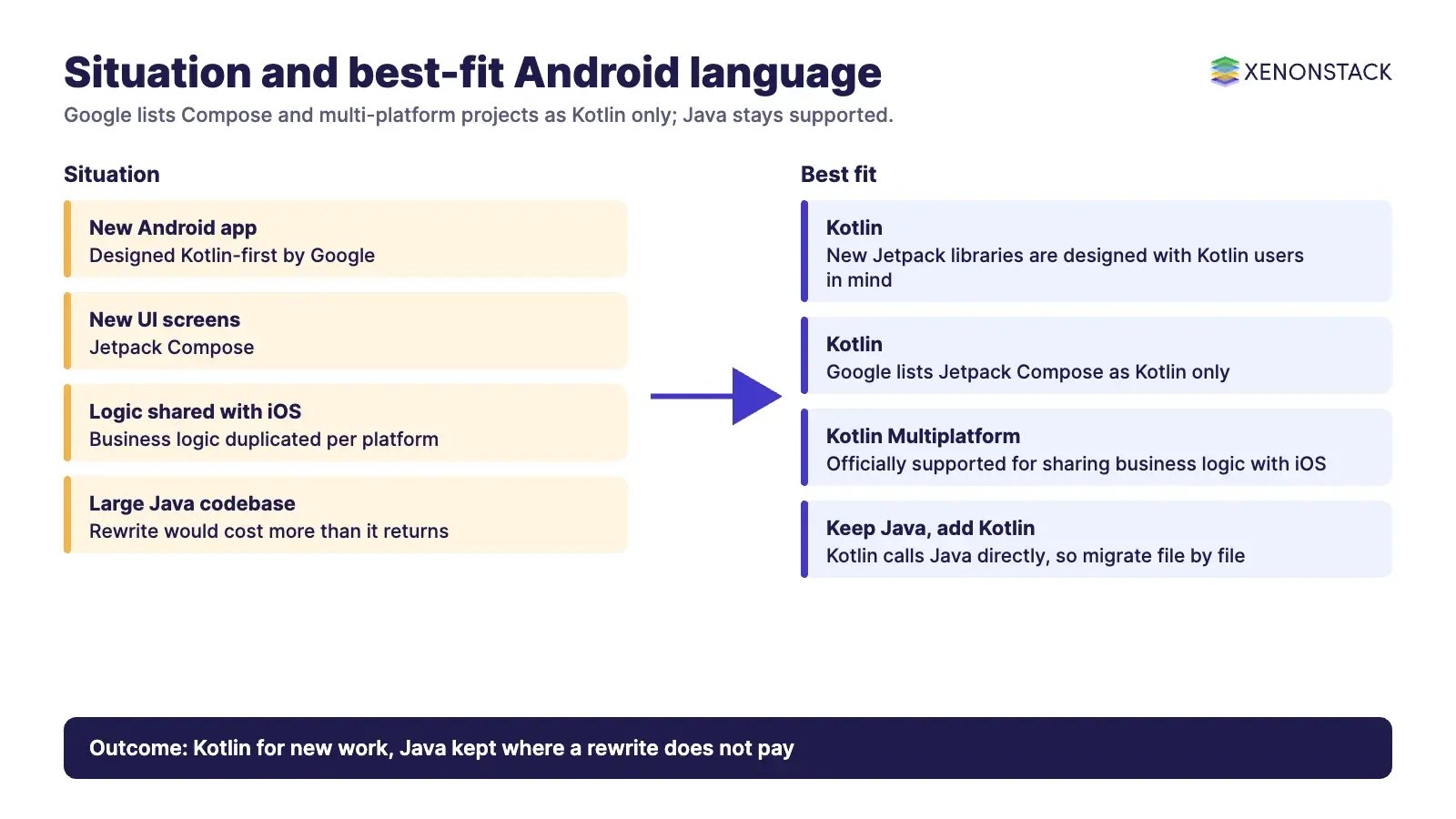
| Situation | Best fit | Why, and current status |
| New Android app | Kotlin | Google designs new Jetpack libraries, samples and training with Kotlin users in mind (Android Kotlin-first). |
| New UI with Jetpack Compose | Kotlin | Google's support table lists Jetpack Compose as Kotlin only. |
| Share business logic with iOS | Kotlin Multiplatform | Google states it is officially supported for sharing business logic between Android and iOS, and is stable and production-ready (Google KMP page). |
| Large existing Java app | Keep Java, add Kotlin gradually | Java is still supported in the Platform SDK, Android Studio, Lint and AndroidX. Kotlin can call Java directly. |
| Library used from both languages | Either, test both call paths | Java types appear in Kotlin as platform types, so nullability needs care (see below). |
What has changed since older Kotlin vs Java comparisons?
Many comparisons, including earlier versions of this post, date from the period when Kotlin was an alternative. The position now is different.
- Kotlin-first is policy. At Google I/O 2019 Android announced that development would be increasingly Kotlin-first. Google's page, last updated 22 September 2026, says it has stood by that commitment. Java is still supported, but the support table marks Jetpack Compose, multi-platform projects and KSP compiler plugin support as Kotlin only, and online training and samples as best effort for Java (source).
- Adoption. Google's Kotlin page says Kotlin is used by over 60% of professional Android developers, with no date or survey given (source). Treat it as a Google statement, not an independent measurement.
- Modern Java on Android. Android Gradle Plugin 8.x requires JDK 17 to run, and Google's documentation lists Java 17 core libraries for Android 14 (API 34). Newer Java language features are therefore available, subject to your minimum SDK and desugaring (source).
- Kotlin release cadence. Kotlin 2.2.0 was released on 23 June 2025, and Kotlin documentation already lists a later 2.2.20 release (source). Check the current release before you pin a version.
How do Kotlin and Java differ in practice?
Both languages run on the Java Virtual Machine and use the same Android toolchain. The differences that matter to a delivery lead are safety, volume of code and asynchronous work.
| Area | Java | Kotlin |
| Null handling | Nullability annotations are available from Android 9 (API 28); the compiler does not enforce them in the same way. | Nullable and non-nullable types are part of the type system, so null mistakes are caught at compile time. |
| Boilerplate | Getters, setters and similar members are written out. | Data classes generate equals, hashCode, toString, componentN and copy. |
| Asynchronous work | Callbacks and other libraries. | Coroutines, which Google calls its recommended solution for asynchronous programming on Android. |
| Modern UI | Views. | Views and Jetpack Compose. |
| Cross-platform sharing | No multi-platform support in Android's table. | Kotlin Multiplatform. |
| Hiring and community | Large, long-established base. | Large and growing. Verify local availability before committing a team. |
Null safety
Kotlin separates String from String?. Assigning null to a non-null type fails at compile time. The Kotlin documentation says the only possible causes of a NullPointerException are an explicit throw, the not-null assertion operator, some initialisation inconsistencies and Java interoperation (source). Google reports that Android apps using Kotlin are 20% less likely to crash, but gives no date or method for the figure, so we treat it as a vendor claim.
var a: String = "abc"
a = null          // compile error: null cannot be a value of a non-null type

var b: String? = "abc"
b = null          // allowed
Less boilerplate
A Java class with private fields, getters and setters becomes one line as a Kotlin data class. The Kotlin documentation says the compiler generates equals, hashCode, toString, componentN and copy from the primary constructor properties (source).
data class Book(var title: String, var author: Author)
Coroutines
Coroutines let you run long tasks without blocking the main thread. Google describes support for suspension, structured concurrency, built-in cancellation and Jetpack integration, and calls coroutines its recommended solution for asynchronous programming on Android (source).
Extension functions and smart casts
Extension functions add behaviour to an existing class without inheriting from it. Smart casts let the compiler insert a cast after an is-check on a value that cannot change. Together with type inference they reduce ceremony, which is what makes Kotlin code shorter to review.
fun MutableList<Int>.swap(index1: Int, index2: Int) {
    val tmp = this[index1]
    this[index1] = this[index2]
    this[index2] = tmp
}
How well do Kotlin and Java work together?
The Kotlin documentation says that pretty much all Java code can be used from Kotlin without issues. Java getters and setters appear as properties, and Kotlin lambdas convert to Java interfaces with a single abstract method (source). That is why incremental migration works.
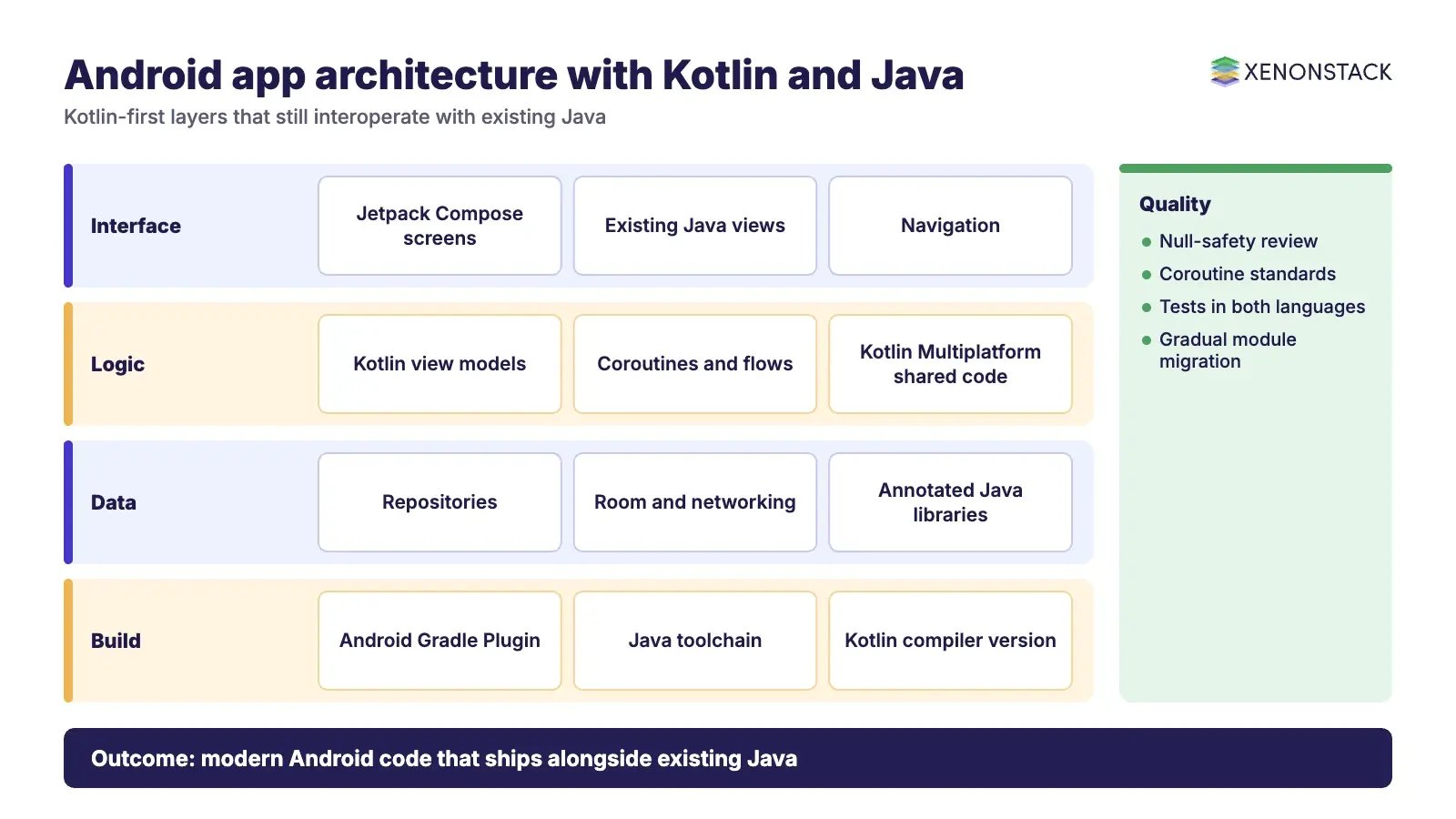
The main trade-off is nullability. Java declarations are seen by Kotlin as platform types, and Kotlin does not raise nullability errors at compile time for them. A null from Java assigned to a non-null Kotlin variable fails at run time. Annotating Java APIs with nullability annotations turns platform types into proper nullable or non-null types. Android Studio also has built-in tools to convert Java to Kotlin, which Google notes on its Kotlin page.
What does Kotlin Multiplatform add for enterprise mobile teams?
Kotlin Multiplatform lets you share code between Android and iOS, from core business logic to the whole app. Google says you do not need to rewrite the application to start sharing code, and that it compiles to the native way each target runs code, with performance on par with native implementations. Many Jetpack libraries, including Room, DataStore, Lifecycle and Paging, are listed as KMP-ready (source). Start with one shared domain module such as pricing or validation rules, not a full rewrite.
What are the trade-offs and when should you not move to Kotlin?
- Stable Java app with low change rate. A rewrite adds risk and delivers little. Write new features in Kotlin only when the team is ready.
- Team skills. Kotlin is quick to pick up for Java developers, but conventions such as null handling, coroutines and scope functions need review standards. Plan training and code review guidance.
- Mixed codebases. Two languages mean two sets of lint rules and two testing styles. Agree conventions early.
- Build tooling. Set the Java toolchain and bytecode target deliberately. Google recommends always specifying a toolchain, and Kotlin versions below 2.2 need the jvmTarget set as well.
- Platform-type nullability. Review Java APIs that return null before exposing them to Kotlin code.
How should you sequence adoption?
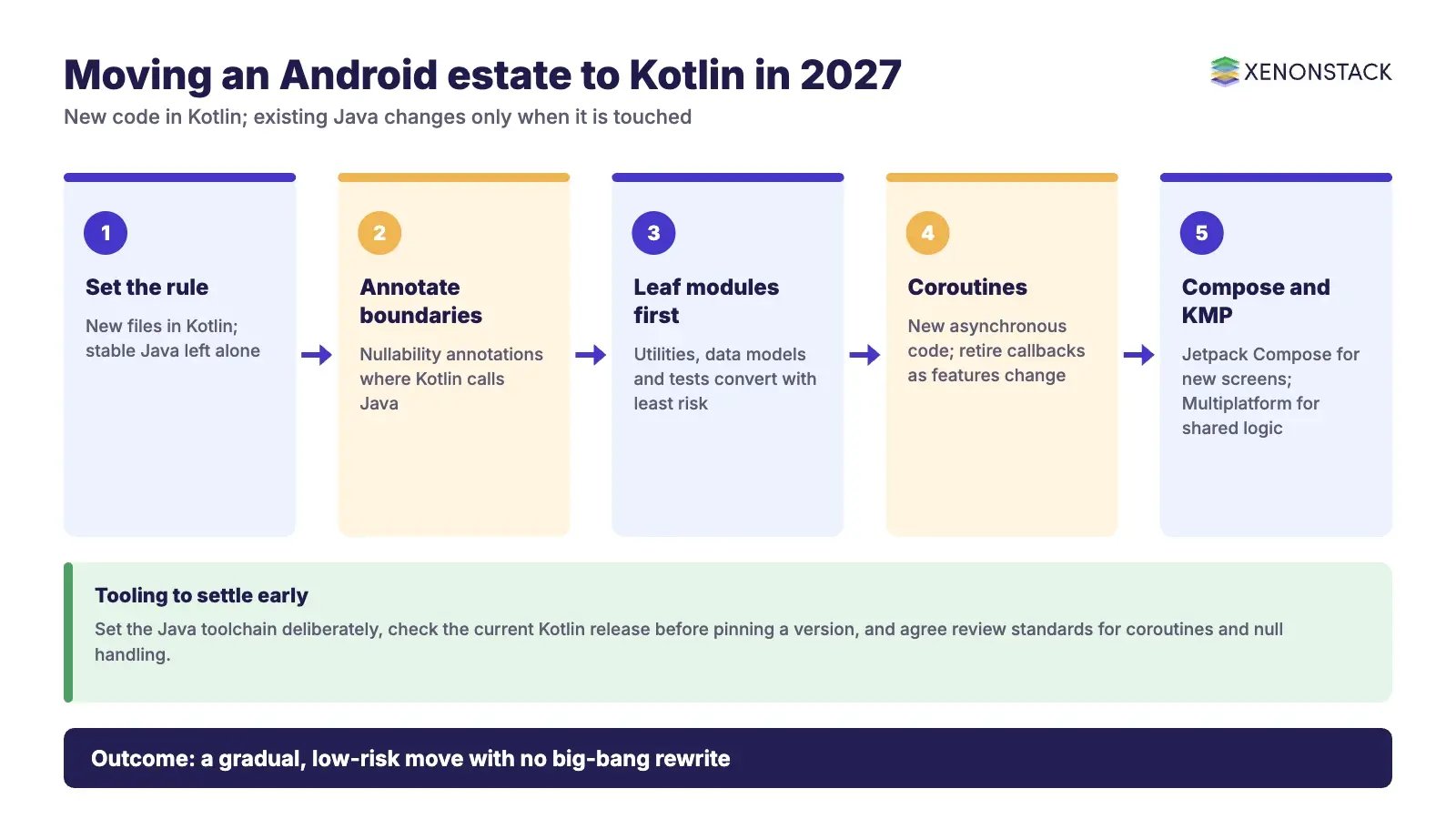
- Set the rule. New files in Kotlin, existing Java left alone unless touched.
- Annotate Java boundaries. Add nullability annotations where Kotlin calls into Java.
- Move the leaf modules first. Utilities, data models and tests convert with the least risk.
- Adopt coroutines for new asynchronous code, then retire callback code as features are changed.
- Introduce Compose for new screens, and consider Kotlin Multiplatform for logic shared with iOS.
- Containerise and release. See Kotlin application deployment with Docker and Kubernetes for the backend side, and our application modernisation guide for wider legacy planning.
Code assistants and agents speed up conversion work, but they also need governed access to your repositories and release rules. ElixirClaw is an agentic OS platform to build, orchestrate and govern AI agents and automation workflows while keeping humans in control, and Agent Scrum uses agentic AI to automate sprint planning and Scrum ceremonies for delivery teams. ElixirData Context OS keeps governed context, versioned policy and decision traces in one decision layer above AI agents. For delivery help, see our software development services and our view of low-code development.
To map one Android release decision your agents should make, and the context and policy it depends on, book a Context Workshop. See what happens in the workshop.
What should you plan for in 2027?
Planning for the year ahead follows the decision table above.
- New work: start new Android apps and new screens in Kotlin, with Jetpack Compose for the interface and Kotlin Multiplatform where logic is shared with iOS.
- Existing Java apps: keep Java where it is stable, set a rule that new files are Kotlin, annotate Java boundaries for nullability and move leaf modules first.
- Tooling: set the Java toolchain deliberately, check the current Kotlin release before pinning a version, and agree review standards for coroutines and null handling before the team grows.
Frequently asked questions
Is Kotlin better than Java for Android app development?
For new apps, Kotlin is the better fit because Jetpack Compose and Kotlin Multiplatform are Kotlin only and new Android tooling is designed Kotlin-first. Java is still supported and suits existing Java codebases.
Is Java still supported for Android?
Yes. Google's support table lists the Platform SDK, Android Studio, Lint and AndroidX as supported for Java, with samples and training as best effort.
Can Kotlin and Java be used in the same Android project?
Yes. Kotlin can use almost all Java code directly, which is why teams migrate gradually rather than rewriting.
Does Kotlin remove null pointer errors?
It greatly reduces them through nullable types checked at compile time, but not completely. The not-null assertion operator, initialisation issues and Java platform types can still cause them.
What is Kotlin Multiplatform?
It is a way to share Kotlin code across platforms. Google states it is officially supported for sharing business logic between Android and iOS, and that it is stable and production-ready.
Which Java version does Android build tooling need?
Android Gradle Plugin 8.x requires JDK 17 to run. Check the release notes compatibility table for the version you use.
What should Android teams plan for in 2027?
Start new apps and new screens in Kotlin with Jetpack Compose, keep stable Java where it is, annotate Java boundaries for nullability, move leaf modules first, and set the Java toolchain and Kotlin version deliberately before the team grows.
Follow XenonStack on LinkedIn: XenonStack on LinkedIn for new guides on agentic AI, data and platform engineering.
Explore the XenonStack platform family: ElixirData · ElixirClaw · ElixirHub · NexaStack · MetaSecure · Neural AI · AgentGRC · AgentSRE · AgentAnalyst · AgentInstruct · AgentRAI · AgentScrum · AgentSearch · AgentForce · AI Aviator · SAIF Aviator · CohortIQ · XenonStack AI · XenonStack UAE