Key takeaway
- How LLMs and AI agents help run Kubernetes: troubleshooting, upgrades, cost and security, the open-source tools, the risks and the guardrails to set.
Large language models help run Kubernetes by turning cluster state, events and logs into plain-language diagnoses and proposed fixes, and AI agents go further by running checks and applying approved changes. The best results so far are in troubleshooting, upgrade preparation, cost reviews and policy checks. The main risk is giving an agent more control of a cluster than its evidence justifies.
This guide explains where LLMs help in Kubernetes managed services, the open-source tools teams use, the guardrails that keep clusters safe, and how a managed service provider should combine people and agents.
What are Kubernetes managed services?
Kubernetes managed services cover the work of running clusters for a business: provisioning, upgrades, security, monitoring, incident response and cost control, delivered by a cloud provider, a partner or both. Our buyer's guide to Kubernetes managed services companies covers how to evaluate providers. This post focuses on how AI changes the operating model.
Where do LLMs help in Kubernetes operations?
| Task | What the model does | Who decides |
|---|---|---|
| Troubleshooting | Explains failing pods, events and logs in plain language and suggests likely causes | Engineer, or agent within read-only scope |
| Upgrade preparation | Finds deprecated APIs and summarises release notes against your manifests | Platform team |
| Configuration review | Flags missing limits, probes and risky settings | Platform team, enforced by policy |
| Cost review | Explains idle and oversized workloads and proposes right-sizing | Service owner |
| Incident response | Correlates alerts, drafts the timeline and runs approved runbooks | On-call engineer |
| Knowledge | Answers questions from runbooks and past incidents | Anyone, with access controls |
Which open-source AI tools work with Kubernetes?
- K8sGPT: scans clusters with built-in analysers and uses a model to explain findings. It was accepted to the CNCF at Sandbox level on 19 December 2023.
- HolmesGPT: an open-source troubleshooting agent that combines telemetry, model reasoning and runbooks; it became a CNCF Sandbox project in October 2025.
- kagent: a framework for building agents that operate Kubernetes, also in the CNCF Sandbox.
- Copilots for kubectl and YAML: assistants that suggest commands and manifests for an engineer to run.
Sandbox status means early-stage projects: test them in non-production clusters and pin versions.
How does an AI agent work safely on a cluster?
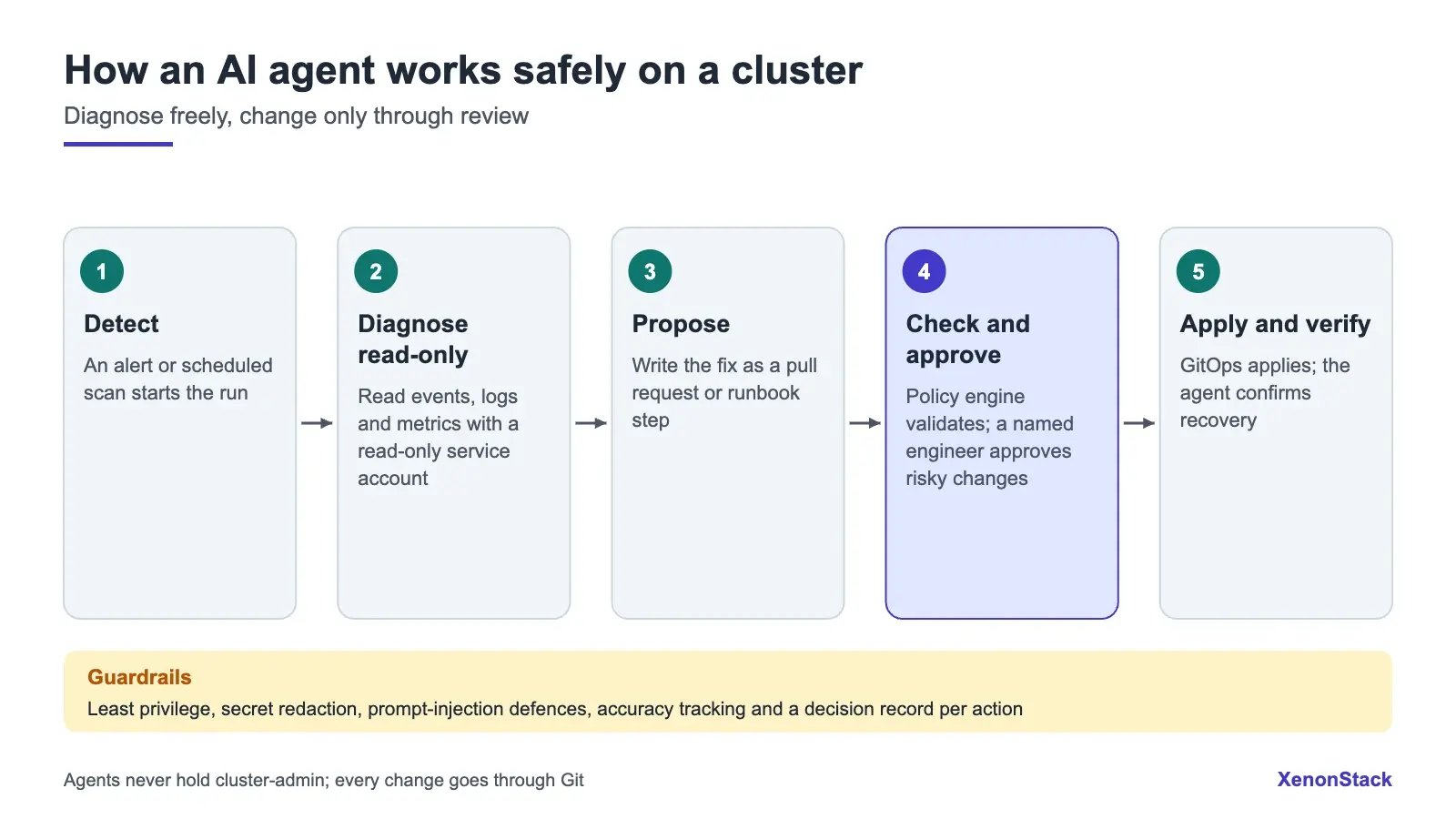
- Detect: an alert or scheduled scan starts the run.
- Diagnose read-only: the agent reads events, logs and metrics with a read-only service account.
- Propose: it writes the fix as a pull request or runbook step, never a direct edit.
- Check and approve: policy engines validate the change and a named engineer approves anything risky.
- Apply and verify: GitOps applies the change, and the agent confirms the service recovered.
Our guides to Kubernetes deployment and GitOps workflows cover the delivery side.
What are the risks of using LLMs to manage Kubernetes?
- Over-privileged agents: a cluster-admin token turns a wrong suggestion into an outage.
- Sensitive data: logs and manifests can contain secrets and personal data sent to a model.
- Confident errors: plausible but wrong diagnoses waste time or cause bad changes.
- Prompt injection: text in logs or annotations can try to redirect the agent.
- No audit trail: without records, nobody can show why a change was made.
See agentic AI security and site reliability engineering for the wider controls.
Where does XenonStack fit?
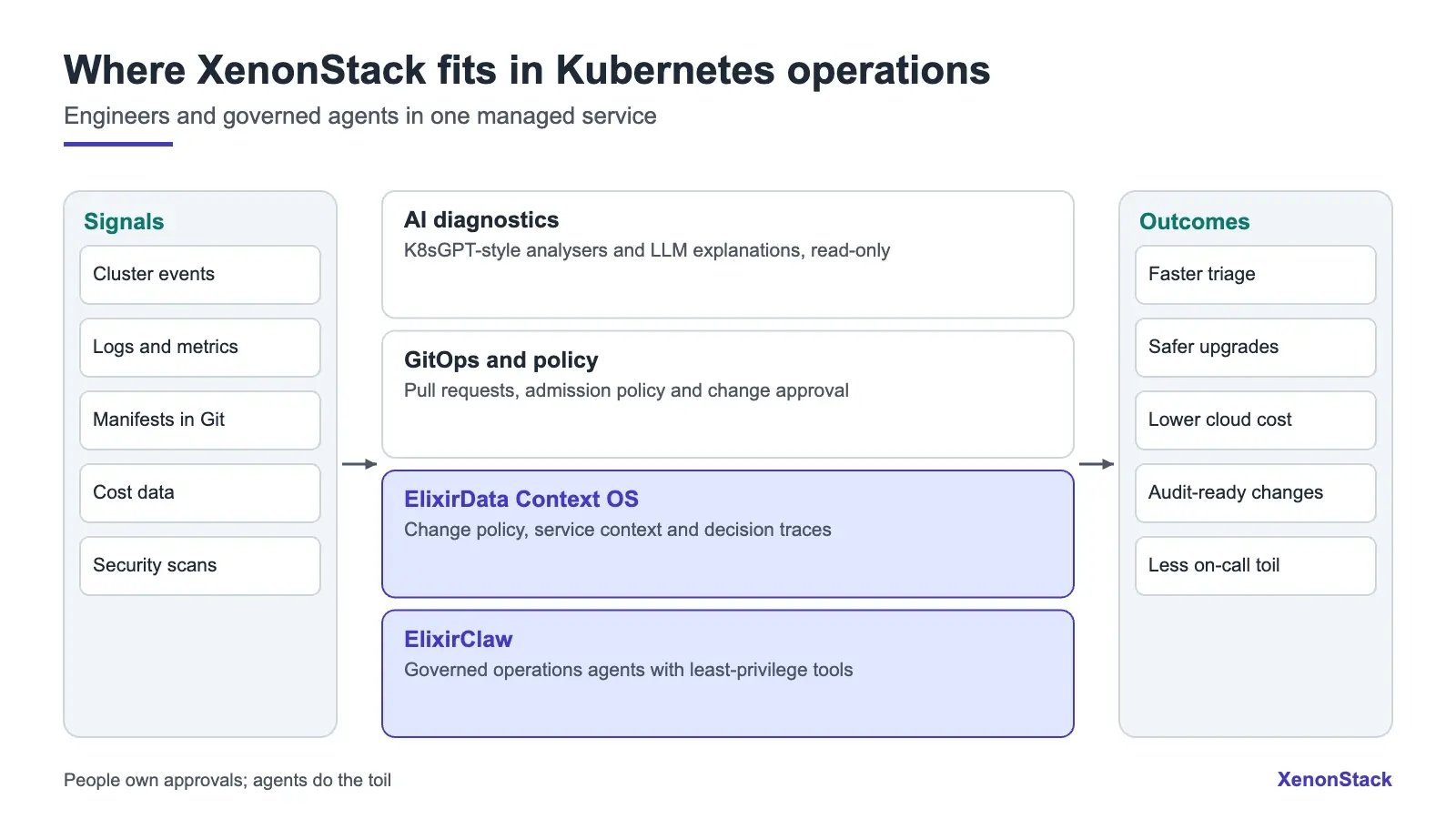
XenonStack runs Kubernetes managed services with engineers and agents working together. ElixirClaw runs governed operations agents with least-privilege access and approval steps, and ElixirData Context OS holds change policy and records a decision trace for every action, so audits and post-incident reviews have the full story.
To map one operations decision your agents should make, and the context and policy it depends on, book a Context Workshop. See what happens in the workshop.
Frequently asked questions
Can an LLM manage a Kubernetes cluster on its own?
Not safely today for production changes. LLMs are strong at diagnosis and drafting fixes; changes should go through policy checks, GitOps and human approval for anything risky.
What is K8sGPT?
K8sGPT is an open-source tool that scans Kubernetes clusters with analysers and uses a language model to explain problems in plain English. It was accepted to the CNCF as a Sandbox project in December 2023.
How do you keep secrets out of AI tools?
Redact or filter secrets and personal data before anything is sent to a model, use read-only service accounts, prefer models you can host privately, and log what was shared.
Will AI replace Kubernetes engineers?
No. It reduces toil in triage, reviews and documentation, but engineers still own architecture, approvals and accountability for production changes.
How should a managed service provider use AI agents?
Start with read-only diagnosis, measure accuracy against engineers, then allow agents to propose changes through pull requests, with approval gates and a decision record for every action.
Follow XenonStack on LinkedIn: XenonStack on LinkedIn for new guides on agentic AI, data and platform engineering.
Explore the XenonStack platform family: ElixirData · ElixirClaw · ElixirHub · NexaStack · MetaSecure · Neural AI · AgentGRC · AgentSRE · AgentAnalyst · AgentInstruct · AgentRAI · AgentScrum · AgentSearch · AgentForce · AI Aviator · SAIF Aviator · CohortIQ · XenonStack AI · XenonStack UAE