Key takeaway
- Guide to edge computer vision on AWS: SageMaker Neo, IoT Greengrass V2, Panorama and Edge Manager status, governance, and a 3 to 5 year outlook.
For edge computer vision on AWS today, the workable path is to train in Amazon SageMaker, compile the model with SageMaker Neo for the target chip, and deploy and update it on devices with AWS IoT Greengrass. AWS Panorama, which used to bundle camera hardware and a managed service, no longer works after 31 May 2026, and SageMaker Edge Manager was discontinued on 26 April 2024, so this Greengrass and Neo path is now the one AWS itself points customers to.
This guide is for architects and platform leads who need to decide how to run vision models close to cameras and sensors. It covers what each service does, how the pieces fit, which parts of older designs no longer apply, the governance and cost questions to settle early, and what to watch over the next 3 to 5 years. For the wider cloud-versus-edge choice see our guide on Cloud vs Edge AI for Vision Workloads, and for the Microsoft equivalent see the Azure IoT Edge computer vision guide.
What do AWS IoT Greengrass and SageMaker Neo each do?
According to AWS, SageMaker Neo lets teams "train once and run anywhere in the cloud and at the edge". It compiles a model exported from a framework into an optimised form for a specific hardware and software target. The documentation lists Gluon, Keras, MXNet, PyTorch, TensorFlow, TensorFlow-Lite and ONNX as supported frameworks, and targets from Ambarella, ARM, Intel, Nvidia, NXP, Qualcomm, Texas Instruments and Xilinx. Neo can optimise models with parameters in FP32 or quantised to INT8 or FP16.
AWS IoT Greengrass is, in AWS's words, an open source IoT edge runtime and cloud service that helps you build, deploy and manage IoT applications on devices. Devices can collect and analyse data close to where it is generated, react autonomously to local events and talk securely to AWS IoT Core. Software is packaged as components, which can run as Lambda functions, Docker containers, native processes or custom runtimes. The core software runs on Windows and Linux distributions such as Ubuntu or Raspberry Pi OS, on ARM or x86 devices (source: How AWS IoT Greengrass works).
| Service | Job in a vision pipeline | What the AWS documentation says |
|---|---|---|
| Amazon SageMaker | Train and version the model in the cloud | Provides tools to build, train and deploy models (named as the build option on the Panorama end of support page) |
| SageMaker Neo | Compile the trained model for one target chip | Converts framework-specific operations into an intermediate representation, then generates optimised binary code and a runtime for the target |
| AWS IoT Greengrass V2 | Deliver, run and update the model and inference code on devices | Deployments are continuous: updates to components are sent to all destination targets |
| AWS IoT Core | Device identity and messaging back to the cloud | Greengrass devices communicate securely with AWS IoT Core |
How does the pipeline work from training to inference at the edge?
The flow has five steps, and the model is the only moving part that changes often.
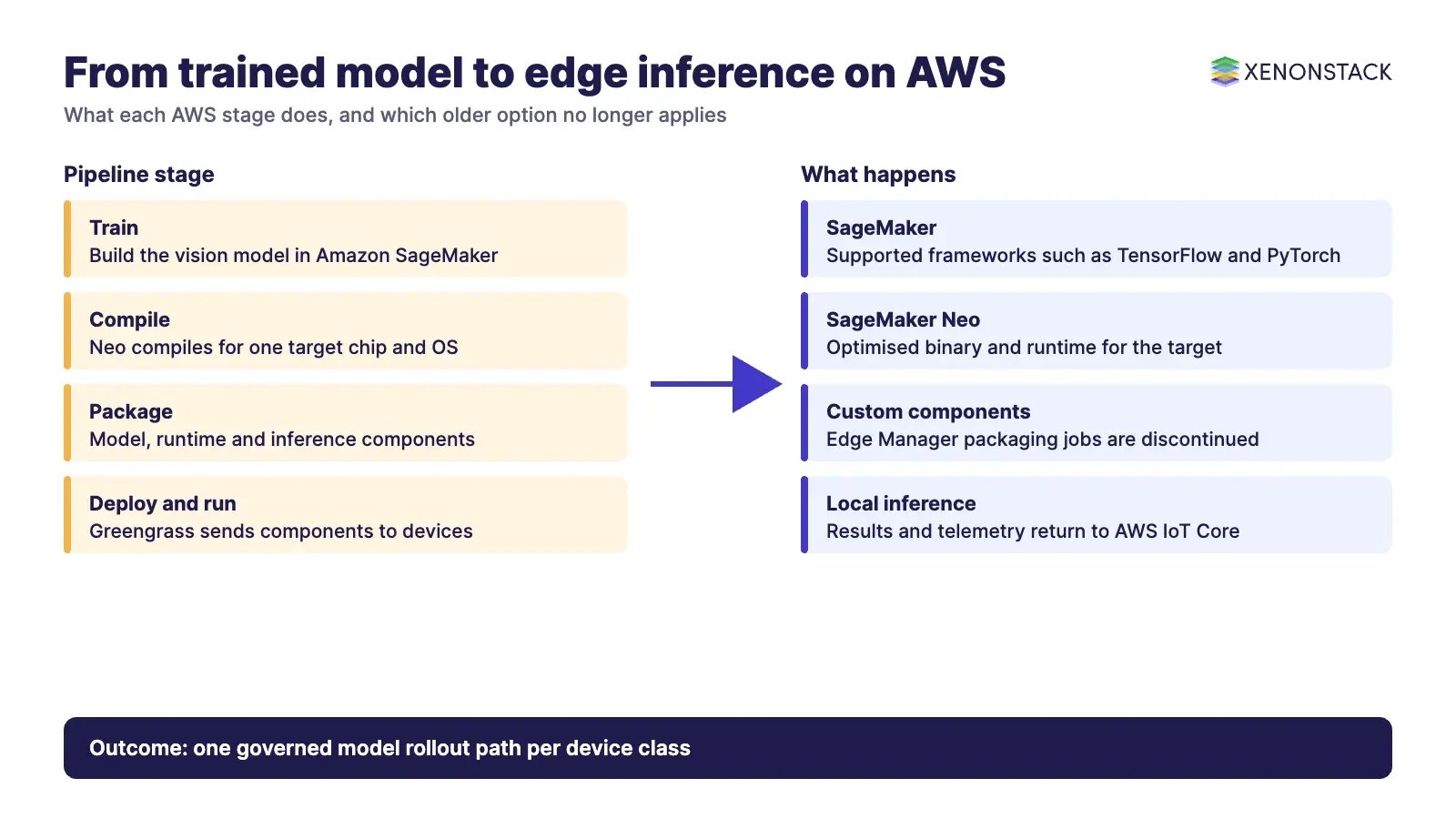
- Train: build the vision model in Amazon SageMaker using a supported framework such as TensorFlow or PyTorch.
- Compile: run a Neo compilation job for the exact processor and operating system of the device. Jobs can be created from the console, the AWS CLI or the SageMaker SDK, per the SageMaker Neo documentation.
- Package: wrap the compiled model as a Greengrass model component, a runtime component that installs the framework, and an inference component with your code. The ML inference guide for Greengrass V2 describes these three component types and notes that deploying the inference component deploys its model and runtime dependencies.
- Deploy: send the components to one core device or a group of devices through a Greengrass deployment.
- Run and monitor: inference runs locally on the device. Results and telemetry go back to AWS IoT Core or Amazon S3, and a new model version triggers a new deployment.
AWS provides sample inference components for image classification and object detection, using Deep Learning Runtime (DLR) and TensorFlow Lite. The documentation states that the DLR image classification sample models support only CPU acceleration, and that using the samples needs at least 500 MB of local storage, so production work normally means your own model and runtime components. Models you supply from Amazon S3 must use SSE-S3 or SSE-KMS encryption, sit in the same account and Region as the components, and be readable by the Greengrass device role.
Which parts of older AWS edge vision designs no longer apply?
Several designs published before 2025 assume services that have changed. The table lists the status as AWS currently documents it. Confirm each item on the linked page before you commit a design, because AWS dates can change.
| Component | Status per AWS documentation | What to do instead |
|---|---|---|
| AWS Panorama | AWS ended support on 31 May 2026 and stopped accepting new customers on 20 May 2025 (see the AWS Panorama end of support page). The console and resources are no longer accessible. | AWS suggests off-the-shelf hardware, such as current-generation Nvidia Jetson devices or an edge server, managed through AWS IoT Core, Greengrass, EKS Anywhere, ECS Anywhere or Systems Manager. Applications need rewriting to remove Panorama-specific API calls. |
| SageMaker Edge Manager | Discontinued on 26 April 2024. Edge packaging jobs and device fleets can no longer be managed (see the SageMaker Edge Manager end of life page). | AWS recommends ONNX as a cross-platform edge runtime and Greengrass V2 for packaging, deployment and monitoring. |
| AWS IoT Greengrass V1 | The Greengrass V2 overview page says AWS ended support for Version 1 on 7 October 2026. | Migrate to Greengrass V2 using the AWS migration guide. |
| SageMaker Neo | The Neo documentation page shows no deprecation notice. It still describes deployment to a SageMaker endpoint or an AWS IoT Greengrass device. | Keep using Neo for compilation, but do not rely on Edge Manager packaging jobs. Package the compiled model as a custom Greengrass component. |
One inconsistency is worth knowing about. The Greengrass ML inference guide still mentions creating model components from Neo-compiled models using SageMaker Edge packaging jobs, while the Edge Manager page says packaging jobs can no longer be made. Treat custom model components as the supported route and test the packaging step in a pilot.
When does this stack fit, and when does it not?
| Situation | Fit with Greengrass and Neo | Reason |
|---|---|---|
| Fleet of cameras or gateways on Linux or Windows with ARM or x86 CPUs | Good fit | These are the platforms the Greengrass core software is documented to run on |
| Mixed accelerators across sites | Fits, with testing per target | Neo compiles per target, so each chip and operating system needs its own compilation job and validation |
| Very constrained devices | Check the nucleus lite page | The nucleus lite page describes a runtime for constrained devices that needs less than 15 MB of RAM and 5 MB of storage, but it needs Linux with systemd and supports only a subset of the V2 API |
| Former Panorama estate | Rebuild required | Applications must be rewritten and the media pipeline and credential storage designed again |
| Workloads that need a server GPU stack | Consider other runtimes | AWS names GStreamer, DeepStream and Nvidia Triton as options for a re-architected pipeline |
| Teams standardised on Azure | Compare first | See the Azure IoT Edge computer vision guide |
Trade-offs to state plainly: edge inference moves operational work to you. You own device hardware, camera credentials, model rollout and rollback, and per-chip validation. If a workload tolerates cloud latency and connectivity, the cloud route in Cloud vs Edge AI for Vision Workloads can be simpler. For low-power hardware choices see AI solutions for edge devices, and for the broader architecture see edge computing and the AWS IoT Greengrass architecture.
What should governance, security and cost cover before rollout?
- Model lifecycle: every deployed model version should have an owner, a test record and a rollback path. Greengrass deployments are continuous, so a bad update reaches every target in the deployment unless you stage it.
- Access and data: the Greengrass device role needs s3:GetObject on the model bucket, and AWS IoT Core handles device identity. Keep the role to the minimum that the model download needs. Camera credentials such as RTSP usernames and passwords need a secure store, as the Panorama migration guidance points out.
- Privacy: video that stays on the device reduces what travels to the cloud, but you still need a lawful basis and retention rules for any frames, metadata or face data you keep. Take legal advice for your jurisdiction.
- Cost: list the cost lines before the pilot: device hardware, per-chip compilation and validation effort, S3 storage for model artefacts, and the engineering time to maintain components. Use current AWS pricing pages for service charges rather than figures from older articles.
- Decision records: when vision outputs trigger actions, log which model version, policy and threshold produced each decision. ElixirData Context OS keeps governed context, versioned policy and decision traces in one decision layer above AI agents, and AgentGRC keeps autonomous agent actions inside policy, with the audit trail risk teams need.
What is a sensible adoption sequence?
- Pick one camera use case and one device class, and record the target operating system and processor.
- Check every AWS service you plan to use against its documentation page for current status.
- Train and compile one model, then package it as Greengrass model, runtime and inference components.
- Deploy to a small group of devices, measure latency, accuracy and resource use on the real hardware, and agree acceptance thresholds.
- Add monitoring and a staged rollout and rollback process, then widen to more devices.
- For physical AI estates that need orchestration across on-premises, cloud and hybrid sites, NexaStack is an agentic operating platform for physical AI that runs across on-premises, cloud and hybrid environments.
What will change in edge computer vision on AWS over the next 3 to 5 years?
AWS does not publish a roadmap in its documentation, so this outlook is our reading of signals that AWS has documented. Treat it as direction, not a forecast, and recheck the sources each quarter.
| Signal | Source | What it suggests for planning |
|---|---|---|
| Panorama ended 31 May 2026; AWS points to Greengrass, SageMaker, partner solutions and off-the-shelf hardware | AWS Panorama end of support page | Expect edge vision on AWS to be assembled from general services and third-party hardware, not a single managed appliance |
| Edge Manager discontinued; ONNX and Greengrass V2 recommended | SageMaker Edge Manager end of life page | Plan for portable model formats and your own packaging and monitoring, so a service change does not strand your fleet |
| Greengrass nucleus lite introduced in version 2.14 for constrained devices | nucleus lite page | Smaller devices may become viable hosts for inference, within the Linux and API limits listed |
| Greengrass V1 support ended 7 October 2026 | AWS IoT Greengrass | Older fleets need migration planning as a recurring task, not a one-off |
| Neo targets processors from eight vendors | SageMaker Neo | Hardware choice will stay broad, so keep a per-chip test matrix |
Planning implications: keep models in portable formats where you can, keep deployment automation separate from any single managed service, and budget time each year for service status reviews. This post does not predict market sizes or accuracy gains because AWS does not publish them.
To map one vision decision your agents should make, and the context and policy it depends on, book a Context Workshop. See what happens in the workshop.
Frequently asked questions
Is AWS Panorama still available?
No. AWS ended support for AWS Panorama on 31 May 2026 and stopped accepting new customers on 20 May 2025, according to the AWS Panorama end of support page. AWS recommends alternatives such as Greengrass, SageMaker, partner solutions and off-the-shelf hardware.
Can I still use SageMaker Edge Manager with Neo?
No. AWS discontinued SageMaker Edge Manager on 26 April 2024. AWS recommends ONNX as an edge runtime and AWS IoT Greengrass V2 for packaging, deployment and monitoring.
What does SageMaker Neo do?
According to AWS, Neo compiles and optimises a trained model for a specific hardware and software target, so it can run efficiently on cloud instances or edge devices. It supports frameworks including PyTorch, TensorFlow, TensorFlow-Lite and ONNX.
What does AWS IoT Greengrass add to an edge vision pipeline?
It delivers and manages the model and inference code on devices through components and continuous deployments, runs them locally, and connects devices securely to AWS IoT Core. The core software runs on Windows and Linux, on ARM or x86 devices.
Which Greengrass version should new projects use?
Greengrass V2. The AWS V2 overview page states that AWS ended support for Version 1 on 7 October 2026 and directs V1 users to the migration guide.
What should we plan for over the next 3 to 5 years?
Plan for portable model formats, your own packaging and monitoring, and regular checks of service status on AWS pages. AWS has retired Panorama and Edge Manager and introduced a lighter Greengrass runtime, so expect the toolchain to keep changing.
Follow XenonStack on LinkedIn: XenonStack on LinkedIn for new guides on agentic AI, data and platform engineering.
Ready to put AI agents to work? Explore ElixirClaw, the agentic OS platform to build, orchestrate and govern AI agents.
Explore the XenonStack platform family: ElixirData · ElixirClaw · ElixirHub · NexaStack · MetaSecure · Neural AI · AgentGRC · AgentSRE · AgentAnalyst · AgentInstruct · AgentRAI · AgentScrum · AgentSearch · AgentForce · AI Aviator · SAIF Aviator · CohortIQ · XenonStack AI · XenonStack UAE