Key takeaway
- AWS IoT Greengrass V2 for enterprise architects: components, nucleus vs nucleus lite, deployments, trade-offs and the V1 end of support on 7 Oct 2026.
What is AWS IoT Greengrass and what has changed in 2026?
AWS IoT Greengrass is, in AWS's words, "an open source Internet of Things (IoT) edge runtime and cloud service" for building, deploying and managing IoT applications on devices. It lets a device collect and analyse data close to where it is generated and react to local events, while still talking securely to AWS IoT Core and the wider AWS Cloud. For an enterprise, that makes it a fleet-management layer for edge software, not just a data connector. If you are comparing it with other options, our guide to edge computing platforms sets it beside the alternatives.
The change that matters most this year is the end of Version 1. AWS ended support for Greengrass V1 on 7 October 2026, and the V1 API operations and resources are no longer available. Any estate still on V1 needs a migration plan to V2 now, and this guide covers the architecture you will be moving to, the choice of runtime, and the order to do it in. For the wider picture of how edge fits with devices and the cloud, see our overview of edge computing for IoT.
What should a decision maker know first?
| Question | Answer | Source |
|---|---|---|
| What is it? | Open source edge runtime plus a cloud service to build, deploy and manage device software | AWS Greengrass V2 developer guide |
| Licence | Apache-2.0 (nucleus repository) | aws-greengrass-nucleus on GitHub |
| Current generation | Version 2 (V2). V1 support ended on 7 October 2026 | AWS V1 and V2 migration pages |
| Platforms | Linux (Armv7l, Armv8, x86_64) and Windows (x86_64) for the Java nucleus | Greengrass nucleus component page |
| Packaging | Components: Lambda functions, Docker containers, native OS processes or custom runtimes | AWS developer guide |
How is AWS IoT Greengrass architected?
A Greengrass core device runs the Greengrass Core software and is registered as an AWS IoT thing. Client devices such as sensors connect to a core device over MQTT, and the core device can process, filter and aggregate their data, and relay messages between client devices, AWS IoT Core and local components. The cloud service holds the device registry and deployments. Everything you run on a core device is modelled as a component, so the architecture is one runtime, many versioned components, and a deployment pipeline from the cloud.
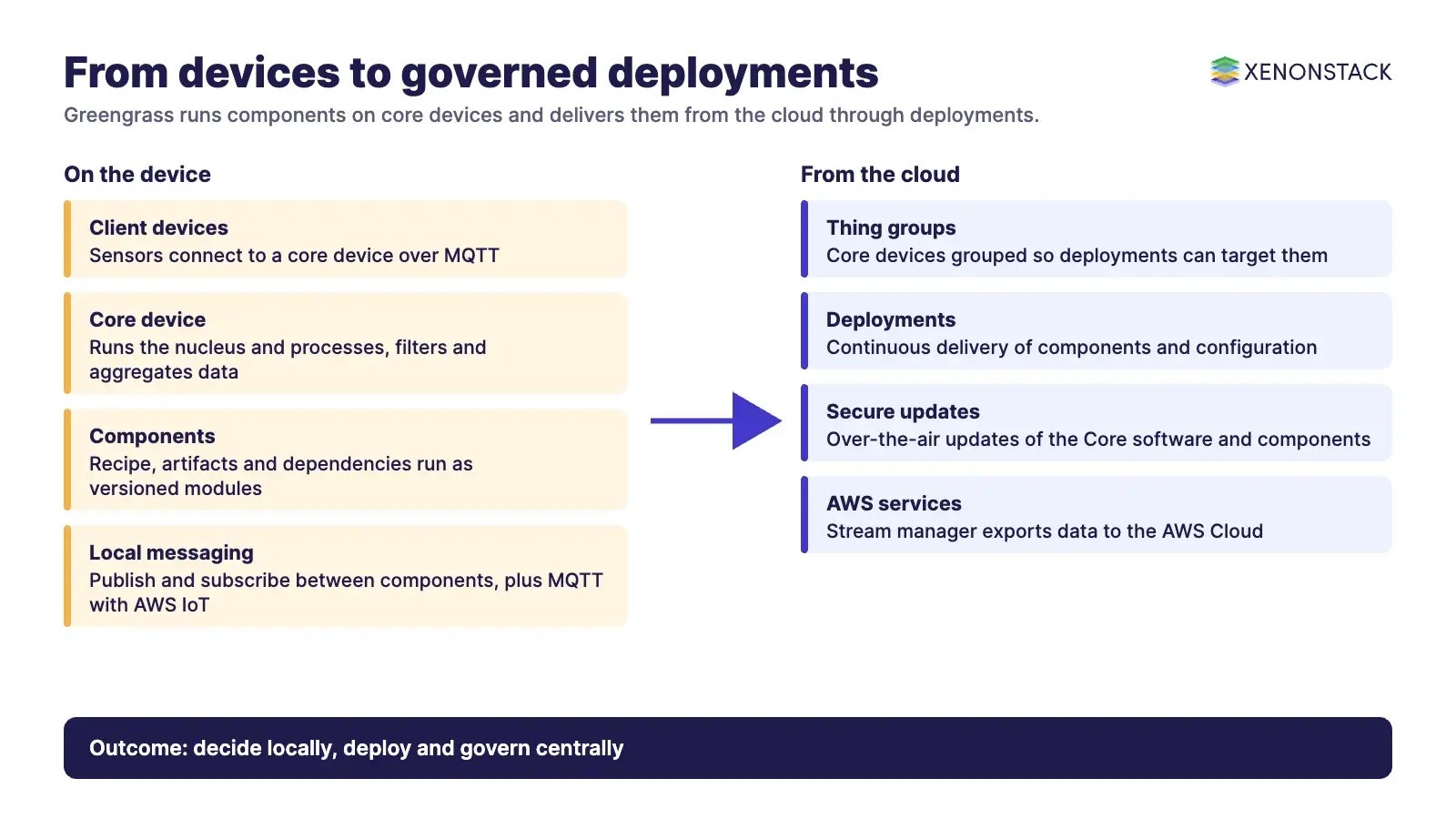
| Building block | What it does | Why it matters to architects |
|---|---|---|
| Nucleus | The minimum installation of the Core software. It manages deployments, orchestration and component lifecycles | The single agent you patch and monitor on every device |
| Component | A software module with a recipe (JSON or YAML), artifacts and dependencies | Versioned units you can roll out and reuse across fleets |
| Deployment | Sends components and configuration to one core device or a group of them. Deployments are continuous, so updates reach all targets | Fleet-wide change control, and cloning to new targets |
| Thing group | Group of core devices that a deployment can target | Segment fleets by site, customer or risk level |
| Local messaging | Local publish and subscribe between components, plus MQTT with AWS IoT | Components cooperate without a round trip to the cloud |
| Stream manager | Processes data streams on the device with automatic exports to the AWS Cloud | Buffer and forward high-volume telemetry |
| Secret manager | Encrypted local storage of secrets with controlled access by components | Keeps credentials out of component code |
The older Lambda-based model still has a place. AWS says Greengrass enables local execution of Lambda functions, Docker containers, native OS processes or custom runtimes, so existing functions can move to the edge with limited rework on the Java nucleus path.
One pattern we have seen in our own delivery work illustrates the architecture. A renewable-energy forecasting platform used Greengrass on site to collect equipment data and to send commands from the central platform back to the equipment, with the cloud side handling forecasting. The edge runtime handled collection and command delivery, and the platform handled the analytics.
Which Greengrass runtime should you choose?
As of the current developer guide, AWS provides two implementations of the device runtime. Choose by device resources and required features.
| Runtime | Strengths | Constraints | Fits when |
|---|---|---|---|
| Greengrass nucleus (Java) | Greatest portability across architectures and operating systems. Supports the local shadow service, client devices and connectors. Minimum 256 MB disk and 96 MB RAM on Linux | Depends on a Java Virtual Machine (JRE 8 or later), so a larger memory footprint | Gateways and industrial PCs with adequate resources, or migrations from V1 that need the full feature set |
| Greengrass nucleus lite (C) | Considerably smaller footprint | Needs separate distribution or compilation per architecture and operating system. No local shadow service, client devices or connectors. Lambda functions must be converted to generic components | Resource-constrained devices |
What are the benefits, and what are the trade-offs?
| Benefit | What the documentation supports | Trade-off to plan for |
|---|---|---|
| Local processing | Devices collect and analyse data close to where it is generated and react to local events | You now operate software on every site, so patching and observability become your job |
| Local machine learning | Run inference on locally generated data with cloud-trained models. AWS supplies sample components for DLR and TensorFlow Lite, and you can write custom components for any runtime | Models are delivered from Amazon S3 through deployments, and the sample components need 500 MB of local storage |
| Secure connectivity | Device authentication and authorisation, encrypted local secrets, and secure over-the-air updates of the Core software and components | Identity and certificate lifecycle still needs an owner |
| Fleet management | Continuous deployments to single devices or thing groups | A bad deployment reaches every target, so use staged rollout groups |
| Cost control | Pricing is per Core device that connects in a month, with devices connecting locally to a Core at no extra charge. Cloud services you export to, such as Amazon S3, are billed separately | Cost shifts to device hardware and operations, so model the whole estate, not only the AWS line |
Note that AWS describes local inference and local reaction to events but does not, on the pages we reviewed, spell out how every feature behaves when the cloud link is down. Test disconnected behaviour on your own device and component mix before you rely on it. For computer vision at the edge, our walkthrough of Greengrass with Amazon SageMaker Neo shows a model deployment in practice.
When does Greengrass fit, and when does it not?
| Situation | Fit | Reasoning |
|---|---|---|
| Fleets of gateways or industrial PCs that need local decisions and central deployment | Good | Components, thing groups and continuous deployments are designed for this |
| Devices that only need to publish telemetry to AWS IoT Core | Often unnecessary | Greengrass adds an edge runtime you must operate. A direct device connection may be enough |
| Very constrained microcontrollers | Check carefully | Confirm your hardware against the nucleus and nucleus lite platform requirements before committing |
| Estates still on Greengrass V1 | Migrate now | V1 support ended on 7 October 2026 |
| Mixed estates across several clouds and on-premises sites | Partial | Greengrass is an AWS edge runtime, so cross-cloud orchestration needs a layer above it |
For physical AI estates that span on-premises, cloud and hybrid sites, NexaStack is an agentic operating platform for physical AI that runs across on-premises, cloud and hybrid environments, which is relevant when Greengrass is one runtime among several.
How do you migrate from Greengrass V1 to V2?
V2 is a major release of the Core software, APIs and console. The V2 cloud service and Core software v2.x are not compatible with V1, and V1 over-the-air updates cannot upgrade core devices from V1 to V2, so each device needs a planned upgrade. AWS describes the workflow as four steps:
- Understand the differences between V1 and V2.
- Choose a runtime, nucleus or nucleus lite, based on device resources and the features you use.
- Set up a new test device and run your V1 applications on V2 before touching production.
- Upgrade V1 core devices to Core software v2.x and V2 components, repeating per device for a fleet.
On the nucleus path, Lambda functions can be imported as Lambda components with minimal code changes and V1 connectors are supported. On the nucleus lite path, Lambda functions must be converted to generic components and connectors are not supported. That single choice drives most of the effort.
What security, governance and cost controls should you put in place?
- Identity: each core device is an AWS IoT thing with device authentication and authorisation. Assign an owner for certificate rotation.
- Secrets: use the secret manager for local credentials instead of embedding them in component artifacts.
- Change control: use thing groups to stage deployments, and keep component recipes in version control.
- Updates: use secure over-the-air updates for the Core software and components, and decommission devices properly, because a device that still connects keeps being billed until the nucleus is stopped and the device is deleted from the service.
- Cost: billing is per Core device that connects in a month. AWS offers a free tier for the first three Core devices for one year. Check the current pricing page for your region before budgeting.
Once many edge agents act on devices, governance moves from the device to the decision. AgentGRC keeps autonomous agent actions inside policy, with the audit trail risk teams need, and AgentSRE describes a system of coordinated AI agents that find issues, identify their causes and resolve them, which suits fleet operations.
What is a sensible adoption sequence?
- Inventory devices and decide which need local decisions. Check Linux or Windows support and memory against the nucleus requirements.
- Pick the runtime per device class: nucleus for capable gateways, nucleus lite for constrained devices.
- Model each workload as a component with a recipe, artifacts and dependencies.
- Pilot on a test device and test disconnected behaviour.
- Roll out by thing group, starting with a low-risk site.
- Add monitoring, certificate rotation and a decommissioning step to operations.
Related reading: industrial IoT applications shows where edge runtimes earn their keep, and ElixirClaw is an agentic OS platform to build, orchestrate and govern AI agents and automation workflows while keeping humans in control.
To map one edge decision your agents should make, and the context and policy it depends on, book a Context Workshop. See what happens in the workshop.
What should you plan for in 2027?
Three points from this guide carry straight into your next planning cycle.
- Finish the move to V2. Choose the runtime per device class, with the Java nucleus for capable gateways and nucleus lite for constrained devices, and test each application on a new device before touching production.
- Stage every change. Use thing groups to roll deployments out by site, starting with a low risk one, because a bad deployment reaches every target.
- Run the estate, not just the install. Give certificate rotation, monitoring and decommissioning a named owner, and test disconnected behaviour on your own device and component mix.
Frequently asked questions
Is AWS IoT Greengrass open source?
Yes. AWS describes it as an open source edge runtime and cloud service, and the Greengrass nucleus repository carries the Apache-2.0 licence.
What happened to AWS IoT Greengrass V1?
AWS ended support for Version 1 on 7 October 2026. The V1 API operations and resources are no longer available, so remaining V1 devices need to move to V2.
What is the difference between the Greengrass nucleus and nucleus lite?
The nucleus is a Java runtime with the greatest portability but a larger memory footprint. Nucleus lite is a C implementation with a considerably smaller footprint, but it needs separate builds per target and does not support the local shadow service, client devices or connectors.
Can Greengrass run machine learning models at the edge?
Yes. AWS says you can run inference locally on locally generated data using cloud-trained models. It provides sample components for DLR and TensorFlow Lite, and custom components can use any runtime.
How is AWS IoT Greengrass priced?
AWS prices it per Core device that connects to the cloud in a month, and local connections to a Core carry no additional charge. Data sent on to other AWS services is billed under those services. Check the AWS pricing page for current rates.
Which operating systems does the Greengrass nucleus support?
AWS lists Linux on Armv7l, Armv8 and x86_64, and Windows on x86_64 including Windows 10, 11 and Server 2019 to 2025. AWS tests only the listed platforms.
Follow XenonStack on LinkedIn: XenonStack on LinkedIn for new guides on agentic AI, data and platform engineering.
Explore the XenonStack platform family: ElixirData · ElixirClaw · ElixirHub · NexaStack · MetaSecure · Neural AI · AgentGRC · AgentSRE · AgentAnalyst · AgentInstruct · AgentRAI · AgentScrum · AgentSearch · AgentForce · AI Aviator · SAIF Aviator · CohortIQ · XenonStack AI · XenonStack UAE