Key takeaway
- Plan Hyperledger Fabric on Kubernetes: current releases, peer storage, TLS, certificate authorities and the chaincode lifecycle for enterprise teams.
Hyperledger Fabric is a modular, enterprise-grade distributed ledger platform for permissioned networks, and Kubernetes is a common place to run its peers, orderers and chaincode. The decision for an enterprise is less about a single deployment script and more about identity, storage, TLS, chaincode lifecycle and who operates each organisation's nodes.
This guide replaces an older walk-through built on early Fabric components. It sets out what a current deployment plan needs. For the wider platform choice, read our guide to enterprise blockchain platforms first.
What has changed in Hyperledger Fabric?
Fabric is now hosted by LF Decentralized Trust, a project of the Linux Foundation, which also lists Fabric-x for regulated digital assets. Fabric v2.5 remains the long-term support (LTS) release for production users. Fabric v3.0 added a Byzantine Fault Tolerant ordering service built on the SmartBFT library, intended for cases where some orderer operators may be untrusted; it requires channel capability V3_0. The release notes list v3.1.5 as the latest version they cover. Sources: Hyperledger Fabric, what's new and LF Decentralized Trust, Fabric.
| Item | When it fits | Current status |
|---|---|---|
| Fabric v2.5 | Production networks that want long-term support | LTS release for production users |
| Fabric v3.x | Networks where orderer operators may be untrusted | v3.0 added SmartBFT ordering; v3.1.5 in release notes |
| Fabric-x | Regulated digital assets | Separate implementation listed by LF Decentralized Trust |
What does a Fabric deployment on Kubernetes need?
The Fabric documentation describes a peer as several containers: the peer itself, an optional CouchDB container, an optional chaincode launcher and the chaincode containers. It recommends a separate container for each chaincode, and says you must make your own allowances in your cluster for the containers the launcher creates. If you use Kubernetes, you must provision storage for the peer and map it into the pod, because peer storage grows with channels and transaction volume. Source: Fabric, planning a peer deployment. For the cluster itself, see our guides to Kubernetes architecture, Helm and Kubernetes operators.
| Concern | What the Fabric documentation says |
|---|---|
| TLS | A requirement for any production network; register peers with the organisation CA and its TLS CA |
| Identities | Use a Fabric CA; the cryptogen tool should never be used for production identities |
| State database | CouchDB supports JSON queries; embedded Goleveldb does not. All peers on a channel must use the same one |
| Storage | Monitor and extend as channels and transactions grow |
How does the chaincode lifecycle work now?
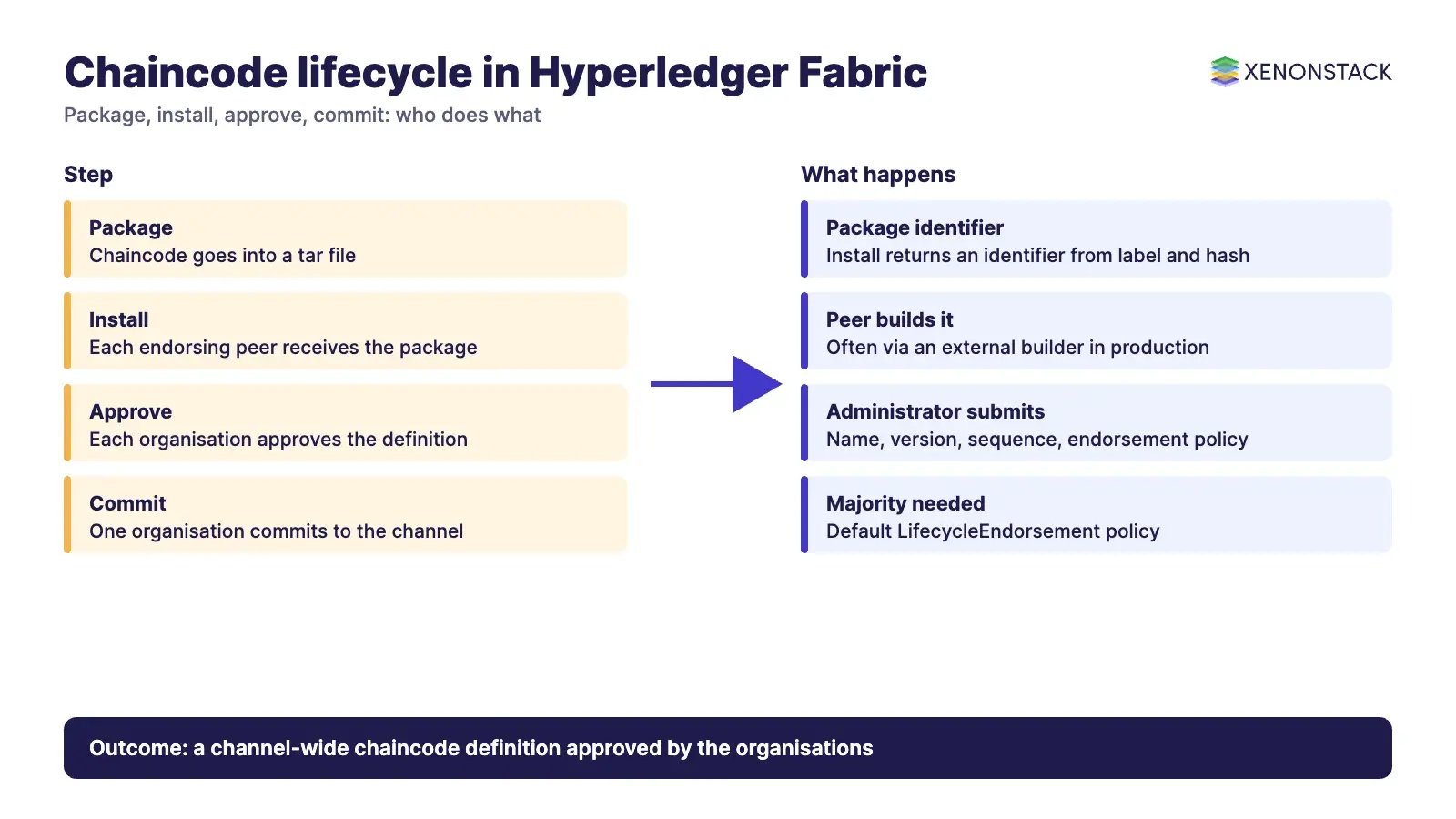
Chaincode is packaged as a tar file, installed on each endorsing peer, approved by each organisation (submitted by its administrator) and then committed to the channel by one organisation once enough have approved. The default LifecycleEndorsement policy requires a majority. Upgrades raise the sequence number by one. In production the documentation notes that an external chaincode builder is often used for more control of the build. Source: Fabric, chaincode lifecycle. This governed approval step suits Kubernetes delivery pipelines well, because each organisation approves its own definition. Where AI agents act on ledger data, ElixirData Context OS keeps governed context, versioned policy and decision traces in one decision layer above AI agents, and NexaStack is an agentic operating platform for physical AI that runs across on-premises, cloud and hybrid environments.
What is the adoption sequence, and when should you not use it?
- Agree the consortium, the channels and the governance of each organisation's nodes first.
- Stand up certificate authorities and TLS before any peer.
- Pilot one channel and one chaincode on a small cluster, with storage monitoring from day one.
- Choose v2.5 for long-term support, or v3.x if untrusted orderer operators are a requirement.
- Do not use a blockchain where a single trusted party already owns the data; a conventional database is simpler to run.
To map one ledger-related decision your agents should make, and the context and policy it depends on, book a Context Workshop. See what happens in the workshop. For background on the technology, see decentralised applications on blockchain technology.
Frequently asked questions
Which Fabric release should production use?
Fabric v2.5 remains the LTS release for production users. Fabric v3.0 added a BFT ordering service for cases where orderer operators may be untrusted.
Do I need TLS?
Yes. The Fabric documentation states TLS is a requirement for any production network.
How is chaincode deployed?
Package, install on peers, approve per organisation, then commit to the channel once enough organisations approve.
What storage does a peer need on Kubernetes?
You must provision storage for the peer and map it into the pod. It grows with channels and transaction volume, so monitor it.
Can I use cryptogen for production identities?
No. The documentation says cryptogen should never be used to generate identities in production; use a Fabric CA.
Follow XenonStack on LinkedIn: XenonStack on LinkedIn for new guides on agentic AI, data and platform engineering.
Ready to put AI agents to work? Explore ElixirClaw, the agentic OS platform to build, orchestrate and govern AI agents.
Explore the XenonStack platform family: ElixirData · ElixirClaw · ElixirHub · NexaStack · MetaSecure · Neural AI · AgentGRC · AgentSRE · AgentAnalyst · AgentInstruct · AgentRAI · AgentScrum · AgentSearch · AgentForce · AI Aviator · SAIF Aviator · CohortIQ · XenonStack AI · XenonStack UAE