Key takeaway
- Streaming analytics explained for leaders: what it is, how it differs from batch, when it pays off, the 2026 platform changes and how to adopt it safely.
Streaming analytics is the practice of analysing data continuously while it is still moving, event by event, instead of storing it first and querying it later. A payment, a sensor reading, a click or a log line is evaluated within milliseconds to seconds of arriving, so a business can act while the moment still matters: block the fraudulent card, reroute the shipment, page the on-call engineer.
It pays off when a decision loses value with every minute of delay and someone, or something, can act inside that window. When neither is true, scheduled batch analytics is usually cheaper and simpler. This guide is for leaders deciding whether streaming analytics is worth funding, where it earns its cost and what it takes to run it well.
It deliberately stays at the decision level. If you are choosing engines, see our streaming analytics tools buyer's guide; if you are designing the layers, see real-time analytics architecture; and for an AWS-specific build, see AWS Kinesis for real-time predictive analytics with agents.
What is streaming analytics, in plain terms?
Traditional analytics answers questions about data at rest: load yesterday's records into a warehouse, then query them. Streaming analytics turns that around. The question (a rule, a model, an aggregation) runs continuously, and each new event flows through it as it arrives. Four ideas carry most of the meaning:
- Events: small, time-stamped facts such as "card 123 was charged at 10:02:07".
- Windows: a stream never ends, so totals and averages are calculated over windows of time, for example "transactions per card in the last five minutes".
- State: the engine remembers what it has seen (running counts, the last known location) so it can compare each new event with recent history.
- Event time: events can arrive late or out of order, so good engines reason about when something happened, not only when it was received.
Apache Flink, one of the most widely used engines, describes itself as a "framework and distributed processing engine for stateful computations over unbounded and bounded data streams", and lists exactly-once state consistency and event-time processing among its correctness guarantees (Apache Flink). Those two properties are what separate dependable streaming analytics from a fast but fragile dashboard.
| Approach | What it does | When it fits | Typical freshness |
| Batch analytics | Stores data, then runs scheduled queries and reports | Finance close, trend reporting, model training, planning | Hours to a day |
| Micro-batch streaming | Processes the stream as a series of small batches | Near-real-time dashboards, enrichment, most alerting | About 100 milliseconds and up (Spark default engine) |
| Record-at-a-time streaming | Evaluates each event as it arrives, with state | Fraud scoring, safety alerts, live personalisation | Milliseconds |
The latency figures come from the Apache Spark documentation: its default micro-batch engine reaches "end-to-end latencies as low as 100 milliseconds" with exactly-once fault tolerance, and its newer Real-time Mode brings this down to "often a few milliseconds" (Spark Structured Streaming guide; Spark Real-time Mode).
When does streaming analytics pay off?
The useful question is not "can we process data in real time?" but "which decision gets worse if we make it later?". Streaming analytics earns its cost when three conditions hold together:
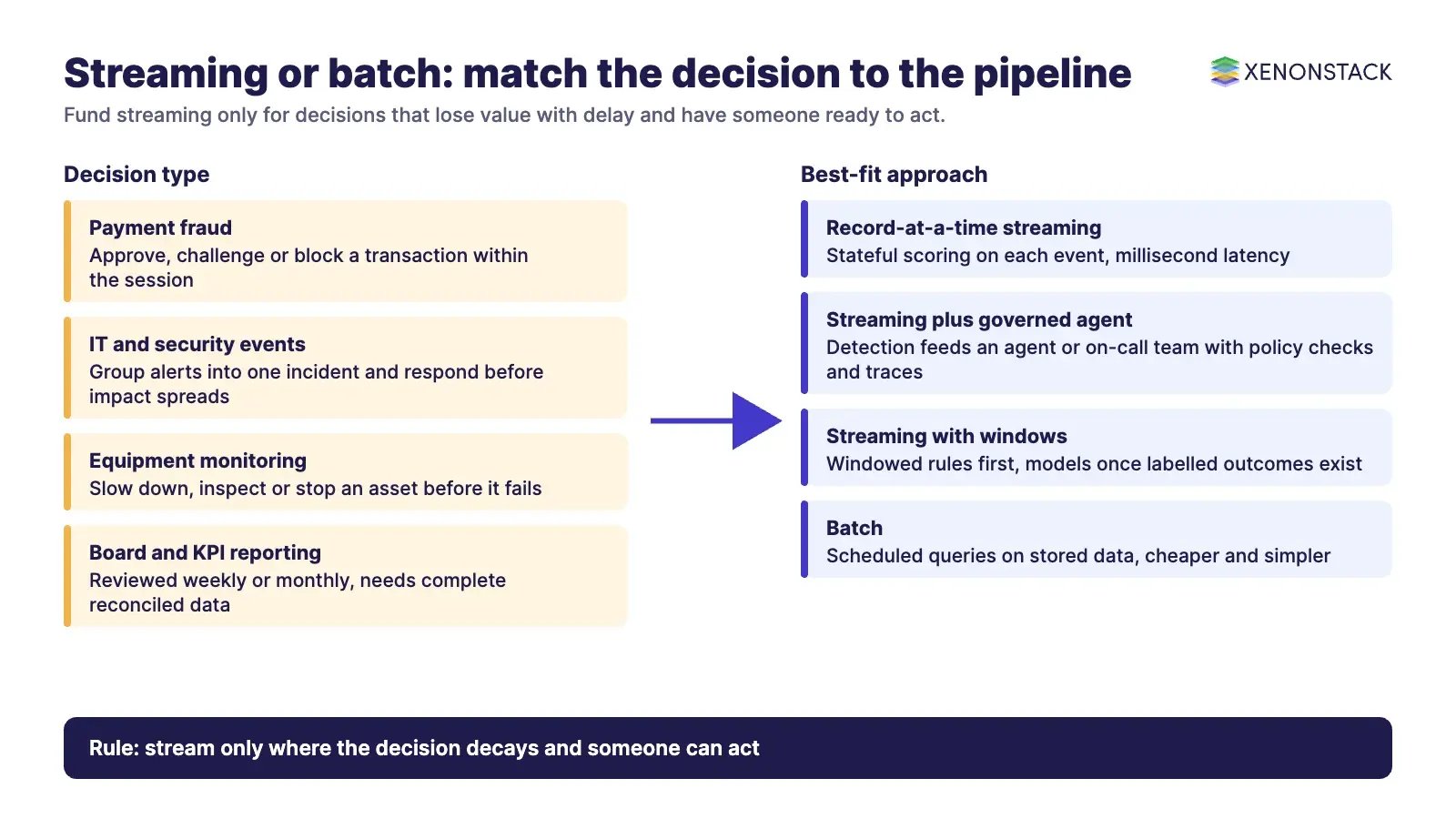
- The decision decays. The value of acting falls sharply after seconds or minutes: a card already charged, a machine already failed, a customer already gone.
- Someone can act in that window. A rule, a person on call or an AI agent with permission to act must be ready. An alert nobody can act on before morning is a batch job with extra cost.
- The signal lives in the sequence. The insight depends on patterns across recent events (a burst, a drift, a gap) rather than a single nightly total.
| Use case | Decision that decays | Who or what acts | Streaming fit |
| Payment and account fraud | Approve, challenge or block a transaction | Scoring rules or model, with analyst review of edge cases | Strong |
| IT operations and security events | Group alerts into one incident and respond | On-call engineer, SOC analyst or a governed agent | Strong |
| Equipment and IoT monitoring | Slow down, inspect or stop an asset | Operator or maintenance workflow | Strong where failure is costly |
| Live personalisation and pricing | Choose the offer for this session | Recommendation service | Good, if the session value justifies it |
| Inventory and logistics | Reroute stock or replan a delivery | Planner or replenishment system | Good for exceptions, batch for planning |
| Monthly KPI and board reporting | None within minutes | Leadership review | Poor: use batch |
When is batch the better answer?
Streaming adds always-on infrastructure, state to protect, and on-call responsibility. Choose batch, or a scheduled refresh every few minutes, when:
- the people who consume the result review it daily or weekly;
- the answer needs complete, reconciled data (financial close, regulatory reporting);
- the main value is historical insight or model training rather than an action;
- the team has no one to own a 24x7 pipeline yet.
Most enterprises end up with both. Streaming handles the small number of decisions that cannot wait; batch handles everything else from the same data, which is why the architecture choice between Lambda, Kappa and lakehouse patterns matters (covered in our real-time analytics architecture guide). Integrating streams with decision logic is also the idea behind continuous intelligence.
What has changed in streaming analytics by 2026?
The idea is not new, but the platform landscape has shifted in ways that affect cost and risk decisions:
| Change | What it means for leaders | Source |
| Kafka is the default event backbone; its site says more than 80% of Fortune 100 companies use it (vendor-published figure) | Skills and connectors are widely available; the log is reusable by many teams | kafka.apache.org |
| Flink 2.x is the current stable line (2.3 listed as stable) | Stateful, event-time processing is mature and well supported | flink.apache.org |
| Spark added Real-time Mode in 4.1.0 and stateful support in 4.3.0; Continuous Processing remains experimental | Teams already on Spark can reach millisecond latency without a second engine, with limits (Kafka source only) | Spark docs |
| AWS stopped new Kinesis Data Analytics for SQL applications on 15 October 2025 and began deleting them from 27 January 2026 | Managed services get retired; plan migration paths (AWS recommends Managed Service for Apache Flink) | AWS docs |
| Single-pipeline (Kappa) designs replace dual batch and speed layers where reprocessing can replay the log | One codebase instead of two lowers maintenance cost | Jay Kreps, O'Reilly, 2014 |
| AI agents increasingly act on streaming signals | The question moves from "how fast is the alert?" to "who is allowed to act, and is it recorded?" | See next section |
How do streaming analytics and AI agents work together?
Streaming analytics is good at noticing; it is not, on its own, good at deciding. Earlier platforms ended at an alert or a dashboard tile, and a person did the rest. In 2026 more of that last step is handed to AI agents: an agent receives the detected pattern, gathers context, proposes or takes an action and records why. That makes the stream the agent's senses, and it raises the bar on governance, because an action taken in seconds is hard to undo.
A practical split is: the streaming engine detects and enriches; a decision layer checks policy, authority and context; the agent or person acts; every step is traced. ElixirData Context OS is built for that decision layer: it keeps governed context, versioned policy and decision traces in one decision layer above AI agents. For business users who want to question streaming data directly, AgentAnalyst offers natural-language analysis and real-time insights across data sources. For operations teams, where log and metric streams are the most common first use case, AgentSRE applies agents to monitoring and incident management.
Video: how a stream of operational alerts is correlated into a single incident and handed to responders, the kind of decision streaming analytics exists to speed up.
What should leaders govern, secure and budget for?
| Risk | Control |
| Bad or late data triggers wrong actions | Schema contracts on event topics, validation at ingestion, event-time handling for late arrivals (see common data quality issues) |
| Sensitive data spreads to every consumer | Classify topics, mask or tokenise personal data before it enters shared streams, least-privilege access per topic |
| Automated actions without accountability | Policy checks before execution, human approval for high-impact actions, a decision trace for every action |
| Duplicate or lost events after failures | Choose engines and sinks with the delivery guarantee the decision needs (exactly-once vs at-least-once) and test failure recovery |
| Cost grows with always-on clusters and retention | Budget per use case: compute running 24x7, log retention for replay, and on-call staff; retire streams nobody acts on |
| Managed service retirement | Prefer open engines or portable APIs; track vendor deprecation notices |
How should an enterprise adopt streaming analytics?
- Pick one decaying decision. Name the decision, the owner, the action and how value falls with delay. If you cannot, stay with batch.
- Measure the current decision latency. How long from event to action today? This is your baseline and your business case.
- Put events on a durable log. Capture the relevant sources once, with schemas and owners, so later use cases reuse them (see our event-driven architecture guide).
- Start with rules, then models. Simple windowed rules prove the pipeline; add models once labelled outcomes exist (see feature engineering for real-time ML).
- Wire the action and the guardrails. Route detections to a person or agent with clear authority, policy checks and a trace.
- Operate it like a product. On-call, monitoring of lag and error rates, and a quarterly review of which streams still drive decisions.
- Scale by reuse. Add the next use case on the same event log and governance, not a new platform.
In our own data platform services work, which spans Hadoop, Spark and Flink estates, the projects that struggle are usually those that built a fast pipeline before agreeing who acts on its output. Steps 1 and 5 are where most of the value is decided.
What should leaders measure?
- Decision latency: time from event to action, not just processing lag.
- Action rate: share of detections that lead to an action; low rates signal noise.
- Precision of alerts: false positives cost attention and trust.
- Outcome value: losses avoided, downtime reduced or revenue protected per use case, against its running cost.
- Reliability: consumer lag, recovery time after failure, and data quality incidents.
Streaming analytics is worth it for the few decisions that cannot wait, run on shared event data with clear ownership and guardrails. For everything else, batch remains the sensible default. For the build itself, continue with the tools guide, the architecture guide and our data pipeline design guide.
To map one time-critical decision your streaming data should drive, and the context and policy it depends on, book a Context Workshop. See what happens in the workshop.
Frequently asked questions about streaming analytics
What is streaming analytics?
Streaming analytics analyses data continuously as events arrive, using windows and state, so results are available within milliseconds to seconds instead of after a scheduled batch run.
What is the difference between streaming analytics and batch analytics?
Batch analytics stores data first and queries it on a schedule, which suits reporting and planning. Streaming analytics runs the query continuously on data in motion, which suits decisions that lose value with delay.
When is streaming analytics worth the cost?
When a decision decays within seconds or minutes, someone or something can act in that window, and the signal depends on recent sequences of events. Fraud, operations incidents and equipment monitoring are common examples.
How fast is streaming analytics?
It depends on the engine and mode. Apache Spark's default micro-batch engine reaches end-to-end latencies as low as 100 milliseconds, and its Real-time Mode, added in Spark 4.1.0, targets a few milliseconds.
How do AI agents use streaming analytics?
The streaming engine detects and enriches events; an agent receives the detection, gathers context and proposes or takes an action within policy, with a decision trace recorded for each step.
Follow XenonStack on LinkedIn: XenonStack on LinkedIn for new guides on agentic AI, data and platform engineering.
Explore the XenonStack platform family: ElixirData · ElixirClaw · ElixirHub · NexaStack · MetaSecure · Neural AI · AgentGRC · AgentSRE · AgentAnalyst · AgentInstruct · AgentRAI · AgentScrum · AgentSearch · AgentForce · AI Aviator · SAIF Aviator · CohortIQ · XenonStack AI · XenonStack UAE