Key takeaway
- How agentic AI keeps an enterprise knowledge base accurate: retrieval, content upkeep, access control and governance, plus a decision table.
An agentic AI knowledge base is a knowledge base where autonomous agents do the upkeep and the retrieval: they classify and tag content, flag articles that have gone stale, answer questions from approved sources and route what they cannot answer to a person. A static knowledge base waits for someone to write, review and search it. An agentic one acts on a defined scope, under policy, and leaves a record of what it did.
For enterprise leaders the question is not whether agents can write articles. It is which knowledge tasks can be handed over safely, how answers stay tied to current, permitted sources, and how you prove it afterwards. This guide covers the architecture, a decision table, governance, trade-offs and an adoption sequence. It builds on our posts on agentic AI for data management and agentic AI for intelligent search.
Why does a static knowledge base fall short?
Most enterprise knowledge sits in several places at once: a CRM, a ticketing tool, cloud storage, a wiki and policy documents. Each has its own owner and update rhythm. The usual failure is not missing content but unmanaged content: duplicate articles, procedures that no longer match the product, and search that matches keywords rather than intent. Support agents then double-check answers, and employees fall back on asking colleagues.
Rule-based automation helps with routing and templates, but it cannot judge whether an article still reflects current policy. That judgement is the gap agents are meant to fill, provided a person stays accountable for what is published.
How does an agentic knowledge base work?
The retrieval pattern behind most agentic knowledge bases is agentic retrieval-augmented generation (agentic RAG). A 2025 survey on the subject, Agentic Retrieval-Augmented Generation: A Survey on Agentic RAG (arXiv:2501.09136, revised April 2026), describes it as embedding autonomous agents in the RAG pipeline, using reflection, planning, tool use and multi-agent collaboration to manage retrieval strategies, refine context and adjust workflows as they run.
In practice this means a layered design rather than one model answering every question:
- Ingestion and enrichment: agents read new and changed content, add metadata and semantic tags, and link related articles.
- Retrieval: a planner decides which sources to query, rewrites the question if the first pass is weak and checks that the retrieved passages support the answer.
- Permission layer: retrieval respects the same access rules as the source systems, so a user only sees what they are entitled to see.
- Action and escalation: agents draft or update articles, and anything outside their authority goes to a named reviewer.
- Trace: each answer and change records the sources used, so it can be audited.
ElixirData's AgentSearch is one example of this layer. Its own page describes context-aware search across enterprise knowledge, with one retrieval layer for documents, knowledge bases and mixed content, and retrieval that follows the same authority model as the rest of Context OS. The page publishes no benchmark or customer results for AgentSearch, so treat accuracy claims for any product, including ours, as something to test on your own content.
Which knowledge base tasks suit agents, and which do not?
| Task | When an agent fits | Keep a human in the loop when |
|---|---|---|
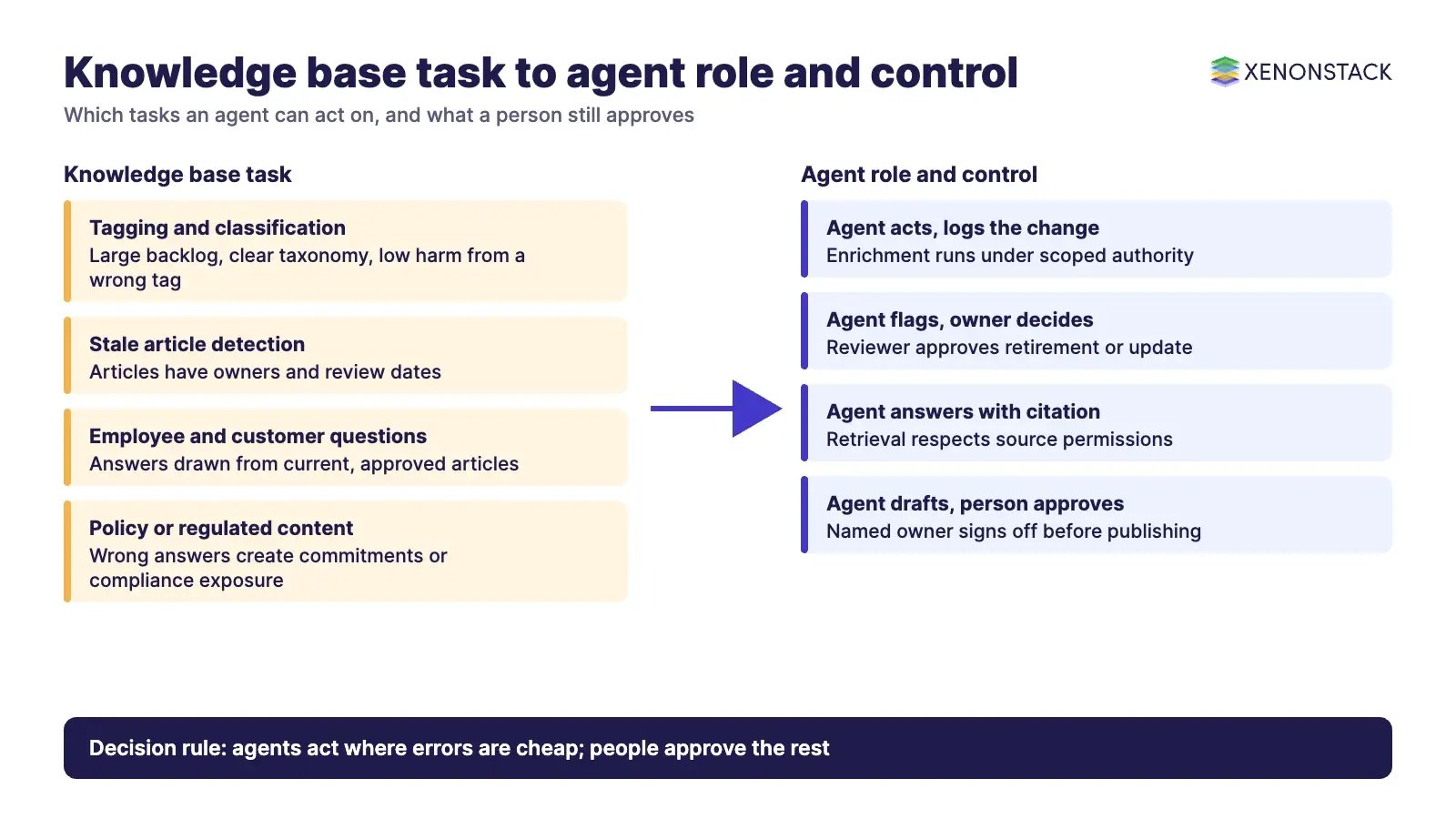
| Tagging and classification | Large backlog, clear taxonomy, low risk of harm from a wrong tag | The taxonomy drives legal or regulatory handling |
| Duplicate and stale article detection | Content has owners and review dates the agent can read | Retiring an article changes a customer commitment |
| Draft updates from product or policy changes | A source of truth exists and drafts go through review | Content is regulated, clinical or contractual |
| Answering employee questions | Sources are current, permissioned and cited in the answer | The answer authorises spend, access or an exception |
| Customer self-service | Answers are limited to published, approved articles | The query involves a complaint, a dispute or personal data |
| Multilingual versions | Source article is stable and translations are spot-checked | Terms of use, safety instructions or legal notices |
A useful test: if a wrong answer can be corrected silently and cheaply, an agent can usually act. If it creates a commitment, a compliance exposure or a safety issue, the agent should draft and a person should decide.
What changes for customer support and employees?
For support teams the main change is that the knowledge base answers in context. The agent reads the query, the customer's product or plan from the CRM where permitted, and the relevant articles, then returns an answer with its source. Unresolved queries become candidates for new articles, so the content improves from real demand rather than guesswork.
For employees the change is one question across many systems: policies, playbooks, project documents and previous tickets. The same governance applies, which is why the permission layer above matters more than the model choice. To see how this connects to analytics, read our guide to real-time analytics and the broader agentic AI system approach to decision intelligence.
How does it apply across industries?
| Industry | Typical knowledge base use | Main control to design in |
|---|---|---|
| Banking and financial services | Compliance manuals, product FAQs and policy changes, see agentic AI for financial services | Version control and an approver for every policy change |
| Healthcare | Clinical documentation, protocols and patient FAQs, see agentic AI in healthcare | Role-based serving of content and protection of patient data |
| Retail and e-commerce | Product guides, return policies and self-service, see AI-driven personalisation in retail | Single source for price and policy statements |
| Manufacturing | Equipment manuals, safety procedures and troubleshooting, see agentic AI for manufacturing | Safety content reviewed by a qualified owner before release |
| Telecom | Network documentation and engineer runbooks, see agentic process automation in telecom | Separate internal runbooks from customer-facing answers |
How do you secure and govern an agentic knowledge base?
Governance is where most enterprise pilots stall, so design it first. Two public references help. The NIST AI Risk Management Framework (version 1.0, January 2023) is a voluntary framework for building trustworthiness into AI design, use and evaluation, and NIST published a Generative AI Profile (NIST-AI-600-1) in July 2024 for risks specific to generative AI. The OWASP Top 10 for LLM Applications (2025) lists risks that map directly onto knowledge bases, including LLM02 Sensitive Information Disclosure, LLM06 Excessive Agency and LLM08 Vector and Embedding Weaknesses.
- Access control: enforce the source system's permissions at retrieval time, not only at login.
- Scoped authority: give each agent a list of actions it may take, and block or escalate the rest. This addresses excessive agency.
- Source citation: every answer shows the article or document it came from, so reviewers can check it.
- Audit trail: log retrievals, drafts, approvals and changes in a form compliance teams can read.
- Data handling: keep sensitive content out of the index unless the access model is proven, and test for leakage before launch.
Policy enforcement and audit evidence can be handled by a governance layer such as ElixirData's AgentGRC, which keeps autonomous agent actions inside policy with the audit trail risk teams need.
What are the costs and trade-offs?
Costs fall into four groups: content preparation, retrieval infrastructure and model usage, integration with source systems, and the review effort that governance requires. We do not quote benchmark savings here because published figures vary widely by content quality and ticket mix; measure your own baseline first.
- Content quality limits answer quality. Agents surface what exists. A weak knowledge base gets weaker answers, faster.
- Review load can shift rather than disappear. Drafting by agents moves effort from writing to approving.
- Latency and cost rise with multi-step retrieval. Planning and verification add calls, so reserve them for harder questions.
- Not every team needs agents. A small, stable, well-owned knowledge base may be served well by good search and a review calendar.
What is a sensible adoption sequence?
- Audit the content. Find owners, duplicates, stale articles and sources the agent must never read.
- Start read-only. Deploy retrieval with citations for one team and measure answer accuracy against a reviewed question set.
- Add enrichment. Let agents tag, link and flag stale articles, with a reviewer approving changes.
- Add drafting. Allow agents to draft updates from product or policy changes, still approved by a named owner.
- Widen scope and autonomy only where logs show stable accuracy and clean escalations.
The platform options include ElixirClaw, an agentic OS platform to build, orchestrate and govern AI agents and automation workflows while keeping humans in control, and ElixirData Context OS, which keeps governed context, versioned policy and decision traces in one decision layer above AI agents. For decision support built on top of the knowledge layer, see decision intelligence platforms.
How do you measure whether it is working?
- Share of questions answered with a correct, cited source, checked against a reviewed sample.
- Support ticket volume for topics covered by the knowledge base, and escalation rate.
- Average time to resolution for knowledge-related tickets.
- Age profile of articles: share reviewed within their review date.
- Number of access or leakage incidents found in testing and in production (the target is zero).
Agree these metrics and a baseline before launch, so the result is a measurement and not an opinion.
Where is knowledge base automation heading?
Three directions are visible. Agents will keep content current with less manual prompting, as long as approval remains in place. Knowledge bases will sit behind chat, voice and workflow tools rather than a separate portal. And organisations will connect knowledge across partners and suppliers, which makes access control and provenance more important, not less. We have not found a primary source with a reliable adoption forecast for this niche, so we leave out market-size claims.
To map one knowledge decision your agents should make, and the content, access rules and policy it depends on, book a Context Workshop. See what happens in the workshop.
Frequently asked questions
What is an agentic AI knowledge base?
It is a knowledge base where autonomous agents enrich content, flag stale articles, retrieve answers from approved sources and escalate what they cannot answer, under policy and with an audit trail.
How is it different from RAG?
Standard RAG retrieves passages and generates an answer in one pass. Agentic RAG embeds autonomous agents in the pipeline, using reflection, planning, tool use and multi-agent collaboration to manage retrieval and refine context, as described in the 2025 agentic RAG survey (arXiv:2501.09136).
Can agents publish articles without review?
They can, technically, but for regulated, clinical, contractual or safety content a named owner should approve. Start with drafting and review, and widen autonomy only when logs show stable accuracy.
How do you stop sensitive data leaking through search?
Enforce the source systems' permissions at retrieval time, keep sensitive content out of the index until the access model is tested, and test for leakage. OWASP lists Sensitive Information Disclosure (LLM02) and Vector and Embedding Weaknesses (LLM08) in its 2025 Top 10 for LLM Applications.
Which governance frameworks apply?
The NIST AI Risk Management Framework 1.0 (January 2023) and its Generative AI Profile (July 2024) are voluntary references. Which regulations apply depends on your sector and region, so confirm with your own compliance team.
Where should we start?
Audit your content, run read-only retrieval with citations for one team, measure accuracy on a reviewed question set, then add enrichment and drafting in stages.
Ready to put AI agents to work? Explore ElixirClaw, the agentic OS platform to build, orchestrate and govern AI agents.
Explore the XenonStack platform family: ElixirData · ElixirClaw · ElixirHub · NexaStack · MetaSecure · Neural AI · AgentGRC · AgentSRE · AgentAnalyst · AgentInstruct · AgentScrum · AgentSearch · AgentForce · AI Aviator · SAIF Aviator · CohortIQ · XenonStack AI · XenonStack UAE
Follow XenonStack on LinkedIn: XenonStack on LinkedIn for new guides on agentic AI, data and platform engineering.