Key takeaway
- AI-driven personalization in retail for leaders: how it works, GDPR and EU AI Act rules, agentic commerce protocols, and a safe adoption sequence.
AI-driven personalization in retail uses machine learning, and now generative AI and AI agents, to tailor what each shopper sees: products, search results, content, offers and service. It works from behaviour and context rather than broad demographic segments, and it runs across web, app, store and messaging channels. Done well it lifts conversion and loyalty; done carelessly it breaches privacy rules and erodes trust.
In 2026 two forces reshape it. Regulation is now specific: GDPR profiling rights, the EU AI Act's bans on manipulative AI and its transparency duties from 2 August 2026, and EU rules on personalised prices. At the same time, agentic commerce protocols let AI assistants shop on a customer's behalf, so personalisation increasingly happens inside someone else's agent. This guide covers the architecture, the rules, the agentic shift and an adoption path for retail leaders.
What is AI-driven personalization in retail?
Personalisation in retail means adapting the shopping experience to an individual rather than to a whole audience. Older approaches used rules and segments such as age, location or loyalty tier. Artificial intelligence lets retailers predict intent from live signals, rank products for each session and, with generative models, write or assemble content for that shopper. The table compares the three generations most retailers now run side by side.
| Approach | How it works | When it fits | Main limitation |
|---|---|---|---|
| Rules and segments | Marketers define segments and rules (for example, loyalty tier plus region) | Small catalogues, regulated offers, clear business rules | Static; misses intent within a session |
| Machine learning personalisation | Models rank products, search results and offers from behaviour, basket and context | Large catalogues and high traffic where ranking quality drives revenue | Needs clean event and product data, and testing discipline |
| Generative and agentic personalisation | Language models write product copy or answers; agents act for the shopper or the retailer | Conversational shopping, assisted service, long-tail product discovery | Transparency duties, hallucination risk and harder governance |
What has changed for retail personalisation since 2024?
Retail leaders reviewing an existing personalisation programme should check these regulatory and market changes first.
| Change | What it means | Status |
|---|---|---|
| EU AI Act Article 5 prohibitions | Article 5 bans AI that uses manipulative or deceptive techniques, or exploits vulnerabilities such as age or economic situation, to distort behaviour in ways that cause significant harm | Applies since 2 February 2025 |
| EU AI Act Article 50 transparency | Article 50 requires disclosure of AI interaction, machine-readable marking of synthetic content and disclosure of deepfakes | Applies from 2 August 2026. The Digital Omnibus on AI, provisionally agreed in May 2026, gives systems already on the market until 2 December 2026 for the marking duty, as reported by Gibson Dunn |
| Agentic Commerce Protocol (ACP) | Open standard co-developed by Stripe and OpenAI so AI agents and merchants can transact through one integration | Launched 29 September 2025 with Instant Checkout in ChatGPT. In March 2026 OpenAI scaled back Instant Checkout and focused ACP on merchant catalogue feeds and product discovery, as reported by MacRumors |
| Universal Commerce Protocol (UCP) | Open-source standard from Google, developed with Shopify, Etsy, Wayfair, Target and Walmart, for agent product discovery and checkout | Announced 11 January 2026; supports A2A, MCP and APIs, and is compatible with AP2 |
| Agent Payments Protocol (AP2) | Open protocol from Google that records what a shopper authorised through checkout and payment mandates | Published; standardisation to continue in FIDO Alliance working groups |
How does an AI personalization system work?
Most retail personalisation stacks follow the same pipeline, whether built in-house or assembled from vendors. Each stage needs a control as well as a capability.
| Stage | What happens | Control to build in |
|---|---|---|
| Collect | Events from web, app, store, service and loyalty systems; product catalogue and stock | Consent status travels with every event; collect only what a use case needs |
| Unify | Resolve identities into a customer profile; join product, price and inventory data | Separate known and anonymous profiles; honour deletion and objection requests |
| Understand | Models build features such as affinity, price sensitivity and intent; natural language processing reads reviews, queries and service chats | Exclude special category data and proxies for it; document features |
| Decide | Ranking, recommendation and next-best-offer models choose what to show; business rules apply margin and stock limits | Policy rules for pricing, vulnerable customers and regulated products |
| Deliver | Personalised pages, search, email, app and assisted service, increasingly through chat and agents | AI interaction disclosure; human hand-off for complaints and complex service |
| Learn | A/B tests and holdout groups measure lift; models retrain on outcomes | Monitor drift, bias and complaint signals, not only conversion |
The hard part is rarely the model. It is joining clean product, consent and behaviour data so that every decision can be explained, which is the same foundation described in our guide to AI in the data-driven enterprise.
Where does AI personalisation create value in retail?
McKinsey research published in November 2021 found that 71 percent of consumers expect personalised interactions and 76 percent are frustrated when they do not get them, and that personalisation most often drives a 10 to 15 percent revenue lift. Treat those as directional; your own holdout tests are the evidence that counts. The table shows where retailers usually start.
| Use case | When it fits | Data needed | Risk level |
|---|---|---|---|
| On-site and app recommendations | Large catalogue, repeat visits | Browsing, basket, product attributes | Low, if consent and opt-out work |
| Personalised search ranking | Many queries with poor results or long scrolls | Queries, clicks, stock, margin | Low |
| Next-best offer and promotions | Loyalty programmes, margin-aware discounting | Purchase history, price response, margin | Medium: fairness and pricing transparency |
| Generative product content and conversational shopping | Long-tail products, complex choices | Product data, reviews, policies | Medium: AI disclosure and accuracy |
| Assisted service and clienteling | High-value or advice-led categories | Orders, service history, preferences | Medium: human hand-off required |
| Personalised pricing | Rarely; most retailers personalise offers instead | Price sensitivity signals | High: EU disclosure duty and reputational risk |
Segment and cohort analysis is usually the first step before any model goes live. CohortIQ builds, compares and analyses customer cohorts, so teams can check which groups respond to a personalised experience before scaling it.
What do GDPR and the EU AI Act require of retail personalisation?
Personalisation is lawful in the EU, but it now sits under several overlapping rules. This summary is for planning, not legal advice; confirm the position for your markets with counsel.
| Rule | What it requires | What to do |
|---|---|---|
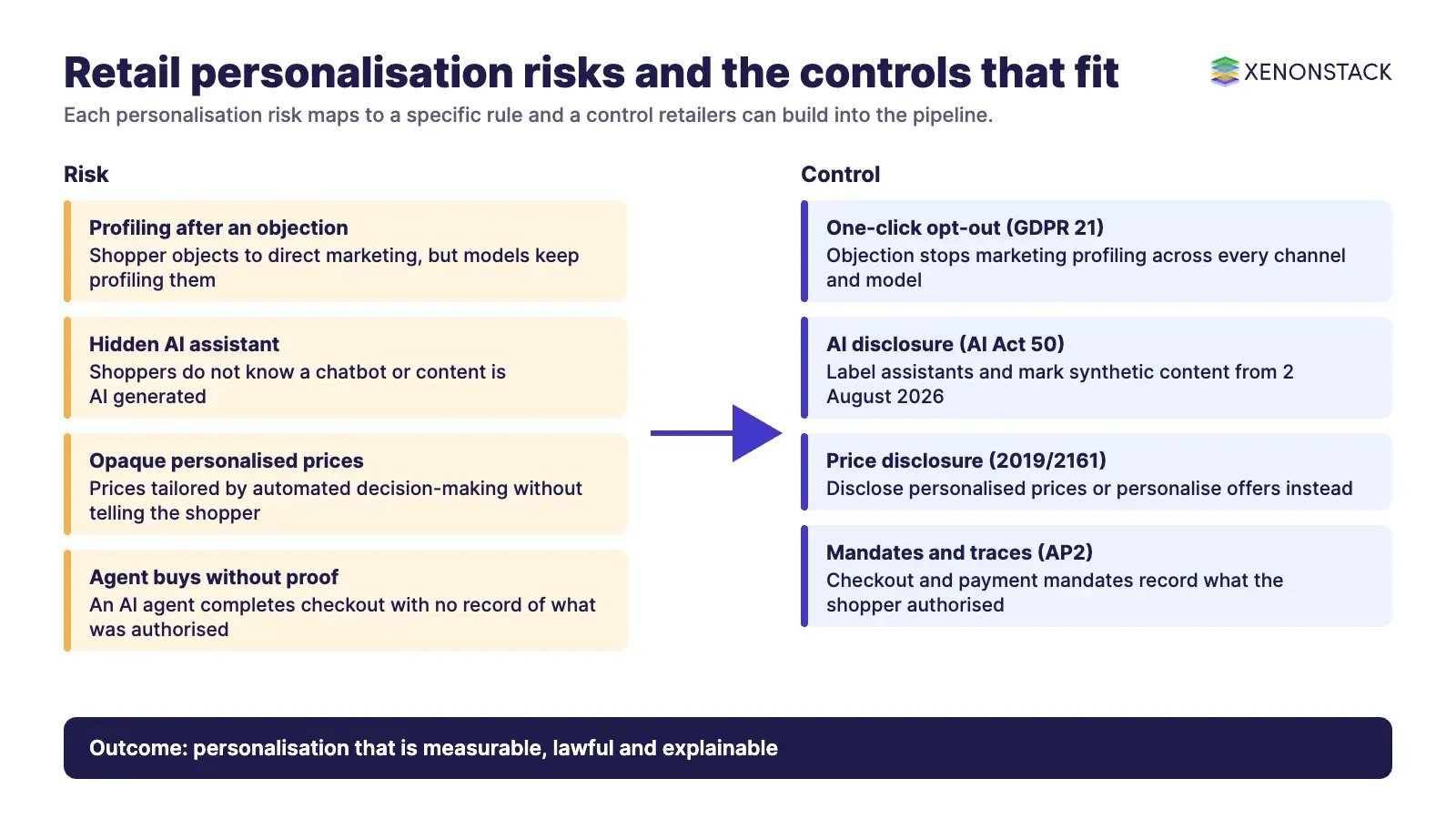
| GDPR Article 21(2) and (3) | A person can object at any time to processing for direct marketing, including profiling related to it; the data must then no longer be processed for that purpose | One-click opt-out that stops marketing profiling across every channel and model |
| GDPR Article 22 | A right not to be subject to a decision based solely on automated processing, including profiling, with legal or similarly significant effects | Keep humans in decisions such as credit, refunds or account blocks; recommendations alone are usually not in scope |
| EU AI Act Article 5(1)(a) and (b) | No manipulative or deceptive techniques, and no exploitation of vulnerabilities such as age, disability or economic situation, that cause significant harm | Ban dark patterns and pressure tactics in model objectives; review offers aimed at vulnerable groups |
| EU AI Act Article 50 | Tell people they are interacting with AI unless obvious; mark synthetic content in machine-readable form; disclose deepfakes | Label shopping assistants; watermark or tag AI-generated images and copy where required |
| Consumer Rights Directive, as amended by Directive (EU) 2019/2161 | Traders must inform consumers when a price is personalised on the basis of automated decision-making | Disclose personalised prices or keep list prices uniform and personalise offers |
| Digital Services Act Article 38 | Very large online platforms and search engines must offer at least one recommender option not based on profiling | Marketplaces at that scale need a non-profiled feed option |
Turning these rules into checks that run before a campaign or model goes live is where most teams struggle. The ElixirData Compliance Agent monitors operations in real time, identifying risks and recommending actions against policy.
How is agentic commerce changing personalisation?
Until recently a retailer controlled the whole personalised journey on its own site and app. Agentic commerce adds a new intermediary: an AI assistant that searches, compares and may buy on the shopper's behalf. Personalisation then depends on what the assistant knows about the shopper and what the retailer exposes to the assistant.
| Protocol | Who is behind it | What it standardises | What it means for retailers |
|---|---|---|---|
| Agentic Commerce Protocol (ACP) | Stripe and OpenAI | A shared language between businesses and AI agents; catalogue and promotion feeds; payment through a Shared Payment Token | Product data quality decides whether you are recommended inside ChatGPT shopping |
| Universal Commerce Protocol (UCP) | Google, with Shopify, Etsy, Wayfair, Target and Walmart; endorsed by Adyen, American Express, Mastercard, Stripe and Visa | Discovery and checkout; businesses publish capabilities in a JSON manifest | One integration can serve several AI surfaces over A2A, MCP or APIs |
| Agent Payments Protocol (AP2) | Google, with standardisation moving to FIDO Alliance working groups | Checkout and payment mandates that record what the shopper authorised | Evidence of consent for agent-initiated purchases, useful for disputes and fraud |
Three practical consequences follow. First, structured product data, stock and price accuracy become personalisation assets, because agents rank what they can read. Second, consent and authorisation must be provable for each agent action. Third, a retailer's own agents, for example a shopping assistant or a returns agent, need the same policy limits as human staff. ElixirData's Context OS keeps governed context, versioned policy and decision traces in one decision layer above AI agents, so those limits are applied and recorded consistently.
How should governance, security and cost be handled?
- Ownership: name one accountable owner per personalisation use case, with marketing, data, legal and security sign-off before launch.
- Data minimisation: keep feature lists short and documented; exclude special category data and obvious proxies.
- Explainability: log why a recommendation or offer was shown (model version, features, rules) so service teams can answer complaints.
- Security: treat customer profiles and model endpoints as sensitive assets; protect conversational assistants against prompt injection and data leakage.
- Measurement: keep a permanent holdout group so incremental revenue, not attributed revenue, funds the programme.
- Cost: generative and agent workloads bill per call; cache common answers, use smaller models for ranking and reserve large models for conversation.
What is a sensible adoption sequence?
- Fix the foundations: product data quality, event tracking, consent capture and identity resolution.
- Pick one surface with high traffic and clear measurement, usually recommendations or search, and run it against a holdout.
- Add margin, stock and policy rules so the model cannot recommend what you cannot sell profitably or lawfully.
- Extend to email, app and store clienteling once lift is proven.
- Introduce generative content and a conversational assistant with AI disclosure, content marking and human hand-off.
- Make your catalogue agent-ready (ACP and UCP feeds) and decide which actions your own agents may take without approval.
What are the trade-offs, and when should you not personalise?
| Situation | Better choice |
|---|---|
| Thin data or low traffic | Curated merchandising and popularity rankings until volume supports testing |
| Regulated or sensitive products (health, credit, age-restricted) | Rules-based experiences with legal review; avoid behavioural targeting |
| Shoppers who have objected to profiling | Non-personalised experience by default, as GDPR Article 21 requires for marketing |
| Price-sensitive categories | Uniform list prices with transparent, personalised offers |
| Service complaints and disputes | Human agents supported by AI, not fully automated decisions |
Over-personalisation also has a cost of its own: shoppers notice when a brand appears to know too much, and narrow recommendations can hide new ranges. Leave room for discovery and editorial choice.
To map one retail personalisation decision your agents should make, and the consent and policy it depends on, book a Context Workshop. See what happens in the workshop.
Frequently asked questions
What is AI-driven personalization in retail?
It is the use of machine learning, and increasingly generative AI and agents, to tailor product recommendations, search results, content, offers and service to each shopper based on behaviour and context, across web, app, store and messaging channels.
Does GDPR allow personalised recommendations?
Yes, with a lawful basis and transparency. Shoppers can object at any time to their data being used for direct marketing, including related profiling, under Article 21 GDPR, and the processing must then stop for that purpose. Article 22 adds a right not to be subject to solely automated decisions with legal or similarly significant effects.
What does the EU AI Act require for retail chatbots and AI content?
Article 50 applies from 2 August 2026. Shoppers must be told when they are interacting with an AI system unless it is obvious, providers of generative systems must mark synthetic output in machine-readable form, and deployers must disclose deepfakes. Article 5 has prohibited manipulative AI techniques and the exploitation of vulnerabilities that cause significant harm since 2 February 2025.
Can retailers show personalised prices?
In the EU, the Consumer Rights Directive, as amended by Directive (EU) 2019/2161, requires traders to inform consumers when a price has been personalised on the basis of automated decision-making. Many retailers therefore personalise offers and bundles rather than list prices.
What is agentic commerce?
Agentic commerce is shopping in which an AI agent discovers products, compares them and may complete checkout for a person. Open protocols such as the Agentic Commerce Protocol (Stripe and OpenAI), the Universal Commerce Protocol (Google with retail partners) and the Agent Payments Protocol define how agents, merchants and payment providers exchange catalogues, carts and payment authorisations.
Where should a retailer start with AI personalization?
Start with one high-traffic surface, such as on-site recommendations or search, with clean product and consent data, a control group and agreed success measures. Add channels, generative content and agent-ready product feeds only once measurement, consent handling and governance work.
Ready to put AI agents to work? Explore ElixirClaw, the agentic OS platform to build, orchestrate and govern AI agents.
Explore the XenonStack platform family: ElixirData · ElixirClaw · ElixirHub · NexaStack · MetaSecure · Neural AI · AgentGRC · AgentSRE · AgentAnalyst · AgentInstruct · AgentRAI · AgentScrum · AgentSearch · AgentForce · AI Aviator · SAIF Aviator · CohortIQ · XenonStack AI · XenonStack UAE