Key takeaway
- Edge computing for enterprise leaders: architecture, cloud and fog differences, use cases, security, adoption steps and a sourced 3 to 5 year outlook.
What is edge computing and when does it pay off?
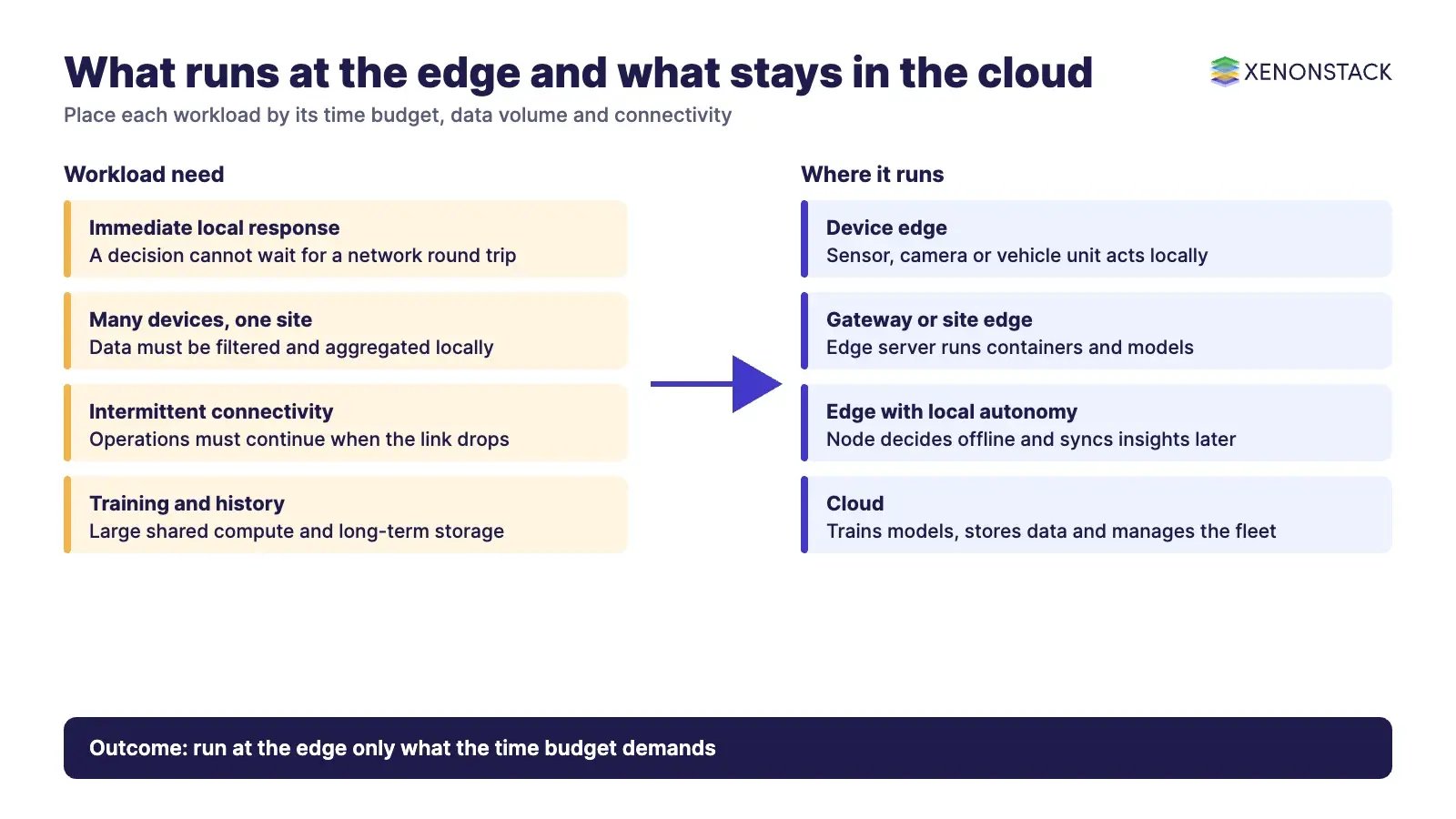
Edge computing processes data on or near the device, gateway or site that produces it, instead of sending everything to a distant cloud region first. It pays off when a decision must be made in the time a network round trip would take, when links are slow, costly or unreliable, or when data should stay on site. It does not replace the cloud. Most enterprises run a hybrid: the edge acts on live data, the cloud trains models, stores history and manages fleets.
This guide is for architects and platform leads who need to decide what to run at the edge, how to keep it secure and manageable, and what is likely to change by 2030. It links to our deeper pages on edge computing platforms, edge versus cloud and IoT edge analytics.
How does edge computing differ from cloud and fog computing?
The three terms describe where work happens. Cloud computing runs in centralised data centres. Edge computing runs at or beside the data source. NIST describes fog computing as a federated model that distributes applications, management and analytics across the network between devices and the cloud, to address the scale, device variety and latency problems of cloud-only IoT designs (NIST SP 500-325, March 2018). In practice many teams use edge and fog loosely for the same idea.
| Tier | Where it runs | Best at | Main limit |
|---|---|---|---|
| Device edge | Sensor, camera, controller or vehicle unit | Immediate local response, filtering raw data | Small compute and storage budget |
| Gateway or site edge | Gateway, edge server or on-premises rack at a plant, store or branch | Aggregating many devices, running models and containers locally | Needs remote patching and monitoring at every site |
| Network edge | Telecom or regional edge nodes (for example multi-access edge computing) | Low-latency services for many mobile or distributed users | Depends on operator footprint and standards |
| Cloud | Central regions | Training, long-term storage, fleet management, heavy analytics | Network round trip and egress cost |
What does an edge architecture contain?
A working edge design has four layers: edge devices that sense and act, a gateway or edge server that runs local workloads, a connectivity layer, and cloud services for management and analytics. Data is filtered, cleaned or scored at the edge, and only the useful output travels upstream.
Which components matter most?
- Devices and sensors: cameras, meters, controllers, vehicles and machines that generate data and take local action.
- Edge nodes and gateways: run containers, local inference and rules. Microsoft describes Azure IoT Edge as a runtime for containerised Linux workloads that supports offline decision-making and sending only insights to the cloud, according to its documentation.
- Management plane: deploys, updates and monitors workloads across many sites. This is where most edge projects succeed or fail; see platform engineering for edge computing and microservices deployment at the edge.
- Cloud tier: model training, long-term data, fleet policy and cross-site analytics.
Lifecycle dates matter in the design. Per Microsoft, Azure IoT Edge 1.5 LTS support was due to end on 10 November 2026, and 1.6 LTS is the current supported release (Microsoft Learn, read 12 November 2026). Check the support status of every runtime in your fleet.
Where does edge computing fit in the enterprise?
Choose edge for workloads where speed, bandwidth, privacy or continuity of operation decide the outcome. The table maps common cases to the page that goes deeper.
| Use case | Why the edge fits | Read next |
|---|---|---|
| Manufacturing and predictive maintenance | Machine data is high volume and a fault needs a local response | Edge AI in smart factories |
| Retail stores | Camera and sensor analytics should keep working when the link drops | Edge AI in retail operations |
| Connected and autonomous vehicles | Decisions happen on the vehicle; the cloud handles updates and fleet learning | Edge AI agents in automotive |
| IoT analytics at scale | Filter and score locally, send insights upstream | IoT edge analytics |
| Security monitoring | Anomalies near the device can be flagged before data is centralised | Design with a security operations centre in the loop |
| Healthcare and regulated data | Sensitive data can be processed on site, subject to the rules that apply to you | Take legal advice for each jurisdiction |
Physical AI and agents add a further pattern: models and agents that sense and act on local hardware. NexaStack is an agentic operating platform for physical AI that runs across on-premises, cloud and hybrid environments, according to its site. Where those agents take actions on behalf of the business, AgentGRC keeps autonomous agent actions inside policy, with the audit trail risk teams need.
What has changed in edge computing recently?
- Standards: ETSI announced a set of Multi-access Edge Computing (MEC) Phase 4 specifications and a white paper on 31 October 2025, aimed at integrating open source and standards for edge clouds (ETSI).
- Device growth: IoT Analytics estimated about 21.1 billion connected IoT devices at the end of 2025, up about 14% from 2024, and forecasts about 39 billion by 2030 (IoT Analytics, 28 October 2025).
- Spending: IDC projected global edge computing spending of nearly $261 billion in 2025, rising to about $380 billion in 2028 at a 13.8% compound annual growth rate, with augmented reality and AI the fastest-growing segments (IDC, 17 March 2025). Treat analyst forecasts as estimates.
- AI at the edge: local inference and agents are now a main reason to deploy edge nodes, which raises the bar for model updates, monitoring and policy at every site.
How do you secure and govern distributed edge infrastructure?
Keeping data local can reduce what travels across networks, but it moves risk to many physical locations. Plan for devices that can be touched, stolen or left unpatched, and for connectivity that is intermittent.
| Risk | Control to put in place |
|---|---|
| Physical tampering and stolen devices | Hardware-backed identity, encrypted storage and remote revocation |
| Unpatched runtimes and containers | Signed images, staged rollouts and tracked support dates for every runtime |
| Configuration drift across sites | Declarative, version-controlled configuration with a single management plane |
| Unclear accountability for local AI decisions | Versioned policy and decision records for agents that act at the edge |
| Regulatory exposure for connected products | Map obligations early. The EU Cyber Resilience Act entered into force on 10 December 2024; reporting obligations apply from 11 September 2026 and the main obligations from 11 December 2027 (European Commission) |
For decisions that agents take at the edge, ElixirData Context OS keeps governed context, versioned policy and decision traces in one decision layer above AI agents, according to its site. On cost, count hardware, site visits, connectivity and fleet operations as well as saved bandwidth, and compare total cost of ownership with a cloud-only design.
How should an enterprise adopt edge computing?
- Pick one workload where latency, bandwidth or offline operation is a measurable problem, not a general ambition.
- Decide what runs where: list the data, the decision and the time budget, then place each at device, site or cloud.
- Standardise the platform first: container runtime, deployment method and monitoring before the second site.
- Add security and governance from the start: identity, signed updates and an audit trail.
- Pilot at two or three sites, measure against the cloud-only baseline, then scale in waves.
When should you not use edge computing?
Keep the workload in the cloud when latency is not critical, data volumes are modest, the model needs large shared compute, or you cannot operate remote sites reliably. A central design is simpler to secure and cheaper to run. Edge adds hardware, logistics and operations, so it should earn its place with a clear measure.
What will change in edge computing over the next 3 to 5 years?
The sourced signals below point to wider deployment, more AI at the edge and tighter rules. They are forecasts and schedules, not guarantees.
| Signal | What the source says | Implication for 2029 to 2031 |
|---|---|---|
| Spending | IDC: nearly $261 billion in 2025, about $380 billion in 2028, 13.8% CAGR | Edge becomes a standard line in infrastructure budgets |
| Connected devices | IoT Analytics: about 21.1 billion end 2025, about 39 billion by 2030 | More endpoints to secure, update and observe |
| Edge standards | ETSI MEC Phase 4 specifications published 31 October 2025 | Clearer multi-vendor edge cloud interfaces |
| 5G-Advanced and 6G | 3GPP: Release 20 is the last 5G-Advanced release and the 6G study release; Release 21 holds the 6G specification work; ITU target for IMT-2030 technology proposals is early 2029, with full specifications by mid-2030 at the latest | Networks with built-in AI and sensing are more likely from the early 2030s, so design for what 5G offers now |
| Regulation | EU Cyber Resilience Act: main obligations from 11 December 2027 | Security and update duties for connected products become a procurement requirement |
Taken together, expect edge and cloud to be managed as one estate, with AI inference and agents running locally under central policy. Edge computing with 5G remains the near-term network path. Sources: 3GPP Release 20 page, read 12 November 2026.
Which video explains the impact of edge computing on IoT?
Video: the impact of edge computing on IoT.
To map one edge decision your agents should make, and the context and policy it depends on, book a Context Workshop. See what happens in the workshop.
What should you plan for in 2027?
Two dated milestones matter for edge estates going into 2027.
- 11 December 2027: the main obligations of the EU Cyber Resilience Act apply, so connected products need security and update processes mapped well before then (European Commission).
- March 2027: the 3GPP Release 21 timeline lists the 5G Advanced and 6G package approval and Stage 1 freeze for this month (3GPP). Later freezes are dated December 2028 and March 2029, so design for what 5G offers now.
Use the time to track runtime support dates for every device and to name an owner for patching at each site.
Frequently asked questions about edge computing
What is edge computing in simple terms?
It is processing data at or near the source, such as a sensor, gateway or on-site server, instead of sending it all to a central cloud first. The cloud still handles training, storage and management.
What is the difference between edge and cloud computing?
Cloud computing runs in central data centres, while edge runs close to the data source. Edge suits time-critical, bandwidth-heavy or offline-capable work; cloud suits training, history and fleet management. Most enterprises use both.
How is fog computing different from edge computing?
NIST describes fog computing as a federated model that spreads applications, management and analytics across the network between devices and the cloud. Many teams use the terms loosely for the same idea.
What are the main risks of edge computing?
Physical tampering, unpatched runtimes, configuration drift across sites and unclear accountability for local AI decisions. Signed updates, hardware-backed identity and a single management plane reduce them.
When should an enterprise avoid edge computing?
When latency is not critical, data volumes are small, or remote sites cannot be operated reliably. A central design is simpler to secure and cheaper to run.
What will change in edge computing over the next 3 to 5 years?
IDC projects spending of about $380 billion in 2028, IoT Analytics forecasts about 39 billion connected devices by 2030, and 3GPP places 6G specification work in Release 21 with full IMT-2030 specifications by mid-2030 at the latest. Expect more local AI and stricter product security rules.
Follow XenonStack on LinkedIn: XenonStack on LinkedIn for new guides on agentic AI, data and platform engineering.
Ready to put AI agents to work? Explore ElixirClaw, the agentic OS platform to build, orchestrate and govern AI agents.
Explore the XenonStack platform family: ElixirData · ElixirClaw · ElixirHub · NexaStack · MetaSecure · Neural AI · AgentGRC · AgentSRE · AgentAnalyst · AgentInstruct · AgentRAI · AgentScrum · AgentSearch · AgentForce · AI Aviator · SAIF Aviator · CohortIQ · XenonStack AI · XenonStack UAE