Key takeaway
- How AI agents evolved from expert systems and reinforcement learning to LLM agents and multi-agent systems, and what comes next for enterprise leaders.
AI agents have evolved from hand-written rule systems, through learning agents trained by reinforcement, to today's agents built on large language models that plan, call tools and work together. Each stage widened what an agent could handle on its own. The current stage, enterprise agentic AI, is less limited by model ability than by governance: deciding what agents may do, with which data, under whose approval.
This guide traces that evolution, explains what changed at each step, and sets out what leaders should put in place before agents take on real decisions.
What is an AI agent?
In the classic textbook definition by Stuart Russell and Peter Norvig, an agent is anything that perceives its environment through sensors and acts on it through actuators. A modern AI agent fits the same pattern: it reads data or events, reasons about a goal, uses tools such as APIs and databases, and takes an action, often over several steps without a person directing each one.
For a fuller introduction, see our guide to what AI agents are and how they work.
How have AI agents evolved?
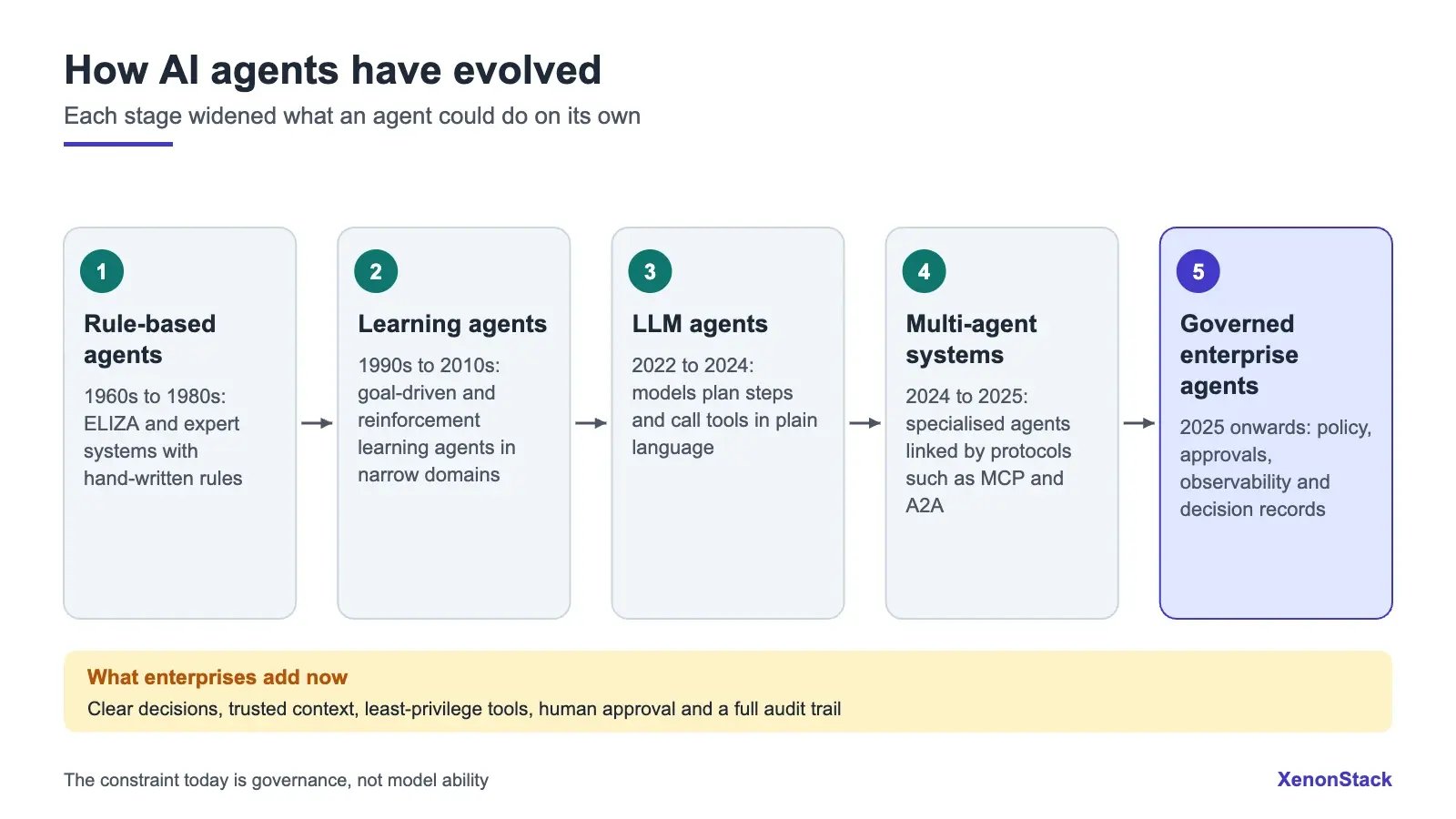
| Stage | Examples | What changed | Limitation |
|---|---|---|---|
| Rule-based agents (1960s to 1980s) | ELIZA, expert systems such as MYCIN | Knowledge written as explicit if-then rules | Brittle; could not handle situations outside the rules |
| Intelligent and learning agents (1990s to 2010s) | Belief-desire-intention agents, reinforcement learning agents such as AlphaGo | Agents learned behaviour from feedback and goals | Narrow; each agent mastered one environment |
| LLM agents (2022 to 2024) | ReAct-style reasoning and acting, early autonomous agent projects, generative agents | Language models planned steps and called tools in plain language | Unreliable over long tasks; hard to test and control |
| Multi-agent systems and protocols (2024 to 2025) | Model Context Protocol, Agent2Agent protocol, orchestration frameworks | Standard ways to connect agents to tools and to each other | Integration sprawl and unclear accountability |
| Governed enterprise agents (2025 onwards) | Agent platforms with policy, approvals, observability and decision records | Agents run inside business controls, with humans approving high-risk steps | Requires decision context and governance most firms do not yet have |
What made LLM-based agents different?
Earlier agents needed an environment designed for them. Language-model agents can read the same documents, tickets and screens that people use, and decide which tool to call next. Research such as the ReAct pattern showed that interleaving reasoning steps with actions improved results, and frameworks made the loop easy to build. Our guide to large language models and AI agents explains the mechanics.
The same flexibility created new risks: agents can be misled by instructions hidden in content, can act with more permissions than they need, and can fail quietly over long tasks. See agentic AI security.
What are multi-agent systems?
A multi-agent system splits work across specialised agents, for example one that gathers evidence, one that analyses it and one that drafts a recommendation, coordinated by an orchestrator. Benefits include clearer responsibilities, easier testing of each agent and parallel work. Challenges include coordination failures, duplicated effort, cost and the difficulty of tracing which agent made which decision.
- Characteristics: autonomy, specialisation, communication through shared protocols and a shared goal.
- Typical uses: IT incident response, financial operations, supply chain planning, customer service and software delivery.
- Key control: a single record that links each action back to the agent, data and policy behind it.
Where are AI agents heading next?
Analyst forecasts point to rapid adoption and a hard filter on value. Gartner has predicted that at least 15% of day-to-day work decisions will be made autonomously through agentic AI by 2028, and, in the same June 2025 release, that over 40% of agentic AI projects will be cancelled by the end of 2027 because of cost, unclear value or weak risk controls.
The organisations that succeed will treat agents as part of their decision infrastructure, not as standalone chatbots: clear decisions, trusted context, policy enforced at run time and a full audit trail.
Where does XenonStack fit in the agent evolution?
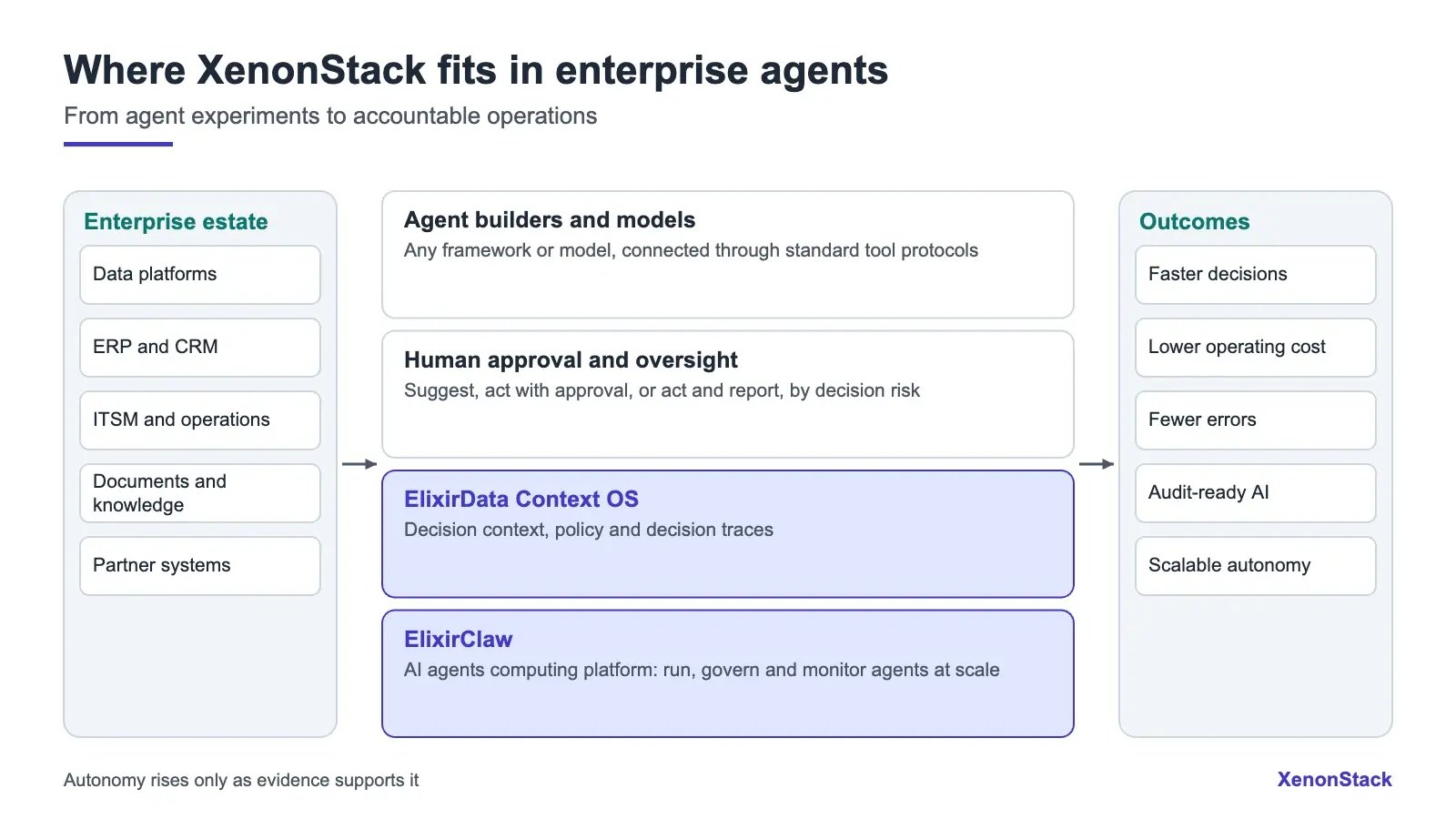
ElixirClaw is XenonStack's AI agents computing platform for running enterprise agents with policy, approvals and monitoring. ElixirData Context OS supplies the decision context each agent needs and records a decision trace for every action. Together they move agents from experiments to accountable operations. For building and testing your own, see custom AI agents and user acceptance testing for AI agents.
How should leaders prepare for the next stage?
- List the decisions you want agents to support, and rank them by value and risk.
- Decide the level of autonomy for each: suggest, act with approval, or act and report.
- Connect agents to governed data and tools with least-privilege access.
- Record every agent decision with its inputs, context and policy.
- Review outcomes regularly and raise autonomy only when evidence supports it.
To map one decision your agents should make, and the context and policy it depends on, book a Context Workshop. See what happens in the workshop.
Frequently asked questions
What was the first AI agent?
Early examples include ELIZA, a 1960s conversational program, and 1970s expert systems such as MYCIN, which applied hand-written rules to diagnose infections. They acted within narrow, rule-defined limits.
What is the difference between an AI assistant and an AI agent?
An assistant responds to a person's prompt and leaves the action to them. An agent pursues a goal over several steps, chooses tools and can take actions in other systems, within the permissions it has been given.
What is agentic AI?
Agentic AI describes systems in which AI agents plan and carry out multi-step tasks with some autonomy, using tools and data, and often working with other agents and with people who approve higher-risk actions.
Why do many agentic AI projects fail?
Common causes are unclear business value, rising costs and weak risk controls. Gartner expects over 40% of agentic AI projects to be cancelled by the end of 2027 for these reasons.
How do you govern autonomous AI agents?
Define which decisions each agent may make, give it least-privilege access, require human approval for high-risk actions, monitor its behaviour and keep a decision record that links each action to its data, context and policy.
Follow XenonStack on LinkedIn: XenonStack on LinkedIn for new guides on agentic AI, data and platform engineering.
Explore the XenonStack platform family: ElixirData · ElixirClaw · ElixirHub · NexaStack · MetaSecure · Neural AI · AgentGRC · AgentSRE · AgentAnalyst · AgentInstruct · AgentRAI · AgentScrum · AgentSearch · AgentForce · AI Aviator · SAIF Aviator · CohortIQ · XenonStack AI · XenonStack UAE