Key takeaway
- Where AI agents fit in user acceptance testing: tasks to hand over, tasks that stay with business users, OWASP and NIST controls and a staged rollout.
User acceptance testing (UAT) is the final check that software works for the people who will use it, and it is normally performed by the intended audience before release (TechTarget). AI agents can take over the preparation and repetition around that check, such as drafting scenarios from user stories and replaying them in a test environment, but the decision to accept the software stays with business users. For the process, roles and entry and exit criteria, see our guide to user acceptance testing; this post covers only what changes when agents take part.
Agentic AI means systems that plan and act toward a goal rather than follow a fixed script. In UAT that makes agents useful for scenario preparation, execution and evidence gathering, and risky when given broad access to a test environment. For CIOs, heads of QA and delivery leads, the question is not whether to use agents but which UAT tasks to hand them, which controls to put around them and where a person must sign off.
What does an AI agent change in user acceptance testing?
Traditional UAT depends on business users working through scenarios by hand, which is slow to prepare and hard to repeat. An agent changes the preparation and repetition, not the ownership. It can read requirements, user stories and notes, propose scenarios in plain language, run them against an application and report what happened with screenshots and logs. It can also adapt a step when a screen changes, which a fixed script cannot. The business user still judges whether the behaviour meets the business need.
This is also where UAT differs from other agentic testing. Unit, regression and API tests have objective pass or fail conditions that an agent can check alone. Acceptance asks whether the software is fit for the business purpose, which depends on judgement. For the wider engineering view, see agentic software testing and agentic process automation testing.
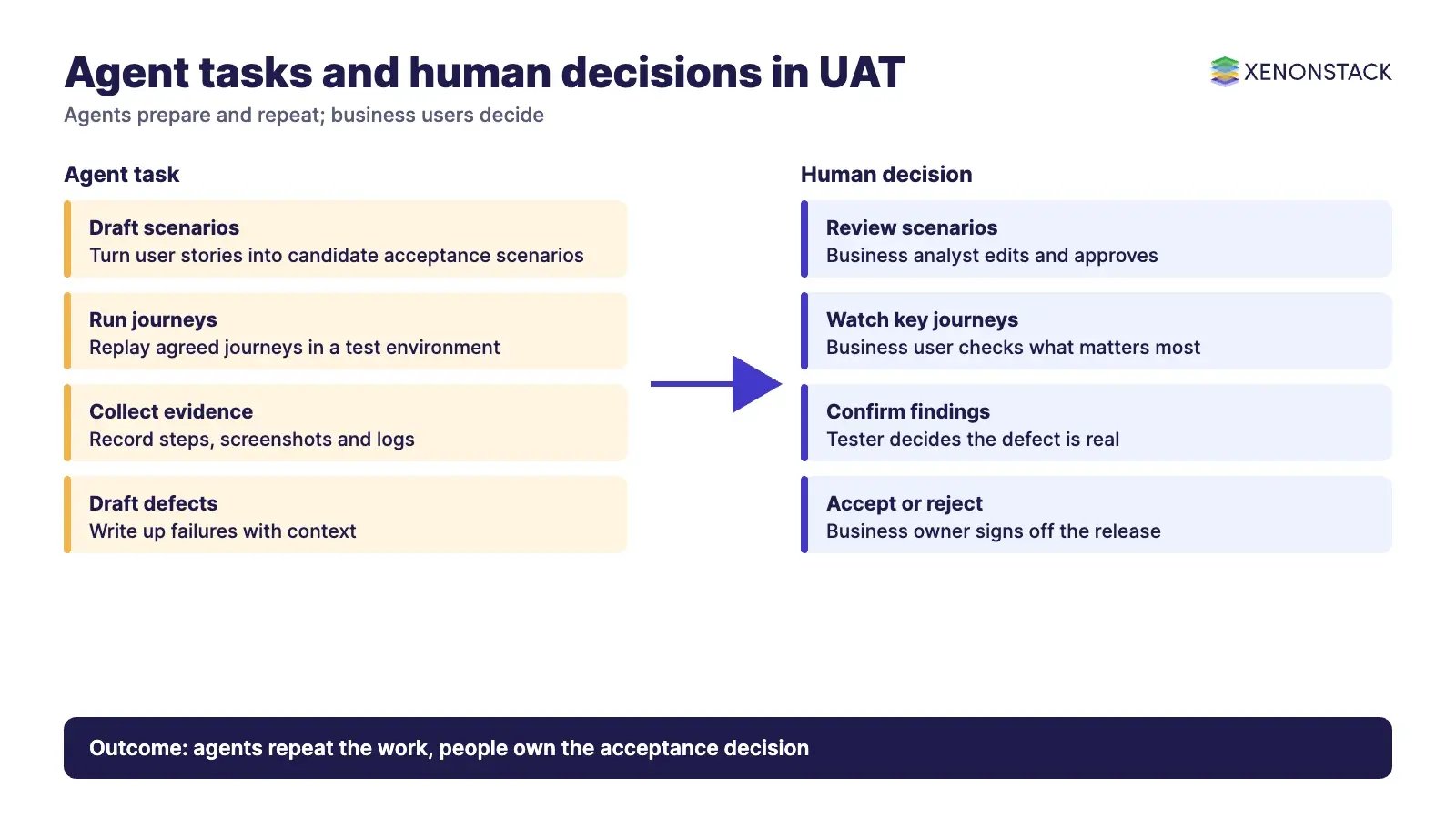
Which UAT activities can agents take on, and which stay with people?
| UAT activity | What an agent can do | Who decides | Fit |
|---|---|---|---|
| Scenario drafting | Turn user stories and requirement documents into candidate acceptance scenarios, using language models and natural language processing | Business analyst reviews and edits | Good, with review |
| Test data and environment set-up | Prepare data and walk through set-up steps in a non-production environment | Test lead approves data and scope | Good, with least-privilege access |
| Scenario execution | Replay agreed journeys across browsers and roles, and try variations | Business user watches key journeys | Good for repeatable journeys |
| Evidence and defect reports | Capture screenshots, logs and steps, and draft a defect with context | Tester confirms the defect is real | Good |
| Usability and fit-for-purpose judgement | Flag oddities only | Business user | Keep with people |
| Accept or reject the release | Summarise results and open items | Business owner and release authority | Keep with people |
How does an agent-assisted UAT cycle run?
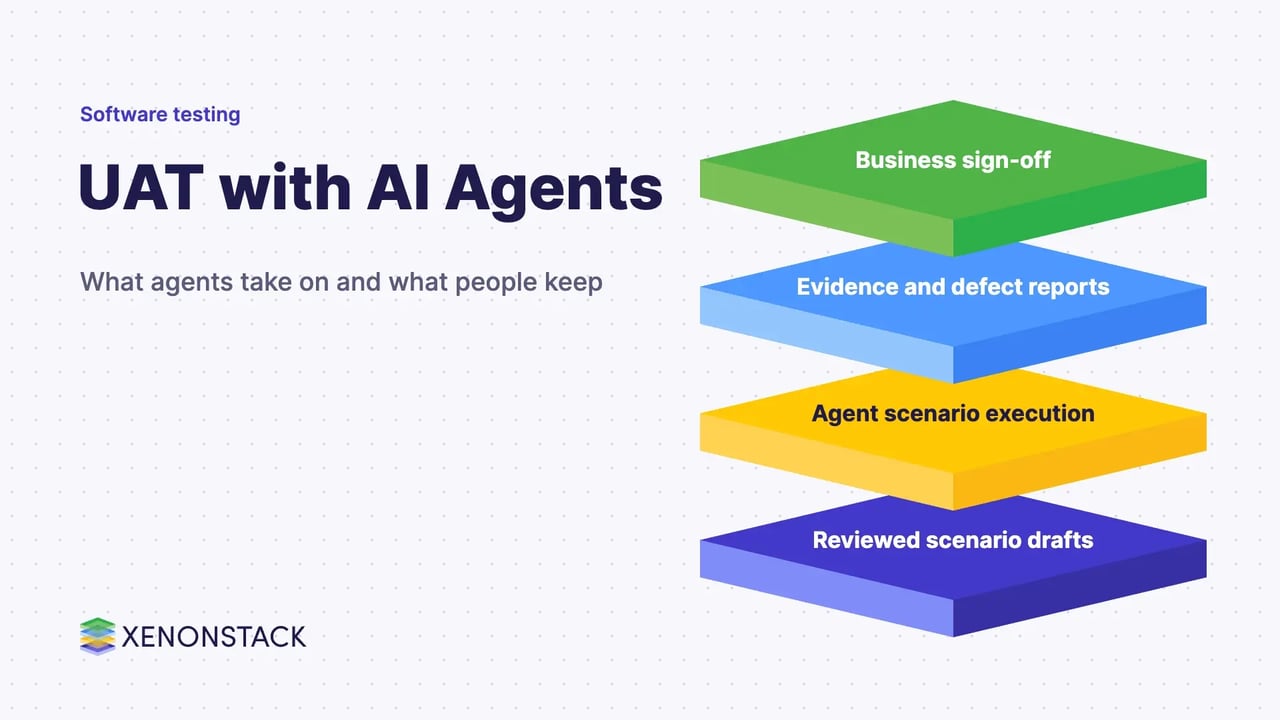
A workable cycle has five steps. Each ends with a person, which keeps the agent useful without making it the authority.
- Agree the scope. The business owner lists the journeys and acceptance criteria in plain language.
- Draft scenarios. The agent proposes scenarios from stories and criteria, with each one traced to a requirement. A business analyst reviews them.
- Run in a test environment. The agent executes approved scenarios with a dedicated test account and no access to production data.
- Collect evidence. Every step, screenshot and log line is recorded so a reviewer can replay what the agent did.
- Decide. Business users review the evidence, try the journeys that matter most themselves, and record accept, reject or accept with conditions.
What do the official testing tools provide today?
Playwright, the browser testing framework, documents three built-in test agents. According to its documentation, the planner explores the app and produces a Markdown test plan, the generator turns that plan into Playwright test files, and the healer runs the suite and repairs failing tests. The same page notes that the planner needs a seed test, that generated tests may contain initial errors, and that the healer may skip a test if it judges the functionality to be broken. (Playwright, Test Agents, read 13 November 2026.) That last point matters for UAT: a skipped test is a finding for a person, not a pass.
These tools produce automated tests that a team can reuse in regression. They do not replace the acceptance step, and the Playwright page does not claim they do.
What are the governance, security and cost considerations?
An agent that clicks through an application holds credentials and takes actions, so treat it as a system with access, not as a tool. OWASP describes Excessive Agency as the vulnerability that lets damaging actions happen when a model produces unexpected, ambiguous or manipulated output, and names three root causes: excessive functionality, excessive permissions and excessive autonomy. Its listed mitigations include minimising extensions and their permissions, avoiding open-ended tools such as shell or URL access, requiring user approval for high-impact actions and enforcing authorisation in downstream systems rather than relying on the model (OWASP LLM06:2025, read 13 November 2026).
| Concern | Control to put in place |
|---|---|
| Access | Dedicated test accounts, least privilege, no production data, no open-ended shell or URL tools |
| Traceability | Log each agent action and tie each scenario to a requirement |
| Review | A person approves generated plans and reviews results before sign-off |
| Risk management | Use a recognised framework: the NIST AI Risk Management Framework is voluntary and was released on 26 January 2023, and NIST published a Generative AI Profile on 26 July 2024 (NIST, read 13 November 2026) |
| Cost | Count model usage, environment time and reviewer time together; measure against your own UAT cycle before scaling |
| Regulated sectors | Check your regulator's rules on testing evidence and personal data before pointing an agent at realistic data |
Governance needs its own tooling. AgentGRC keeps autonomous agent actions inside policy, with the audit trail risk teams need, and ElixirClaw is an agentic OS platform to build, orchestrate and govern AI agents and automation workflows while keeping humans in control. Both address the same need as the controls above. For the wider pattern, see agentic workflows.
When should you not use agents in UAT?
- The acceptance criteria are unclear. An agent cannot check what nobody has written down. Fix the criteria first.
- Only production-like data is available and it holds personal data. Do not give an agent access until masking and approvals are in place.
- The journey depends on human judgement. Look and feel, tone and usability need real users.
- The release is a one-off. Setting up an agent and its controls may cost more than a manual run.
- No one can review the output. Unreviewed agent results are not acceptance evidence.
How should an enterprise adopt agent-assisted UAT in stages?
| Stage | What to do | Exit check |
|---|---|---|
| 1. Assist | Agent drafts scenarios; people run them | Reviewers accept most drafts with light edits |
| 2. Execute | Agent replays approved journeys in a test environment | Every run has a replayable log; skipped or failed steps are reviewed |
| 3. Report | Agent compiles evidence and drafts defects | Testers confirm the defect reports are accurate |
| 4. Extend | Add journeys and roles; reuse generated tests in regression | Access and cost reviewed; sign-off still by the business owner |
Journeys that suit this approach include e-commerce checkout, appointment booking, account opening and role-based access in multi-tenant software, because they are repeatable and have clear acceptance criteria. Regulated flows still need a named human approver.
To map one acceptance decision your agents should support, and the context and policy it depends on, book a Context Workshop. See what happens in the workshop. ElixirData keeps governed context, versioned policy and decision traces in one decision layer above AI agents.
Frequently asked questions
What is user acceptance testing with AI agents?
It is UAT in which agents help prepare and run acceptance scenarios, such as drafting test plans from user stories and replaying journeys in a test environment, while business users still decide whether the software is accepted.
Can AI agents replace business users in UAT?
No. UAT is performed by the intended audience, usually end users and internal functional experts. Agents can prepare scenarios, execute them and collect evidence, but the accept or reject decision stays with the business owner.
How is this different from a general UAT guide?
A general guide covers the UAT process, roles and entry and exit criteria. This post covers only what changes when agents take part: which tasks they can take, the controls they need and when not to use them.
What are the main risks of using agents in UAT?
Agents act on systems, so the OWASP Excessive Agency guidance applies: limit functionality, permissions and autonomy, and require human approval for high-impact actions. Generated tests can also contain errors, so a person should review them.
How should a team start?
Start with one low-risk journey in a non-production environment, keep a person reviewing every generated plan and result, log each agent action, and widen scope only after the review shows the agent's output can be trusted.
Explore the XenonStack platform family: ElixirData · ElixirClaw · ElixirHub · NexaStack · MetaSecure · Neural AI · AgentGRC · AgentSRE · AgentAnalyst · AgentInstruct · AgentRAI · AgentScrum · AgentSearch · AgentForce · AI Aviator · SAIF Aviator · CohortIQ · XenonStack AI · XenonStack UAE