Key takeaway
- OpenLineage is an open standard for data lineage metadata. See its job, run and dataset model, Flink support and how AI agents depend on lineage.
Data lineage is the record of where a data asset comes from, how it is transformed and where it is used, and OpenLineage is an open standard for collecting that record in one consistent format across tools. Instead of every orchestrator, engine and catalogue inventing its own lineage format, OpenLineage defines a common set of events that pipelines emit and any compatible backend can read.
This guide is for data platform leads, governance owners and engineers who need to trace data across Spark, Airflow, Flink or dbt pipelines. It covers the OpenLineage model, how it differs from event tracing, where streaming and Flink fit, and what changes when AI agents consume your data. It builds on our guides to data lineage, data governance and data quality.
What is data lineage and why does it matter?
Lineage answers four practical questions: where does this data originate, how is it transformed and consumed, who has access to it, and how do we follow up on a quality problem. A useful lineage record holds three things: the sources and destinations of a dataset, the transformations applied between them, and the metadata that explains how and when that context was produced. For governance teams it is the evidence behind audits, impact analysis before a change, and root-cause work when a report is wrong.
What is OpenLineage and how does it work?
The OpenLineage documentation calls it a framework for collecting and analysing data lineage, built around an extensible specification for exchanging lineage metadata. It is described as an open standard for lineage metadata collection designed to record metadata for a job in execution, and it is a project of the LF AI & Data Foundation.
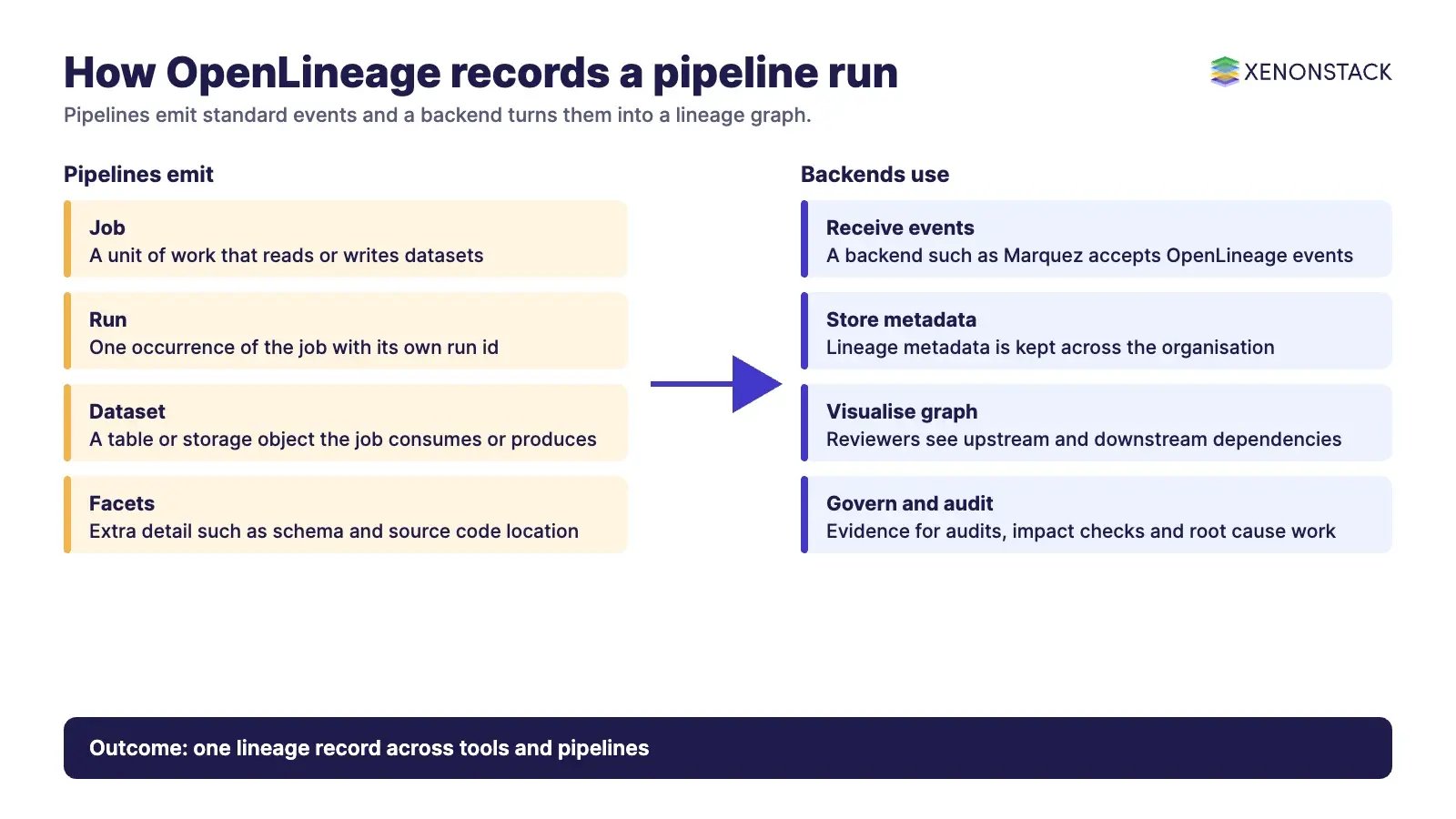
According to the object model page, the specification has three core entities, and extra detail is attached through facets, which the docs describe as atomic pieces of metadata attached to one of those entities.
| Concept | What it represents | Facets named in the docs |
|---|---|---|
| Job | A discrete unit of work that consumes or produces datasets, such as a task, a model or a query | sourceCodeLocation, sourceCode |
| Run | One occurrence of a job, with a unique run identifier created by the client | nominalTime, parent, errorMessage, sql |
| Dataset | A discrete collection of data, such as a table or a cloud storage object | schema, dataSource, lifecycleStateChange, version |
Events carry this model. A run event is emitted at runtime, usually when a job starts and finishes. Job and dataset events describe static details at design time and are not tied to a run. The docs stress that OpenLineage cares how datasets come into being, not only that relationships exist between them.
What is the difference between data lineage and event tracing?
The two are related but answer different questions. Lineage explains how data was produced and changed. Event tracing follows individual events through a system to find errors and delays.
| Aspect | Data lineage | Event tracing |
|---|---|---|
| Focus | The life cycle and transformations of data | Real-time events, for performance and error detection |
| Typical question | Which upstream tables feed this report? | Why did this transaction fail at this step? |
| Example in payments | Data from initiation to settlement | Approval of one transaction |
| Best used for | Governance, audit, impact analysis | Operations and debugging |
Why do open standards matter for lineage?
When each tool records lineage in its own shape, a lineage graph breaks wherever two tools meet. A shared specification lets every pipeline emit the same events and lets you change the backend without rewriting the producers. The docs name Marquez as the reference implementation of the OpenLineage API, and Marquez describes itself as enabling consuming, storing and visualising OpenLineage metadata from across an organisation. Visualisation matters because a graph is how most reviewers will read lineage, so pair it with sound data visualisation tools.
The integrations list in the docs covers Apache Airflow, Apache Flink, Apache Hive, Apache Spark, dbt, Feast, Great Expectations, SQL and Trino.
How does OpenLineage work with streaming and Flink?
Streaming adds pressure on lineage because data keeps arriving and transforming, so records must be captured as jobs run rather than reconstructed later. For Apache Flink, the Flink integration page describes a single connector with two implementations. The Flink 1.x version relies on the job's execution environment, needs a change to job code and does not support Flink SQL. The Flink 2.x version uses Flink's native lineage interfaces, needs no job code changes and supports Flink SQL.
Check your Flink version before you plan the rollout. Kafka does not appear on the integrations list in the docs, so confirm how your topics will show up as datasets before you promise end-to-end coverage.
How do AI agents change data lineage?
An AI agent reads data and then acts on it, so a lineage gap becomes a decision you cannot explain. Lineage tells you which datasets, jobs and runs sat behind an input to an agent, and a run record lets you ask whether the data was current when the agent used it. That raises the bar for capturing lineage on the pipelines agents depend on. For governed context around those decisions, see ElixirData, XenonStack's Context OS.
What should you do first?
- List the ten datasets that feed your most important reports or agents.
- Check which of your engines and orchestrators appear on the OpenLineage integrations list.
- Stand up one backend, such as Marquez, and send events from a single pipeline.
- Agree who owns each job and dataset name, since names identify entities.
- Review the resulting graph with a governance owner and extend to the next pipeline.
To map one decision your agents make, and the lineage and policy it depends on, book a Context Workshop. See what happens in the workshop.
Frequently asked questions
What is OpenLineage?
OpenLineage is an open standard and framework for collecting data lineage metadata, built around jobs, runs and datasets with facets for extra detail.
Is OpenLineage a lineage tool or a standard?
It is a standard. Tools such as Marquez, the reference implementation, receive, store and visualise the events that pipelines emit in the OpenLineage format.
Does OpenLineage support Apache Flink?
Yes. The docs describe a single Flink connector with a Flink 1.x implementation that needs job code changes and a Flink 2.x implementation that uses native lineage interfaces and supports Flink SQL.
How is lineage different from event tracing?
Lineage records how data is produced and transformed across systems, while event tracing follows individual real-time events to detect errors and performance problems.
Why do AI agents need data lineage?
Agents act on the data they read, so lineage shows which sources and runs sat behind a decision and helps you explain it afterwards.
Follow XenonStack on LinkedIn: XenonStack on LinkedIn for new guides on agentic AI, data and platform engineering.
Ready to put AI agents to work? Explore ElixirClaw, the agentic OS platform to build, orchestrate and govern AI agents.
Explore the XenonStack platform family: ElixirData · ElixirClaw · ElixirHub · NexaStack · MetaSecure · Neural AI · AgentGRC · AgentSRE · AgentAnalyst · AgentInstruct · AgentRAI · AgentScrum · AgentSearch · AgentForce · AI Aviator · SAIF Aviator · CohortIQ · XenonStack AI · XenonStack UAE