Key takeaway
- Data catalog architecture explained: components, harvesting workflow, how it differs from a metastore, best practices and what AI agents need from it.
Data catalog architecture is the design of the system that harvests metadata from an organisation's data sources, stores and indexes it, and makes it searchable and governed so people and AI systems can find, understand and trust data. IBM describes a data catalog as "a detailed inventory of data assets within an organization".
This guide is for data architects, platform engineers and governance leads who are designing or reviewing a catalog. It covers the components, the workflow from harvesting to search, how catalogs differ from nearby systems, rollout steps and best practices, and what AI agents need from the architecture.
What are the components of a data catalog architecture?
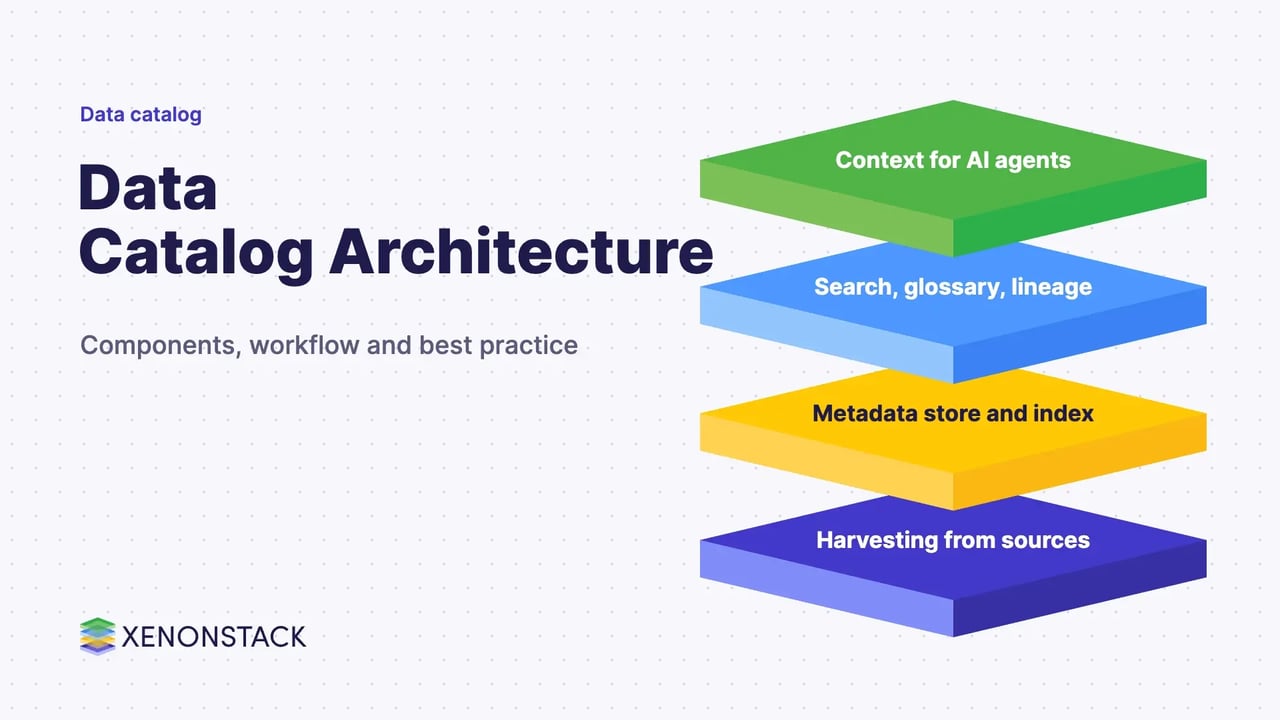
Whatever the product, most catalogs are built from the same parts. The metadata is the thread that connects them: each component either produces it, stores it or uses it.
| Component | Role | Design question |
|---|---|---|
| Metadata harvesting engine | Pulls technical metadata from databases, data lakes and cloud storage | How often does it refresh, and which sources does it support? |
| Metadata store and index | Keeps metadata and makes retrieval fast | Can it hold lineage and business terms as well as schemas? |
| Search and discovery interface | Lets users find data sets by keyword or question | Does it rank by relevance and show ownership? |
| Business glossary and classification | Gives terms agreed meanings and marks sensitive data | Who approves changes? |
| Lineage | Shows where data came from and what depends on it | Is it captured automatically or entered by hand? |
| Access control and policy | Applies role based permissions | Does it integrate with your identity and policy tools? |
| Integration APIs | Connect governance tools, BI tools and pipelines | Can other systems read the catalog programmatically? |
| Machine learning assistance | Suggests tags, titles and classifications | Can a steward review suggestions before they are published? |
How does a data catalog work, step by step?
A catalog is built and kept current in a repeating cycle of six stages.
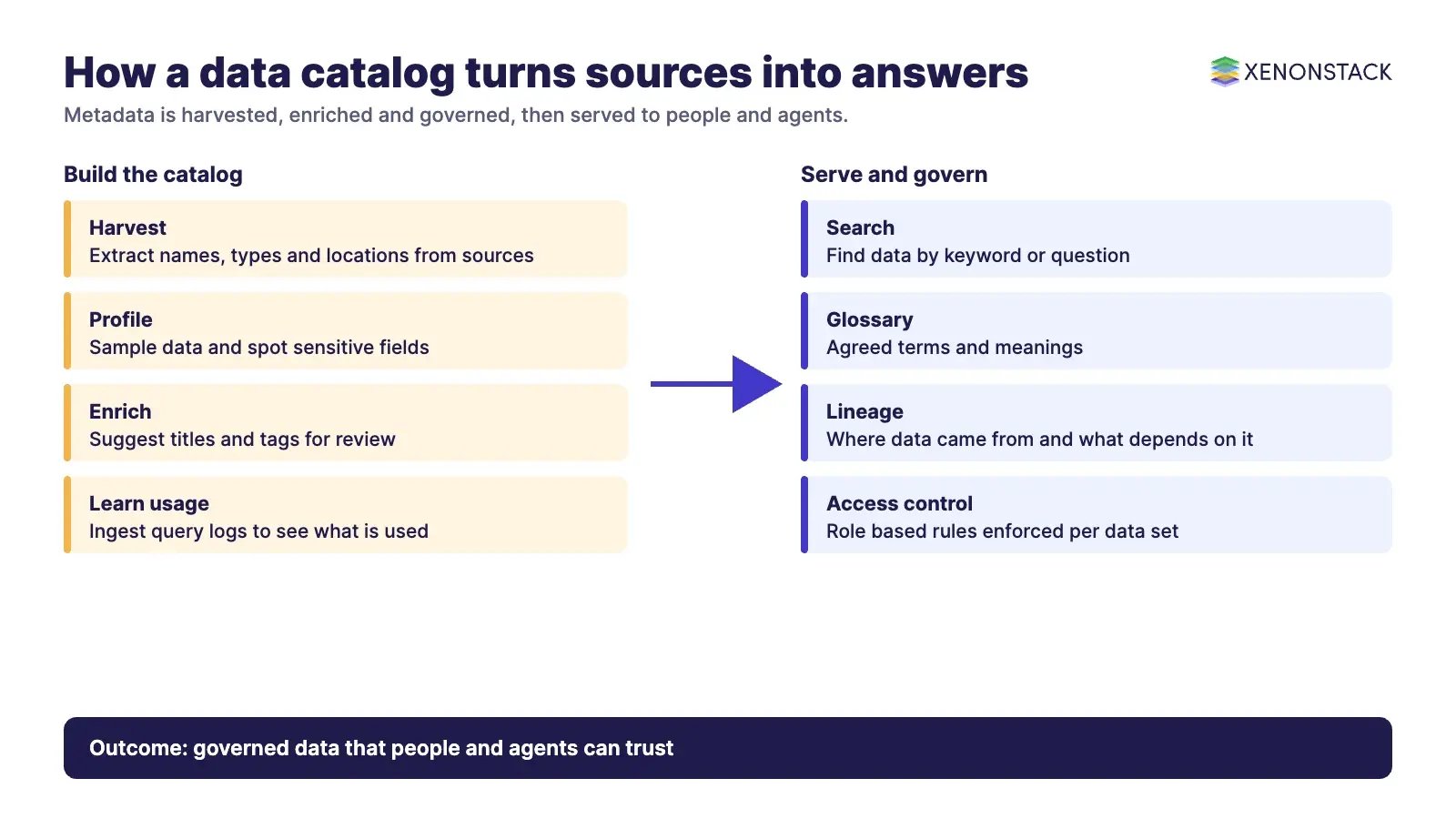
- Connect sources and extract metadata such as names, types and locations.
- Sample data to profile it, for example to spot sensitive fields.
- Generate suggested titles and tags with machine learning and natural language processing.
- Ingest query logs to learn which data sets are used and by whom.
- Let experts and users add descriptions, ratings and corrections.
- Publish to search, then monitor use and refresh on a schedule.
Real systems differ in detail. The AWS Glue Data Catalog documentation, for example, describes a catalog that can be populated by a crawler that scans data sources, or by defining tables manually, and that is organised into databases and tables. The Hive design page describes the Hive Metastore as a repository for table and partition structure, including column types and data locations. These are technical catalogs; a business catalog adds meaning and ownership on top.
How is a data catalog different from a data dictionary or metastore?
| System | Scope | What it lacks on its own |
|---|---|---|
| Data dictionary | Fields of one database or system | Organisation wide search, ownership and lineage |
| Metastore | Table and partition structure for query engines | Business glossary and stewardship workflow |
| Data catalog | Data assets across the organisation | Needs good metadata sources and owners to stay useful |
See our guides to the AWS data catalog, the enterprise data catalog tools and the Delta Lake storage layer for how these pieces appear in practice. Microsoft states that Azure Data Catalog was retired on 15 May 2024 in favour of Microsoft Purview, so treat older material such as our Azure Data Catalog article as background only.
Why does a data catalog matter?
IBM lists benefits including accelerated data analysis, operational efficiency, better data driven decisions and reduced regulatory risk. In architectural terms, a catalog saves time otherwise spent looking for data, gives one place to apply access rules, helps remove redundant copies, and records the lineage that audits require. See also the top use cases of a data catalog in enterprises.
Enhances Data Understanding
A robust catalog aids users in comprehending data by providing easy access to relevant information, including data usage and origin
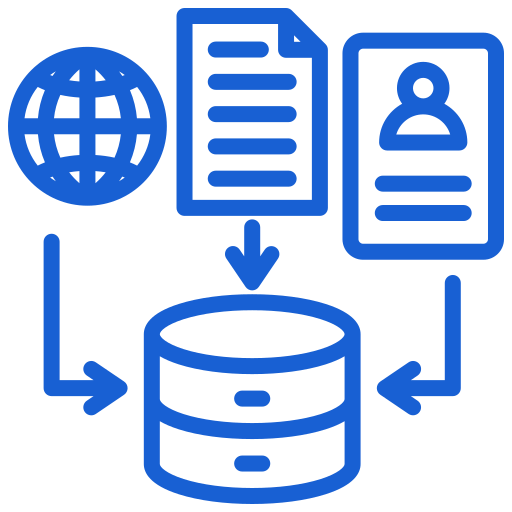
Supports Multiple Data Sources
The catalog aggregates various data sources, helping users identify quality data and gain insights across multiple datasets
What are the best practices for data catalog adoption?
- Assign an owner to every data set and a steward to every domain.
- Combine machine suggestions with human review.
- Make search the front door: clear titles, descriptions and tags.
- Protect data by defining access policies and sensitive data classes up front.
- Start with a few high value domains and widen only once people use it.
How do AI agents change data catalog architecture?
An agent cannot ask a colleague what a column means. It relies on the catalog for definitions, ownership, lineage and access rules, so the architecture must expose them through APIs in a form a program can use, and keep them current. Metadata quality becomes decision quality. ElixirData, XenonStack's Context OS, is built to turn that kind of metadata into governed context for decisions.
What should you do first?
- Pick one business domain and list its ten most used data sets.
- Connect those sources and harvest technical metadata.
- Name owners and write plain descriptions.
- Mark sensitive fields and set access rules.
- Measure search use after a month, then add the next domain.
To map one decision your agents make, and the data and policy it depends on, book a Context Workshop. See what happens in the workshop.
Frequently asked questions
What is a data catalog?
A data catalog is an inventory of an organisation's data assets that uses metadata to help people find, understand, trust and govern data.
What are the main components of data catalog architecture?
Metadata harvesting, a metadata store and index, search and discovery, a business glossary, lineage, access control and integration APIs.
How is a data catalog different from a data dictionary?
A data dictionary describes the fields of one database or system. A data catalog covers data assets across the organisation and adds search, ownership, lineage and governance.
Is Azure Data Catalog still available?
No. Microsoft states that Azure Data Catalog was retired on 15 May 2024 and directs users to Microsoft Purview.
Who should own a data catalog?
Each data set needs a named owner, and the catalog as a whole needs a team that keeps definitions, access rules and quality checks current.
Ready to put AI agents to work? See an ElixirClaw demo: the agentic OS to build, orchestrate and govern AI agents across your enterprise systems.
Explore the XenonStack platform family: ElixirData · ElixirClaw · ElixirHub · NexaStack · MetaSecure · Neural AI · AgentGRC · AgentSRE · AgentAnalyst · AgentInstruct · AgentRAI · AgentScrum · AgentSearch · AgentForce · AI Aviator · SAIF Aviator · CohortIQ · XenonStack AI · XenonStack UAE