Key takeaway
- Choosing a cloud security provider? This buyer's guide covers capabilities, evaluation criteria, first-meeting questions, risks and the role of AI agents.
A cloud security company is an external provider that helps an organisation assess, build and run the controls that protect its cloud workloads, identities, data and configurations. Services range from one-off assessments to managed monitoring and response, so the right choice depends on what you need done and who stays accountable.
This guide is for security leaders, CIOs and procurement teams comparing providers. It covers what the category includes, the capabilities to check, how to score providers, what to ask in a first meeting, the commercial models you will meet, and how AI agents are changing the work. It also links to our guides on cloud security best practices and the cloud-native autonomous SOC.
What does a cloud security company actually cover?
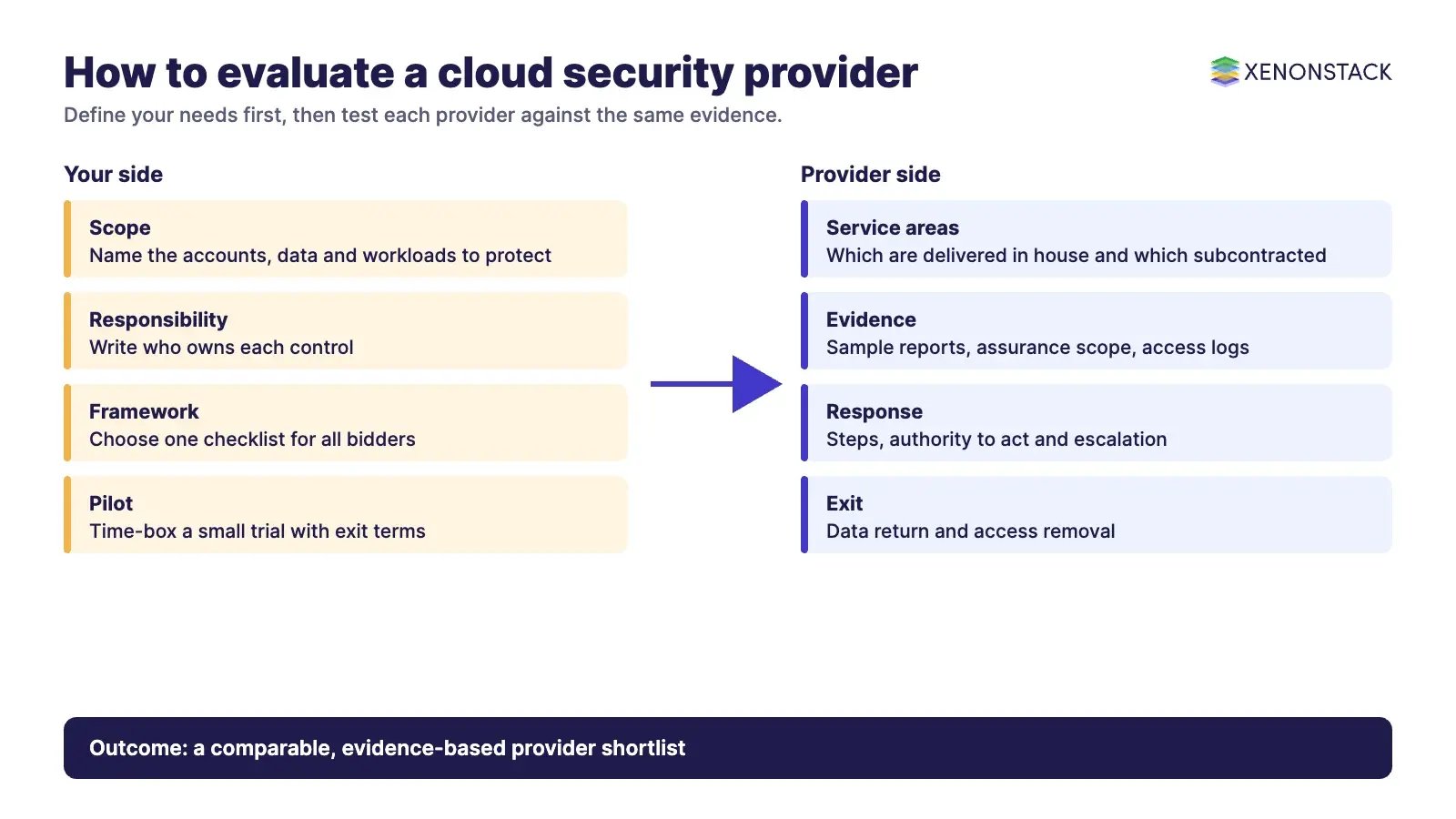
The category is broad, so start by naming the problem. Common service areas are: security assessment and architecture review; identity and access management; configuration and posture management; workload and container protection; data protection and key management; monitoring, detection and incident response; and compliance support.
Providers rarely cover all of these equally well. A firm that is strong at advisory work may outsource round-the-clock monitoring, and a managed detection provider may do little architecture design. Ask which areas are delivered by the provider's own staff and which are subcontracted.
What should you check before comparing providers?
Settle responsibility first. The NIST SP 800-144 guidance, published in December 2011, advises organisations to weigh security and privacy factors when they outsource data, applications and infrastructure to a public cloud. In practice, that means writing down which controls your cloud platform owns, which your provider owns and which stay with your own team.
A useful reference is the Cloud Security Alliance Cloud Controls Matrix. The page describes it as a cybersecurity control framework for cloud computing, with 197 control objectives in 17 domains, and says it defines the security roles between cloud service providers and customers. Mapping your needs to a framework like this gives every bidder the same checklist.
Which criteria separate one provider from another?
Score every provider against the same table and ask for evidence, not slogans.
| Criterion | What good evidence looks like |
|---|---|
| Scope fit | A written service description that names the cloud platforms, accounts and environments covered, and what is excluded |
| Control coverage | A mapping of services to a recognised control framework, such as the Cloud Controls Matrix, with named owners |
| Responsibility split | A shared responsibility table covering provider, platform vendor and your team |
| Detection and response | Documented response steps, escalation paths and who can take action in your environment |
| People and access | Named roles, how staff access your tenant, and how that access is logged and revoked |
| Reporting | Sample reports that show findings, owners and closure, not only counts of alerts |
| Assurance | Independent audit reports or attestations you can read, with scope that matches your use |
| Exit terms | Clear data return, access removal and handover steps if you leave |
What should you ask in a first meeting?
- Which of our cloud accounts and services would you cover on day one, and which would you not?
- Who holds administrative access to our environment, and how is it approved and logged?
- Which controls do you operate yourselves, and which depend on tools or partners?
- What happens in the first hour after you detect a serious event, and what are you allowed to change without asking us?
- How do you report findings, and how do we see that a fix was verified?
- Can we read your latest independent assurance report and its scope?
- How do you handle our data, and what do you return or delete when the contract ends?
Which delivery and commercial models will you meet?
| Model | In plain words | Watch for |
|---|---|---|
| Project or assessment | A fixed piece of work with a report at the end | Findings that nobody owns after the report is delivered |
| Retainer or advisory | A set amount of expert time each month | Unclear outputs for the fee |
| Managed service | The provider monitors and responds on an ongoing basis | Alert volume as the only measure of value, and unclear authority to act |
| Co-managed | Your team and the provider share tooling and duties | Gaps when each side assumes the other is covering a task |
| Platform plus services | Software and people sold together | Lock-in to tooling you cannot take with you |
What risks and warning signs should you look for?
Be cautious when a provider cannot say what is out of scope, will not share a sample report, or answers every question with a product name. Other warning signs are access to your tenant that nobody can explain, success measured only by the number of alerts handled, and contract terms that make leaving expensive. Also be wary of any claim of guaranteed protection: no provider can promise that.
How do AI agents change cloud security work?
AI agents can take on repetitive investigation steps: gathering context for an alert, checking a configuration against policy, drafting a ticket and routing it to the right owner. They do not remove the need for human accountability, because someone must decide which actions an agent may take on its own and which need approval. XenonStack offers one option here, ElixirClaw, the AI agents computing platform, alongside the cyber security analytics use case.
When you evaluate any provider that uses agents, ask what data the agents can read, what actions they can take, how those actions are logged and how a person can reverse them.
What should you do first?
- List the cloud accounts, data and workloads that matter most.
- Write the shared responsibility split between your cloud platform, a provider and your team.
- Pick a control framework to use as a common checklist.
- Score two or three providers against the same criteria table.
- Run a small, time-boxed pilot with clear exit terms before signing a long contract.
To map one decision your agents make, and the data and policy it depends on, book a Context Workshop. See what happens in the workshop.
Frequently asked questions
What does a cloud security company do?
It helps you assess, build and run the controls that protect cloud workloads, identities, data and configurations. Services range from assessments and architecture review to managed monitoring and incident response.
How do I compare cloud security providers fairly?
Use one criteria table for every provider and ask for evidence for each row: scope, control coverage, responsibility split, response steps, reporting and exit terms. Avoid comparing on slogans or alert counts.
Who is responsible for security in the cloud?
Responsibility is shared between the cloud platform, any provider you hire and your own team. Write the split down, and use a control framework such as the Cloud Controls Matrix to assign each control an owner.
Should I choose a managed service or a project?
A project suits a one-off assessment or design. A managed service suits ongoing monitoring and response, but only if you define what the provider may change in your environment and who approves it.
Can AI agents replace a security team?
No. Agents can speed up investigation and routing, but people still set the policy, approve high-impact actions and own the outcome.
Follow XenonStack on LinkedIn: XenonStack on LinkedIn for new guides on agentic AI, data and platform engineering.
Ready to put AI agents to work? Explore ElixirClaw, the agentic OS platform to build, orchestrate and govern AI agents.
Explore the XenonStack platform family: ElixirData · ElixirClaw · ElixirHub · NexaStack · MetaSecure · Neural AI · AgentGRC · AgentSRE · AgentAnalyst · AgentInstruct · AgentRAI · AgentScrum · AgentSearch · AgentForce · AI Aviator · SAIF Aviator · CohortIQ · XenonStack AI · XenonStack UAE