Key takeaway
- Agentic AI in robotics for enterprise leaders: how robots perceive, plan and act, where simulation helps, and the EU and ISO safety rules to plan for.
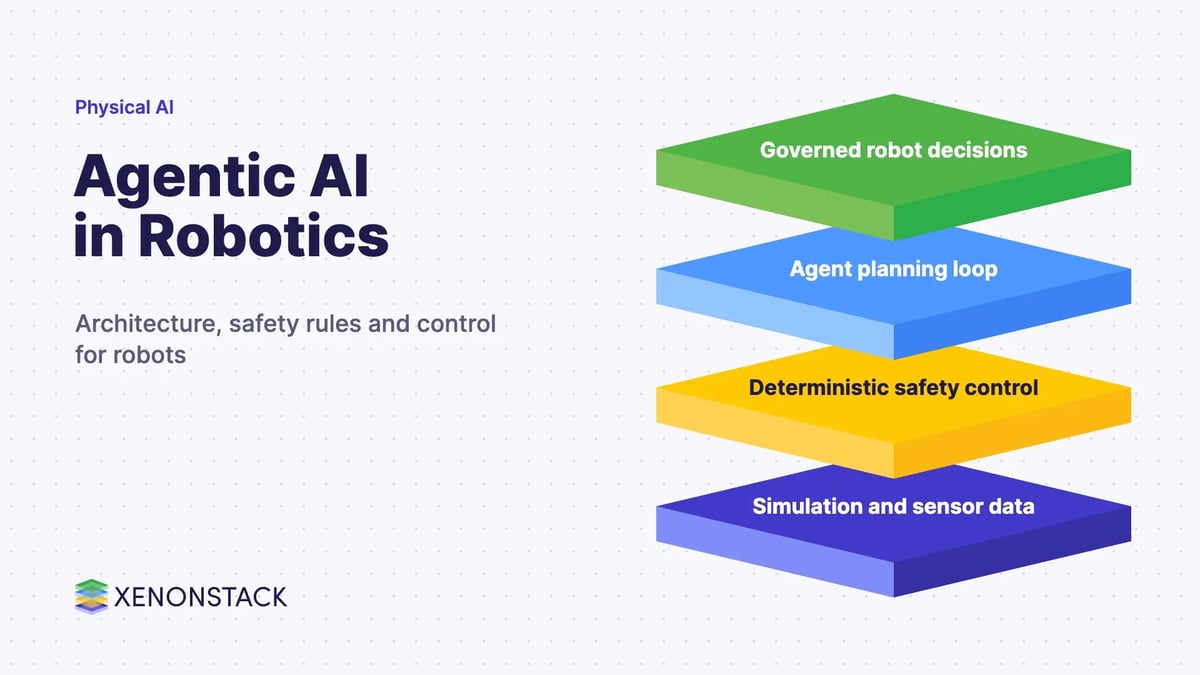
Agentic AI in robotics is the use of AI agents that let a robot perceive its surroundings, plan toward a goal, act, and check the result, instead of replaying a fixed script. For an enterprise the useful question is not whether the robot is clever, but what it is allowed to decide, how that is proven safe, and who can see what it did. This guide covers how the stack works, where simulation helps, what the safety rules say and what to plan for over the next 3 to 5 years.
The pattern builds on agentic AI and on embodied agents, and it sits within physical AI. Factory use is covered in agentic AI in manufacturing.
What is agentic AI in robotics, and how does it differ from scripted automation?
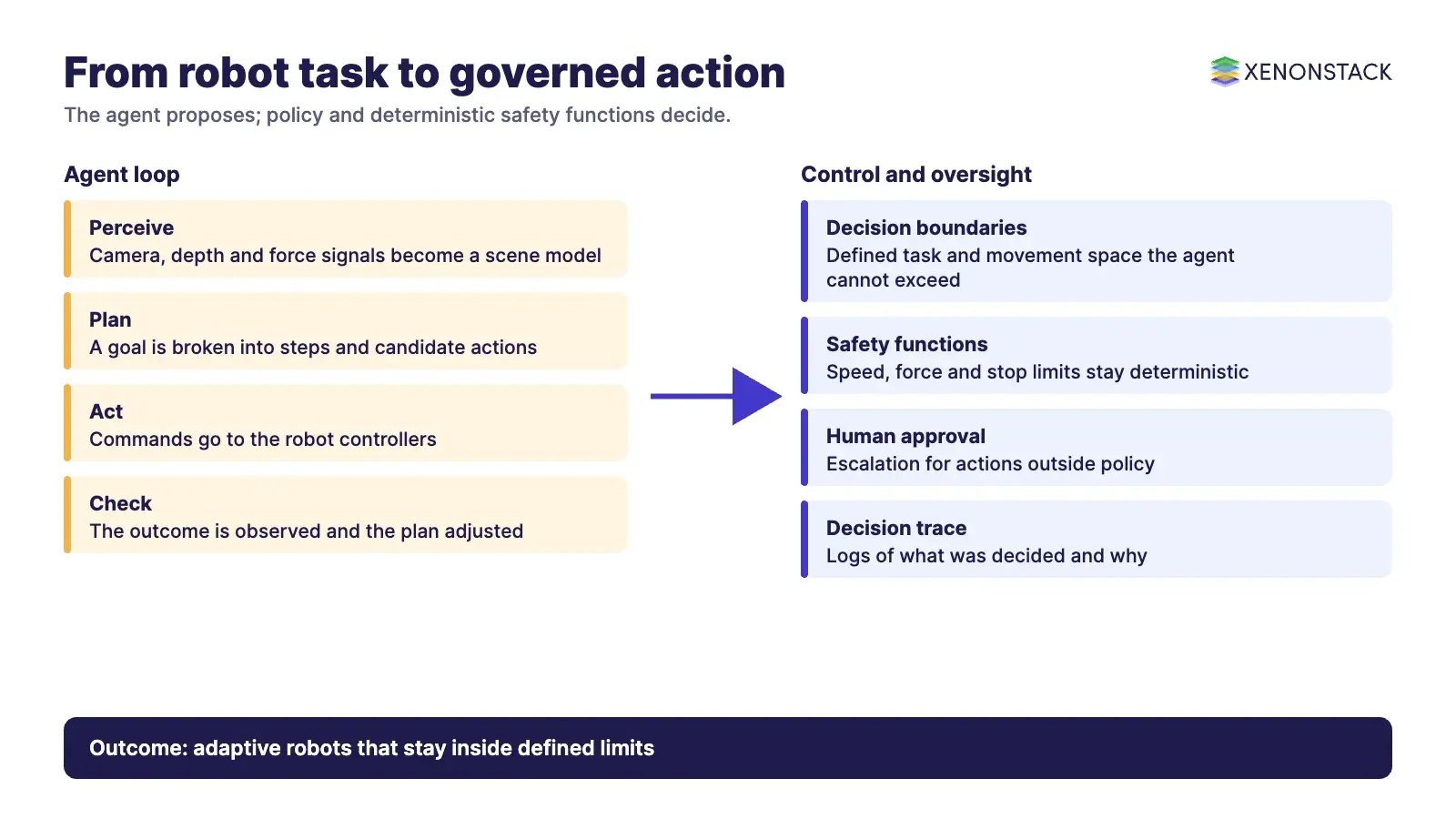
A scripted robot repeats programmed motions inside a fixed cell. An agentic robot works through a loop: sense the scene, form a plan for a goal, act through its controllers, then observe the outcome and adjust. Language and vision models usually handle interpretation and planning, while low-level controllers keep motion within limits. The robot is the body; the agent is the decision loop that drives it.
| Layer | What it does | Where the control sits |
|---|---|---|
| Perception | Turns camera, depth and force signals into a model of the scene | Edge hardware on or near the robot |
| Planning | Breaks a goal into steps and picks actions | Agent with explicit decision boundaries |
| Motion control | Executes movement within speed, force and workspace limits | Deterministic controllers and safety functions |
| Oversight | Approvals, logs and review of what the agent decided | Governed workflow outside the robot |
The design rule that follows is simple: let the agent propose, and let deterministic safety functions and policy decide what is permitted. The wider pattern is described in agentic workflows.
How do simulation and digital twins help train robot agents?
Training on real hardware is slow and can damage equipment, so teams train and test in simulation first and then transfer to the physical robot. According to NVIDIA's developer site, Isaac Sim is built on Omniverse and offers a physically based virtual environment, Isaac Lab is tuned for robot learning, and Cosmos works with Isaac Sim to produce synthetic training data from 3D scenes. NVIDIA also describes Isaac GR00T as a research initiative and development platform for humanoid robotics, including general-purpose robot foundation models. A digital twin of the cell or warehouse lets engineers check behaviour before it reaches the floor.
NVIDIA's developer blog (18 March 2025) also describes Newton, an open-source physics engine being developed by NVIDIA, Google DeepMind and Disney Research. It is built on NVIDIA Warp and uses MuJoCo-Warp, a Warp-accelerated version of MuJoCo, and it works with learning frameworks such as MuJoCo Playground and Isaac Lab.
What is the sim-to-real gap?
It is the difference between how a robot performs in simulation and how it performs in the physical world. Friction, lighting, sensor noise and wear are hard to reproduce, so a policy that works in simulation can fail on the floor. Teams narrow the gap with higher-fidelity simulation, varied training data, staged rollouts and monitoring of real behaviour against what the twin predicted.
Which technical challenges should enterprise teams plan for?
- Data: varied, high-quality sensor and task data is costly to collect and label, and it needs lineage so a behaviour can be traced to its training source.
- Compute: perception and planning models need accelerated hardware, which raises the question of what runs on the robot, at the edge or in the cloud. See edge computing and edge AI in smart factories.
- Integration: connecting agent software to existing controllers, safety PLCs, warehouse and maintenance systems is often harder than the model itself.
- Latency: safety-relevant reactions cannot wait for a remote call, so they stay in local deterministic control.
NexaStack describes itself as the agentic operating platform for Physical AI, with a control plane for deploying, operating and governing autonomous systems across edge devices, robots and private cloud, according to its site. NexaStack is an agentic operating platform for physical AI that runs across on-premises, cloud and hybrid environments.
What do the safety standards and EU rules say?
Nothing in this section is legal advice or a certification claim. Check your own obligations with your notified body and counsel.
| Source | What it covers (per the official page) | Relevance to agentic robots |
|---|---|---|
| ISO 10218-1:2025 (ISO) | Safety requirements for industrial robots; edition 3, published February 2025 | Robot-level design and risk reduction |
| ISO 10218-2:2025 (ISO) | Safety requirements for industrial robot applications and robot cells, across the lifecycle; published February 2025 | Integration of the robot, tools and the agent into a cell |
| ISO/TS 15066:2016 (ISO) | Safety requirements for collaborative industrial robot systems, supplementing ISO 10218; the ISO page carries a flag that it is to be revised | Robots working beside people |
| Regulation (EU) 2023/1230 (EUR-Lex) | Machinery Regulation; repeals Directive 2006/42/EC; its recitals and Annex III address control systems with fully or partially self-evolving behaviour, which must not cause actions beyond the defined task and movement space | Directly relevant to learning or adaptive control logic |
| EU AI Act (European Commission) | High-risk rules for AI embedded in regulated products (Annex I) apply from 2 August 2028 after the AI Omnibus; Annex III uses apply from 2 December 2027 | Robots with AI safety components may fall in scope; confirm against Annex I |
The practical reading for an architect: keep adaptive behaviour inside a defined task and movement space, keep safety functions deterministic and separately verified, and record what the agent decided. Governance patterns are covered in agentic AI risk management.
Where is agentic AI in robotics being applied?
| Area | What the agent adds | What to keep deterministic |
|---|---|---|
| Manufacturing cells | Task sequencing, changeover planning, inspection follow-up | Speed, force and guarding |
| Warehouses and logistics | Re-planning routes and picks when orders or layouts change | Collision avoidance and stop functions |
| Inspection and maintenance | Reading sensor trends and raising work orders | Access limits to live equipment |
| Service and healthcare settings | Task assistance with human confirmation | Any action touching a person |
Bias in training data, accountability when a robot acts, and human oversight remain the main ethical risks. Clear decision boundaries and logs address the last two directly.
What will change in agentic robotics over the next 3 to 5 years?
This outlook is limited to dated, official sources. Market forecasts are left out because none was read from a primary source.
| Change | Source and date | What it means for planning |
|---|---|---|
| Machinery Regulation replaces the Machinery Directive | Regulation (EU) 2023/1230, repeal of Directive 2006/42/EC from January 2027 (EUR-Lex) | Treat learning-based control logic as a conformity question from the design stage |
| High-risk AI rules for regulated products | European Commission AI Act page: Annex I products from 2 August 2028 | Plan technical documentation and human oversight before that date |
| Updated industrial robot safety standards in use | ISO 10218-1 and -2, published February 2025 | Use the 2025 editions as the baseline for new cells |
| Collaborative-robot guidance under review | ISO page for ISO/TS 15066 shows a to-be-revised flag | Watch for a revision before fixing collaborative designs |
| Open simulation tooling matures | NVIDIA developer blog on Newton, 18 March 2025 | Expect shared physics engines to shorten the training loop |
What is the likely adoption sequence?
Most teams will start with agents that plan and report while a human approves actions, then allow bounded autonomy inside a defined task space, and only then widen scope. Each step needs evidence from the previous one: logs, near-miss reviews and drift checks against the twin.
How does XenonStack help govern agentic robotics?
Robots that act on their own need trusted operational context and clear limits on what they may decide.
- ElixirData, the Context OS: keeps governed context, versioned policy and decision traces in one decision layer above AI agents, so agents reason over the same governed view of the plant or warehouse.
- ElixirClaw: an agentic OS platform to build, orchestrate and govern AI agents and automation workflows while keeping humans in control.
- Approval Agent: automates approvals within policy and escalates exceptions with full context, according to its site.
- NexaStack: the platform for physical AI and agent orchestration.
To map one robot decision your agents should make, and the context and policy it depends on, book a Context Workshop. See what happens in the workshop.
Related on XenonStack
- NexaStack: agent runtime and inference for private cloud, on-prem and edge.
- ElixirClaw: run governed AI agents with decision boundaries and human approvals.
Frequently Asked Questions (FAQs)
What is agentic AI in robotics?
It is the use of AI agents that let robots perceive their environment, plan toward a goal, act and check the result, instead of following a fixed script.
How is agentic AI different from traditional robot programming?
Traditionally programmed robots repeat predefined motions. Agentic robots plan their own steps toward a goal and adapt to changes, with deterministic safety functions still limiting what they may do.
What is the sim-to-real gap?
It is the difference between how a robot performs in a simulated environment and in the physical world. Higher-fidelity simulation, varied data and staged rollouts narrow it.
Which standards and EU rules apply to industrial robots?
ISO 10218-1 and ISO 10218-2 (2025 editions) cover industrial robots and robot applications, ISO/TS 15066 covers collaborative operation, and Regulation (EU) 2023/1230 replaces the Machinery Directive from January 2027. The EU AI Act applies to AI embedded in regulated products from 2 August 2028. This is not legal advice.
What will change in agentic robotics over the next 3 to 5 years?
The main dated changes are the Machinery Regulation, the AI Act dates for regulated products, the 2025 ISO 10218 editions and a possible revision of ISO/TS 15066.
What are the main risks of agentic AI in robotics?
Safety and accountability when robots act autonomously, bias in training data and limited transparency in decisions. Human oversight and clear decision boundaries reduce them.
Follow XenonStack on LinkedIn: XenonStack on LinkedIn for new guides on agentic AI, data and platform engineering.
Explore the XenonStack platform family: ElixirData · ElixirClaw · ElixirHub · NexaStack · MetaSecure · Neural AI · AgentGRC · AgentSRE · AgentAnalyst · AgentInstruct · AgentRAI · AgentScrum · AgentSearch · AgentForce · AI Aviator · SAIF Aviator · CohortIQ · XenonStack AI · XenonStack UAE