Key takeaway
- Agentic AI in medical imaging explained: what agents can own in radiology workflows, FDA and EU rules, adoption steps and a 3 to 5 year outlook.
Agentic AI in medical imaging is software that does more than flag a finding on a scan. It plans a sequence of steps, calls specialist tools, checks its own output and hands a result to a clinician, while people keep authority over the diagnosis. For hospital and health-system leaders, the practical question is which steps of the imaging workflow an agent may own, and which must stay with a radiologist.
This post takes a different angle from our guide to AI-assisted medical imaging, which covers single-purpose diagnostic models. Here we cover orchestration, governance and adoption: what an agent can own in a radiology workflow, what has changed in regulation, and how to roll it out safely. For the wider vision picture, read Agentic AI in Computer Vision.
What is agentic AI in medical imaging?
A conventional imaging model takes one image and returns one output, such as a flag, a score or a mask. An agentic system wraps that model in a loop. It decides which tool to call next, pulls context from the patient record, checks the result against rules, and escalates to a person when confidence is low or the case is outside its scope. The research direction is visible in the literature: a December 2025 arXiv paper, Radiologist Copilot, describes an agent that coordinates region localisation, template selection, report composition and quality control for radiology reporting. It is a research proposal, not a cleared product.
How does agentic AI differ from traditional AI in radiology?
| Dimension | Traditional imaging AI | Agentic imaging AI |
|---|---|---|
| Unit of work | One image, one output | A multi-step task across images, priors and records |
| Data used | Pixels, usually one modality | Imaging plus clinical notes, labs and history where permitted |
| Behaviour | Fixed model, fixed output | Chooses tools, checks itself, escalates |
| Human role | Reads the output | Sets the boundary, reviews exceptions, signs off |
| Main risk | Missed or false findings | Missed findings plus wrong actions and unlogged decisions |
Multimodal inputs are what make this possible. Our explainer on agentic AI frameworks and use cases sets out the building blocks, and the same pattern underpins governed data access across clinical teams.
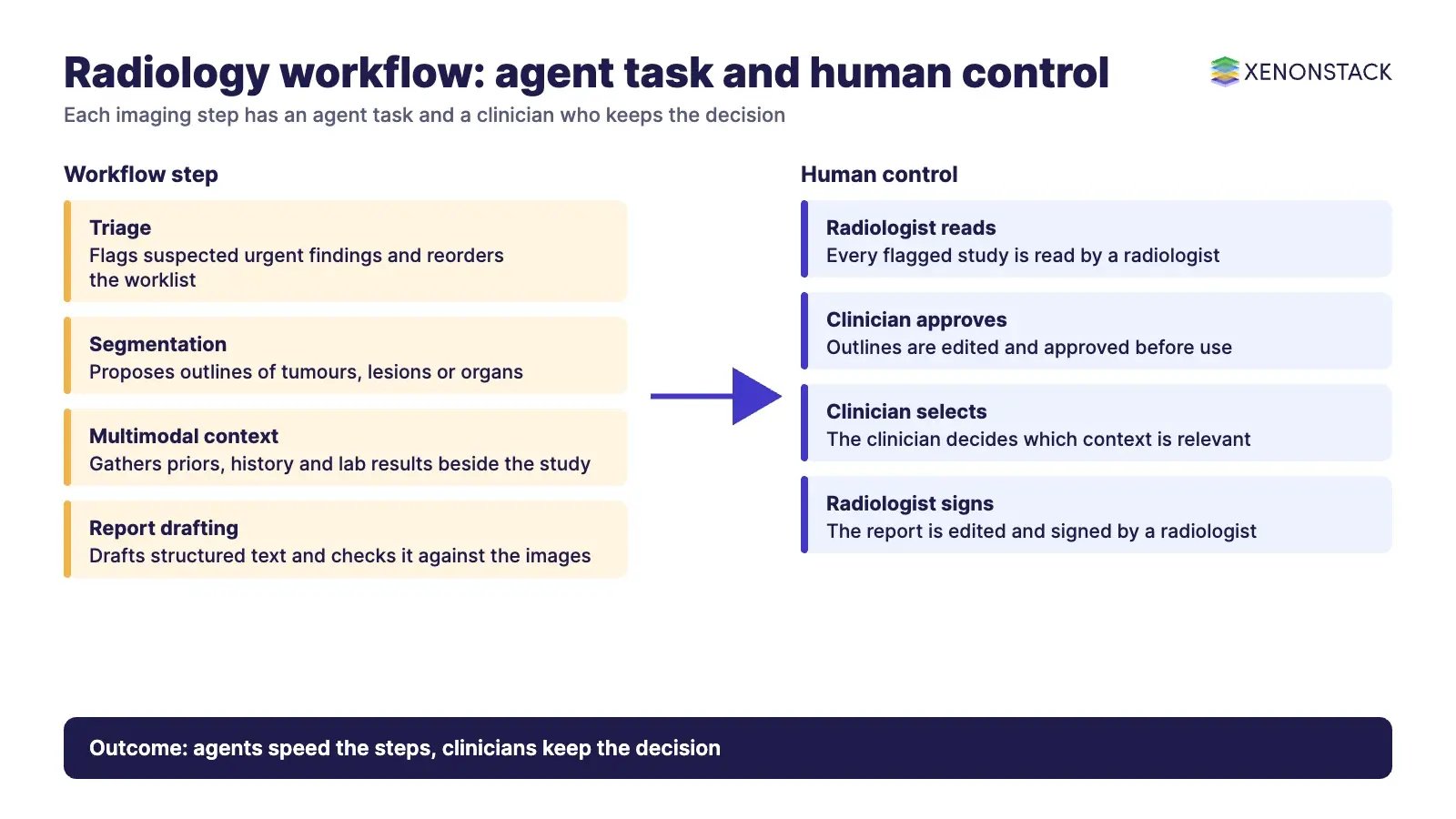
Where does an agent fit in the imaging workflow?
| Workflow step | What the agent can do | Where it fits | Human control |
|---|---|---|---|
| Triage and worklist priority | Flags suspected urgent findings, such as a suspected brain haemorrhage, and moves the study up the worklist | Emergency and stroke pathways | Radiologist reads every flagged study |
| Segmentation and annotation | Proposes outlines of tumours, lesions or organs for review | Treatment planning, tumour follow-up | Clinician edits and approves outlines |
| Multimodal context | Assembles prior scans, history and lab results next to the current study | Complex oncology and neurology cases | Clinician decides what is relevant |
| Report drafting and quality control | Drafts structured text and checks it against the images | High-volume reporting queues | Radiologist edits and signs the report |
| Treatment and procedure planning | Suggests options, for example radiotherapy planning inputs or imaging guidance for robotic procedures | Oncology and surgical teams | Multidisciplinary team decides |
Our guide to how agentic AI solves healthcare's top challenges covers the operational side, and the XenonStack healthcare page describes our approach to autonomous operations.
What has changed in regulation and the market?
-
Change control for adaptive software. The US FDA finalised its guidance on predetermined change control plans (PCCPs) for AI-enabled device software on 4 December 2024. A PCCP lets a manufacturer describe planned modifications, the protocol to validate them and a benefit-risk assessment, so that preapproved changes do not each need a new authorisation (as reported by Foley & Lardner).
-
Scale of cleared AI. As reported by MedTech Dive, FDA's list held more than 1,400 AI devices authorised since 1995 at its March 2026 update, 331 of them in 2025, the most in a single year, with the majority in radiology.
-
Generative and agentic functions. On 18 August 2026 FDA's Digital Health Center of Excellence issued a discussion paper on generative AI-enabled devices and asked for comments, including on whether autonomous multi-step action, external tool use and reduced human review need extra evaluation. Comments closed on 19 October 2026. The paper is nonbinding and is not guidance (as reported by Arnold & Porter).
-
EU timetable. The Digital Omnibus on AI was published in the Official Journal on 24 July 2026 and entered into force on 27 July 2026. It moves high-risk obligations for AI embedded in regulated products, including medical devices, to 2 August 2028 (as reported by CMS).
What do governance, security and cost require?
Patient images and records fall under privacy law such as HIPAA in the US, so access, logging and retention need to be designed in, with cybersecurity controls around every agent. Models trained on narrow datasets can carry bias into recommendations, so test performance across the patient groups you serve before go-live and again after any model update. For cost, count integration with PACS, the electronic record and the reporting system, plus validation and monitoring, not only the licence.
Accountability is the harder problem. When an agent reorders a worklist or drafts a report, the hospital must be able to show which policy applied, which version of the model ran and who approved the outcome. ElixirData Context OS keeps governed context, versioned policy and decision traces in one decision layer above AI agents, and the ElixirData Audit Agent assembles audit evidence such as decision lineage, policy versions and approvals for compliance teams. To build and govern the agents themselves, ElixirClaw is an agentic OS platform to build, orchestrate and govern AI agents and automation workflows while keeping humans in control.
How should a hospital adopt agentic imaging AI?
-
Pick one bounded task with a clear owner, such as worklist prioritisation for one modality.
-
Run in shadow mode. The agent produces output that clinicians do not see, and you compare it with final reports.
-
Move to supervised use. Clinicians see the output and record agreement or override.
-
Set boundaries in policy. Define which actions the agent may take alone, which need approval and which are blocked.
-
Monitor after go-live. Track overrides, drift and model changes, and re-validate when the vendor updates the model.
When is agentic imaging AI the wrong choice?
-
When the task is a single, well-defined read, a validated single-purpose model is simpler to audit than an agent.
-
When imaging, record and reporting systems cannot yet be integrated, so the agent would work from partial context.
-
When no clinician owner is available to review exceptions.
-
When the function is intended to diagnose or direct treatment and the vendor cannot show the regulatory status for your market.
What will change in agentic AI for medical imaging over the next 3 to 5 years?
| Prediction | Why we expect it | Timeframe | What leaders should do now |
|---|---|---|---|
| Regulators will set explicit expectations for agentic and generative imaging functions | FDA's August 2026 discussion paper asks about autonomous multi-step action and tool use, and proposes risk framing by autonomy and severity of harm (as reported by Arnold & Porter). It is nonbinding today. | Likely 2027 to 2029 | Classify each agent action by autonomy and potential harm, and keep that register current |
| Change control plans become a standard ask in imaging AI procurement | FDA finalised PCCP guidance on 4 December 2024, and its generative AI paper asks how to track third-party foundation model changes | Already starting; common by 2028 | Ask vendors for their change control plan and how model updates reach your site |
| EU high-risk obligations reach AI embedded in medical devices | The Digital Omnibus moves the Annex I date to 2 August 2028 (as reported by CMS); implementing acts may limit duplication with existing device rules | From August 2028 | If you operate in the EU, plan the documentation and oversight evidence now |
| Orchestrated reporting agents move from research to supervised pilots | Research such as Radiologist Copilot (arXiv, December 2025) shows tool-orchestrating designs for reporting. XenonStack's view: the first uses will be drafting and quality checks under radiologist sign-off, not autonomous reads. | Pilots 2027 to 2028, our view | Run a shadow-mode trial on one reporting queue and measure overrides |
| Integration and audit, not model accuracy, become the bottleneck | FDA's list already held more than 1,400 AI devices by March 2026, 331 added in 2025 (as reported by MedTech Dive). XenonStack's view: as tools multiply, hospitals need one governed layer to log decisions across them. | 2027 to 2030, our view | Decide where decision traces and policy will live before adding a third or fourth AI tool |
These are expectations, not guarantees. The regulatory rows would be proved wrong if FDA or the EU deferred or dropped these measures, and the two labelled as our view would be proved wrong if hospitals keep buying standalone tools without a shared governance layer. For imaging leaders, the decision this year is to fix the boundary between agent and clinician, because every later approval will ask for it.
To map one imaging decision your agents should make, and the context and policy it depends on, book a Context Workshop. See what happens in the workshop.
Frequently asked questions
What is agentic AI in medical imaging?
It is AI that plans and carries out a multi-step imaging task, for example triage, segmentation, context gathering and report drafting, calling specialist tools and escalating to a clinician when needed. A radiologist keeps the diagnostic decision.
How is it different from AI-assisted medical imaging?
AI-assisted tools usually return one output for one image. Agentic systems chain steps, use records alongside images and act within boundaries set by policy, which raises the need for audit trails and human oversight.
Does FDA regulate agentic imaging tools?
FDA regulates AI-enabled device software that meets the definition of a medical device, and its PCCP guidance lets manufacturers pre-specify planned changes. Its August 2026 discussion paper on generative AI-enabled devices is nonbinding and asks for views on agentic features.
When do EU AI Act high-risk rules apply to AI in medical devices?
As reported by CMS, the Digital Omnibus on AI, in force since 27 July 2026, sets 2 August 2028 for high-risk AI embedded in regulated products such as medical devices. Check current implementing acts before planning.
How should a hospital start?
Choose one bounded task, run the agent in shadow mode, move to supervised use, define in policy what it may do alone, and monitor overrides and model changes after go-live.
What will change in agentic AI for medical imaging over the next 3 to 5 years?
We expect clearer regulatory treatment of agentic and generative functions, change control plans as a procurement norm, EU high-risk obligations from August 2028, supervised pilots of reporting agents, and governance and integration becoming the main constraint rather than model accuracy.
Explore the XenonStack platform family: ElixirData · ElixirClaw · ElixirHub · NexaStack · MetaSecure · Neural AI · AgentGRC · AgentSRE · AgentAnalyst · AgentInstruct · AgentRAI · AgentScrum · AgentSearch · AgentForce · AI Aviator · SAIF Aviator · CohortIQ · XenonStack AI · XenonStack UAE