Key takeaway
- Agentic AI data democratization: governed natural-language access to data, least-privilege agents, audit trails and a staged rollout for enterprises.
Agentic AI data democratization means letting AI agents answer questions, prepare data and trigger follow-up actions for people who are not data specialists, while the agents inherit each user's access rights and leave an audit trail. The gain is speed: a finance or operations lead asks in plain language and gets an answer without joining an analyst queue. The condition is control: an agent that can act on data is only safe when its permissions, its actions and its answers are governed.
This guide is for CDOs, CTOs, CISOs and data platform owners deciding how far to take agents beyond self-service dashboards. It looks at the controls that matter, a decision table for choosing an approach, and an adoption sequence. For the wider case for open but governed data access, read our guide to data democratization benefits and best practices; this post covers what changes when the user is an AI agent. For the data platform side, see agentic AI for data management and warehousing.
Why did traditional data democratization stall?
Self-service BI promised that anyone could explore data. In practice four problems remain, and they are the reason agents are now being considered.
- Data silos: fragmented sources mean each team sees a partial picture.
- Analytical complexity: non-technical users still struggle to interpret raw tables and write queries.
- Dependence on data teams: deeper questions still wait for analysts and data scientists.
- Security exposure: wider access without policy can lead to leaks and inconsistent numbers.
Our data democratization guide makes the same point: democratization does not mean open access to everything. It means a governed, understandable route to the data each person needs.
What does an agentic data layer do that self-service BI does not?
A BI tool shows data when a person asks and builds the view. An agentic AI layer can interpret a question, plan the steps, query several sources, assemble the answer and, where policy allows, act on it. That also widens the risk, so each capability needs a matching control.
| Capability | What it does for the user | Control it needs |
|---|---|---|
| Natural-language query | Asks a question in plain language instead of writing SQL | Queries run under the user's own identity, not a shared service account |
| Automated data preparation | Extracts, cleans and structures data with less manual work | Lineage recorded for every transformation |
| Proactive alerts | Flags when a KPI moves outside its normal range | Defined metric owners and thresholds |
| Generated reports | Builds tailored reports without an analyst request | Certified metric definitions so teams do not get conflicting numbers |
| Actions on data | Triggers follow-up steps in connected systems | Policy check before the action, human approval for high-impact steps |
Agents differ from generative AI used for data governance in one respect that matters to risk teams: a generative model drafts content, while an agent can take steps. Our overview of AI agents and their business applications covers the categories.
One example of a product built for the query layer is AgentAnalyst, which lets teams ask questions of enterprise data in plain language and get real-time insights, running on ElixirData, which keeps governed context, versioned policy and decision traces in one decision layer above AI agents. As a vendor page, its claims on trust controls should be tested in a pilot.
What can go wrong when agents act on enterprise data?
The OWASP Top 10 for LLM applications lists Excessive Agency (LLM06:2025) as a vulnerability where a system has more capability to act than it needs, so unexpected, ambiguous or manipulated model output can cause damaging actions. OWASP names three root causes: excessive functionality, excessive permissions and excessive autonomy. These map directly onto a democratised data estate.
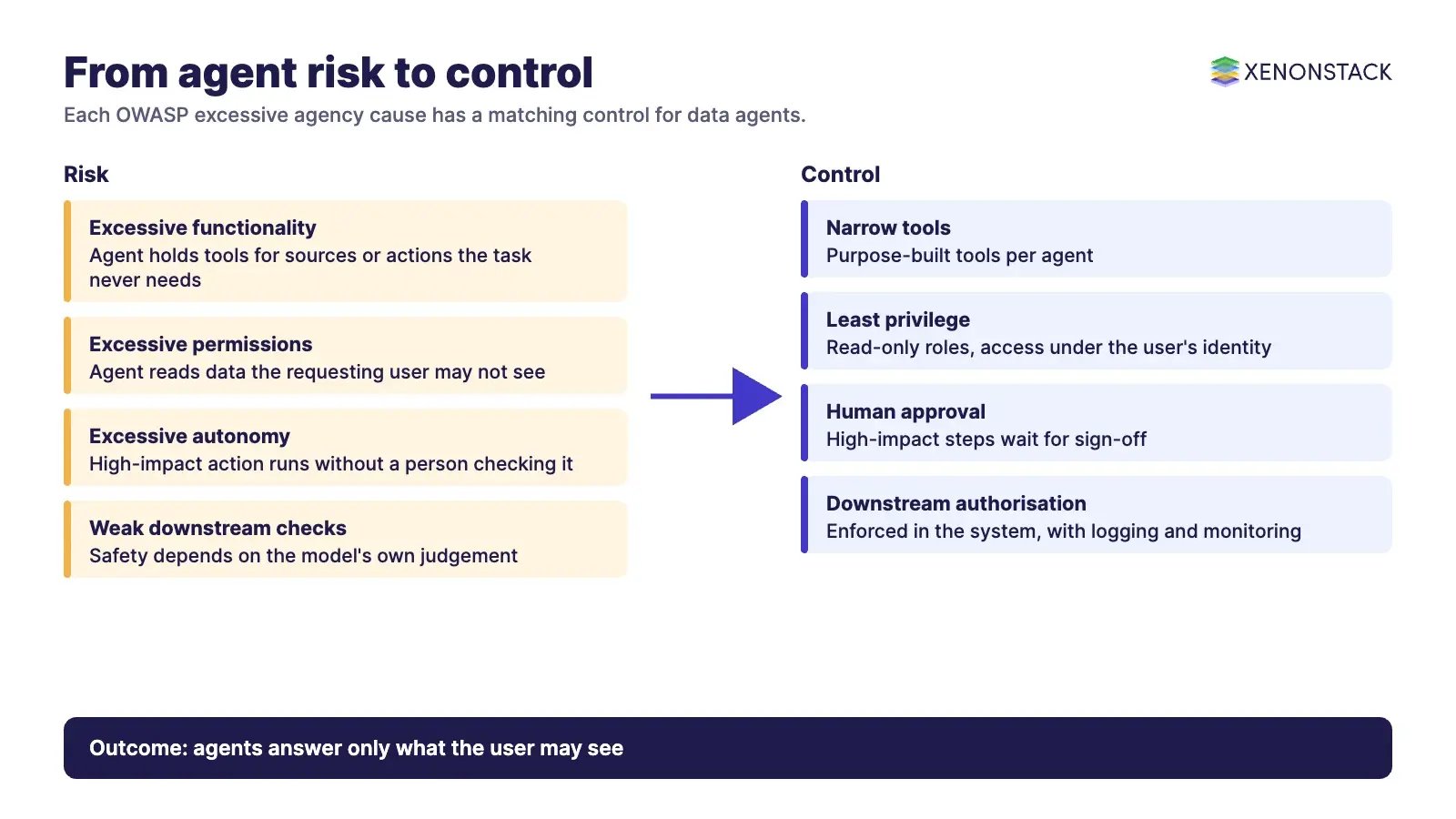
| Risk | How it shows up with data agents | Control |
|---|---|---|
| Excessive functionality | An agent holds tools for sources or actions the task never needs | Narrow, purpose-built tools per agent |
| Excessive permissions | An agent reads data the requesting user is not allowed to see | Least privilege, read-only roles, access under the user's identity |
| Excessive autonomy | A high-impact action runs without a person checking it | Human approval for high-impact steps |
| Weak downstream checks | Safety depends on the model's judgement | Authorisation enforced in the downstream system, with logging and monitoring to limit damage |
Source: OWASP GenAI Security Project, LLM06:2025 Excessive Agency. OWASP notes that logging, monitoring and rate limiting do not prevent excessive agency; they only limit the damage, so the preventive controls above matter most.
How should you govern AI agents that serve data to the business?
The NIST AI Risk Management Framework is a voluntary framework for managing AI risk; version 1.0 was released on 26 January 2023, and NIST published a Generative AI Profile (NIST-AI-600-1) on 26 July 2024. NIST states that the framework is being revised as part of the White House AI Action Plan, so check the current version before you cite it in a policy. Its Govern, Map, Measure and Manage functions give a sensible structure for the practices below.
Give every agent an owner, a scope and an identity
Each agent should have a named business owner, a documented list of datasets and tools it may use, and an identity that inherits the requesting user's access rules.
Certify the metrics agents are allowed to quote
Keep a catalogue of definitions, owners and certified metrics so agents answer from one source of truth. Conflicting dashboards are the usual first symptom of ungoverned access.
Record lineage and decision traces
Capture which sources fed an answer and which action followed, so finance, audit and security teams can verify a number after the fact. See agentic AI in data governance and compliance for the governance patterns.
Add human approval where the impact is high
Reading and summarising can run unattended. Writing to a system of record, sharing data outside the company or changing a policy should wait for approval.
Train people to question the answer
Explainable output and AI literacy help users challenge an agent's answer rather than accept it. Cross-functional training reduces both over-trust and avoidable support requests.
Which approach to data democratization fits your organisation?
| Approach | When it fits | Main trade-off |
|---|---|---|
| Self-service BI and catalogue | Stable reporting needs, strong analyst capacity, low appetite for new risk | Users still need BI skills; backlog for new questions |
| Natural-language query agent (read-only) | Many business questions, certified metrics in place, clear access rules | Answer quality depends on metric definitions and data quality |
| Agents that also act on data | Repeatable workflows with defined approvals and rollback | Needs policy checks, approvals and audit trails before scale |
When not to start with agents: if your metric definitions conflict, if ownership of the main datasets is unclear, or if access rights cannot be mapped to individual users, fix those first. An agent will surface the same inconsistencies faster, to more people.
What is a sensible adoption sequence?
- Pick priority decisions and datasets. Start with a few decisions that are slowed by analyst queues.
- Assign owners and certify metrics. Publish definitions and a catalogue.
- Map access to identities. Confirm the agent can only see what the user can see.
- Pilot read-only. Run a natural-language query agent with a small group and compare its answers with analyst answers.
- Add logging and review. Check lineage, traces and access logs weekly during the pilot.
- Extend to actions with approvals. Allow bounded actions only after the earlier steps hold.
This follows a staged-autonomy idea, with agents working alongside people before receiving more independence, which is how the AgentAnalyst page describes its own rollout.
What is likely to change in the next few years?
No reliable figures exist for how fast organisations will adopt agent-led data access, so plan on direction rather than numbers. Expect natural-language access to become a standard feature of data platforms, more emphasis on certified metrics and decision traces, and more scrutiny of agent permissions from security and audit teams. Treat vendor roadmaps as claims to test, and review your controls whenever NIST or OWASP update their guidance.
To map one data decision your agents should make, and the context and policy it depends on, book a Context Workshop. See what happens in the workshop.
Frequently asked questions
What is agentic AI data democratization?
It is the use of AI agents to give non-technical staff governed access to data: they ask in plain language, the agent queries and prepares the answer under the user's own permissions, and actions are logged.
How is it different from self-service BI?
Self-service BI waits for a person to build the view. An agent interprets the question, plans the steps and can act on the result, which is why it needs stronger controls.
What is the biggest security risk?
OWASP identifies Excessive Agency: too much functionality, permission or autonomy. Limit tools, apply least privilege, enforce authorisation downstream and require approval for high-impact actions.
Should agents have their own access to data?
Prefer access under the requesting user's identity with read-only roles where possible, so the agent cannot show a user data that user is not allowed to see.
Where should we start?
With certified metrics, named owners and a read-only natural-language pilot for a small group, then extend to actions with approvals once the logs and answers hold up.
Ready to put AI agents to work? Explore ElixirClaw, the agentic OS platform to build, orchestrate and govern AI agents.
Explore the XenonStack platform family: ElixirData · ElixirClaw · ElixirHub · NexaStack · MetaSecure · Neural AI · AgentGRC · AgentSRE · AgentAnalyst · AgentInstruct · AgentRAI · AgentScrum · AgentSearch · AgentForce · AI Aviator · SAIF Aviator · CohortIQ · XenonStack AI · XenonStack UAE