Key takeaway
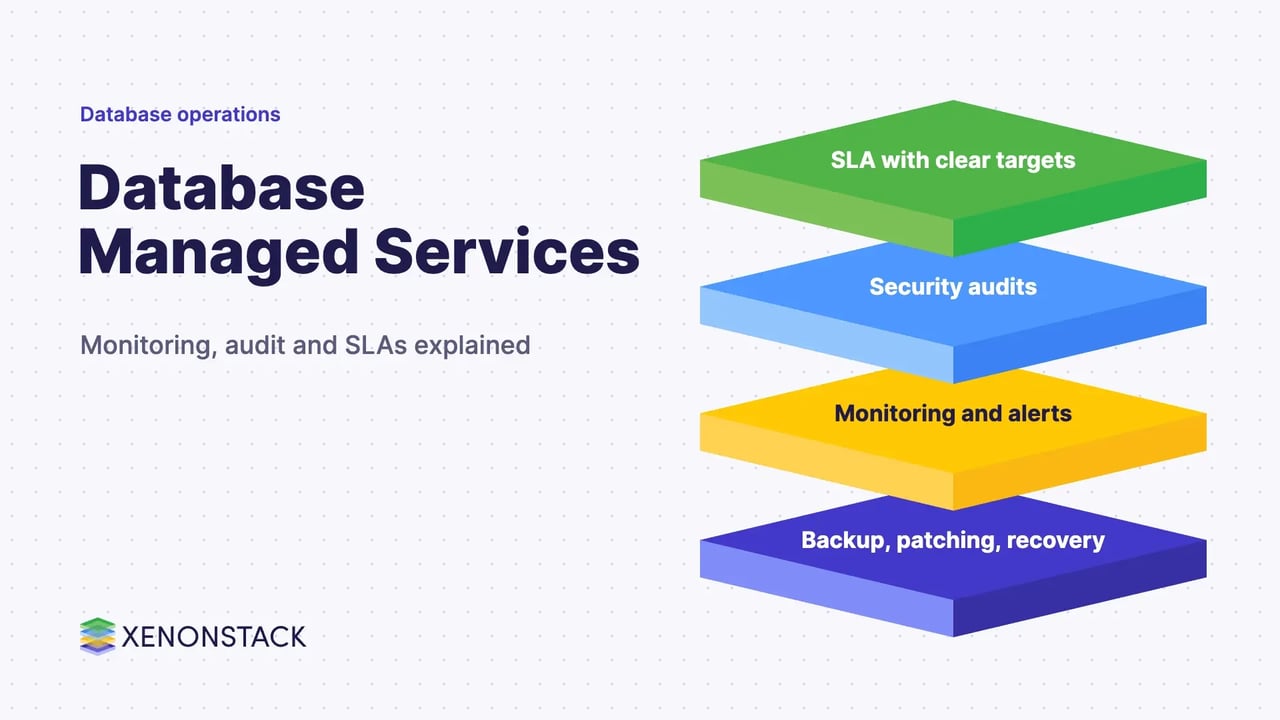
- Database managed services hand monitoring, backups, patching and audits to a provider under an SLA. See what to include and how to compare options.
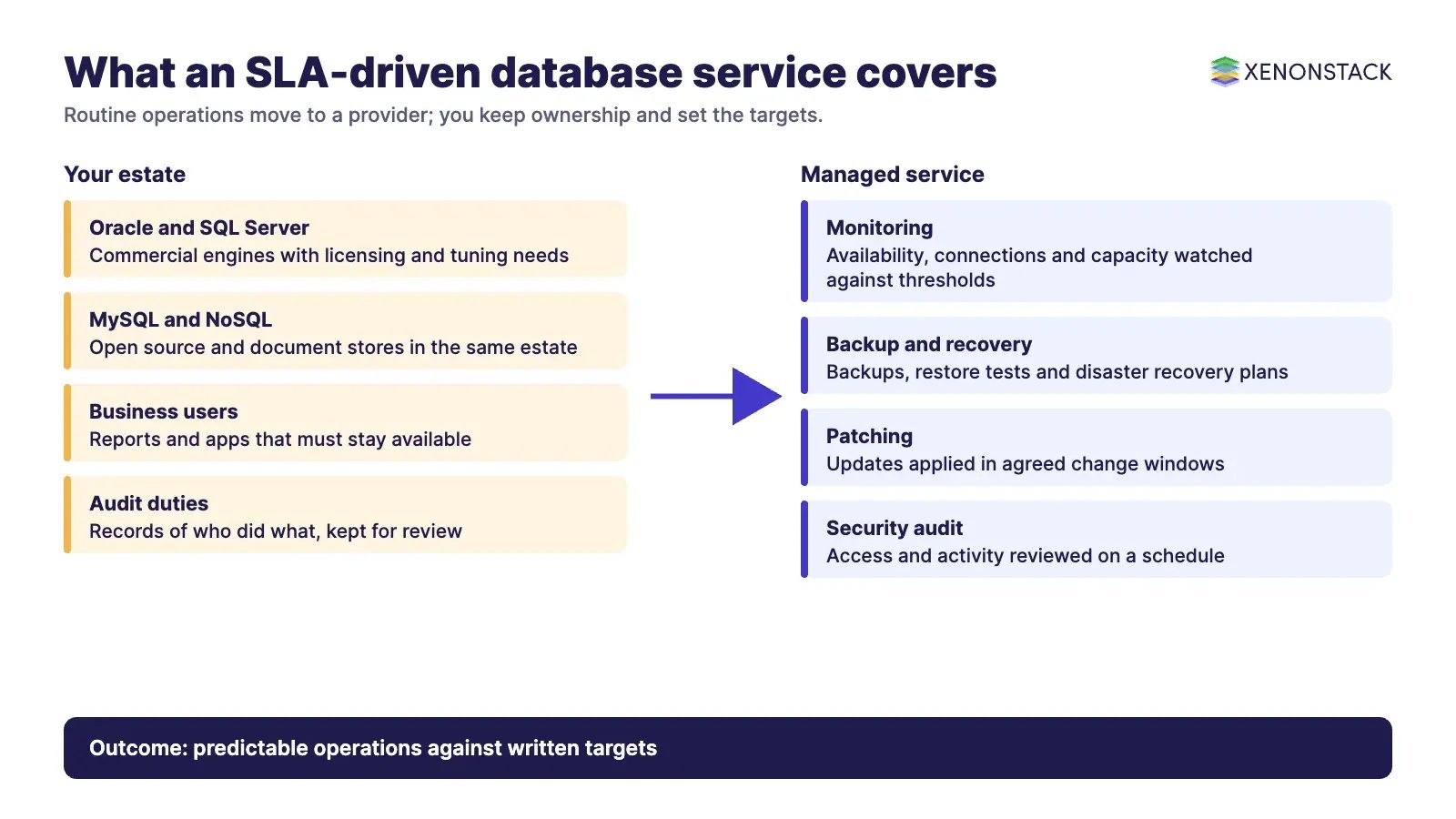
Database managed services are an arrangement in which a provider runs the routine work on your databases, including monitoring, backup, patching, security auditing and incident response, against a service level agreement (SLA). The databases stay yours, while the repeatable operational work moves to a team that does it every day.
This guide is for IT and data leaders who run Oracle, Microsoft SQL Server, MySQL or NoSQL estates and cannot staff every skill in house. It covers what a managed service includes, how security audits and monitoring work, how it compares with other models, what an SLA should say, and how AI agents change the work. For the wider picture, see our pages on data management services and SQL, NoSQL and NewSQL databases.
What do database managed services cover?
Databases sit underneath most business-critical applications, so operational gaps show up as outages, slow reports or audit findings. A managed service gathers the recurring tasks into one accountable team. Managed cloud databases show the typical scope: the Amazon RDS features page lists automated backups with point-in-time recovery, software patching handled by the service, enhanced monitoring, Multi-AZ standby deployments, encryption with keys managed in AWS KMS, and network isolation through Amazon VPC.
| Area | What the provider does | What you should ask for |
|---|---|---|
| Monitoring | Watches availability, connections and capacity, and raises alerts before users notice | Alert thresholds, on-call cover and who is paged |
| Backup and recovery | Runs backups, tests restores and keeps a disaster recovery plan | Recovery point and recovery time targets in writing |
| Patching and upgrades | Applies database and operating system updates in agreed windows | Change windows, rollback plans and version policy |
| Security and audit | Manages access, encryption and audit trails | Audit scope, log retention and review frequency |
| Performance tuning | Reviews slow queries, indexes and resource use | Regular tuning reports with actions taken |
| Incident response | Triages, resolves and reports on faults by severity | Response and resolution times for each severity level |
Why do security audits matter for databases?
Auditing is the monitoring and recording of database activity. The Oracle Database Security Guide defines it as "the monitoring and recording of database activity, from both database users and nondatabase users". The same page lists typical uses: enabling accountability for actions, investigating suspicious activity, supporting post-incident investigations, detecting problems with authorisation or access control, and addressing auditing requirements for compliance.
In a managed service, audit work becomes a standing routine rather than a one-off project. Decide which actions are recorded, who reviews the records, how long they are kept, and which findings trigger an incident.
How does database monitoring work?
Monitoring collects signals such as availability, the number of user connections over time, storage growth and query behaviour, then compares them with thresholds agreed in the SLA. The aim is to act on a trend before it becomes a critical incident, for example by adding capacity when connection counts climb or restarting a failed replica. Good monitoring also produces a record that feeds capacity planning and audit reviews.
How do managed services differ from other operating models?
| Model | Who does the work | Best fit | Main trade-off |
|---|---|---|---|
| In-house DBA team | Your employees | Stable estates with deep local knowledge | Hard to cover nights, holidays and every database engine |
| Managed service from a provider | A provider team under an SLA | Mixed estates that need 24x7 cover and consistent process | You must manage the contract and keep access controls tight |
| Cloud-native managed database | The cloud provider runs the engine; you run schema and queries | New workloads on a single cloud | Operational duties above the engine, such as tuning and governance, remain yours |
The models combine well. Many teams keep architecture decisions in house and hand daily operations to a provider, or use a cloud database and add a provider for tuning and audit.
What should a database managed service SLA include?
An SLA turns a promise into something you can check. Ask the provider to commit to the following in writing.
- A named technical contact who knows your estate.
- Support hours, including whether cover is 24x7x365.
- Response and resolution times for each severity level.
- Backup frequency, restore testing and disaster recovery targets.
- Monitoring scope, alert routing and reporting cadence.
- Architecture design and platform maintenance duties, including patching windows.
- Security and DevOps responsibilities, and how cloud cost is reviewed.
- Professional services for projects outside routine operations.
What benefits can you expect?
The benefits come from specialisation and consistency rather than from any single tool. Your own team can focus on data products and application delivery, while operational tasks follow a repeatable process. Cover improves outside office hours, and recurring work such as patching and backup testing gets done on a schedule. A managed model can also help a big data strategy by keeping the underlying databases dependable. Whether it lowers cost depends on your current staffing and contract terms, so compare the full cost of both options before deciding.
Where graph workloads are involved, see our guide to graph database solutions and services.
How do AI agents change database operations?
AI agents can read alerts, check the runbook, gather diagnostics and draft a fix for a person to approve, which shortens the routine part of incident handling. They need governed context: which database is production, who owns it, what policy applies and what an agent may change. ElixirData, XenonStack's Context OS, is where that kind of data and governance context belongs. Keep humans in the approval path for schema changes, access grants and anything that touches production data.
What should you do first?
- List every database, its engine, owner and business criticality.
- Write down your recovery targets and audit requirements.
- Mark which tasks your team does well and which cause after-hours pain.
- Draft the SLA terms above and ask providers to respond to each one.
- Start with one non-critical database, review the monthly reports, then extend.
Related reading: managed security services, big data managed services for digital operations and cloud managed services for digital operations.
To map one decision your agents make, and the database context and policy it depends on, book a Context Workshop. See what happens in the workshop.
Frequently asked questions
What are database managed services?
They are services in which a provider takes over routine database operations such as monitoring, backup, patching, security auditing and incident response, under an SLA.
What does database auditing do?
Per the Oracle Database Security Guide, auditing is the monitoring and recording of database activity, used for accountability, investigating suspicious activity and meeting compliance requirements.
Is a managed service the same as a managed cloud database?
No. A managed cloud database means the cloud provider runs the engine. A managed service adds people and process for tuning, audit, incident response and governance, and can cover several engines and environments.
What should be in a database SLA?
Support hours, response and resolution times by severity, backup and recovery targets, monitoring scope, patching windows, security duties and reporting.
Can AI agents run a database on their own?
They can triage alerts and draft fixes, but changes to production data, access and schema should stay behind human approval and clear policy.
Ready to put AI agents to work? See an ElixirClaw demo: the agentic OS to build, orchestrate and govern AI agents across your enterprise systems.
Explore the XenonStack platform family: ElixirData · ElixirClaw · ElixirHub · NexaStack · MetaSecure · Neural AI · AgentGRC · AgentSRE · AgentAnalyst · AgentInstruct · AgentRAI · AgentScrum · AgentSearch · AgentForce · AI Aviator · SAIF Aviator · CohortIQ · XenonStack AI · XenonStack UAE