Key takeaway
- A graph database lets recommendation systems follow customer, product and transaction links to suggest more relevant products at scale for businesses.
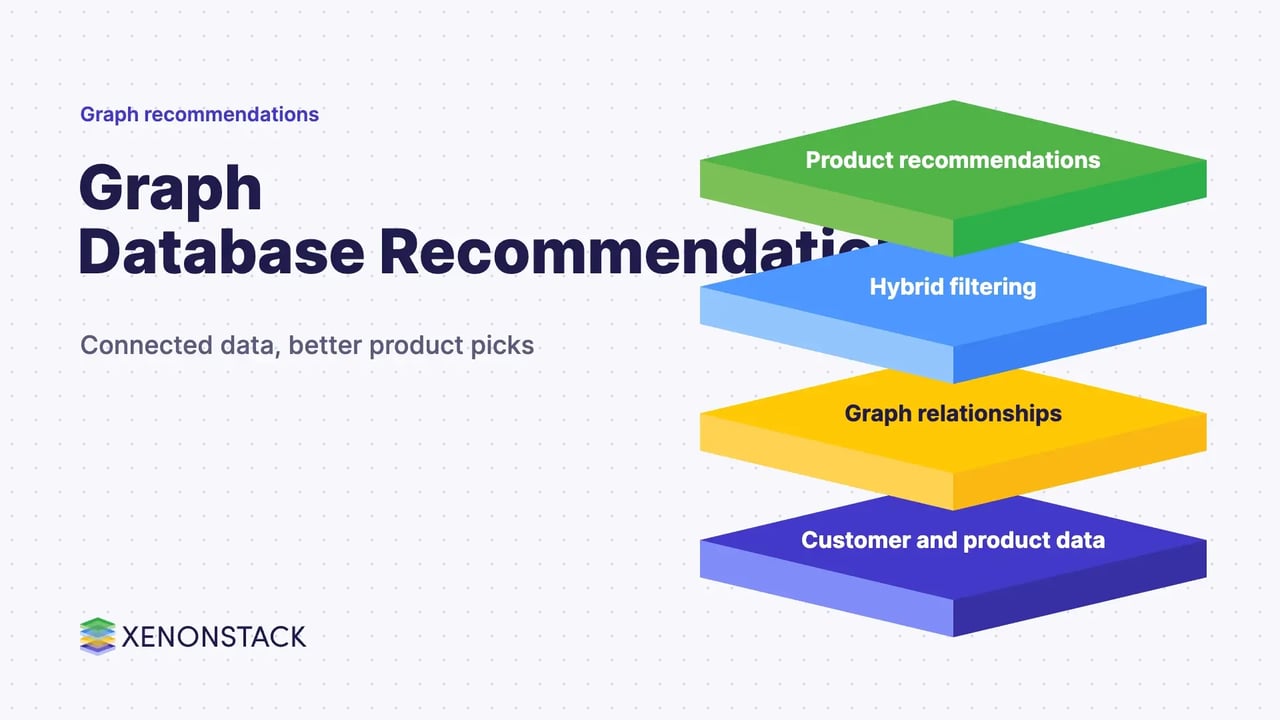
A product recommendation system predicts which items a customer is most likely to want, using their preferences, item details and past interactions. A graph database strengthens it by storing customers, products and transactions as connected data, so the system can follow relationships such as social circles and shared behaviour rather than treating each record in isolation.
What is a recommendation system?
A recommendation system is any rating system that anticipates a person's preferred options from the information at hand. Social media, online commerce and video streaming all use them. In most cases the system projects the rating a user would give a product and recommends the highest-scoring options. Two things shape the result: the information used and the prediction model applied to it.
Why use a graph database for product recommendations?
A graph database models highly connected data, which is exactly what recommendations depend on. It gives quicker access to related data and supports data import, integration, ingestion and graph algorithms for pathfinding. Recommendation lists can then reflect user preferences, item details and past interactions in one view.
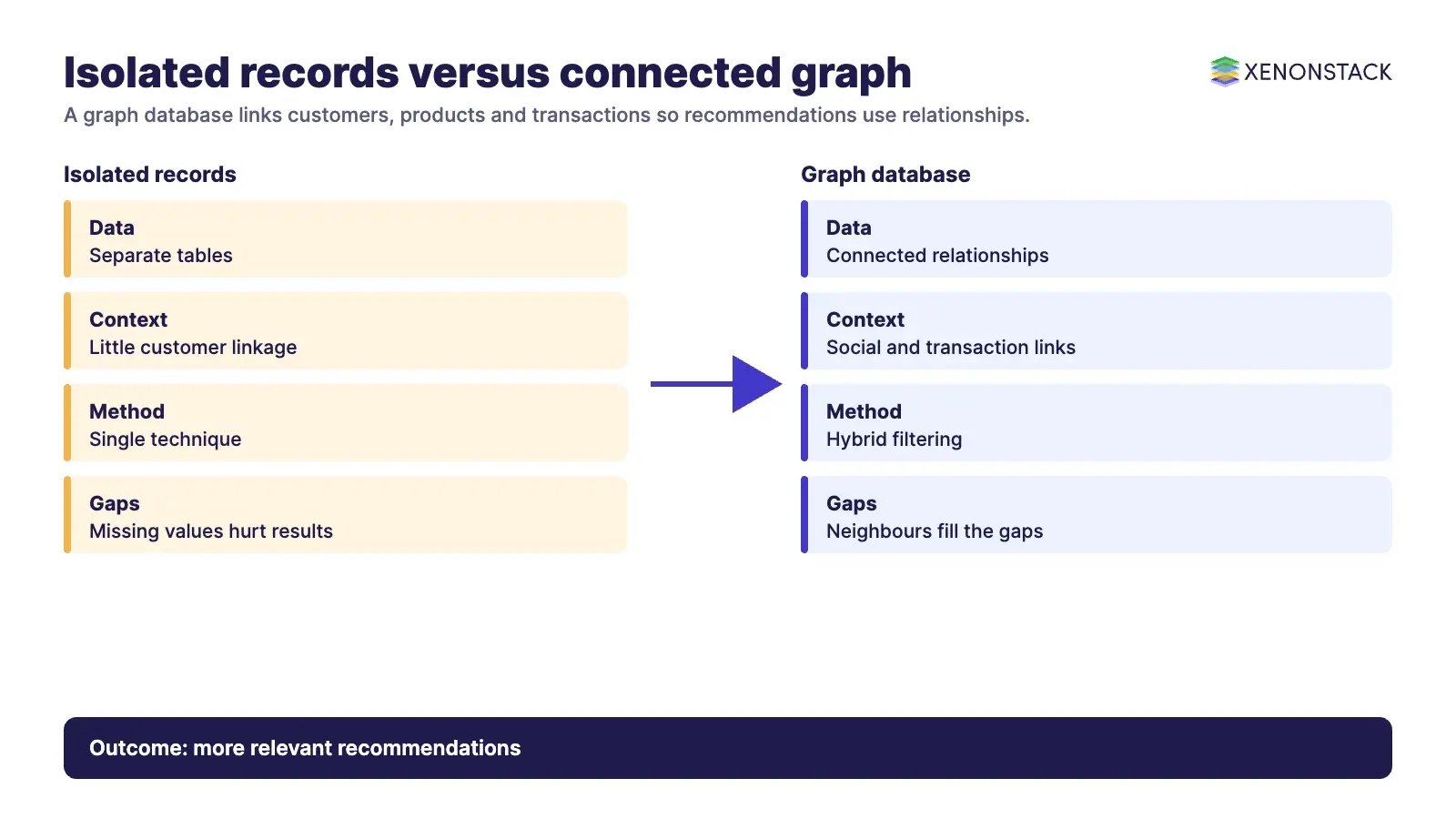
For executives, the value is relevance at scale: customers see more suitable products, and the business learns more from every interaction.
What challenges arise when building a recommendation system?
Most programmes struggle with the data before they struggle with the model.
| Challenge | What it means in practice |
|---|---|
| Collecting data | Gathering behaviour, transaction and product signals from many sources |
| Storing data | Holding relationships as well as records, so connections are not lost |
| Analysing data | Finding patterns across customers, products and time |
| Filtering data | Removing noise so only relevant options are shown |
| Missing values | Making sensible recommendations when information is incomplete |
How does a hybrid recommendation platform work?
The recommended approach is a hybrid platform, not one that is only collaborative or only content-based. It combines several techniques, each contributing a different signal.
| Technique | What it does |
|---|---|
| Link analysis | Collects information about a customer's social circle |
| Transaction tracking | Follows interactions between a customer and a merchant in the graph, yielding data that serves recommendations and other uses, for example when a customer travels often |
| Content-based filtering | Recommends products similar to what the customer already owns |
| Collaborative filtering | Tracks behaviour patterns across customers and recommends a new product to customers with similar tastes |
Where else do graph databases add value?
The same connected-data foundation supports many enterprise uses beyond recommendations. These include fraud detection, knowledge graphs, master data management, identity and access management, supply chain transparency, regulatory compliance, and network and infrastructure monitoring. Graph processing engines and algorithms such as PageRank power much of this work, alongside machine learning. Teams building these capabilities often pair them with governed context for agents and analytics through ElixirData.
How should leaders get started?
Start with one customer journey, map the connections that matter, and choose the signals your hybrid approach will combine. If you want to frame the data and context decisions first, join our Context Workshop.
FAQ
What is a recommendation system?
A recommendation system is any rating system that anticipates a person's preferred options from the information available, and it is widely used in social media, online commerce and video streaming.
Why use a graph database for recommendations?
A graph database stores connected data, so the system can follow relationships between customers, products and transactions and give quicker access to the related information that recommendations need.
What is a hybrid recommendation system?
A hybrid recommendation system combines collaborative filtering, content-based filtering, link analysis and transaction tracking, so it does not rely on a single technique.
What is the difference between content-based and collaborative filtering?
Content-based filtering recommends products similar to what the customer already owns, while collaborative filtering uses behaviour patterns across customers to recommend items that similar customers liked.
What challenges should we plan for?
Plan for collecting, storing, analysing and filtering data, and for handling missing values, because data quality shapes recommendation quality more than the model alone.
Ready to put AI agents to work? See an ElixirClaw demo: the agentic OS to build, orchestrate and govern AI agents across your enterprise systems.
Explore the XenonStack platform family: ElixirData · ElixirClaw · ElixirHub · NexaStack · MetaSecure · Neural AI · AgentGRC · AgentSRE · AgentAnalyst · AgentInstruct · AgentRAI · AgentScrum · AgentSearch · AgentForce · AI Aviator · SAIF Aviator · CohortIQ · XenonStack AI · XenonStack UAE