Key takeaway
- Compare edge AI development companies using their own sites: NVIDIA, Intel, Siemens, IBM, Cognex and NexaStack, plus how to choose and a 2027 outlook.
Edge AI development companies fall into five groups: silicon and module makers, industrial automation vendors, machine vision specialists, enterprise infrastructure and services firms, and agentic platforms. The right choice depends on where the model has to run, who operates it afterwards, and how much of the stack you want to own. This guide describes six vendors strictly as their own pages describe them, and gives CIOs, CTOs and architects a way to compare them.
Edge AI means running models on or near the device that produces the data, as covered in our guides to edge computing and IoT edge analytics. We do not rank the vendors below. A ranking would need independent evidence that we could not source, so the list is ordered by layer of the stack, not by merit.
What do edge AI development companies actually provide?
IBM describes edge AI as deploying AI algorithms and models directly on local edge devices, which allows real-time data processing and analysis without constant reliance on cloud infrastructure (according to its site). Companies that build this for you differ mainly in the layer they sell.
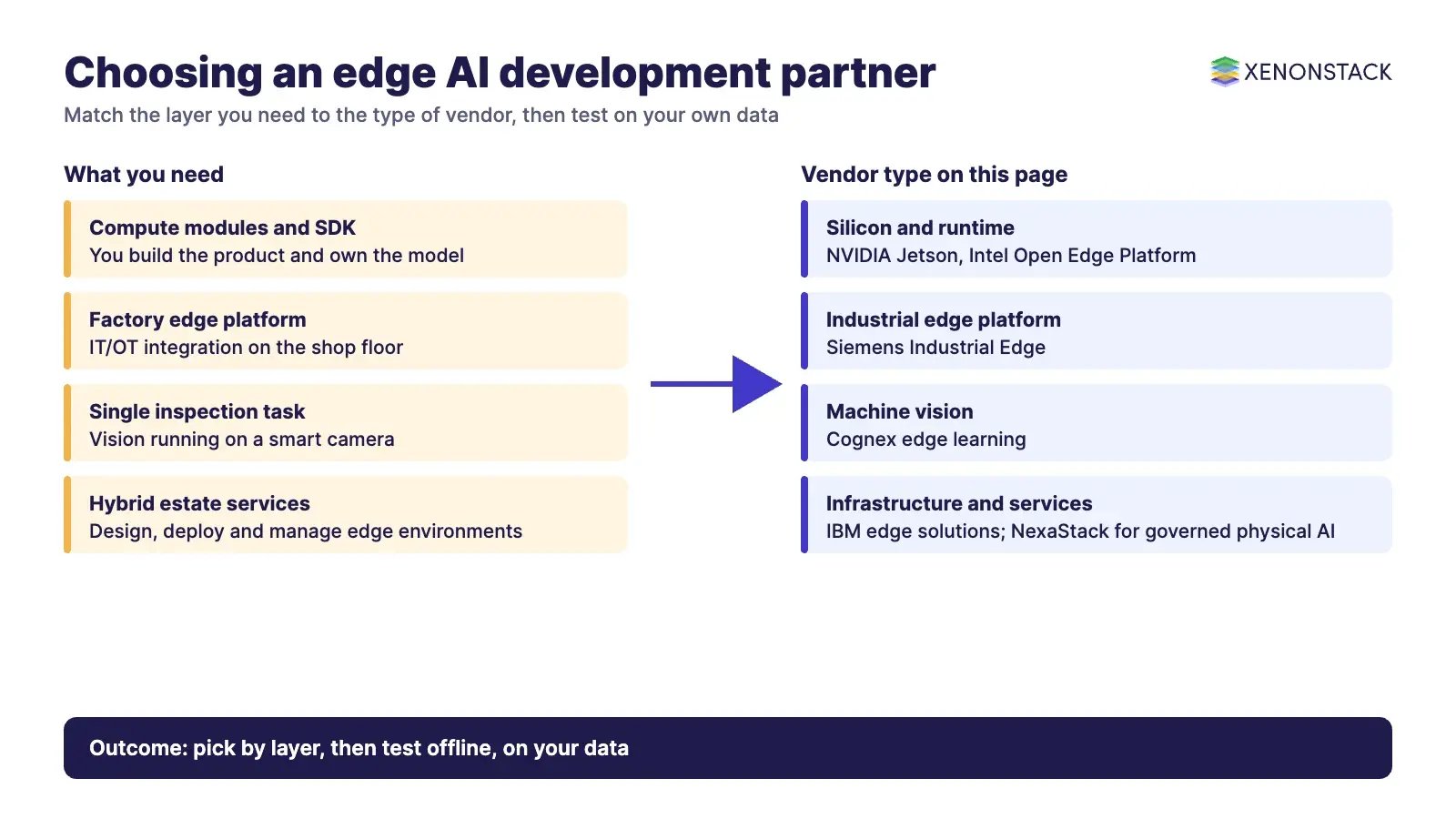
| Layer | What you buy | When it fits | Vendors on this page |
|---|---|---|---|
| Silicon and modules | Compute modules, SDKs and runtimes | You build the product and own the model | NVIDIA, Intel |
| Industrial edge platform | Managed edge runtime for the shop floor | You run factories and need IT/OT integration | Siemens |
| Machine vision | Inspection on a smart camera | One defined inspection task | Cognex |
| Enterprise infrastructure and services | Design, deploy and manage edge environments | Hybrid cloud estate, limited in-house edge skills | IBM |
| Agentic platform for physical AI | Governed operation of machines across cloud and edge | You need policy and control above the models | NexaStack |
Which edge AI companies are worth shortlisting?
Every statement below comes from the vendor's own page, read on 12 November 2026. Where a page said little, we say little.
NVIDIA
According to its site, NVIDIA calls Jetson the leading platform for robotics and edge AI applications: a family of compact edge AI computers supported by the JetPack SDK. The lineup runs from Jetson Orin Nano to AGX Thor, and the page names use cases from manufacturing and construction to healthcare and delivery. It suits teams building their own robots, drones or vision systems.
Intel
Intel describes its Open Edge Platform as an Intel-based, partner-enabled, secure, optimised open platform for the edge, and says its OpenVINO toolkit is a built-in runtime for optimising vision and agentic AI models for its silicon (according to its site). It also offers Edge AI Libraries for building multimodal edge applications.
Siemens
According to its site, Siemens Industrial Edge is an edge computing platform designed to optimise factory operations, combining Siemens and partner hardware, software and connectivity. The page lists AI models for defect detection and monitoring, centralised management of distributed apps and devices, and IT/OT integration with ERP, MES and SCADA systems. Our smart factory guide covers this setting in more depth.
IBM
IBM's edge AI page lists edge computing solutions and Edge Infrastructure Services, described as designing, deploying and managing secure edge environments that integrate with a hybrid cloud and AI strategy (according to its site).
Cognex
Cognex describes edge learning as AI placed at the edge, on a smart camera in machine vision applications, processing data on the device (according to its site). It is a narrow, task-specific option rather than a general edge platform.
XenonStack and NexaStack
NexaStack is an agentic operating platform for physical AI that runs across on-premises, cloud and hybrid environments. It is our own product, so weigh the description accordingly and compare it with the vendors above on the same criteria. Our agentic AI at the edge guide explains the architecture.
How should an enterprise choose an edge AI partner?
Score every shortlisted vendor against the same questions, and ask for evidence from your own data and devices, not a demo.
| Question | Why it matters | Evidence to ask for |
|---|---|---|
| Where does the model run, and what happens offline? | Edge AI is chosen to work without constant cloud reliance | A test with the network cut |
| Who owns the model, data and updates? | Lock-in sits in the runtime and SDK | Export and portability terms |
| How are fleets managed and secured? | Thousands of devices need central control | Update, rollback and access design |
| How are model decisions governed and traced? | Regulators and auditors ask for records | Decision logs and policy controls |
| Does it integrate with your IT/OT estate? | Pilots stall at integration | Reference integrations with your systems |
| How will you test agents and models before and after go-live? | Quality drifts after changes | Benchmarks on your own workflows |
For the last row, AgentEvaluation scores and benchmarks enterprise AI agents before and after they go live, according to its page. Our Edge AI implementation guide covers the delivery steps.
What are the trade-offs, and when is edge AI not the answer?
- Cloud may be enough. If latency, connectivity and data residency are not constraints, central inference is simpler to run.
- Fleet operations cost effort. Updating and monitoring many devices is a standing operational task, not a one-off project.
- Privacy is not automatic. Keeping data on the device helps, but training and updates may still move data. See edge AI vs federated learning.
- Single-vendor stacks narrow your options. A vision camera, a robot module and a plant platform are different purchases.
Retail teams weighing store-level deployments can read our edge AI in retail operations guide.
What will change in edge AI development over the next 3 to 5 years?
The table uses only dated, published sources. Where a source gives a forecast, it is labelled as one.
| Change | Source and date | What it means for buyers |
|---|---|---|
| More connected devices: about 21.1 billion at end 2025 (forecast), 39 billion by 2030, 13.2% CAGR | IoT Analytics, 28 October 2025 | Fleet management becomes the main edge cost |
| Edge cloud standards: ETSI released its first MEC Phase 4 specifications and a white paper | ETSI MEC, 31 October 2025 | Ask vendors which open standards they follow |
| EU AI Act high-risk rules now apply from 2 December 2027 (Annex III) and 2 August 2028 (Annex I), after the AI Omnibus entered into force on 27 July 2026 | European Commission | Plan decision records and controls into edge designs now |
| Vendor direction: NVIDIA lists AGX Thor and a new Orin Nano 2 for entry-level edge AI; Intel positions OpenVINO for vision and agentic models | Vendor pages above, read 12 November 2026 | Hardware roadmaps are moving towards agentic and physical AI workloads |
The outlook is our reading of these sources, not a forecast of any vendor's results. Related reading: edge computing architecture and 2026 outlook.
Edge decisions also need governed context and an audit trail: ElixirData Context OS keeps governed context, versioned policy and decision traces in one decision layer above AI agents. To map one edge decision your agents should make, and the context and policy it depends on, book a Context Workshop. See what happens in the workshop.
What should you plan for in 2027?
The European Commission page on the AI Act, last updated 19 October 2026, gives the dates that matter most for edge deployments.
- 2 December 2027: the Commission page says high risk rules for Annex III use cases, which include critical infrastructure, apply from this date, following the AI Omnibus that entered into force on 27 July 2026.
- 2 August 2028: rules for AI embedded in regulated products have an extended transition period until this date.
- By 2027: the same page says the EU evaluation capacity for AI models is expected to be operational by 2027.
Build decision records and controls into edge designs during 2027 rather than after.
Frequently asked questions
What do edge AI development companies do?
They supply the hardware, runtime, platform or services needed to run AI models on or near devices, so data can be processed locally instead of constantly relying on cloud infrastructure.
Is this a ranking of the best edge AI companies?
No. We could not source an independent ranking, so vendors are grouped by layer and described from their own pages.
Which company suits manufacturing?
Siemens describes Industrial Edge for factory operations, and Cognex describes edge learning on smart cameras for machine vision. NVIDIA and Intel supply the modules and runtimes if you build your own system.
How many connected devices will edge AI have to serve?
IoT Analytics forecasts about 39 billion connected IoT devices by 2030, up from about 21.1 billion at the end of 2025.
Does the EU AI Act affect edge AI systems?
It can, depending on the use case. The Commission lists high-risk rules applying from 2 December 2027 for Annex III use cases and 2 August 2028 for AI in regulated products. Check your own classification with counsel.
Follow XenonStack on LinkedIn: XenonStack on LinkedIn for new guides on agentic AI, data and platform engineering.
Ready to put AI agents to work? Explore ElixirClaw, the agentic OS platform to build, orchestrate and govern AI agents.
Explore the XenonStack platform family: ElixirData · ElixirClaw · ElixirHub · NexaStack · MetaSecure · Neural AI · AgentGRC · AgentSRE · AgentAnalyst · AgentInstruct · AgentRAI · AgentScrum · AgentSearch · AgentForce · AI Aviator · SAIF Aviator · CohortIQ · XenonStack AI · XenonStack UAE