Key takeaway
- DevSecOps for enterprise teams: a stage-by-stage pipeline, current tools, governance with NIST SSDF, SLSA and the EU CRA, and a practical adoption plan.
DevSecOps is the practice of building security into every stage of software delivery, from planning and code through build, release and production, so that security checks run automatically in the same pipeline as tests and deployments. Developers, operations and security teams share responsibility, and most issues are caught when they are cheapest to fix: before code reaches production.
In 2026 DevSecOps is less about buying scanners and more about software supply chain integrity, policy as code and evidence. Frameworks such as the NIST Secure Software Development Framework and SLSA, the OWASP Top 10:2025 and the EU Cyber Resilience Act now shape what a pipeline must prove. This guide gives enterprise leaders and architects the pipeline, the tools, the governance model and an adoption sequence.
What is DevSecOps and how is it different from DevOps?
DevOps joined development and operations to release software faster and more reliably. DevSecOps keeps that goal but treats security as a shared, automated part of the pipeline rather than a gate at the end. The difference shows up in timing, ownership and evidence.
| Aspect | DevOps | DevSecOps |
|---|---|---|
| Main focus | Speed and reliability of delivery | Speed, reliability and security of delivery |
| When security happens | Often late, in a separate review or penetration test | Every stage, from threat modelling to runtime monitoring |
| Who owns security | A separate security team | Shared by development, operations and security, with security setting policy |
| How controls run | Manual reviews and tickets | Automated scans and policy gates in CI/CD |
| Evidence | Reports gathered before audits | Pipeline records, signed artefacts and provenance produced on every build |
If you are choosing between the terms DevSecOps and SecDevOps, our comparison of DevSecOps vs SecDevOps explains where each puts the emphasis.
What has changed in DevSecOps since 2024?
Several standards and tools that DevSecOps teams rely on have moved on. Leaders reviewing an existing programme should check these first.
| Change | What it means | Current status |
|---|---|---|
| NIST SSDF version 1.2 | SP 800-218 Rev. 1 is the draft of SSDF version 1.2, the first revision since version 1.1 | Initial public draft published 17 December 2025; comments closed 30 January 2026. Version 1.1 (February 2022) remains final |
| SSDF profile for generative AI | SP 800-218A extends the SSDF with practices for producers of AI models and AI systems | Final, July 2024 |
| SLSA 1.2 | SLSA now has a Source track alongside the Build track | Version 1.2 is current; version 1.1, with only the Build track, is retired |
| OWASP Top 10:2025 | The 2025 list adds A03 Software Supply Chain Failures and A10 Mishandling of Exceptional Conditions | Released; replaces the 2021 list |
| EU Cyber Resilience Act | The CRA requires manufacturers to handle vulnerabilities across the product lifecycle | In force 10 December 2024; reporting of actively exploited vulnerabilities from 11 September 2026; main obligations from 11 December 2027 |
| Opsgenie | Alerting and on-call tool used in many incident workflows | End of sale 4 June 2025, end of support 5 April 2027; Atlassian recommends Jira Service Management |
| kube-hunter | Kubernetes penetration testing tool | No longer under active development; the project points to Trivy |
| Terrascan | Infrastructure as code scanner | Archived on 20 November 2025 and no longer maintained |
| Vendor names | Tools that changed owner or brand | ZAP is now ZAP by Checkmarx; HCL AppScan is sold by HCLSoftware; Fortify is now OpenText Fortify SAST |
What does a DevSecOps pipeline look like, stage by stage?
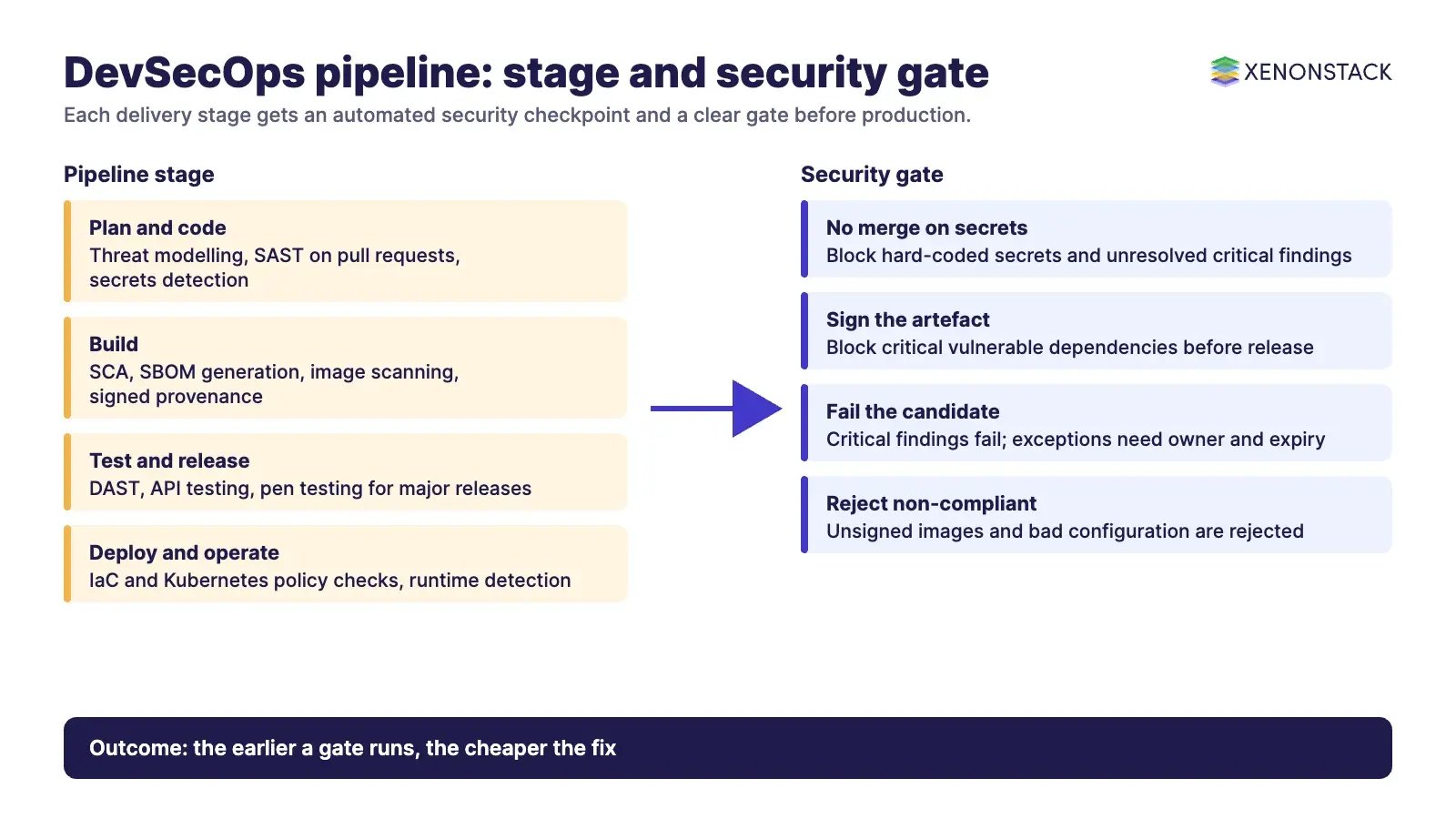
A DevSecOps pipeline adds a security checkpoint to each stage of the software delivery lifecycle. Early stages give developers fast feedback; later stages enforce policy before anything reaches production. The table shows a practical baseline.
| Stage | Security checkpoint | Typical gate |
|---|---|---|
| Plan | Threat modelling, security acceptance criteria, risk rating of the change | High-risk changes need a security review before work starts |
| Code | Static analysis (SAST) in the IDE and on pull requests, secrets detection, security-aware code review | No merge with hard-coded secrets or unresolved critical findings |
| Build | Software composition analysis (SCA), SBOM generation, container image scanning, signed build provenance | Block known exploited or critical vulnerable dependencies; sign the artefact |
| Test | Dynamic testing (DAST), API security testing, fuzzing for exposed parsers | Critical findings fail the release candidate |
| Release | Penetration testing for major releases, residual risk sign-off, compliance evidence | Exceptions recorded with an owner and expiry date |
| Deploy | Infrastructure as code and Kubernetes policy checks, signature verification at admission | Unsigned images or non-compliant configuration are rejected |
| Operate | Runtime threat detection, SIEM and XDR monitoring, log retention, vulnerability rescans | Incidents and new vulnerabilities feed back into the backlog with service levels |
Penetration testing still has a place at release time; our guide to penetration testing covers scope and methods. The principle behind the table is fail fast, fix fast: the earlier a gate runs, the cheaper and less disruptive the fix.
Which DevSecOps tools fit each job?
Aim for one tool per job, integrated with your source control and CI/CD platform, rather than many overlapping scanners. The examples below use current product names; choose by language coverage, false-positive rate, integration with your pipeline and how findings reach developers.
| Job | What it does | Examples | When it fits |
|---|---|---|---|
| SAST | Scans source code for insecure patterns | GitHub CodeQL, SonarQube, Checkmarx One, OpenText Fortify SAST, HCL AppScan | Every repository; run on pull requests |
| SCA and SBOM | Finds vulnerable or unlicensed open source dependencies and lists components | Trivy, Black Duck, Checkmarx One, Veracode | Every build; required evidence for regulated products |
| DAST and API testing | Tests running applications and APIs from the outside | ZAP, Burp Suite, HCL AppScan | Web applications and public APIs before release |
| Container and IaC scanning | Checks images, Terraform, Helm and Kubernetes manifests | Trivy, Checkov | Any cloud or Kubernetes workload |
| Secrets management | Stores and rotates credentials outside code | HashiCorp Vault, AWS Secrets Manager | All pipelines and services |
| Signing and provenance | Signs artefacts and records how they were built | Sigstore (Cosign, Fulcio, Rekor), in-toto, SLSA provenance | Before you distribute software or deploy to production |
| Policy as code | Enforces rules for builds, infrastructure and clusters | Open Policy Agent, Kyverno | Once teams agree what must block a release |
| Runtime detection | Detects suspicious behaviour in containers and hosts | Falco, SIEM and XDR platforms | Production workloads |
| Open source project health | Scores dependencies on security practices | OpenSSF Scorecard | Choosing or reviewing critical dependencies |
Open Policy Agent, Kyverno, Falco and in-toto are all graduated projects of the Cloud Native Computing Foundation, which means they are considered stable for production use. For the application layer itself, see our application security best practices.
How should DevSecOps be governed?
Governance turns individual scans into a programme leaders can rely on. It answers four questions: which rules apply, who can grant an exception, how fast findings must be fixed, and what evidence proves it.
- Policy as code: write release rules (for example, no critical vulnerabilities, signed images only) as code in the pipeline so they are versioned, reviewed and applied the same way everywhere.
- Exceptions with expiry: every waived finding needs an owner, a reason and an end date, recorded where auditors can see it.
- Vulnerability service levels: agree fix times by severity and exploitability, and report against them.
- Evidence by default: keep SBOMs, scan results, signatures and provenance for each release, mapped to SSDF practices.
- Security champions: name a trained engineer in each team who owns security questions and feeds lessons back.
As AI agents begin to triage alerts, open pull requests or approve changes, the same governance must cover their actions. AgentGRC keeps autonomous agent actions inside policy, with the audit trail risk teams need.
Which frameworks and regulations should you map to?
| Framework | What it covers | When it fits |
|---|---|---|
| NIST SSDF (SP 800-218) | Secure development practices across the lifecycle; version 1.1 final, version 1.2 in draft | Any organisation that develops or buys software |
| NIST SP 800-218A | SSDF practices for generative AI and foundation models | Teams building or buying AI models and AI systems |
| SLSA 1.2 | Build and source integrity levels for software artefacts | Anyone publishing or consuming software at scale |
| OWASP Top 10:2025 | The most critical web application security risks | Developer training and scanner coverage checks |
| CISA Secure by Design pledge | Seven goals, including MFA, removing default passwords, reducing classes of vulnerability, patches, disclosure policy, accurate CVEs and evidence of intrusions | Software vendors that want a public commitment |
| EU Cyber Resilience Act | Cybersecurity requirements and vulnerability handling for products with digital elements | Anyone placing hardware or software products on the EU market |
How does DevSecOps apply to microservices and cloud-native applications?
Cloud-native systems move much of the attack surface into APIs, identities and orchestration. The pipeline should therefore test and enforce controls at those layers as well as in code.
- API security: use OAuth 2.0 and OpenID Connect for authentication, rate limiting and an API gateway, and test APIs with DAST in the pipeline.
- Identity and access: apply least privilege and role-based access to pipelines, cloud accounts and clusters, with MFA for people and short-lived credentials for workloads.
- Kubernetes: enforce admission policies with Open Policy Agent or Kyverno, verify image signatures before deployment, apply network policies and watch runtime behaviour with Falco.
- Service mesh: Istio or Linkerd, both CNCF graduated, provide mutual TLS between services without changes to application code.
Runtime findings land in the security operations centre, so pipeline and SOC tooling should share context. Our overview of Microsoft Sentinel shows how a cloud SIEM collects and acts on these signals, and MetaSecure AI is powered by modular AI agents and protocol-driven automation for round-the-clock coverage.
How should teams handle AI-generated code and AI agents in the pipeline?
AI coding assistants and agents now write code, propose dependency updates and open pull requests. Treat their output like any other untrusted contribution: it passes the same SAST, SCA, secrets and review gates, and it is attributed so you can trace which changes came from which tool. NIST SP 800-218A adds AI-specific secure development practices for producers and acquirers of AI models and AI systems.
Where agents act on the pipeline itself, give them scoped, short-lived credentials and keep a human approval step for production changes. ElixirClaw is an agentic OS platform to build, orchestrate and govern AI agents and automation workflows while keeping humans in control.
How should an enterprise adopt DevSecOps?
A staged rollout avoids the most common failure: switching on every scanner at once, flooding developers with findings and losing their trust.
- Inventory: list applications, repositories, pipelines and owners, and rate each by business risk.
- Baseline scans in report-only mode: add secrets detection, SCA and SAST to pull requests without blocking, and tune rules to cut false positives.
- Turn on blocking gates: block hard-coded secrets and critical, exploitable findings first; widen the gate as noise falls.
- Secure the supply chain: generate SBOMs, sign artefacts and record build provenance; verify signatures at deployment.
- Policy as code: move release, infrastructure and cluster rules into versioned policy.
- Measure and report: track mean time to fix by severity, exception counts and gate pass rates, and review them with engineering leaders each quarter.
What are the trade-offs, and when should you hold back?
- Tool sprawl: overlapping scanners produce duplicate findings and cost. Consolidate before adding more.
- False positives: a gate that blocks on noise teaches developers to bypass it. Keep new rules in report-only mode until they are tuned.
- Pipeline speed: full DAST or deep SAST on every commit can slow delivery. Run fast checks on pull requests and deeper scans nightly or before release.
- Culture before tooling: without shared ownership, DevSecOps becomes a new queue for the security team. Name champions and agree service levels first.
- When not to gate: prototypes and internal experiments can run lighter controls, as long as they cannot reach production data or customers without passing the full pipeline.
To map the security and release decisions your pipelines and agents make, and the policy each depends on, book a Context Workshop. See what happens in the workshop.
Frequently asked questions about DevSecOps
What is DevSecOps in simple terms?
DevSecOps is DevOps with security built into every stage of the delivery pipeline. Threat modelling, code scanning, dependency checks, policy gates and runtime monitoring run automatically alongside build and deployment, and developers, operations and security teams share responsibility for the result.
How is DevSecOps different from DevOps?
DevOps joins development and operations to ship software faster. DevSecOps adds security as a shared, automated part of the same pipeline, so checks run on every commit and build rather than as a separate review just before release.
Which frameworks should a DevSecOps programme map to?
A practical set is the NIST Secure Software Development Framework (SP 800-218, with version 1.2 in draft since December 2025) for development practices, SLSA for build and source integrity, the OWASP Top 10:2025 for application risk, and the EU Cyber Resilience Act for anyone selling products with digital elements in the EU.
What does the EU Cyber Resilience Act mean for DevSecOps teams?
The Act entered into force on 10 December 2024. Manufacturers must report actively exploited vulnerabilities from 11 September 2026, and the main obligations apply from 11 December 2027. Teams need lifecycle vulnerability handling and evidence they can show to assessors.
Which DevSecOps tools have been retired or changed recently?
Atlassian stopped selling Opsgenie on 4 June 2025 and ends support on 5 April 2027. kube-hunter is no longer under active development and points users to Trivy. Terrascan was archived on 20 November 2025. ZAP is now ZAP by Checkmarx, AppScan is sold by HCLSoftware and Fortify by OpenText.
Where should an enterprise start with DevSecOps?
Start with an inventory of applications and pipelines, add secrets detection, dependency scanning and SAST in report-only mode, then turn on blocking gates for critical findings once false positives are tuned. Add signing, provenance and policy as code next, and measure fix times against agreed service levels.
Explore the XenonStack platform family: ElixirData · ElixirClaw · ElixirHub · NexaStack · MetaSecure · Neural AI · AgentGRC · AgentSRE · AgentAnalyst · AgentInstruct · AgentRAI · AgentScrum · AgentSearch · AgentForce · AI Aviator · SAIF Aviator · CohortIQ · XenonStack AI · XenonStack UAE