Key takeaway
- Data governance for business-ready data: owners, policies, quality, metadata and access controls that make data trusted for analytics and AI.
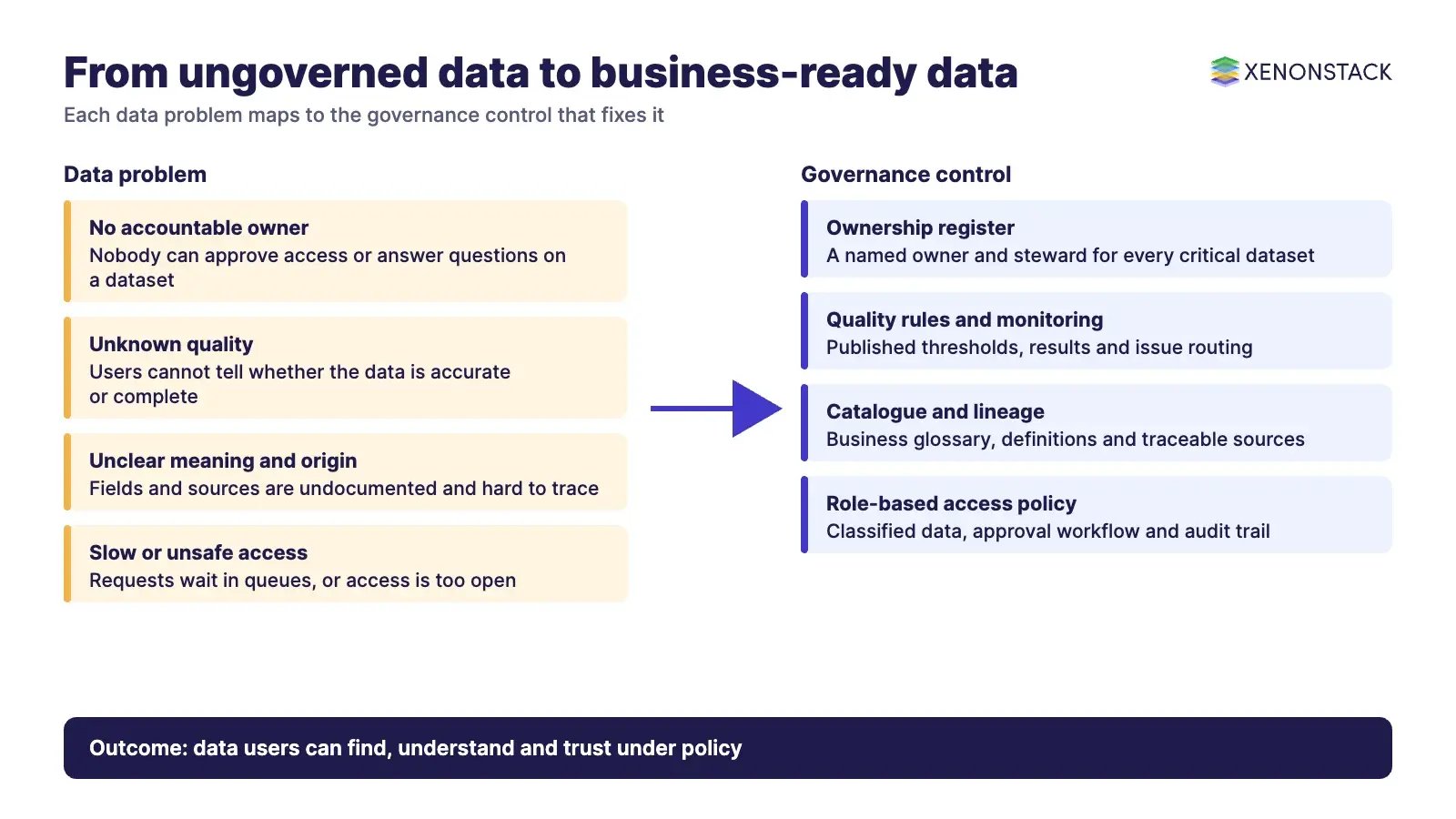
Data governance is the set of owners, policies, standards and controls that decide who is accountable for data, how good it must be, who may use it and how its use is evidenced. Business-ready data is the result: data that a decision maker, an analyst or an AI agent can find, understand, trust and use under policy, without a manual clean-up each time. Compliance is one outcome of governance, not the goal of it.
For a CIO or Chief Data Officer, the practical question is sequence. Name accountable owners first, then set measurable quality rules, then make metadata and access policy visible in a catalogue, and only then automate enforcement. This guide covers each step, the 2026 context of AI and privacy rules, and the trade-offs. For the term itself, see our data governance glossary entry.
What does business-ready data mean?
Business-ready data meets a short list of conditions that a business user can check without asking engineering. The table turns each condition into a test you can assign to an owner.
| Condition | Test a business user can apply | Governance control behind it |
|---|---|---|
| Accurate and complete | Does the dataset publish its quality rules and current results? | Quality metrics, monitoring and a named steward |
| Findable | Can I find it by business name, not table name? | Catalogue and business glossary |
| Understood | Do I know where it came from and what each field means? | Metadata and lineage |
| Accessible under policy | Can I get it quickly, and only if I should? | Role-based access and approval workflow |
| Accountable | Is there one named owner I can ask? | Ownership register and decision rights |
Why is compliance alone not enough?
Compliance sets a floor. It tells you which records you must be able to produce, not how to make data useful. The two are linked, though: you cannot answer a regulator or a customer request on data you cannot locate or explain.
The California Attorney General's CCPA page, for example, lists consumer rights to know, delete, correct and opt out of sale or sharing, and says businesses must respond to know, delete and correct requests within 45 calendar days (extendable once by 45 days) and to opt-out requests within 15 business days. Meeting those deadlines depends on knowing where personal data sits and who owns it. That is a governance capability. See the California Attorney General CCPA page for the current text. For the EU's GDPR, start from the official regulation on EUR-Lex and take legal advice on your obligations.
AI adds a second driver. As reported by the AI Act explorer, Article 10 of the EU AI Act requires training, validation and testing data for high-risk AI systems to be subject to data governance and management practices appropriate to the intended purpose. These include data origin, preparation steps such as labelling and cleaning, bias examination and identifying data gaps. Check the application dates for your systems against the official text.
What are the pillars of data governance?
Two views are useful together. The first is what you govern: ownership, stewardship, quality, security and lifecycle. The second is what carries it: people, process, technology and policy.
| Element | What it decides | Typical accountable role |
|---|---|---|
| Ownership | Who is accountable for a domain's data and who approves access | Business data owner |
| Stewardship | Day-to-day definitions, quality rules and issue triage | Data steward |
| Quality | Fitness for use, measured against agreed thresholds | Steward with engineering |
| Security and privacy | Classification, masking, retention and access rules | CISO and privacy office |
| Lifecycle | Creation, retention, archive and deletion | Owner with records management |
Roles in the last column are a common pattern, not a standard. Your operating model may differ.
How does data governance differ from data management?
Governance sets decision rights, policies and standards. Management carries them out through pipelines, storage, integration and operations. DAMA International describes its DAMA-DMBOK as a framework of principles, practices and functions for building and governing data programmes, which is a useful reference for the split.
How do you build business-ready data?
Make quality measurable
Agree quality rules per critical dataset, publish the results and route failures to a steward. Our guide to why data quality matters covers the business cost and the main quality dimensions.
Make metadata and lineage visible
Metadata is what turns a table into something a business user can understand. According to Microsoft's documentation, Microsoft Purview data governance pairs a Data Map, which scans sources to capture metadata, with a Unified Catalog for curating and granting access to data, with built-in data quality and lineage. The same page notes that its roles and permissions cover that metadata and not the underlying data itself, so access control on the data store remains a separate task. For tool choice, see our enterprise data catalogue tools guide and the open and unified metadata platform overview.
Open access with guardrails
Self-service analytics needs access that is fast for approved uses and refused for the rest. Define classifications, map them to roles, and automate approval for low-risk data. Keep sensitive data behind explicit owner approval.
Treat data pipelines like software
Governance rules that live only in documents drift. Version them, test them in the pipeline and monitor them in production. Our Data DevOps guide shows how version control, automated tests and observability apply to data.
Build data literacy
Train users to read definitions, quality scores and lineage before they build on a dataset. Governance that only the data team understands is rarely followed.
What has changed with AI agents?
Agents read and act on data at machine speed, so a policy that a person would apply from judgement must now be applied by the system. This moves governance from periodic review to runtime control. ElixirData Context OS keeps governed context, versioned policy and decision traces in one decision layer above AI agents, and AgentGRC keeps autonomous agent actions inside policy, with the audit trail risk teams need. For how agents can help the governance function itself, read agentic AI in data governance and compliance.
Which approach fits your organisation?
| Model | When it fits | Main trade-off |
|---|---|---|
| Centralised council | Early programmes, heavy regulation, few data domains | Can become a bottleneck |
| Federated, domain-owned | Many domains with strong local expertise | Needs shared standards and tooling to stay consistent |
| Policy-as-code with agents | AI workloads and fast-changing pipelines | Needs mature metadata first |
What is a sensible adoption sequence?
- Pick the critical data. Start with the datasets behind your top decisions, reports or AI use cases.
- Name owners and stewards. Write down who decides access and who fixes issues.
- Set quality and access rules. Keep them few, testable and tied to a business outcome.
- Catalogue and trace. Capture definitions, lineage and classifications for those datasets.
- Automate checks. Move rules into pipelines and access workflows.
- Review on value. Track time to find data, issues closed and requests answered on time, then widen the scope.
Video: Data Governance and enterprise information management, from XenonStack.
What are the challenges, and when should you hold back?
- Over-policing. Controls that slow every request push users to shadow copies. Tier controls by data sensitivity.
- Compliance versus speed. Automate the routine checks so people review only exceptions.
- Tool cost and sprawl. Start with the capability you need, not the largest platform.
- Culture. Silos and unclear ownership defeat any tool. Leadership sponsorship and visible quick wins matter more than the catalogue.
- When to hold back. If no one can be named as owner of a dataset, fix that before buying tooling.
Looking ahead, expect more of the routine work, such as classification, quality monitoring and policy checks, to be assisted by AI, with humans keeping decision rights. Treat vendor claims on this as product statements and test them on your own data.
To map one data decision your agents should make, and the context and policy it depends on, book a Context Workshop. See what happens in the workshop.
Frequently asked questions
What is business-ready data?
Data that is accurate, findable, understood, accessible under policy and owned by a named person, so users can rely on it without extra clean-up.
How is data governance different from data management?
Governance sets decision rights, policies and standards. Management implements them through pipelines, storage and operations.
Why does AI make data governance more important?
AI systems depend on the quality and origin of their data. As reported by the AI Act explorer, Article 10 of the EU AI Act requires data governance practices for high-risk AI systems, including data origin, preparation and bias examination.
Where should a governance programme start?
With the critical datasets behind your top decisions: name owners, set a few testable quality and access rules, then catalogue and automate.
Does a data catalogue replace governance?
No. A catalogue makes metadata visible. Microsoft's Purview documentation notes its catalogue permissions cover metadata, not the underlying data, so access control and ownership still need to be defined.
Follow XenonStack on LinkedIn: XenonStack on LinkedIn for new guides on agentic AI, data and platform engineering.
Ready to put AI agents to work? Explore ElixirClaw, the agentic OS platform to build, orchestrate and govern AI agents.
Explore the XenonStack platform family: ElixirData · ElixirClaw · ElixirHub · NexaStack · MetaSecure · Neural AI · AgentGRC · AgentSRE · AgentAnalyst · AgentInstruct · AgentRAI · AgentScrum · AgentSearch · AgentForce · AI Aviator · SAIF Aviator · CohortIQ · XenonStack AI · XenonStack UAE