Key takeaway
- Data governance in Snowflake combines access policies, tags, classification and data quality checks. See how each feature works and what to set up first.
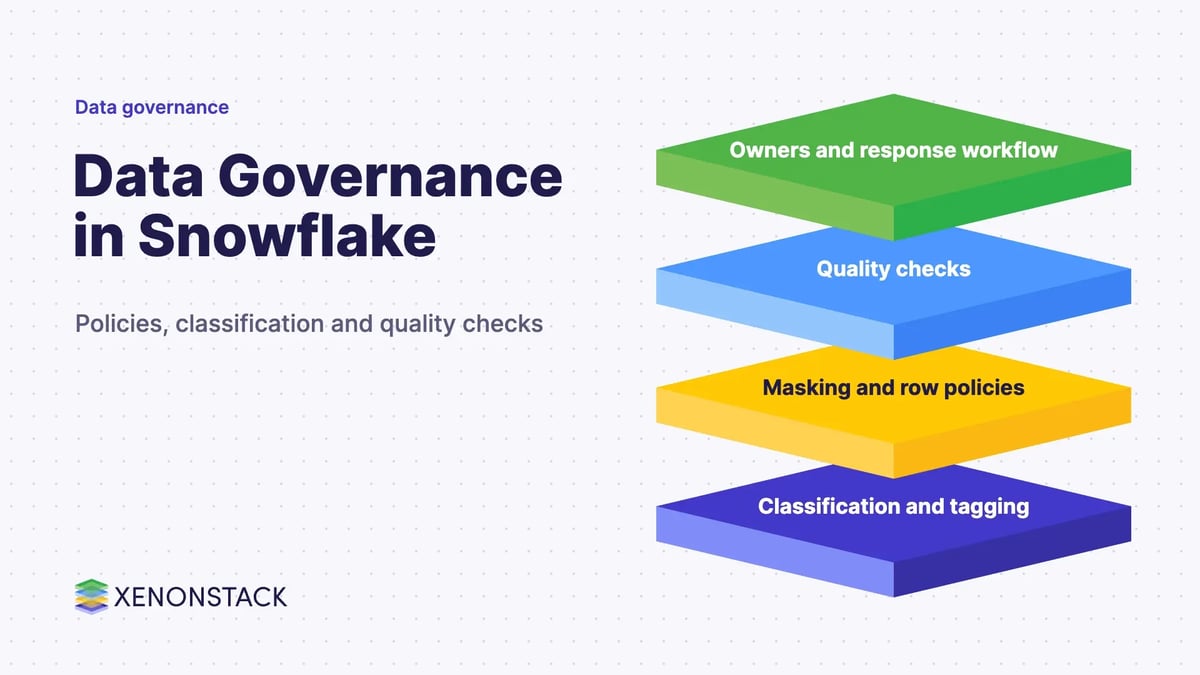
Data governance in Snowflake is the set of policies, controls and checks that decide who can see which data, how sensitive data is identified and protected, and whether the data can be trusted. Snowflake provides these as built-in features, so most of the work is deciding the rules and owning them.
This guide is for data platform owners, data stewards and analytics leaders who run Snowflake and want a clear map of its governance and data quality features. It covers what governance means, the main features, how data quality checks work, how agents fit in, and what to do first. For the wider discipline, see our guide to modern data governance.
What is data governance and why does it matter?
Data governance is the agreement on who owns data, who may use it, how it must be protected and what quality it must meet. It matters because the same data is now read by dashboards, analysts and AI systems, and each needs rules it can follow. Without them, access is granted ad hoc, sensitive data is hard to find and quality problems surface only when someone complains. Our guide to data governance for business-ready data explains how governance supports decisions.
What governance features does Snowflake provide?
The Snowflake governance overview describes a set of features that work together, available through the Governance and security area of Snowsight.
| Feature | What the documentation says it does | Governance question it answers |
|---|---|---|
| Masking policies | Apply protection to a column within a table or view | Who may see the real value? |
| Row access policies | Control which rows a query returns | Who may see which records? |
| Tag-based masking | Attach a masking policy to a tag, then set the tag on objects | Does protection follow the data? |
| Object tagging | Track sensitive data for compliance, discovery, protection and resource usage | Where is sensitive data, and who pays for what? |
| Sensitive data classification | Categorise potentially personal or sensitive data | What do we hold that needs protection? |
| Access history | Audit user access through the ACCESS_HISTORY view | Who accessed what, and when? |
| Object dependencies | Show how objects reference each other through the OBJECT_DEPENDENCIES view | What breaks if this changes? |
| Data quality monitoring | System and user-defined data metric functions monitor the state and integrity of data | Can we trust this table today? |
How does data quality monitoring work in Snowflake?
The Snowflake data quality documentation explain the building blocks. A data metric function (DMF) measures an attribute of your data, such as the number of NULL values or how often a table updates. It returns a value but does not decide whether the value is a problem. Snowflake provides system DMFs for common metrics without configuration, and you can define a custom DMF where none fits.
An expectation turns a DMF into a check: the returned value is compared with the expectation, and values that fail are reported as expectation violations. Scheduled DMFs run once an hour by default, and metric outputs are stored in an event table. Data quality monitoring requires Enterprise Edition, trial accounts do not support it, and scheduled DMFs run on serverless compute billed under the Data Quality Monitoring heading. Set thresholds from your own data, not from generic examples.
For worked patterns, see our guides to real-time data quality monitoring in Snowflake, automating data quality checks in Snowflake workflows and AI-driven data observability.
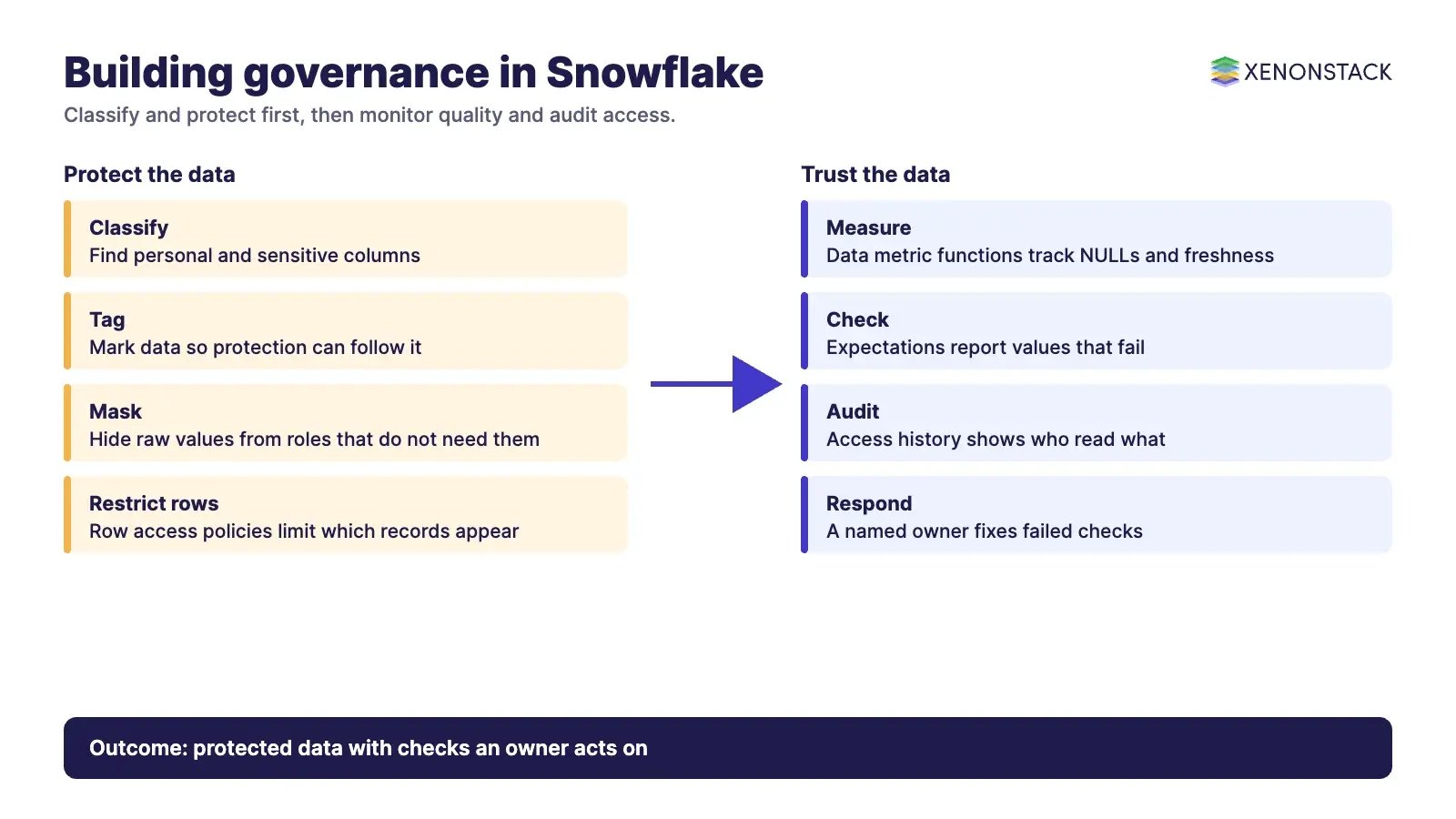
How do you build a governance framework in Snowflake?
| Step | Decision | Snowflake feature to use |
|---|---|---|
| Define standards | Which tables are critical, and what must be true of them? | Data metric functions and expectations |
| Classify | Which columns hold personal or sensitive data? | Classification and object tagging |
| Protect | Who may see raw values or full rows? | Masking and row access policies |
| Assign owners | Who fixes a failed check? | Team workflow outside the platform |
| Audit | Can you show who accessed what? | Access history |
Open the checks from the governance area of Snowsight, and see our notes on using the Snowflake web interface and agentic capabilities for the interface route. Interoperability matters too: read about Snowflake Open Catalog and Iceberg tables and scalable computer vision pipelines on Snowflake when data leaves Snowflake.
How do AI agents change data governance?
Agents are new consumers of governed data. They read tables, call tools and act on results, so every rule written for a person now applies to a system that works faster and does not tire. Masking and row access policies still limit what an agent can read. Agents can also help run governance: summarising failed checks, tracing which downstream tables a failure affects, and drafting the change a steward must approve. Keep the final decision on access and rules with a named owner. ElixirData is XenonStack's Context OS for keeping governed context, policy and decision records together above agents.
What should you do first?
- List the ten tables that matter most and name an owner for each.
- Classify the sensitive columns and tag them.
- Apply masking and row access policies to the highest-risk data.
- Add a few data metric functions with expectations on critical tables and review the first results.
- Decide who responds to a failed check and how quickly.
If you want help applying this, contact us or talk to a specialist.
To map one decision your agents make, and the data and policy it depends on, book a Context Workshop. See what happens in the workshop.
Frequently asked questions
What is data governance in Snowflake?
It is the set of policies and checks that control access, identify and protect sensitive data and monitor quality. Snowflake provides masking, row access policies, tagging, classification, access history and data metric functions for these tasks.
What is a data metric function?
A data metric function measures an attribute of your data, such as a count of NULL values. It returns a value but does not decide whether it is a problem. An expectation does that.
How often do data quality checks run?
Snowflake documentation says the default schedule runs a data metric function once every hour. You can change the schedule.
Which Snowflake edition is needed for data quality monitoring?
The documentation says data quality monitoring requires Enterprise Edition and that trial accounts do not support it.
Can governance policies apply to AI agents?
Yes. An agent that reads Snowflake data through a role is subject to the same masking and row access policies as any other user of that role.
Follow XenonStack on LinkedIn: XenonStack on LinkedIn for new guides on agentic AI, data and platform engineering.
Ready to put AI agents to work? Explore ElixirClaw, the agentic OS platform to build, orchestrate and govern AI agents.
Explore the XenonStack platform family: ElixirData · ElixirClaw · ElixirHub · NexaStack · MetaSecure · Neural AI · AgentGRC · AgentSRE · AgentAnalyst · AgentInstruct · AgentRAI · AgentScrum · AgentSearch · AgentForce · AI Aviator · SAIF Aviator · CohortIQ · XenonStack AI · XenonStack UAE