Key takeaway
- Agentic AI with Snowflake explained: how Cortex Agents, Analyst, Search and Snowpark fit together, plus governance, cost and a safe build sequence.
Agentic AI with Snowflake means building AI agents that plan, call tools and answer from data that stays inside Snowflake's governed environment. According to Snowflake's docs, Cortex Agents is a fully managed agentic platform: agents plan the work, call tools and generate responses without you building your own orchestration loop or runtime.
For an enterprise leader the question is less "can an agent query our data" and more "which decisions may it make, under whose privileges, and how do we prove what it did". This guide covers the Snowflake building blocks, a build sequence, governance and cost, and where a separate decision layer such as ElixirData helps. It builds on our guides to agentic workflows and metadata management for agentic AI.
What is agentic AI, and what does Snowflake add?
Agentic AI describes systems that do more than generate an answer: they plan steps, use tools and act on the result, with people setting the limits. Snowflake adds the data foundation and the managed agent service. Its platform has three layers, according to its key concepts page: database storage, compute in virtual warehouses, and a cloud services layer that handles security and access control, metadata management and query optimisation. Storage and compute are kept separate, and each virtual warehouse is independent of the others.
How do Snowflake Cortex Agents work?
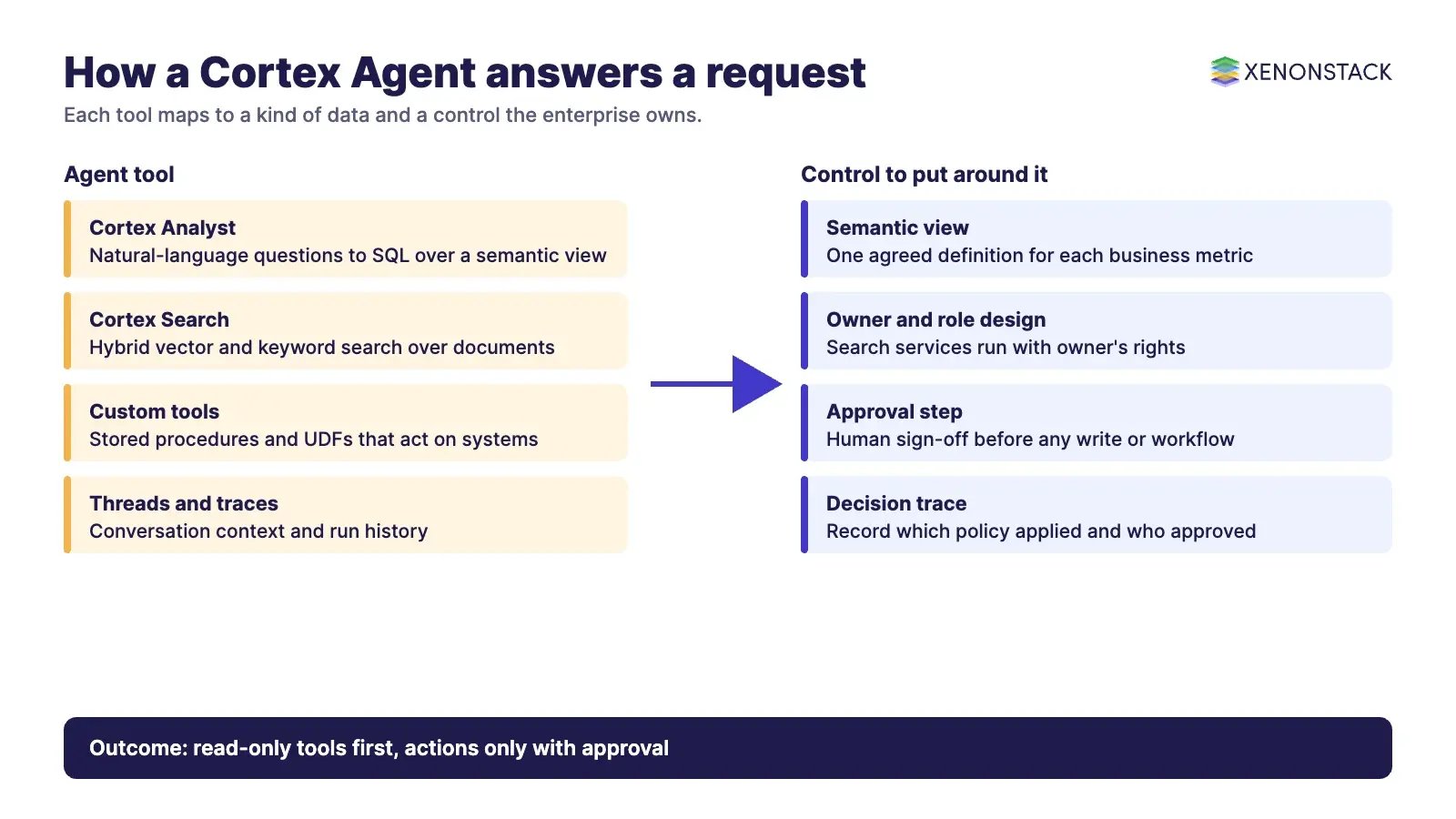
Each request follows a loop of plan, use tools, then reflect and respond. During reflection the agent decides its next step: ask a clarifying question, call another tool or give a final answer. Applications call agents through the REST API (the agent:run endpoint), and threads keep conversation context across turns so the client application does not manage state. The agent's tools are the part that decides what it can do:
| Tool | What it does, per Snowflake docs | Fits when |
|---|---|---|
| Cortex Analyst | Turns natural-language questions about structured data into SQL, using a semantic view that defines tables, metrics, relationships and verified queries. | Business questions over governed tables |
| Cortex Search | Hybrid search over your data: vector search, keyword search and semantic reranking. Snowflake manages embeddings and index refresh. | Documents, tickets and policies the agent must cite |
| Custom tools | Stored procedures and user-defined functions that implement your own logic or call backend systems. | Actions with side effects, which need the tightest controls |
The docs also list further tools, including code execution, MCP connectors and web search, and some features carry a preview label, so check the current page before you commit a design. Web search must be enabled at the account level. Snowflake also notes that the accuracy of LLM responses and citations is not guaranteed, so keep a review step for anything customer-facing.
What does the Snowflake platform contribute to agent workloads?
- One governed copy of the data. Snowflake stores structured, semi-structured and unstructured data, so a tool such as Cortex Search and a tool such as Cortex Analyst can work on the same estate.
- Fresh data. Snowpipe Streaming sends rows straight into tables. Its docs state ingest-to-query latency as low as 5 seconds for standard tables, with real results depending on row size, batching and concurrency. Classic Snowpipe suits pipelines that already write files to cloud storage and can accept higher latency.
- Code next to the data. Snowpark is available in Java, Python and Scala and pushes data transformation to Snowflake. UDFs run against the data without moving it to the client, which is how custom agent tools are usually packaged.
- Independent compute. Separate virtual warehouses let you keep agent query load away from reporting workloads.
How should an enterprise build its first agent on Snowflake?
- Choose one decision. Pick a decision that already uses Snowflake data and has a human reviewer today.
- Prepare the data. Fix quality and ownership first. Our guide to data quality checks in Snowflake workflows and the data catalog for Snowflake cover this.
- Define meaning. Write a semantic view for Cortex Analyst so that terms such as "active customer" have one definition.
- Add tools one at a time. Start with read-only tools (Analyst, Search) before any custom tool that writes or triggers a workflow.
- Run in shadow mode. Compare the agent's answers with the reviewer's decisions before it gains authority.
- Review traces and feedback. Snowflake lets you review threads, logs and traces and collect user ratings and comments, which feed evaluation.
Seamless AI Model Evaluation for Reliability and Performance

How do you govern and secure Snowflake agents?
Snowflake's docs state that data access for agents is governed by Snowflake privileges and the execution context of each tool. Callers need the SNOWFLAKE.CORTEX_USER or SNOWFLAKE.CORTEX_AGENT_USER database role plus privileges on the agent and on the objects its tools use. Cortex Analyst generated SQL is subject to the caller's role-based access control, and Cortex Search services run with owner's rights, so design who owns a service deliberately.
| Control | What the docs say | What it does not cover |
|---|---|---|
| Role-based access | Agent runs follow the caller's privileges; if a role cannot use a tool, the run can continue with the tools it can access. | Whether the action was a good decision |
| Dynamic data masking | Masking policies mask plain-text column data at query time, by role. Requires Enterprise Edition or higher. | Free text an agent writes elsewhere |
| Threads, logs and traces | Conversation context and run history can be reviewed. | Business policy and approval limits |
Platform controls answer "may this role read this data". They do not record which policy version applied to a decision or who approved an exception. That gap is where a decision layer helps: ElixirData keeps governed context, versioned policy and decision traces in one decision layer above AI agents, and AgentGRC keeps autonomous agent actions inside policy, with the audit trail risk teams need. For regulatory questions such as GDPR, CCPA or HIPAA, confirm Snowflake's current attestations on its compliance pages rather than assuming coverage. See also agentic AI risk management.
Which use cases fit, and when should you not use agents?
| Candidate decision | Why it fits | Hold back when |
|---|---|---|
| Answering metric questions from governed tables | Cortex Analyst with a semantic view; read-only | Metric definitions are still disputed |
| Searching policies, contracts or tickets with citations | Cortex Search as the retrieval layer | Source documents are stale or unowned |
| Flagging anomalies for a reviewer | Agent proposes, a person decides | The agent would act without review |
| Triggering a downstream workflow | Custom tool with approval step | No audit trail or rollback exists |
These are decision patterns, not customer results. Avoid agents where the data is poorly governed, where one wrong action is costly and unrecoverable, or where a plain SQL query or dashboard already answers the question. Analyst-style questions can also be served by AgentAnalyst, which lets teams ask questions of enterprise data in plain language and get real-time insights.
What does it cost, and what has changed?
Cortex Analyst is billed per successful message, with warehouse costs for executing the SQL on top, and usage is visible in the CORTEX_ANALYST_USAGE_HISTORY view, according to its docs. Snowflake's conversational application, described as Snowflake CoWork in the current docs and as Snowflake Intelligence elsewhere, offers resource budgets and per-user quotas. Confirm current pricing on Snowflake's pages, and compare with our FinOps for Snowflake guide.
| Area | Current direction in Snowflake docs |
|---|---|
| Cortex Analyst | Snowflake recommends transitioning to Cortex Agents, which support all Cortex Analyst capabilities. |
| Semantic layer | Semantic views are recommended; YAML semantic models remain supported for backward compatibility. |
| End-user access | CoWork runs on the Cortex Agent API and inherits existing governance controls such as row access policies and column-level security. |
Related on XenonStack
- Snowflake AI agents: agents and actions on Snowflake.
- Agentic AI for data quality: what agents can fix safely.
- ElixirClaw: an agentic OS platform to build, orchestrate and govern AI agents and automation workflows while keeping humans in control.
To map one decision your Snowflake agents should make, and the context and policy it depends on, book a Context Workshop. See what happens in the workshop.
Frequently Asked Questions (FAQs)
What is agentic AI with Snowflake?
It is the use of AI agents that read governed data in Snowflake, reason about it and take actions, such as answering a business question or triggering a workflow, instead of only producing a report.
What are Snowflake Cortex Agents?
According to Snowflake's docs, Cortex Agents is a fully managed agentic platform where agents plan, call tools such as Cortex Analyst, Cortex Search and custom tools, and respond, without you building the orchestration loop.
How does Snowpark help build AI agents?
Snowpark offers Java, Python and Scala APIs that push processing to Snowflake. UDFs and stored procedures built with it are commonly used as custom agent tools.
How do you keep AI agents on Snowflake governed?
Use Snowflake roles, masking and access policies for the data, then add decision boundaries, human approvals and a decision trace for every action the agent takes.
Where should an enterprise start?
Pick one decision that already uses Snowflake data and has a human reviewer, run the agent in shadow mode, and compare its answers with the reviewer's before giving it authority.
Follow XenonStack on LinkedIn: XenonStack on LinkedIn for new guides on agentic AI, data and platform engineering.
Explore the XenonStack platform family: ElixirData · ElixirClaw · ElixirHub · NexaStack · MetaSecure · Neural AI · AgentGRC · AgentSRE · AgentAnalyst · AgentInstruct · AgentRAI · AgentScrum · AgentSearch · AgentForce · AI Aviator · SAIF Aviator · CohortIQ · XenonStack AI · XenonStack UAE