Key takeaway
- How AI cuts carbon emissions in the energy sector: forecasting, grids and storage, plus IEA data, GHG Protocol and EU CSRD checks for leaders.
Carbon emissions in the energy sector can be reduced by AI where it improves forecasting, grid balancing, maintenance and storage dispatch, and where emissions data is measured well enough to prove the result. The IEA Global Energy Review 2025 reports that energy-related CO2 emissions rose 0.8% in 2024 to an all-time high of 37.8 Gt, so the sector still needs both better operations and better evidence.
This guide is for energy and utility leaders, CTOs, CIOs and sustainability heads. It sets out where AI helps, what governs the claims you can make about it, and how to sequence adoption with controls. It builds on our posts on agentic AI in data governance and compliance and agentic AI risk management.
What does the energy sector emissions picture look like now?
According to the IEA Global Energy Review 2025, total energy-related CO2 emissions, including flaring, reached 37.8 Gt in 2024, up 0.8%. The same page says atmospheric CO2 hit a record 422.5 ppm, and that emissions grew more slowly than global GDP, which grew 3.2%. It also states that clean energy adoption avoided 2.6 billion tonnes of additional CO2 emissions per year.
The practical reading for an enterprise is that growth in energy demand and the shift to clean supply are happening together. AI is one set of tools for managing that shift, and it is not a substitute for the supply change itself.
Where can AI cut emissions in energy operations?
| Lever | What AI does | When it fits | Evidence to keep |
|---|---|---|---|
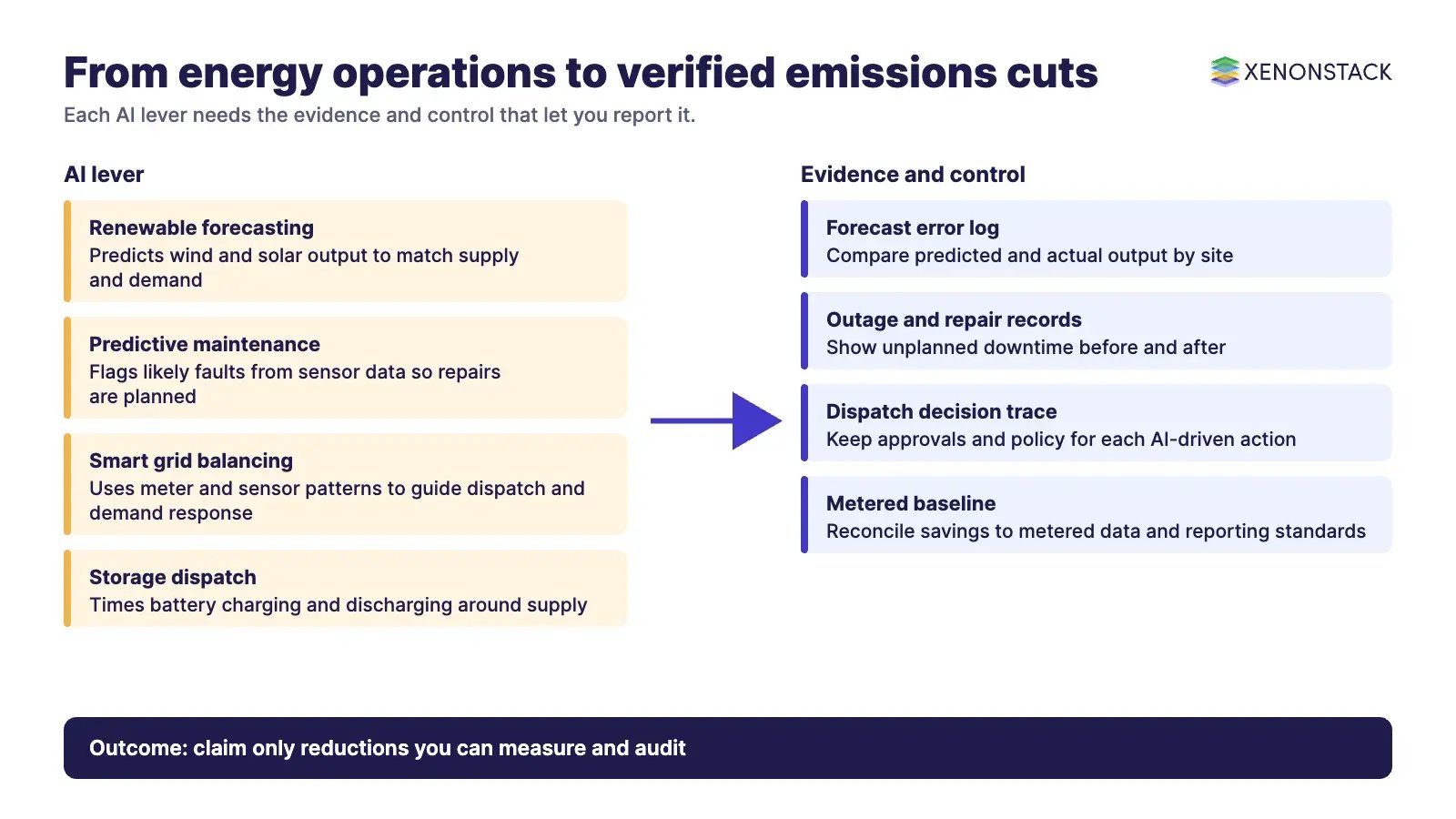
| Renewable forecasting | Machine learning predicts weather-driven wind and solar output so supply can be matched to demand | Operators with variable generation and balancing costs | Forecast error against actual output, by site and horizon |
| Predictive maintenance | Models flag likely turbine or plant faults from sensor data so repairs are planned | Asset-heavy fleets with sensor coverage | Unplanned outage hours and repair records |
| Smart grid balancing | Demand and supply patterns from meters and sensors guide dispatch and demand response | Utilities with metering data and control authority | Dispatch logs and the load shifted at peak periods |
| Storage dispatch | Models choose when to charge and discharge batteries around generation and price | Sites with battery storage and variable supply | Charge cycles, losses and avoided backup generation |
| Building and industrial efficiency | Models find savings in equipment, controls and occupant behaviour | Large estates with metered energy use | Metered consumption before and after, with weather normalisation |
How does AI help renewable generation?
Wind and solar output varies with the weather, which makes a steady supply harder to guarantee. Forecasting models help operators plan balancing, and the same sensor data can show when a turbine needs maintenance before it fails. Fewer unplanned outages mean less reliance on backup generation, though the saving should be measured on your own fleet rather than assumed.
How does AI help grids and storage?
Smart meters and grid sensors give utilities demand patterns that guide production and distribution. Demand response can encourage consumers to reduce load during periods when generation is most carbon-intensive. For batteries, models can time charging and discharging to reduce losses and the need for fossil-fuelled backup. Edge processing close to the asset often matters here, as covered in our guide to IoT edge analytics.
Operating these systems as governed, auditable processes is easier when they are built as agentic workflows with clear approval points, and the platform choices behind them can use ElixirClaw, described on its site as an agentic OS platform to build, orchestrate and govern AI agents and automation workflows while keeping humans in control.
Which standards and rules decide what you can claim?
Emissions claims need a measurement basis. The GHG Protocol Corporate Standard is the widely used accounting framework; per its own page it was updated in 2015 with the Scope 2 Guidance, which covers emissions from purchased electricity, steam, heat and cooling. The page also points to a separate Corporate Value Chain (Scope 3) Standard for value chain emissions. Read the current versions on the GHG Protocol site before building a reporting model.
In the EU, the Commission's corporate sustainability reporting page (last updated 3 July 2026) records that the stop-the-clock Directive postponed reporting for wave two and wave three companies, that a political agreement on the Omnibus I package was reached on 9 December 2025, and that on 3 July 2026 the Commission adopted a delegated act amending the ESRS (Delegated Regulation (EU) 2023/2772) to simplify certain standards. The EUR-Lex record shows Directive (EU) 2026/470, which amends the CSRD, entered into force on 18 March 2026. As reported by a law firm summary, in-scope undertakings must exceed both EUR 450 million net turnover and 1,000 employees. Confirm the final scope, thresholds and application dates on the Commission page and EUR-Lex text, because they have changed more than once. This is not legal advice.
| Source | What it covers | Status to confirm |
|---|---|---|
| IEA Global Energy Review 2025 | Global energy-related CO2 emissions in 2024 | Check for newer editions |
| GHG Protocol Corporate Standard | Corporate inventory method, Scope 2 Guidance, Scope 3 Standard | Check the site for revisions |
| EU CSRD and ESRS | Corporate sustainability reporting in the EU | Scope, thresholds and dates after Omnibus I: confirm on the Commission page |
What are the governance, security and cost trade-offs?
AI has its own energy footprint. The IEA's Energy and AI page says there is no AI without energy, specifically electricity for data centres, and that AI could transform how the energy industry operates if adopted at scale. A model that saves less than it consumes is not a decarbonisation measure, so count the compute in the business case.
Control points to set before scaling: who may approve an AI-driven dispatch or maintenance decision, what data the model may use, how model changes are versioned, and how the decision trace is kept for audit. A layer such as ElixirData Context OS keeps governed context, versioned policy and decision traces in one decision layer above AI agents, and AgentGRC keeps autonomous agent actions inside policy, with the audit trail risk teams need.
How should an energy enterprise sequence adoption?
| Step | Action | Exit test |
|---|---|---|
| 1. Measure | Set the emissions baseline and metering, mapped to Scope 1, 2 and 3 categories | Baseline accepted by finance and sustainability leads |
| 2. Pick one lever | Start with forecasting or maintenance on one asset class | Measured improvement against the baseline |
| 3. Add controls | Define approvals, data access and decision traces | Audit trail reviewed by risk |
| 4. Extend | Add grid, storage or building use cases | Each case has its own evidence |
| 5. Report | Feed verified data to reporting processes | Figures reconcile to metered data |
When should you not use AI for emissions reduction?
Do not start with AI when metering is poor, when the decision is rare and low value, or when the asset cannot act on a recommendation. A simple rule or a control upgrade is often cheaper. Avoid publishing reduction claims that rest on model estimates alone.
What will change in AI and energy emissions over the next 3 to 5 years?
| Signal | Source | What it suggests for planning |
|---|---|---|
| Energy-related CO2 still at a record in 2024, growing slower than GDP | IEA Global Energy Review 2025 | Operational efficiency still matters alongside clean supply |
| AI electricity demand is a stated IEA theme | IEA Energy and AI page | Plan compute and energy together |
| EU reporting scope and standards still being revised | European Commission page, 3 July 2026 | Keep reporting systems flexible to rule changes |
These are signals from the cited pages, not forecasts of company results. Expect more scrutiny of both emissions data and AI energy use.
To map one emissions-related decision your agents should make, and the context and policy it depends on, book a Context Workshop. See what happens in the workshop.
Frequently asked questions
What is the main way AI reduces carbon emissions in the energy sector?
AI improves forecasting, grid balancing, maintenance planning and storage dispatch so that less fossil-fuelled backup is needed. The gain should be measured against a baseline.
How large were energy-related CO2 emissions in 2024?
The IEA Global Energy Review 2025 reports 37.8 Gt, up 0.8%, an all-time high.
Which standard governs corporate emissions accounting?
The GHG Protocol Corporate Standard, with its Scope 2 Guidance and a separate Scope 3 Standard, is the widely used framework. Check the current versions on its site.
Has the EU CSRD changed?
Yes. Directive (EU) 2026/470 entered into force on 18 March 2026, and the Commission page records ESRS simplification adopted on 3 July 2026. Confirm current scope and dates on the Commission page.
Does AI itself add to energy demand?
The IEA says there is no AI without electricity for data centres, so include compute in any business case.
What will change in this area over the next 3 to 5 years?
Expect continued revision of EU reporting rules and closer attention to both emissions data and AI energy use, based on the cited IEA and Commission pages.
Explore the XenonStack platform family: ElixirData · ElixirClaw · ElixirHub · NexaStack · MetaSecure · Neural AI · AgentGRC · AgentSRE · AgentAnalyst · AgentInstruct · AgentRAI · AgentScrum · AgentSearch · AgentForce · AI Aviator · SAIF Aviator · CohortIQ · XenonStack AI · XenonStack UAE