Key takeaway
- SAP Business Data Cloud brings SAP and third-party data together with SAP Databricks for AI. See its parts, how it fits, and how to prepare for agents.
SAP Business Data Cloud is SAP's data product that, in SAP's words, "unifies and governs SAP and third-party data with a business data fabric", and SAP Databricks is the part of it aimed at building custom AI and machine learning models. Together they are SAP's answer to a common problem: business data is rich in SAP systems, but hard to combine with everything else for analytics and AI.
This guide is for data, SAP and AI leaders who need to understand what the offering contains, how Databricks fits beside the SAP components, and what to prepare before building agents on it. It uses SAP's own product page for facts and marks our own advice as advice.
What is SAP Business Data Cloud?
The SAP Business Data Cloud page describes it as a way to unify and govern SAP and third-party data with a business data fabric, and positions it as the trusted data base for AI agents. SAP says customers can access their SAP data through "curated, semantically rich data products built on SAP's business process definitions". The aim is to keep business meaning attached to data, so each new use does not rebuild it.
What does SAP Business Data Cloud include?
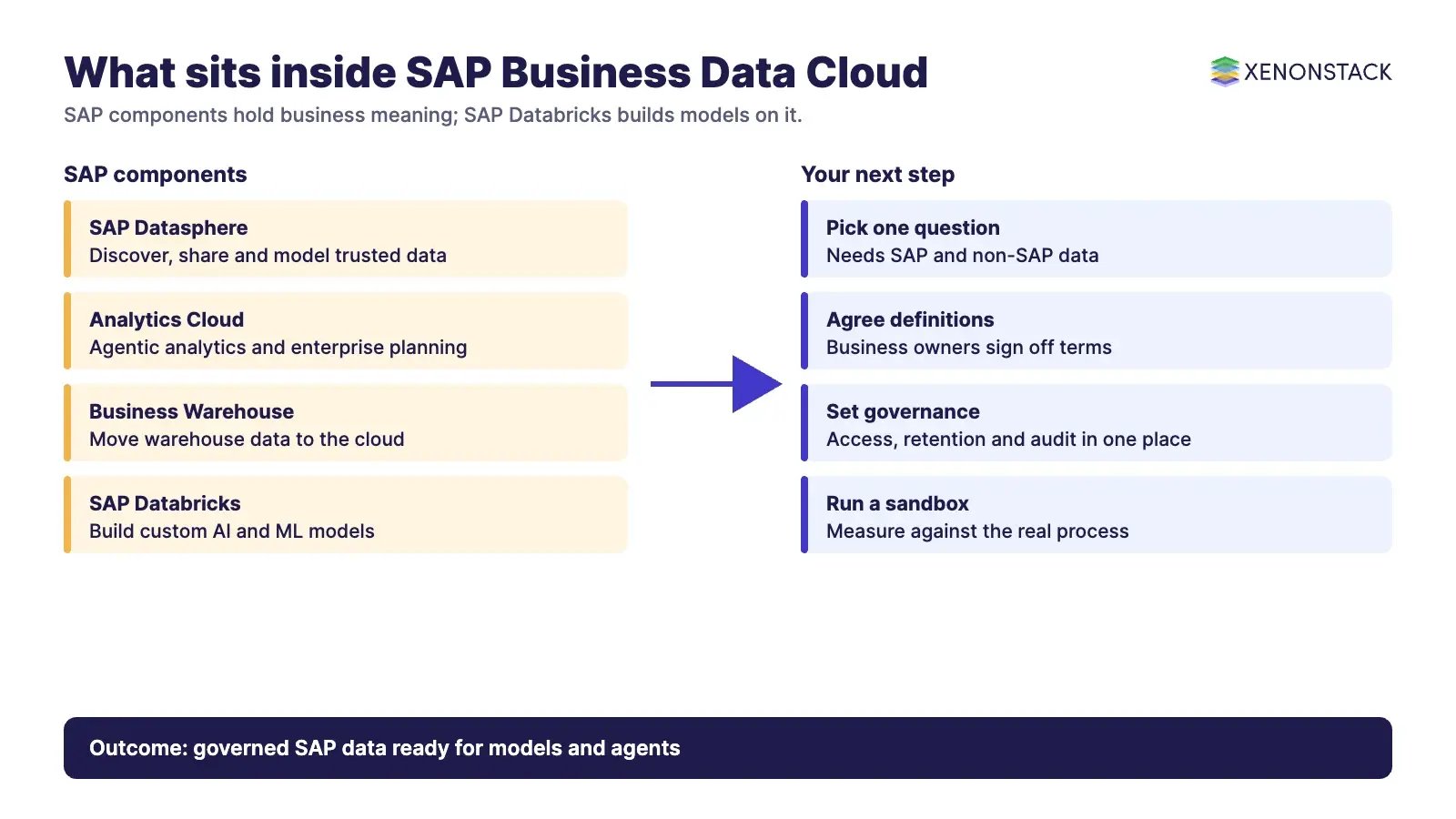
| Component | What SAP says it does | Role in the stack |
|---|---|---|
| SAP Datasphere | "Discover, share, and model the same trusted data across your business data fabric" | Finding, sharing and modelling consistent data |
| SAP Analytics Cloud | "Bring together agentic analytics and enterprise planning in a single solution" | Analytics and planning on business data |
| SAP Business Warehouse | "Modernize your Business Warehouse data to the cloud without disruption" | Moving existing warehouse data to the cloud |
| SAP Databricks | "Develop custom AI and machine learning models across your data landscape" | Model building on the same data landscape |
Read the table as a division of labour. The SAP components hold business definitions and planning. SAP Databricks is where data scientists build models. The page gives no deployment steps or performance figures, so anything beyond this needs your own proof of concept.
Why does combining SAP data with Databricks matter?
Databricks is the platform SAP names for model building. For background, see our guides to Apache Spark architecture and machine learning tools. SAP data is valuable because it carries finance, supply chain and operations context. Models trained on it can use that context, but only if definitions, history and access rules travel with the data. That is why the data product idea matters more than any single tool. See our guides to a data intelligence platform and to modern data infrastructure for the architecture questions around it.
How should you prepare to build on it?
- Pick one business question that needs both SAP and non-SAP data, such as demand or supplier risk.
- List the SAP data products and external tables it needs, and name an owner for each.
- Agree definitions with the business before modelling, for example what counts as an open order.
- Set access, retention and audit rules in one place, not per project.
- Build one model or agent in a sandbox and measure it against the process it will change.
Our related guides cover domain-specific AI models with SAP Databricks, data quality monitoring in Databricks, benchmarking data quality standards with Databricks and AI and auto-scaling clusters for AI inference.
What governance questions come first?
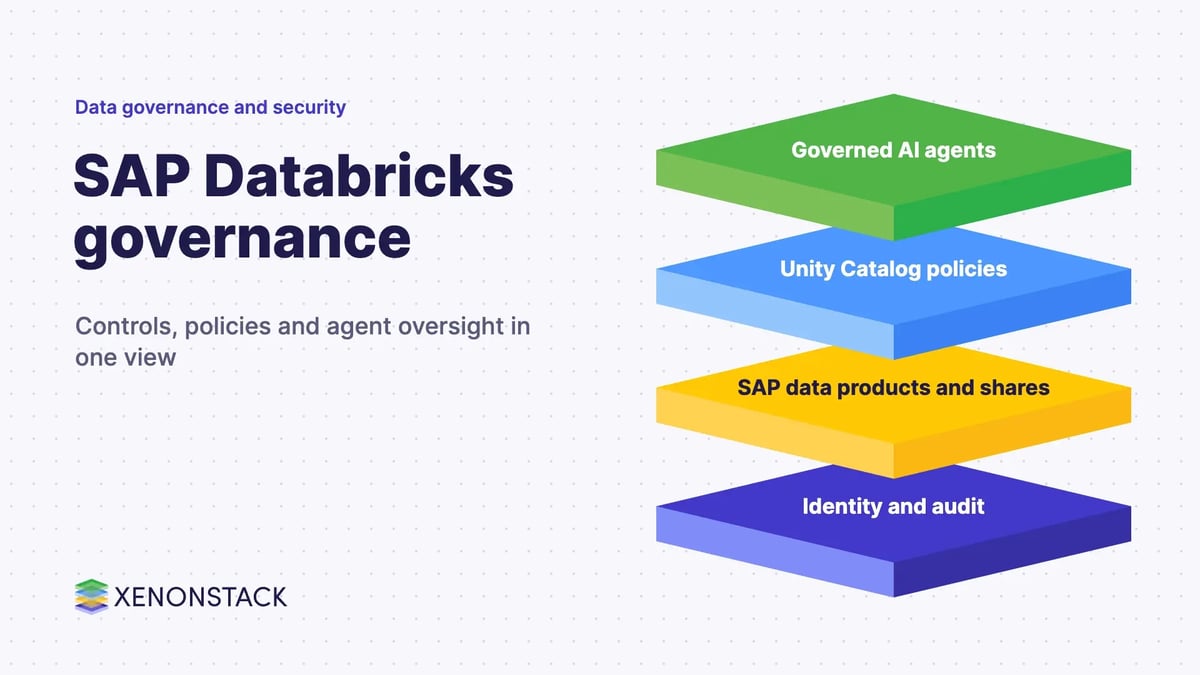
Governance decides whether an AI agent can be trusted with SAP data. Ask who owns each data product, who may use it for AI, how a change in definition is communicated and how a model's output is traced back to its inputs. Data quality sits underneath all of this: bad inputs produce confident but wrong outputs. If you also run Snowflake, compare approaches in data validation in Snowflake and integrating text, image and video data.
How do AI agents change SAP data work?
Analytics answers a question you already know to ask. An AI agent can watch the data, notice a shift, gather the related context from several sources and propose an action for a person to approve. That needs the unified, governed data SAP describes, plus a record of which policy and context drove each recommendation. XenonStack's Context OS, ElixirData, is designed for that decision layer. Our overview of generative AI in data analytics and artificial intelligence gives the wider context.
What should you do first?
- Read SAP's product page and map each component to a system you already own.
- Choose one use case and write its success measure before any build.
- Run a data quality and ownership review on the tables it needs.
- Decide where agent actions need human approval.
- Plan a short, time-boxed proof of concept, then decide whether to scale.
If you want to compare architectures, talk to a specialist or contact us.
To map one decision your agents make on SAP data, and the data and policy it depends on, book a Context Workshop. See what happens in the workshop.
Frequently asked questions
What is SAP Business Data Cloud?
SAP describes it as a solution that unifies and governs SAP and third-party data with a business data fabric, and as the trusted data base for AI agents.
What is SAP Databricks?
It is one component of SAP Business Data Cloud. SAP says it is for developing custom AI and machine learning models across your data landscape.
What are SAP data products?
SAP describes them as curated, semantically rich data products built on SAP's business process definitions, so business context is kept with the data.
Which other components are part of it?
SAP lists SAP Datasphere, SAP Analytics Cloud and SAP Business Warehouse alongside SAP Databricks.
Do I need an AI agent to benefit from it?
No. Analytics and model building work without agents. Agents add value when you want the system to watch data, gather context and propose actions, and that needs governed data first.
Follow XenonStack on LinkedIn: XenonStack on LinkedIn for new guides on agentic AI, data and platform engineering.
Ready to put AI agents to work? Explore ElixirClaw, the agentic OS platform to build, orchestrate and govern AI agents.
Explore the XenonStack platform family: ElixirData · ElixirClaw · ElixirHub · NexaStack · MetaSecure · Neural AI · AgentGRC · AgentSRE · AgentAnalyst · AgentInstruct · AgentRAI · AgentScrum · AgentSearch · AgentForce · AI Aviator · SAIF Aviator · CohortIQ · XenonStack AI · XenonStack UAE