Key takeaway
- Batch vs stream processing for leaders: how they differ, which workloads need streaming, what changed by 2026, and how to adopt both in a sensible order.
Batch processing vs stream processing: which should you choose?
Batch processing collects data over a period and processes it as one finite job on a schedule. Stream processing handles each event, or a small group of events, as it arrives, with no defined end to the input. Choose batch when a result is only needed at a set time, such as a nightly ledger or a monthly report. Choose stream when the value of the answer falls quickly with age, such as a fraud check at the point of payment or a sensor alert.
Most enterprises need both, so the decision is per workload, not per company. The cost of each choice is real: batch is simpler to run and to correct, while streaming needs always-on capacity, state handling and on-call ownership. This guide gives leaders and architects a way to decide, what has changed by 2026, and an order of adoption.
This post compares the two models. For a deeper look at one engine, see our guide to stream processing with Apache Flink and NATS, our guide to modern batch processing, and our streaming analytics overview. For the layers around the engine, read real-time analytics architecture.
What is the difference between batch and stream processing?
The core difference is the shape of the input. Apache Flink describes bounded streams as having a defined start and end, and says processing a bounded stream is also known as batch processing. Unbounded streams have a start but no defined end and must be processed continuously. Everything else in the table follows from that.
| Dimension | Batch processing | Stream processing |
|---|---|---|
| Input | Finite, known set of records (bounded) | Continuous events with no defined end (unbounded) |
| When results appear | After the job completes, on a schedule or trigger | As events arrive, continuously |
| Typical latency | Minutes to hours or more, set by the schedule | Spark micro-batch: as low as 100 ms end to end. Record-at-a-time engines such as Spark Real-time Mode: often a few milliseconds |
| Compute pattern | Starts, processes, releases resources | Long-running; capacity is held while the stream is live |
| Correction and replay | Re-run the job on the same input | Replay from a retained log, or rely on checkpointed state |
| Hard problems | Data quality checks over a large window, large reruns, scheduling dependencies | Late and out-of-order events, state size, back-pressure, exactly-once output |
| Best for | Reporting, reconciliation, model training, bulk transformation | Alerting, fraud checks, monitoring, live personalisation |
Figures for micro-batch and Real-time Mode come from the Apache Spark Structured Streaming guide (version 4.3.0) and the Real-time Mode page. Treat them as engine capabilities under the documented conditions, not as your production latency. Network, sink, state size and cluster sizing decide what you actually see.
Why is "real time" a spectrum?
Teams often say real time when they mean fresh enough. A dashboard refreshed every five minutes, a fraud score returned in tens of milliseconds and a nightly load are three different requirements with three different costs. Write the freshness target in the requirement as a number and an owner, then pick the model that meets it at the lowest operating burden.
How do you decide which workloads need streaming?
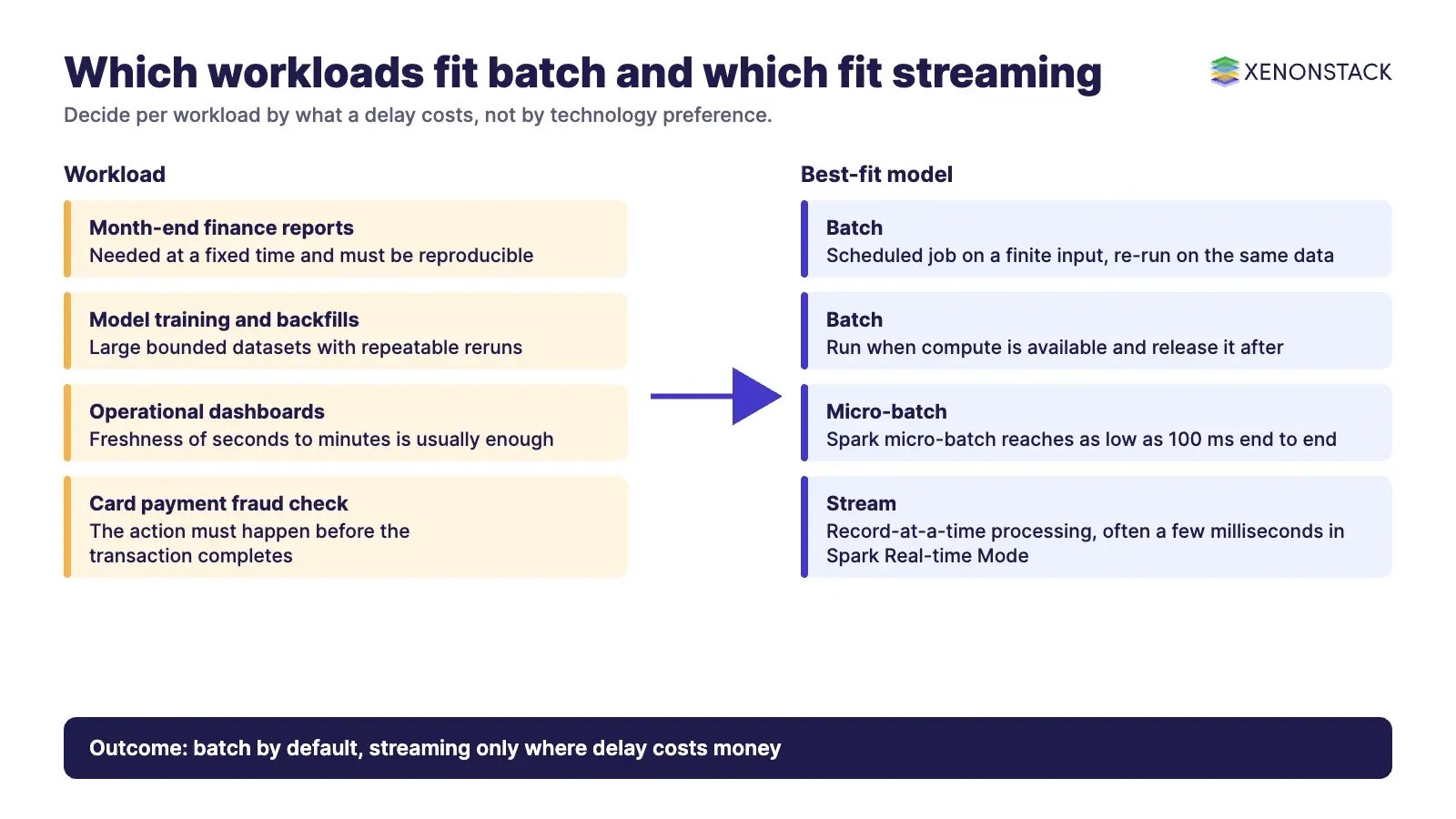
Start with the decision the data supports, not the technology. Ask what action follows, who takes it, and what a one-hour delay costs. If the answer is nothing, batch is the right default.
| Workload | Fits | Why | Current status of the tooling |
|---|---|---|---|
| Month-end finance, regulatory reports | Batch | Results are needed at a fixed time and must be reproducible | Mature; run on any warehouse or Spark-style engine |
| Model training and feature backfills | Batch | Large bounded datasets, repeatable reruns | Mature |
| Card payment fraud check | Stream | The action must happen before the transaction completes | Established streaming engines support this |
| Sensor and equipment monitoring | Stream | A delayed alert means downtime | Established streaming engines support this |
| Operational dashboards | Micro-batch or stream | Freshness of seconds to minutes is usually enough | Spark Structured Streaming micro-batch as low as 100 ms end to end |
| Web analytics after a site change | Both | A day is too slow, a minute is fine | Near-real-time pipeline into a warehouse |
The last row is the common middle ground. When a minute is acceptable you do not need record-at-a-time processing. Micro-batch or frequent small batches usually cost less to run and are easier to operate.
What has changed in batch and stream processing by 2026?
| Change | What it means for you | Source |
|---|---|---|
| Batch and stream share engines and models | Apache Flink treats batch as processing of bounded streams. Apache Beam describes a unified model for batch and streaming pipelines, with bounded and unbounded collections in one pipeline. One team can often own both. | Flink and Beam documentation |
| Spark Real-time Mode | Introduced in Spark 4.1.0 for stateless queries; stateful support added in 4.3.0. It has limits: Kafka source only, no stream-stream joins, update output mode, and the built-in Kafka sink gives at-least-once delivery. | Spark documentation |
| Spark Continuous Processing | Offered since Spark 2.3 at as low as 1 ms with at-least-once guarantees. The Spark Real-time Mode page is the current route for millisecond work. | Spark documentation |
| Kinesis Data Analytics for SQL retired | No new applications from 15 October 2025; applications deleted from 27 January 2026. AWS recommends Amazon Managed Service for Apache Flink. Migration means re-creating each application. | AWS documentation |
| Kafka as the common log | Apache Kafka describes itself as an open-source distributed event streaming platform and states that more than 80% of Fortune 100 companies use it (vendor figure). | kafka.apache.org |
If you still run older tooling, check it against the table. Our event-driven architecture guide covers brokers and trade-offs, and our data pipeline architecture guide covers reliability design.
When do you need both batch and stream processing?
Many estates run both. The older Lambda approach keeps a batch layer for accuracy and a speed layer for freshness, which means writing and maintaining the logic twice. In 2014 Jay Kreps proposed what became known as the Kappa architecture: keep the input in a retained log such as Kafka, and when code changes, run a second copy of the job from the start of the log into a new output, then switch over. It removes the duplicate code, at the price of a log that retains enough history and a replay that completes in a useful time.
A practical rule: choose Kappa-style replay when history fits in the log and the job logic is the same for live and historic data. Keep a separate batch path when you need large joins against warehouse tables, heavy model training or strict month-end reproducibility. Source: Jay Kreps, Questioning the Lambda Architecture, O'Reilly Radar, 2 July 2014.
What should governance, security and cost cover?
| Risk | Batch | Stream | Control |
|---|---|---|---|
| Stale or wrong data reaching a decision | Caught by checks before the job publishes | Bad events act within seconds | Validate at ingestion; quarantine bad records; schema registry |
| Duplicate or lost output | Rerun is idempotent if outputs are overwritten | Exactly-once processing may still give at-least-once delivery at the sink | Make sinks idempotent; test failure and restart |
| Auditability | Job logs and run dates | Event-time ordering and state are harder to reconstruct | Keep decision records and replayable inputs |
| Access and privacy | Controlled at the store | Controlled on topics, streams and sinks | Role-based access on every topic; encrypt in transit and at rest |
| Cost | Pay for compute during runs | Pay for always-on capacity | Cost per decision, not per event; right-size state |
Governance matters most when a stream triggers an action. An automated decision needs a trace of the input, the policy applied and the outcome. ElixirData Context OS keeps governed context, versioned policy and decision traces in one decision layer above AI agents, and AgentAnalyst lets teams ask questions of enterprise data in plain language and get real-time insights.
How should you adopt stream processing in order?
Move one workload at a time, and only where the delay costs money.
- List workloads and write the freshness target, the action and the owner for each.
- Keep anything that is fine with hourly or daily freshness in batch.
- Move the first candidate to micro-batch, since it reuses batch skills and tooling.
- Add record-at-a-time streaming only where micro-batch latency is not enough.
- Set service levels: end-to-end latency, lag, error rate and cost per decision.
- Review quarterly and retire streaming paths that no longer pay for themselves.
For operations teams, AgentSRE applies agents to SRE, AIOps, monitoring and incident management, which is where always-on streaming pipelines need most support. Our data ingestion guide covers the entry point of both models.
Video: AI incident detection, an example of turning a continuous alert stream into one actionable incident (ElixirClaw).
What are the trade-offs and when should you not use each model?
| Model | Do not use when | Main limitation |
|---|---|---|
| Batch | The action must happen before the next run | Stale results between runs; large reruns are slow and costly to repeat; debugging needs scheduling and dependency knowledge |
| Stream | A daily or hourly result is enough, or the team cannot run always-on systems | Always-on capacity, state management, late events, back-pressure; output rate must keep up with input rate or memory and storage fill |
There is no universal winner. Teams that can run both, and choose per workload, avoid paying for streaming where batch is enough and avoid waiting a day where a minute matters.
To map one batch or streaming decision your agents should make, and the context and policy it depends on, book a Context Workshop. See what happens in the workshop.
Frequently asked questions
What is the main difference between batch and stream processing?
Batch processes a finite set of records as one job on a schedule. Stream processing handles events continuously as they arrive. Apache Flink describes batch as processing of bounded streams and stream processing as handling unbounded streams.
Is stream processing always faster?
It gives fresher results, but speed depends on the engine and set-up. Spark's micro-batch engine reports end-to-end latencies as low as 100 ms, and Spark Real-time Mode often a few milliseconds, under documented conditions.
Can one engine do both?
Often yes. Apache Flink treats batch as bounded streams, and Apache Beam defines a unified model for batch and streaming pipelines.
What is the Kappa architecture?
Proposed by Jay Kreps in 2014, it keeps the input in a retained log and reprocesses by running a new copy of the job from the start of the log, instead of maintaining separate batch and speed code.
What replaced Amazon Kinesis Data Analytics for SQL?
AWS recommends Amazon Managed Service for Apache Flink or Flink Studio. New SQL applications could not be created from 15 October 2025, and applications are deleted from 27 January 2026.
When should we stay with batch?
When the result is only needed on a schedule, the action does not depend on the latest event, or the team cannot run always-on systems.
Follow XenonStack on LinkedIn: XenonStack on LinkedIn for new guides on agentic AI, data and platform engineering.
Ready to put AI agents to work? Explore ElixirClaw, the agentic OS platform to build, orchestrate and govern AI agents.
Explore the XenonStack platform family: ElixirData · ElixirClaw · ElixirHub · NexaStack · MetaSecure · Neural AI · AgentGRC · AgentSRE · AgentAnalyst · AgentInstruct · AgentRAI · AgentScrum · AgentSearch · AgentForce · AI Aviator · SAIF Aviator · CohortIQ · XenonStack AI · XenonStack UAE