Key takeaway
- How to implement AIOps on Azure with Azure Monitor, Log Analytics, Application Insights, Automation and Azure SRE Agent, plus the governance AIOps needs.
AIOps on Azure combines Azure Monitor, Log Analytics and Application Insights for telemetry, their built-in machine learning for anomaly detection, Azure Automation and Logic Apps for remediation, and Azure SRE Agent for AI-led investigation and response. Together they let operations teams detect problems earlier, find root causes faster and automate routine fixes across Azure workloads.
This guide maps each Azure service to the AIOps lifecycle, shows a reference architecture, and explains the governance needed before an AI agent is allowed to change production.
What is AIOps?
AIOps, a term introduced by Gartner, means applying big data and machine learning to IT operations to automate tasks such as event correlation, anomaly detection and root cause analysis. In 2026 it increasingly includes AI agents that investigate incidents and carry out runbooks. Our guide to AIOps for IT operations management covers the fundamentals, and AIOps vs MLOps explains how the two differ.
Which Azure services support AIOps?
| Azure service | AIOps role | Examples of use |
|---|---|---|
| Azure Monitor | Collects metrics, logs and alerts across Azure and hybrid resources | Metric alerts with dynamic thresholds that learn normal behaviour |
| Log Analytics | Stores and queries logs with Kusto Query Language (KQL) | Built-in time-series functions for anomaly detection and forecasting |
| Application Insights | Application performance monitoring and distributed tracing | Smart detection of failure and performance anomalies |
| Azure Automation and Logic Apps | Runbooks and workflows for remediation | Restart services, scale resources, open and update tickets |
| Microsoft Defender for Cloud | Security posture and threat protection (formerly Azure Security Center) | Security alerts feeding the same incident process |
| Azure Machine Learning | Custom models where built-in detection is not enough | Capacity forecasting and domain-specific anomaly models |
| Azure SRE Agent | AI agent for operations, generally available since March 2026 | Investigates alerts, queries telemetry, proposes and runs mitigations |
According to Microsoft's documentation, Azure SRE Agent integrates with Azure Monitor, Application Insights, Log Analytics and Grafana for observability, with Azure Monitor alerts, PagerDuty and ServiceNow for incidents, and with GitHub and Azure DevOps for code.
How does an AIOps pipeline on Azure work?
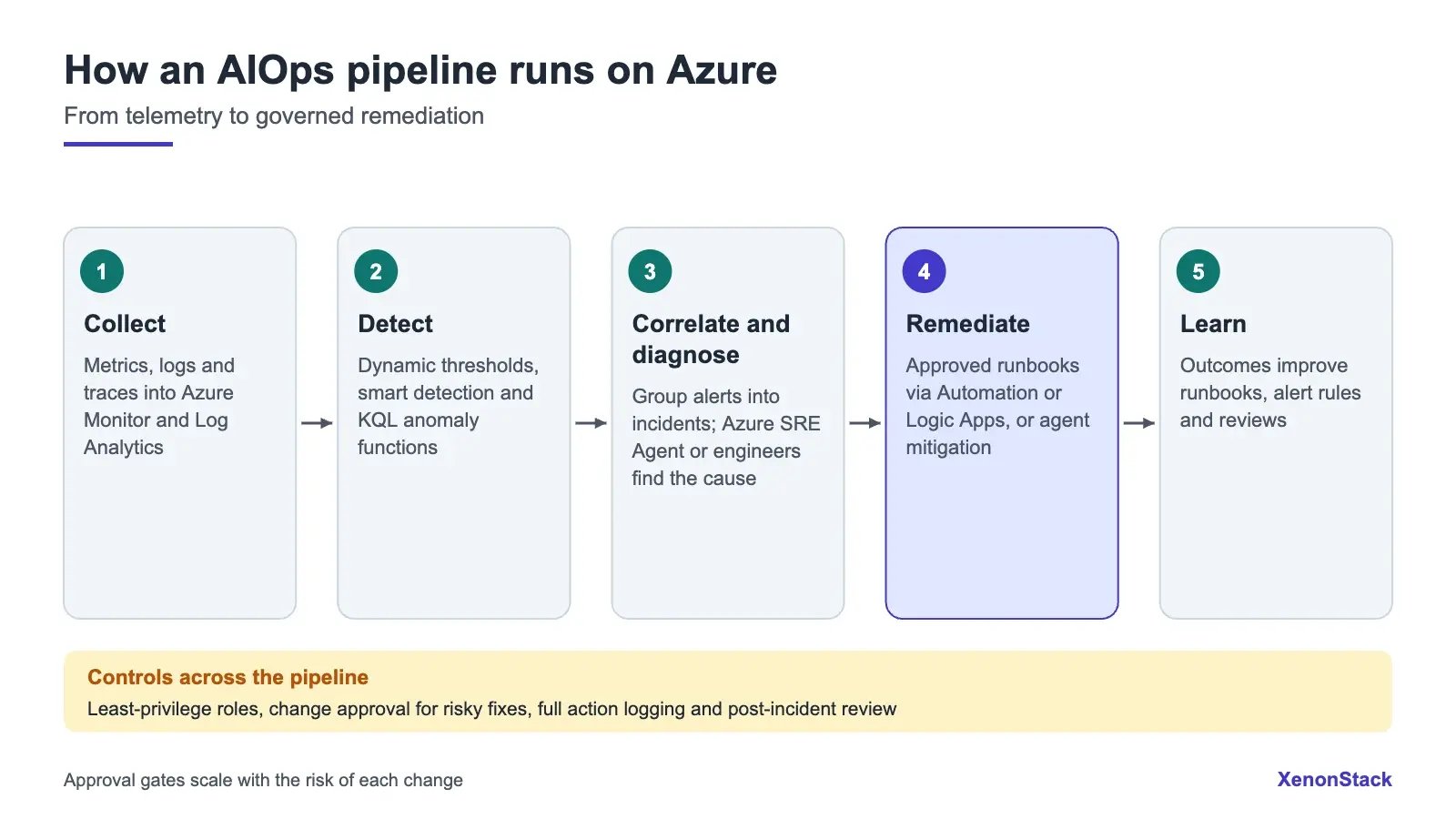
- Collect: send metrics, logs and traces from applications and infrastructure to Azure Monitor and Log Analytics workspaces.
- Detect: use dynamic thresholds, smart detection and KQL anomaly functions to spot unusual behaviour.
- Correlate and diagnose: group related alerts into incidents and let Azure SRE Agent or engineers investigate the cause.
- Remediate: run approved runbooks through Azure Automation or Logic Apps, or let the agent mitigate within its permissions.
- Learn: feed incident outcomes back into runbooks, alert rules and post-incident reviews.
How do you predict capacity needs with Azure?
Capacity planning is one of the most practical AIOps wins. Teams use Log Analytics time-series functions or Azure Machine Learning models on historical CPU, memory, storage and request data to forecast demand, then set autoscale rules and budget alerts ahead of peaks. The forecast should be reviewed alongside business calendars, because launches and seasonal events rarely appear in past telemetry.
What are the benefits and limits of AIOps on Azure?
- Benefits: fewer noisy alerts, faster diagnosis, consistent runbook execution and less manual toil for on-call engineers.
- Limit, coverage: native services see Azure best; hybrid and multi-cloud estates need extra connectors.
- Limit, data quality: anomaly detection is only as good as the telemetry and tagging behind it.
- Limit, control: letting an agent change production needs clear permissions, approvals and audit records.
For comparison with other platforms, see enterprise AIOps platforms and AIOps on AWS.
Where does XenonStack fit in Azure AIOps?
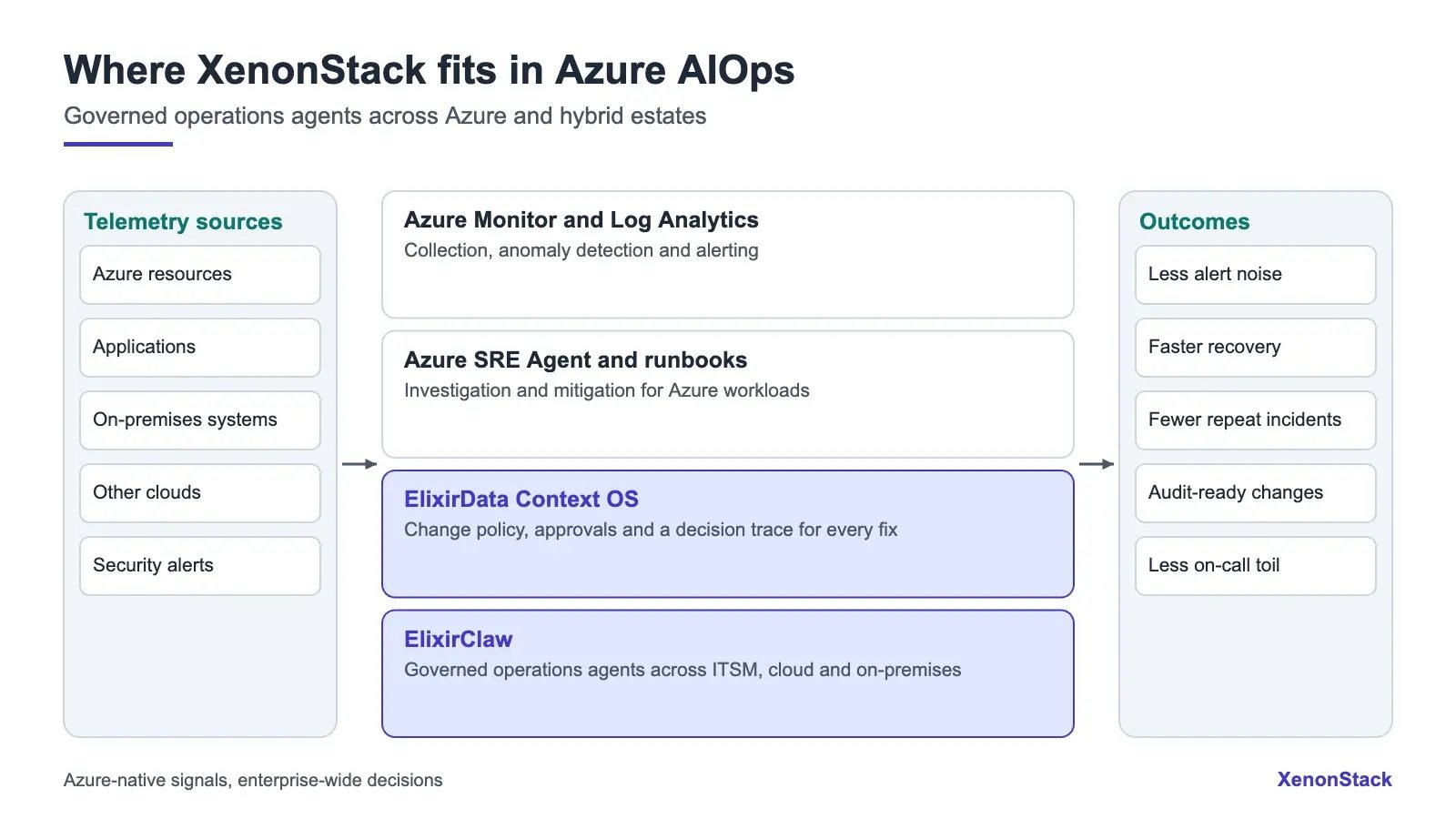
Most enterprises run Azure alongside other clouds, on-premises systems and an ITSM platform. ElixirClaw runs governed operations agents across that whole estate, and ElixirData Context OS holds the context and policy behind each operational decision, such as whether a fix needs a change approval, and records a decision trace for audit. Read more in incident management and autonomous incident resolution with ServiceNow AI agents.
To map one operations decision your agents should make, and the context and policy it depends on, book a Context Workshop. See what happens in the workshop.
Frequently asked questions
Does Azure have a built-in AIOps tool?
Azure has AIOps capabilities built into Azure Monitor, Log Analytics and Application Insights, such as dynamic thresholds and smart detection, and Azure SRE Agent adds an AI agent that investigates and mitigates incidents.
What is Azure SRE Agent?
Azure SRE Agent is Microsoft's AI-powered operations agent. It investigates incidents across Azure resources, queries logs and metrics, suggests fixes and can run mitigations. It became generally available in March 2026.
What happened to Azure Security Center?
Azure Security Center was renamed Microsoft Defender for Cloud. It provides security posture management and threat protection, and its alerts can feed the same AIOps incident process.
Can AIOps on Azure cover on-premises and other clouds?
Partly. Azure Monitor and Azure Arc can collect telemetry from hybrid and multi-cloud resources, but most enterprises also need connectors to their ITSM and other monitoring tools for a complete view.
How do you stop an AIOps agent making a bad change?
Give it least-privilege permissions, require approval for changes above a defined risk level, test runbooks in lower environments, monitor every action and keep a decision record that links each change to its evidence and policy.
Follow XenonStack on LinkedIn: XenonStack on LinkedIn for new guides on agentic AI, data and platform engineering.
Explore the XenonStack platform family: ElixirData · ElixirClaw · ElixirHub · NexaStack · MetaSecure · Neural AI · AgentGRC · AgentSRE · AgentAnalyst · AgentInstruct · AgentRAI · AgentScrum · AgentSearch · AgentForce · AI Aviator · SAIF Aviator · CohortIQ · XenonStack AI · XenonStack UAE