

Key takeaway
- Compare Dynatrace, Datadog, ServiceNow, PagerDuty and BigPanda on root cause, agents, governance and cost, and when an AIOps platform is not worth it.
The best enterprise AIOps platform depends on where your alerts and service data already live. Dynatrace and Datadog start from observability and add AI agents on top. ServiceNow starts from the service map and the incident workflow. PagerDuty starts from on-call and incident response. BigPanda focuses on correlating alerts from many tools. All five now describe AI agents that investigate incidents, so the useful comparison is no longer "does it have AI". It is how each one reaches a root cause, what it may change on its own, and what it records.
This guide is for CIOs, heads of infrastructure and operations, and SRE leads shortlisting a platform. It compares five options on five criteria and says when not to buy.
Disclosure: XenonStack builds agentic AI and AIOps solutions and does not resell any platform below. Every claim comes from the vendor's own pages or a named trade source and is worded as a vendor claim. We did not benchmark these products.
How should you evaluate an enterprise AIOps platform?
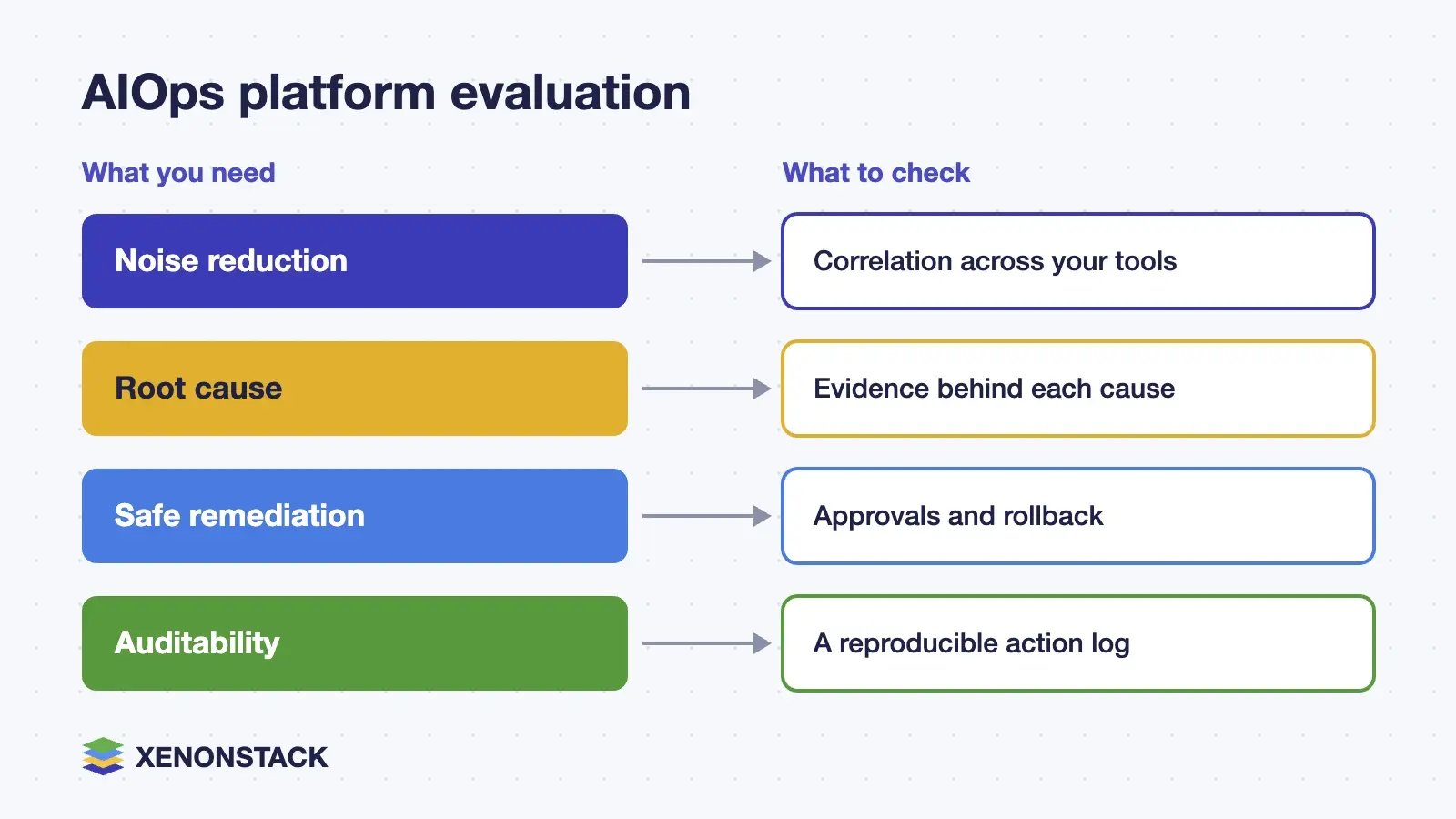
- How it finds the cause: does it trace causality through a service topology, correlate alerts statistically, or have an AI agent test hypotheses against telemetry?
- Data it can see: does it need its own agents and data store, or can it work across the tools you already run?
- Agent autonomy and approval: what can the agent change in production, and who approves it?
- Audit trail: can you review each step the agent took and the evidence it used?
- Cost model: is AI included, charged per seat, per investigation or per tier?
Which platforms are compared here?
| Platform | Starts from | Best fit | What to check |
|---|---|---|---|
| Dynatrace Intelligence | Full-stack observability and a live topology map | Complex hybrid estates that want deterministic root cause | Availability status of its agents is not given on its Davis AI page, confirm with Dynatrace; pricing for high log volume |
| Datadog Bits AI SRE (Bits Investigation) | Observability and incident response | Teams already on Datadog | Depends on data in Datadog; check per-investigation cost |
| ServiceNow ITOM with AI agents | The CMDB, service map and incident workflow | ServiceNow-centred enterprises | Needs good CMDB and alert-to-CI binding |
| PagerDuty AIOps and SRE Agent | On-call, event orchestration and incidents | Teams with many monitoring tools and on-call rotations | Which agent capabilities are available and on which plan, confirm with PagerDuty |
| BigPanda | Alert correlation across tools | Large NOCs with alert storms | Specialist scope; pair with an observability tool |
What does Dynatrace offer?
According to Dynatrace, its engine builds a real-time map of how services depend on each other (Smartscape) and uses causal AI to trace a problem to its root cause by following those dependencies, rather than guessing from patterns. Trade coverage of its January 2026 launch describes Dynatrace Intelligence as combining that deterministic AI with agentic AI, with domain agents for SRE, development and security, and a path from insights to supervised automation to autonomous operations with guardrails. Dynatrace describes Davis AI as analysing problems continuously at very large scale.
Choose it when you need explainable root cause across a complex estate and are willing to adopt its agent and data model. The Davis AI page does not say whether the agents are generally available or in preview, so confirm that with Dynatrace, and ask for a cost estimate at your log volume, since one third-party review notes pricing can be hard to predict at high volumes.
What does Datadog offer?
According to Datadog, Bits Investigation is an agent that investigates alerts the moment they fire, tests root-cause hypotheses against telemetry and produces an audit-ready root cause analysis. The newer release adds an Agent Trace view showing each tool call, query and intermediate step, and triage actions such as paging engineers and creating incidents. Datadog publishes its own speed, cost and quality figures for these investigations; treat them as vendor benchmarks and test them against your own incidents. It joins an incident as a responder, and the investigation stays in the incident record for postmortems and audits.
Choose it when most of your telemetry is already in Datadog. Its depth depends on what Datadog can see.
What does ServiceNow ITOM offer?
According to ServiceNow, AI Agents for AIOps automate alert triage, impact analysis and root cause investigation, turning what it describes as a long, click-heavy manual process into an agentic flow, and keep humans in control of final decisions. The agents can collaborate with third-party agents from observability vendors including New Relic, Dynatrace and Kentik.
Choose it when ServiceNow is already your system of record for services and changes. Its own community notes show alert-to-configuration-item binding is a known setup hurdle, so budget time for CMDB quality.
What does PagerDuty offer?
According to PagerDuty, its SRE Agent (named Paige) acts as a virtual responder that triages alerts, queries observability tools through the Model Context Protocol, recommends a runbook and runs approved remediation actions. PagerDuty's page does not state a general availability date or how the capability is packaged and priced, so confirm current availability, plan and price with PagerDuty before you budget. PagerDuty also describes agent-to-agent links with the AWS and Azure SRE agents.
Choose it when you have many monitoring tools and need strong on-call and incident orchestration.
What does BigPanda offer?
BigPanda is a specialist in event correlation and alert noise reduction and integrates with most major monitoring and ITSM platforms. It suits large network and service operations centres facing alert storms from many tools. It is not a full observability platform, so most buyers pair it with one. We did not find independent, current figures on its agent features; confirm on the official page.
How do the options compare on governance and audit?
| Platform | Human approval | Visibility into agent reasoning | Scope of action |
|---|---|---|---|
| Dynatrace | Guardrails and supervised stage before autonomy | Root cause tied to the topology path | Agentic workflows policy-guarded; status not stated on its page |
| Datadog | Triage and remediation within Datadog | Agent Trace and hypothesis tree | Datadog plus integrations |
| ServiceNow | Humans keep the final decision (vendor wording) | Insights shown in the operator workspace | Across ServiceNow workflows and partner agents |
| PagerDuty | Approved remediation only | Responder timeline | Runbooks and connected tools |
| BigPanda | Confirm on official page | Confirm on official page | Correlation and routing |
Ask each vendor to show the full record for one incident that the agent handled, including what it did not do.
Which platform fits your situation?
- You want a deterministic cause across a complex estate: shortlist Dynatrace.
- Your telemetry is in Datadog: use Bits Investigation before adding another layer.
- ServiceNow runs your services and changes: ITOM with AI agents, after fixing CMDB quality.
- Too many tools and a heavy on-call load: PagerDuty, with BigPanda if the problem is alert storms.
- You need agents across mixed tools and your own policies: consider a governed agent layer on top and ask where the audit record lives.
When should you not buy an AIOps platform?
- Your monitoring is incomplete. Agents cannot reason about data they cannot see.
- Your CMDB or service catalogue is out of date. Several platforms depend on it.
- You have not agreed what an agent may change alone.
- Alert volume is manageable and a few good routing rules would do.
How can you test an AIOps platform before committing?
Run a four-week pilot on one service. Compare agent-found root cause with your engineers' findings for the same incidents, count wrong or missing causes, record cost per investigation, and check whether a reviewer can reproduce each conclusion from the log.
Related on XenonStack: ElixirClaw, the enterprise agentic OS for governed agent execution, agentic AI for IT service management and enterprise AI orchestration platforms compared.
To agree what an agent may change on its own and where the audit record lives, book a Context Workshop or see what happens in the workshop. Want a second opinion on your shortlist? Book a strategy call.
Frequently asked questions
What is an AIOps platform?
Software that uses machine learning and AI agents to cut alert noise, find root causes and speed up incident response across IT operations.
What is the difference between AIOps and observability?
Observability collects and analyses telemetry. AIOps acts on it: correlating alerts, finding causes and triggering response. Many platforms now do both.
Do AI agents fix incidents on their own?
Some can run approved actions. Most vendors keep an approval step for production changes, and you should set that policy first.
Which AIOps platform is best for a ServiceNow shop?
ServiceNow ITOM is the natural start, provided your configuration data is accurate.
How do you measure AIOps value?
Track time to detect, time to root cause, alert volume per incident, false or wrong causes found on review, and cost per investigation.
Can you use more than one platform?
Yes. Many enterprises combine an observability platform with an incident or correlation tool. Decide which one owns the audit record.
Follow XenonStack on LinkedIn: XenonStack on LinkedIn for new guides on agentic AI, data and platform engineering.
Ready to put AI agents to work? Explore ElixirClaw, the agentic OS platform to build, orchestrate and govern AI agents.
Explore the XenonStack platform family: ElixirData · ElixirClaw · ElixirHub · NexaStack · MetaSecure · Neural AI · AgentGRC · AgentSRE · AgentAnalyst · AgentInstruct · AgentRAI · AgentScrum · AgentSearch · AgentForce · AI Aviator · SAIF Aviator · CohortIQ · XenonStack AI · XenonStack UAE


