

Key takeaway
- Compare seven enterprise AI orchestration platforms on automation depth, integrations, governance and audit evidence, with decision tables and when to skip.
The best enterprise AI orchestration platform is the one that lets agents, people and systems complete a business process under policy, with a record you can show an auditor. For most enterprises that means judging platforms on five things: how deep the automation goes, how many systems it reaches, how it controls what agents may do, whether every decision leaves evidence, and where it can be deployed. This guide compares seven options on those criteria, using each vendor's own pages.
Disclosure: XenonStack sells one of the options below (ElixirData Context OS). The list is in alphabetical order, not ranked, and every vendor claim is worded "according to its site". Orchestration here means coordinating AI agents, automations, data and human approvals across one workflow. It is different from evaluating agent platforms in general, which is a separate question about building and running individual agents.
What is AI orchestration, and how is it different from workflow automation?
Classic workflow automation follows a fixed path: if this, then that. AI orchestration adds agents that reason, choose tools and hand work to other agents or people, so the platform must coordinate steps that are not fully predictable. Our guide to agentic workflows covers the patterns, and our explainer on agentic process automation shows how this extends older RPA thinking.
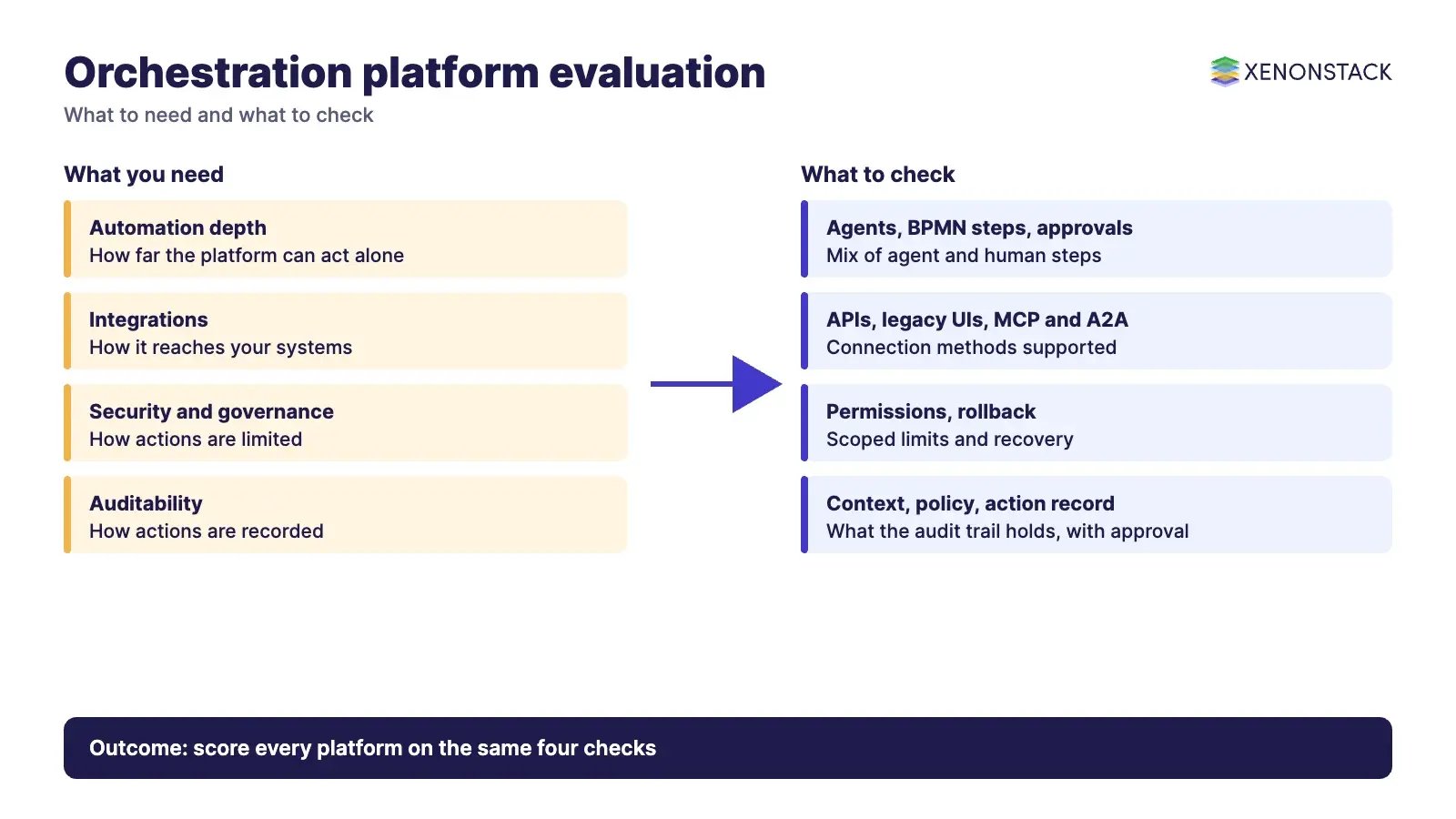
The orchestration layer is where risk concentrates. It decides which agent acts, with which permissions, on which data, and who is asked before money moves or a record changes. That is why governance and auditability belong in the buying criteria, not in a later phase.
How should you compare orchestration platforms?
Use the same five criteria for every vendor, and ask each to demonstrate rather than describe.
- Automation depth: does it coordinate agents, deterministic process steps and human approvals, or only one of these?
- Integrations: how does it reach your systems of record, including those without modern APIs, and does it support open protocols such as MCP and A2A?
- Security and governance: can you scope agent permissions, inventory agents, and stop or roll one back?
- Auditability: is there a durable record of context, policy, approval and action for each decision, or only system logs?
- Deployment: SaaS only, your cloud, or on premises?
Which enterprise AI orchestration platforms are worth shortlisting?
The seven below were chosen because each describes orchestration of agents and workflows on its own site. All claims are vendor statements read on 13 November 2026 and should be confirmed in a proof of concept.
Camunda
According to its documentation, Camunda combines deterministic BPMN process logic with LLM driven flexibility, running the non deterministic parts of a process on a BPMN foundation. It says agents reach systems through connectors, APIs and MCP servers, and that agent activity is recorded as part of the process instance, so you can inspect what an agent did and why. Best for teams that already model processes in BPMN and want agents inside controlled process flows. Deployment options: confirm on the official page.
ElixirData Context OS (XenonStack's option)
According to its site, Context OS is a "decision harness" that compiles scoped context for an agent, applies policy before reasoning and again before execution, and records a Decision Trace of context, policy, authority, action and outcome. The site lists integration with more than 50 enterprise systems, a trust path from shadow to supervised to bounded to full autonomy, and deployment as managed SaaS, in a customer VPC, or on premises or hybrid. It also lists SOC 2 attestation and ISO/IEC 27001 certification; confirm current certificates in its Trust Center. Specific agents, such as the Audit Agent, turn decision lineage into audit evidence. Best for regulated workflows where proving why an action was allowed matters most. Less suited to teams who only need simple app to app automation.
IBM watsonx Orchestrate
According to its site, watsonx Orchestrate helps you build, deploy, orchestrate, manage and govern AI agents, with consistent access, policy and guardrails across agents, tools and workflows. It cites connections through APIs and open standards such as A2A and MCP, can discover agents in other environments including Amazon Bedrock, and offers visibility into token usage and cost. It says it can run on several clouds or on premises. The page does not use the word audit, so ask for the evidence model in a demonstration. Best for IBM estates and multi cloud organisations.
Microsoft Copilot Studio
According to Microsoft's documentation, Copilot Studio is a low code studio for building agents and workflows, with prebuilt or custom connectors, human in the loop controls, analytics, evaluations, and administration for agent inventory, role based access and cost management. The page makes few specific security claims, so check Microsoft's trust and compliance documentation. Best for organisations standardised on Microsoft 365 and Power Platform.
ServiceNow AI Agents
According to its site, an AI Agent Orchestrator coordinates teams of agents, a Control Tower provides central oversight, and Action Fabric unifies third party agents and tools using A2A and an MCP client. The page does not describe audit trails, so confirm those separately. Best for enterprises where IT, HR and service workflows already run on ServiceNow.
UiPath agentic automation
According to its site, UiPath combines orchestration, execution and governance. Its Maestro component supports BPMN, flow and case styles of work, and the page describes an agent registry with versioning, pause and rollback, and a "business-transaction record" capturing agent actions, human decisions and applied policies. It says it reaches APIs, legacy interfaces and mainframes, and names third party agent platforms such as Azure AI Foundry, AWS Bedrock, LangChain and CrewAI. We have not used its ROI figures because the page gives no methodology. Best where legacy systems without APIs are central.
Workato
According to its site, Workato connects to "17,000+" apps, APIs, databases, files and MCP servers (its page also shows a lower figure, so confirm the count), offers deterministic orchestration across agents, apps and data, and aims to govern every model, agent, workflow, API and MCP interaction with centralised control over access, approvals, monitoring and cost. Best for integration heavy automation across many SaaS applications.
How do the options compare side by side?
| Platform | Automation depth (per site) | Integration approach (per site) | Governance and audit (per site) | Deployment (per site) |
|---|---|---|---|---|
| Camunda | BPMN plus LLM steps | Connectors, APIs, MCP servers | Agent activity recorded in process instance | Confirm on official page |
| ElixirData Context OS | Governed agent decisions, human authority | 50+ enterprise systems | Dual policy gates, Decision Traces, audit exports | SaaS, customer VPC, on premises or hybrid |
| IBM watsonx Orchestrate | Agents, tools, workflows | APIs, A2A, MCP, catalogue | Policy and guardrails; audit not described | Multi cloud or on premises |
| Microsoft Copilot Studio | Agents and agent flows, human in the loop | Prebuilt and custom connectors | Inventory, role based access, evaluations | Confirm in Microsoft documentation |
| ServiceNow AI Agents | Multi agent orchestration | Action Fabric, A2A, MCP client | Control Tower; audit not described | Confirm on official page |
| UiPath | Agents, RPA, API, BPMN, case | APIs, legacy UIs, mainframes, third party agents | Registry, rollback, business-transaction record | Confirm on official page |
| Workato | Deterministic orchestration of agents and apps | "17,000+" connectors | Central control of access, approvals, cost | Confirm on official page |
Which platform fits which situation?
| If your priority is | Start by testing |
|---|---|
| Proving why each agent action was allowed | ElixirData Context OS, UiPath, Camunda |
| Legacy systems without APIs | UiPath |
| Many SaaS integrations quickly | Workato |
| Existing Microsoft estate | Copilot Studio |
| Existing service management on ServiceNow | ServiceNow AI Agents |
| Process modelling with BPMN | Camunda |
| Hybrid or on premises control | IBM watsonx Orchestrate, ElixirData Context OS |
When should you not buy an orchestration platform?
- One simple workflow: if a single deterministic automation does the job, a full orchestration platform adds cost and process overhead.
- No process owner: orchestration exposes unclear ownership. Name who approves exceptions before you buy.
- Data not ready: agents acting on stale or ungoverned data automate mistakes faster. Fix context first; see our note on agentic analytics.
- Already well served: if your existing suite covers agents and approvals with the audit evidence you need, adding another layer may duplicate it.
- Need for a single agent only: a chat assistant for one team is a smaller decision; see our overview of AI agents and the wider agentic AI frameworks and use cases.
What questions should you ask every vendor?
- Show one complete workflow where an agent is blocked, escalated and approved. What record is created?
- Can I export that record for an auditor without engineering help?
- How are agent permissions scoped and revoked, and can I roll back a faulty agent?
- Which of my systems are supported out of the box, and which need custom work?
- Where does it run, and where does my data go?
- What does it cost at ten times today's volume, including model usage?
How can you test this on your own workflow?
Pick one decision that matters, such as an approval, a payment exception or a compliance check, and map what context an agent needs, which policy applies and who has authority. ElixirData runs a free half day Context Workshop that ends with a decision map and a go or no go call, and you can also book a Context OS demo. The map is useful even if you choose another platform from this list.
Frequently asked questions
What is an enterprise AI orchestration platform?
It is software that coordinates AI agents, automations, data and human approvals across a business process, with controls over permissions and a record of what happened.
How is orchestration different from RPA?
RPA repeats scripted steps. Orchestration coordinates agents that reason and choose tools, so it also needs policy controls and evidence. Many platforms, such as UiPath, now combine both according to their sites.
What should a regulated enterprise look for first?
Auditability and scoped permissions. Ask to see the record created for a single blocked and a single approved action, and whether it exports without engineering work.
Do these platforms support MCP and A2A?
According to their sites, IBM watsonx Orchestrate and ServiceNow cite both A2A and MCP, Workato and Camunda mention MCP servers. Confirm protocol versions in a proof of concept.
Can I run an orchestration platform on premises?
According to its site, IBM watsonx Orchestrate and ElixirData Context OS list on premises options. For others, confirm on the official page.
Is ElixirData the best choice?
Not for everyone. It fits regulated workflows where evidence of why an action was allowed matters. Teams needing broad SaaS connectivity or legacy screen automation may prefer other options above.
Ready to put AI agents to work? Explore ElixirClaw, the agentic OS platform to build, orchestrate and govern AI agents.
Explore the XenonStack platform family: ElixirData · ElixirClaw · ElixirHub · NexaStack · MetaSecure · Neural AI · AgentGRC · AgentSRE · AgentAnalyst · AgentInstruct · AgentRAI · AgentScrum · AgentSearch · AgentForce · AI Aviator · SAIF Aviator · CohortIQ · XenonStack AI · XenonStack UAE


