Key takeaway
- An AI factory turns data into governed AI output. See its layers, data flow, build or rent options, controls and a 3 to 5 year outlook for enterprises.
An AI factory is purpose-built infrastructure that turns data into AI output, which NVIDIA describes as intelligence measured by token throughput. It brings compute, networking, storage and software together so that models are trained, served and improved as one repeatable production line. It is not the same as a general-purpose data centre.
For an enterprise, the useful question is not "should we have one" but "which AI workloads need a shared, governed production line, and who owns it". This guide covers the layers, the data flow, the build or rent choice, the controls and the sequence we recommend. Read it alongside our guides to sovereign AI and agentic workflows.
What is an AI factory?
According to NVIDIA, an AI factory is a specialised computing infrastructure designed to create value from data across the full AI lifecycle. Its page lists high-performance GPUs, CPUs, networking, storage and cooling as the hardware, with modular software, automation for tasks such as tuning and deployment, and an inference platform with a data flywheel for continuous model improvement. These are the vendor's own descriptions.
The idea is wider than one vendor. The European Commission uses the term for publicly backed AI Factories that pool compute, data and talent through EuroHPC supercomputing. For an enterprise the common thread is the same: one governed place where data, compute and models meet, instead of each team assembling its own stack. NexaStack, according to its site, lists an AI Factory capability under private cloud compute, positioned as secure, sovereign infrastructure for training and running physical AI systems.
How is an AI factory different from a traditional data centre?
| Dimension | Traditional data centre | AI factory |
|---|---|---|
| Primary output | Hosted applications and storage | Trained and served models, measured by inference throughput (per NVIDIA) |
| Workload shape | Many mixed, steady workloads | Training, fine-tuning and inference with bursty accelerator demand |
| Software layer | Virtualisation and general orchestration | Model serving, workload orchestration and data pipelines tied to accelerators |
| Success measure | Availability and utilisation of servers | Time to deploy a model, cost per inference, and governed reuse across teams |
| Owner | Infrastructure team | Shared platform team with data, security and business stakeholders |
What are the layers of an AI factory?
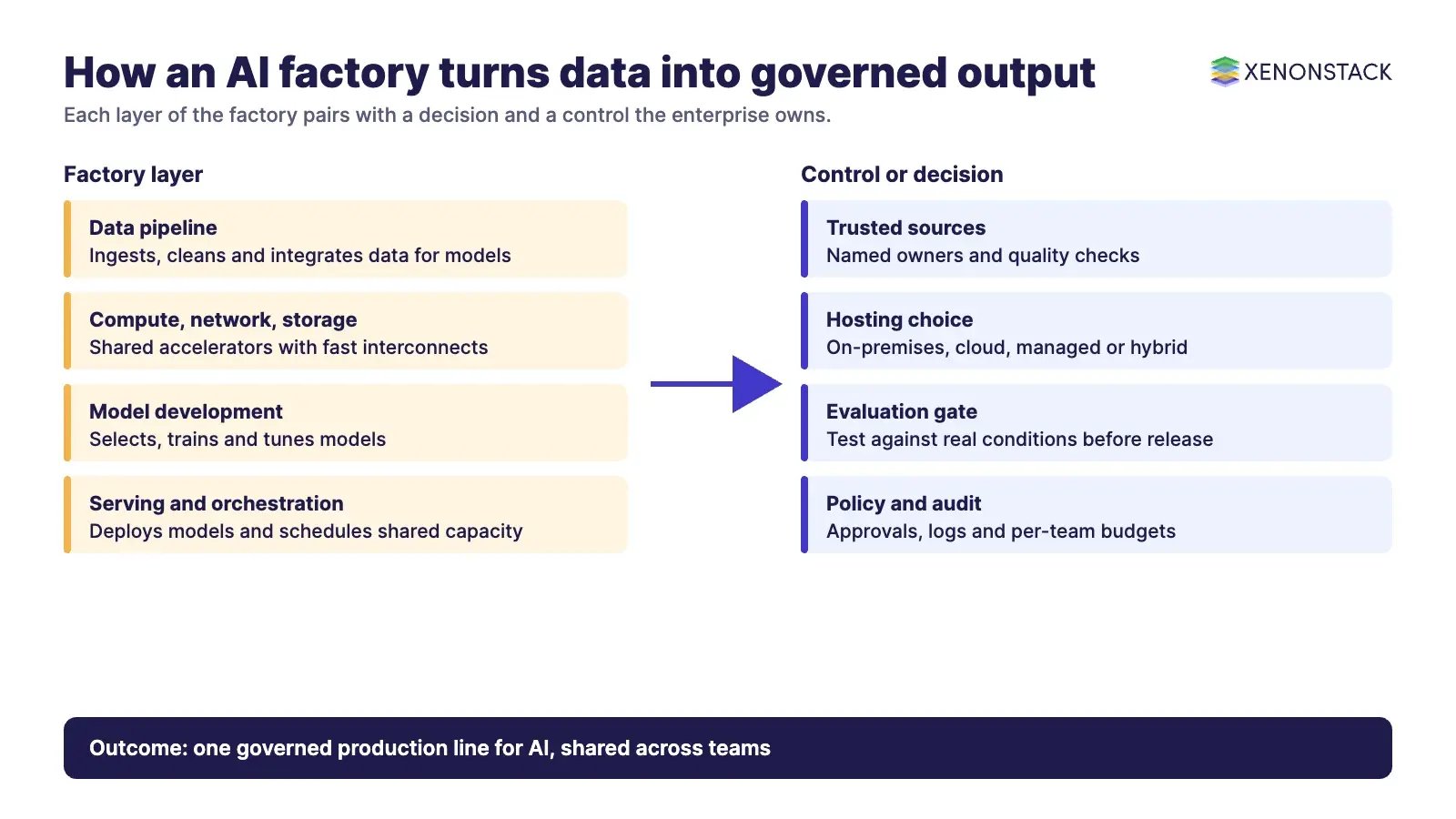
An AI factory rests on four engines: a data pipeline, algorithm development, software infrastructure and an experimentation platform. We describe them as five layers so that governance has its own place.
| Layer | What it does | Decision to make |
|---|---|---|
| Data pipeline | Acquires, cleans and integrates data so models receive fit-for-purpose inputs | Which sources are trusted, and who owns data quality |
| Compute, network and storage | GPUs and CPUs with fast interconnects and storage close to the accelerators (NVIDIA names NVLink, InfiniBand and Ethernet options) | On-premises, cloud or hybrid, and how much headroom to reserve |
| Model and algorithm development | Selects, trains and tunes models for the business outcome | Build, fine-tune or buy, and how to evaluate |
| Serving and orchestration | Deploys models, schedules shared accelerators and routes requests | Who gets which share of the accelerators, and at what priority |
| Experimentation and governance | Runs tests against real conditions, records decisions and enforces policy | What must be approved, logged and reviewable before a model goes live |
Bad data still produces poor forecasts, so the pipeline is the layer to fund first. The most capable accelerator cannot recover from untrusted inputs.
How does data flow through an AI factory?
Ingest. Raw data arrives from internal systems, sensors, devices and users into the pipeline.
Clean and integrate. The pipeline validates, cleans and joins data into a form models can use.
Select and train. Teams choose algorithms for the task and train or tune models on the prepared data.
Deploy and test. Trained models are released to scalable serving infrastructure and tested under real conditions on the experimentation platform.
Learn from use. Feedback from production returns to the pipeline so models improve. NVIDIA calls this loop a data flywheel.
Which workloads justify an AI factory?
NVIDIA names drug discovery, autonomous vehicles, telecom and financial services among the uses it supports. The test for your own estate is workload volume and reuse, not the industry label.
| Workload pattern | When a shared factory fits | What to check first |
|---|---|---|
| Many teams training or fine-tuning models | Shared accelerators and pipelines avoid duplicate stacks | Scheduling policy and chargeback |
| High-volume inference for agents and applications | Central serving gives consistent latency and policy | Latency targets and fallback behaviour |
| Physical AI and edge workloads | Training in the core, inference near the source | Connectivity, device fleet management and update control |
| Regulated or sovereign data | Keeps data and decisions inside a controlled boundary | Residency, access control and audit evidence |
| A single small model with low traffic | Rarely, a managed service is usually simpler | Total cost against a hosted option |
How should you govern, secure and cost an AI factory?
A shared factory concentrates risk as well as capability, so controls belong in the design, not after launch. The NIST AI Risk Management Framework gives a neutral structure: Govern, Measure, Manage and Map. NIST released AI RMF 1.0 on 26 January 2023 and its Generative AI Profile on 26 July 2024, and says the framework is being revised as part of the White House AI Action Plan.
| Area | Control to put in place | Owner |
|---|---|---|
| Access | Role-based access to data, models and accelerators; separate environments for training and production | Platform and security |
| Policy and audit | Versioned policy, decision traces and approval records for model release and agent actions | Risk and governance |
| Data | Lineage, quality checks and residency rules at the pipeline | Data office |
| Cost | Per-team accelerator budgets, utilisation reporting and unit costs per inference | Finance and platform |
| Agents | Limits on what autonomous agents may call, change or approve | Product and risk |
Agents raise the stakes because they act on behalf of the business. ElixirData Context OS keeps governed context, versioned policy and decision traces in one decision layer above AI agents, and AgentGRC keeps autonomous agent actions inside policy, with the audit trail risk teams need. For the control model in depth, see our guide to agentic AI risk management, and for cost practice see FinOps for AI engineering.
Should you build, rent or run a hybrid AI factory?
| Option | When it fits | Trade-off |
|---|---|---|
| On-premises build | Sovereign or regulated data, steady high utilisation. NVIDIA offers an Enterprise AI Factory validated design for on-premises builds, per its site | Capital cost, power, cooling and skills sit with you |
| Public cloud | Variable demand, fast start, no facility to run | Cost at sustained load and data residency need review |
| Managed private compute | Dedicated capacity without owning the facility | Provider dependence and contract terms |
| Hybrid with edge | Train centrally, serve near machines and sites. See our guide to edge computing | More moving parts to govern and update |
| Public AI Factory programmes | European users can access EuroHPC supercomputing through the Commission's AI Factories | Access rules are set by the programme, not by you |
To orchestrate and govern the agents that run on top of whichever option you choose, ElixirClaw is an agentic OS platform to build, orchestrate and govern AI agents and automation workflows while keeping humans in control.
What is a sensible adoption sequence?
Inventory workloads. List current and planned training and inference jobs, their data and their owners.
Fix the data pipeline. Agree sources, quality checks and ownership before buying capacity.
Choose the hosting model. Use the table above and your data residency rules.
Stand up shared serving and scheduling. Start with one or two products and measure cost per inference.
Add governance gates. Approval, logging and policy checks before a model or agent goes live.
Scale by reuse. Add teams only when shared components are proven.
When should you not build an AI factory?
Do not build one if workloads are few, traffic is low, or the data is not yet in shape. A hosted model service or a managed platform will usually be cheaper and faster. Avoid starting with hardware: without a named owner, a data pipeline and a governance route, accelerators sit idle while the bill continues. Treat it as a platform product with users, not a one-off project.
What will change in AI factories over the next 3 to 5 years?
The sources below describe direction, not guarantees. We have not added forecasts that the sources do not state.
| Area | What the source says | Source |
|---|---|---|
| Public capacity in Europe | The Commission says 19 AI Factories and 13 Antennas are being set up through EuroHPC, and it has launched a call to establish up to seven AI Gigafactories of more than 100,000 high-end AI chips | European Commission |
| Design tooling | NVIDIA describes an Omniverse Blueprint for designing, testing and optimising AI factories with digital twins before construction | NVIDIA |
| Workload mix | NVIDIA says its design targets agentic AI and physical AI workloads on top of training | NVIDIA |
| Risk frameworks | NIST says AI RMF 1.0 is being revised as part of the White House AI Action Plan | NIST |
Our reading for planners: expect more shared public and private capacity, more simulation before building, and more governance requirements on what runs inside the factory. Plan for portability and policy that moves with the workload, and re-check these pages before each budget cycle.
To map one AI factory decision your agents should make, and the context and policy it depends on, book a Context Workshop. See what happens in the workshop.
What should you plan for in 2027?
The points below come from the guidance already set out above, and they hold whatever your budget cycle looks like.
- Start with workloads and data. Inventory current and planned training and inference jobs, and fix the data pipeline before you buy any capacity.
- Choose the hosting model deliberately. Weigh on premises, public cloud, managed private compute and hybrid against your data residency rules, utilisation and skills.
- Build governance in from the start. Put approval, logging and policy gates in place before a model or agent goes live, and name an owner for the platform.
Check the cited sources before each budget cycle.
Frequently asked questions
What is an AI factory in simple terms?
An AI factory is specialised infrastructure that turns data into AI output across training, deployment and improvement. NVIDIA describes its main product as intelligence, measured by token throughput.
How is an AI factory different from a data centre?
A data centre hosts general workloads. An AI factory is organised around the AI lifecycle: data pipelines, accelerator compute, model serving, orchestration and governance.
What are the main layers of an AI factory?
The data pipeline, compute with networking and storage, model development, serving and orchestration, and experimentation with governance.
Should we build an AI factory on-premises or use the cloud?
It depends on data residency, utilisation and skills. On-premises suits sovereign data and steady load, cloud suits variable demand, and hybrid suits training in the core with inference at the edge.
What will change in AI factories over the next 3 to 5 years?
Per the European Commission, 19 AI Factories are being set up in Europe with a call for up to seven larger AI Gigafactories. NVIDIA points to digital-twin design and to agentic and physical AI workloads, and NIST is revising its AI risk framework.
Follow XenonStack on LinkedIn: XenonStack on LinkedIn for new guides on agentic AI, data and platform engineering.
Explore the XenonStack platform family: ElixirData · ElixirClaw · ElixirHub · NexaStack · MetaSecure · Neural AI · AgentGRC · AgentSRE · AgentAnalyst · AgentInstruct · AgentRAI · AgentScrum · AgentSearch · AgentForce · AI Aviator · SAIF Aviator · CohortIQ · XenonStack AI · XenonStack UAE