Key takeaway
- AI risk management in financial institutions: where AI fits credit, fraud and cyber risk, and how SR 11-7, DORA and the EU AI Act shape governance.
AI helps a financial institution manage risk when it is treated as a governed model inside the existing risk framework, not as a separate tool. It can score credit, flag fraud and watch networks for unusual behaviour, but every one of those uses is a model that needs an owner, validation and evidence. Supervisors already expect this: the Federal Reserve's SR 11-7 guidance on model risk management and the EU's DORA and AI Act all apply to AI-driven risk work.
This guide is for risk, technology and compliance leaders. It sets out where AI fits across credit, fraud, cyber and scenario work, which official rules shape it, how to govern the models, and a sequence for adopting it. It is not financial or legal advice, so confirm obligations with your regulator and counsel. For the wider banking picture, see AI in banking.
What does AI risk management mean in a financial institution?
It means using machine learning and, increasingly, generative and agentic systems to identify, measure, monitor and respond to risk, while managing the risk of those systems themselves. The first half is the benefit. The second half is what supervisors ask about. SR 11-7 defines model risk as "the potential for adverse consequences from decisions based on incorrect or misused model outputs and reports", and that definition covers an AI scoring model as much as a spreadsheet.
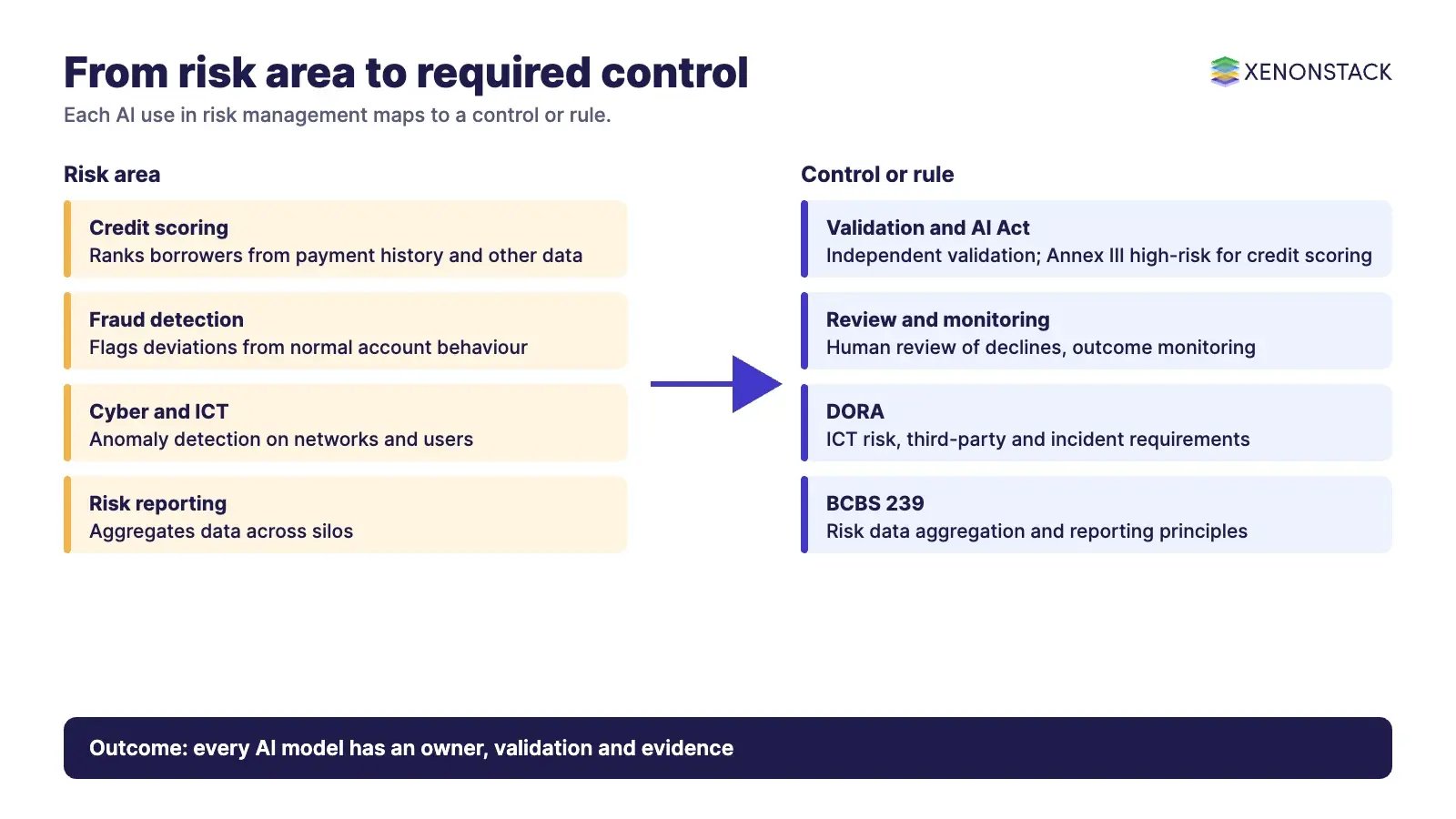
| Risk area | Where AI is used | What the institution must still control |
|---|---|---|
| Credit risk | Scoring and early warning from payment history, financial ratios and other data | Explainability, bias testing, validation, and EU AI Act obligations for credit scoring of natural persons |
| Fraud | Learning normal transaction behaviour and flagging deviations | False-positive handling, human review of declined customers, outcome monitoring |
| Cyber and operational | Anomaly detection on network and user behaviour | ICT risk management, incident reporting and third-party oversight under DORA for EU entities |
| Market and liquidity | Forecasting and scenario generation for stress testing | Model validation, documented limits, challenge of synthetic scenarios |
| Risk data and reporting | Aggregating data across silos for one view of exposure | Data lineage and accuracy, in line with the Basel Committee's BCBS 239 principles |
Where does AI add value across credit, fraud, cyber and scenarios?
Credit risk
Models can combine traditional credit data, such as payment history and debt-to-income ratios, with other signals to rank borrowers by likelihood of default. The gain is earlier warning on deteriorating accounts. The risk is that a better-fitting model is harder to explain, so credit teams need documented drivers and independent validation before a score influences a lending decision.
Fraud detection
Fraud models learn what normal behaviour looks like for an account and flag departures, such as a sudden large payment from a low-activity account or patterns linked to account takeover. The operating question is the balance between catching fraud and blocking genuine customers, which is a tuning and review decision, not a modelling one.
Cybersecurity
Anomaly detection and behavioural analytics watch network traffic and user activity for deviations that may indicate unauthorised access or data exfiltration. These tools feed the security operations process; they do not replace it. For autonomous agents acting on systems, see agentic AI risk management.
Scenario and stress testing
Generative models can produce synthetic scenarios, such as sharp market falls or supply chain disruption, to probe portfolio weaknesses. Treat the output as a prompt for risk teams to challenge, not as a forecast, and record the assumptions behind each scenario.
Which official rules shape AI risk management?
| Source | What it says (per its official page) | Why it matters for AI |
|---|---|---|
| Federal Reserve SR 11-7 | Issued 4 April 2011 with the OCC. Covers model development, validation and governance, with "effective challenge" as the guiding principle and rigour scaled to materiality | Any AI model that produces quantitative estimates for decisions falls into model risk management scope |
| Basel Committee BCBS 239 | "Principles for effective risk data aggregation and risk reporting", published 9 January 2013, to strengthen banks' risk data aggregation and internal risk reporting | Models are only as reliable as the aggregated data they use |
| EU DORA (Regulation 2022/2554) | Applies from 17 January 2025 to financial entities. Covers ICT risk management, ICT third-party risk, resilience testing, incident reporting and information sharing | AI services bought from vendors are ICT third-party arrangements |
| EU AI Act, Annex III | Lists AI systems that evaluate the creditworthiness of natural persons or set their credit score, and life and health insurance risk assessment and pricing, as high-risk. AI used to detect financial fraud is carved out of the creditworthiness item | Credit scoring models carry high-risk obligations; fraud detection does not under that item |
The European Commission's AI Act page gives 2 December 2027 as the date from which Annex III high-risk obligations apply, following the AI Omnibus. Confirm current dates on that page before planning, and take legal advice on how these rules apply to your entity.
How should an institution govern AI risk models?
SR 11-7 gives a workable structure that most institutions already know. Apply it to AI models in the same way as to any other model.
Inventory: keep a list of every model, including vendor models, with an owner and a stated purpose.
Development: document the design, the data and its quality, and test that the model is accurate, robust and stable.
Validation: have it done independently of development and use, covering conceptual soundness, ongoing monitoring and outcomes analysis.
Challenge and escalation: give reviewers the standing and competence to challenge and change a model.
Board oversight: senior management sets the approach and keeps model risk within tolerance.
Evidence is the practical constraint. Reviewers need to see which data, policy and model version led to a decision. ElixirData Context OS keeps governed context, versioned policy and decision traces in one decision layer above AI agents, and AgentGRC keeps autonomous agent actions inside policy, with the audit trail risk teams need. For a wider treatment of controls, read agentic AI governance and compliance.
What changes with generative and agentic AI?
Predictive models return a score. Agentic systems take actions, such as opening a case, requesting documents or updating a record. That moves the risk question from "is the score right?" to "was the action permitted, and can we prove it?". Each agent needs a defined scope, policy checks before it acts, human approval for material decisions and a decision trace. The same applies to customer-facing agents; see banking chatbots on Amazon Lex with agentic AI for one pattern.
What is a sensible adoption sequence?
| Step | What to do | Exit test |
|---|---|---|
| 1. Inventory | List AI and machine learning models and agents, with owners and purposes | No model in production without an owner |
| 2. Classify | Mark each by materiality, and by EU AI Act and DORA relevance where they apply | High-impact uses identified |
| 3. Fix the data | Confirm lineage and quality for the data each model uses | Risk reports reconcile to source |
| 4. Validate | Independent validation and a monitoring plan before go-live | Validation sign-off recorded |
| 5. Pilot with a human in the loop | Run in parallel with the current process on one risk area | Outcomes compared with actual results |
| 6. Scale and review | Extend to more areas and review at least as often as policy requires | Findings reach the board risk committee |
What are the trade-offs, and when should you not use AI?
Explainability versus fit: a simpler, explainable model may be the better choice for decisions that must be justified to customers or supervisors.
Data quality: where risk data is fragmented or unreliable, fix that first. A model will not repair it.
Vendor dependence: third-party AI adds ICT third-party risk and exit planning.
Fully automated adverse decisions: avoid them where you cannot explain, review or reverse the outcome.
Human judgement: AI should support risk professionals, not replace accountability.
To map one risk decision your agents should make, and the context and policy it depends on, book a Context Workshop. See what happens in the workshop.
Frequently asked questions
Does SR 11-7 apply to AI models?
SR 11-7 defines a model as a quantitative method that applies statistical, economic, financial or mathematical theories to input data to produce quantitative estimates. An AI model that does this falls within that definition. Applicability to your entity depends on your supervisor, so confirm with your regulator.
Is credit scoring with AI high-risk under the EU AI Act?
Annex III lists AI systems used to evaluate the creditworthiness of natural persons or establish their credit score as high-risk. AI used to detect financial fraud is excluded from that item. The Commission's page gives 2 December 2027 for Annex III obligations, so check it for current dates.
What does DORA mean for AI in risk management?
DORA applies from 17 January 2025 and covers ICT risk management, third-party risk, resilience testing and incident reporting for financial entities. AI platforms and services are ICT assets, and vendor AI is an ICT third-party arrangement.
Why does BCBS 239 matter for AI?
BCBS 239, published on 9 January 2013, sets principles for risk data aggregation and risk reporting. Models fed by weak or inconsistent data produce weak risk views, so data aggregation sits before model choice.
How is agentic AI different for risk teams?
Agents take actions, so controls must cover what an agent is allowed to do, when a human approves, and how each decision is recorded for review.
Follow XenonStack on LinkedIn: XenonStack on LinkedIn for new guides on agentic AI, data and platform engineering.
Ready to put AI agents to work? Explore ElixirClaw, the agentic OS platform to build, orchestrate and govern AI agents.
Explore the XenonStack platform family: ElixirData · ElixirClaw · ElixirHub · NexaStack · MetaSecure · Neural AI · AgentGRC · AgentSRE · AgentAnalyst · AgentInstruct · AgentRAI · AgentScrum · AgentSearch · AgentForce · AI Aviator · SAIF Aviator · CohortIQ · XenonStack AI · XenonStack UAE