Key takeaway
- Build banking chatbots on Amazon Lex with agentic AI: architecture, Bedrock Agents hand-off, use-case fit, CFPB risks, controls and an adoption sequence.
A banking chatbot becomes agentic when it stops only answering and starts completing governed tasks: it understands the request, plans the steps, calls approved banking APIs and hands anything risky to a person. Amazon Lex supplies the conversation layer (speech and text understanding, intents and slots), and an agent layer such as Amazon Bedrock Agents supplies the reasoning and action. The bank supplies the controls that decide what the agent may do.
This guide is for CTOs, CIOs, heads of digital banking, enterprise architects and risk leaders who are deciding how far to take a Lex-based assistant. It sets out the architecture, a decision table for use cases, the security and governance controls and an adoption sequence. For the wider picture, see our guides to agentic process automation in finance and banking and AI in banking.
What changes when a banking chatbot becomes agentic?
A rule-based bot matches a phrase to a scripted answer. An agentic assistant treats the phrase as a goal, breaks it into steps, gathers missing information through conversation and acts on bank systems through defined actions. According to AWS, Amazon Bedrock Agents extends foundation models to understand requests, break tasks into smaller steps, collect additional information from users and take actions by calling company APIs defined in action groups.
That shift moves the design question from "what can the bot say?" to "what is the bot allowed to do, and who can see why it did it?". The rest of this guide follows that question. Our overview of agentic workflows covers the underlying pattern.
What does Amazon Lex provide, and where does the agent layer sit?
According to the Amazon Lex V2 developer guide, Lex is an AWS service for building conversational interfaces for voice and text, with automatic speech recognition (ASR) and natural language understanding (NLU). It takes speech or text, identifies the intent and fulfils it by invoking a business function. Bots can be published to mobile apps, web apps and chat services, and Lex works natively with AWS Lambda and Amazon CloudWatch. Billing is pay-as-you-go by text or speech request, with a free tier.
| Layer | What AWS documents | Role in a banking assistant |
|---|---|---|
| Amazon Lex V2 bot | ASR and NLU, intents, slots, channels, Lambda integration | Understands the customer and manages the conversation |
| AWS Lambda | One function per bot alias per language, invoked at the conversation stages you choose | Validates input and calls bank services |
| Generative AI features in Lex | Built on Amazon Bedrock: descriptive bot builder, utterance generation, assisted slot resolution, AMAZON.QnAIntent, AMAZON.BedrockAgentIntent | Improves understanding and answers knowledge questions |
| Amazon Bedrock Agents | Orchestration, action groups, optional knowledge bases, tracing | Plans multi-step tasks and calls approved actions |
AWS states that generative features may give inaccurate or inappropriate responses and may incur additional charges. Treat both points as design inputs, not footnotes.
How does the architecture work end to end?
The documented hand-off is the clearest way to add an agent to Lex. The AMAZON.BedrockAgentIntent routes a request to an Amazon Bedrock Agent or knowledge base. Once active, the conversation stays in that intent and user messages go to the agent until the agent marks the conversation finished, at which point Lex resumes control. AWS lists three requirements: generative AI enabled for the bot locale, the agent ID and agent alias ID, and the agent's User Input setting set to enabled so it can ask follow-up questions.
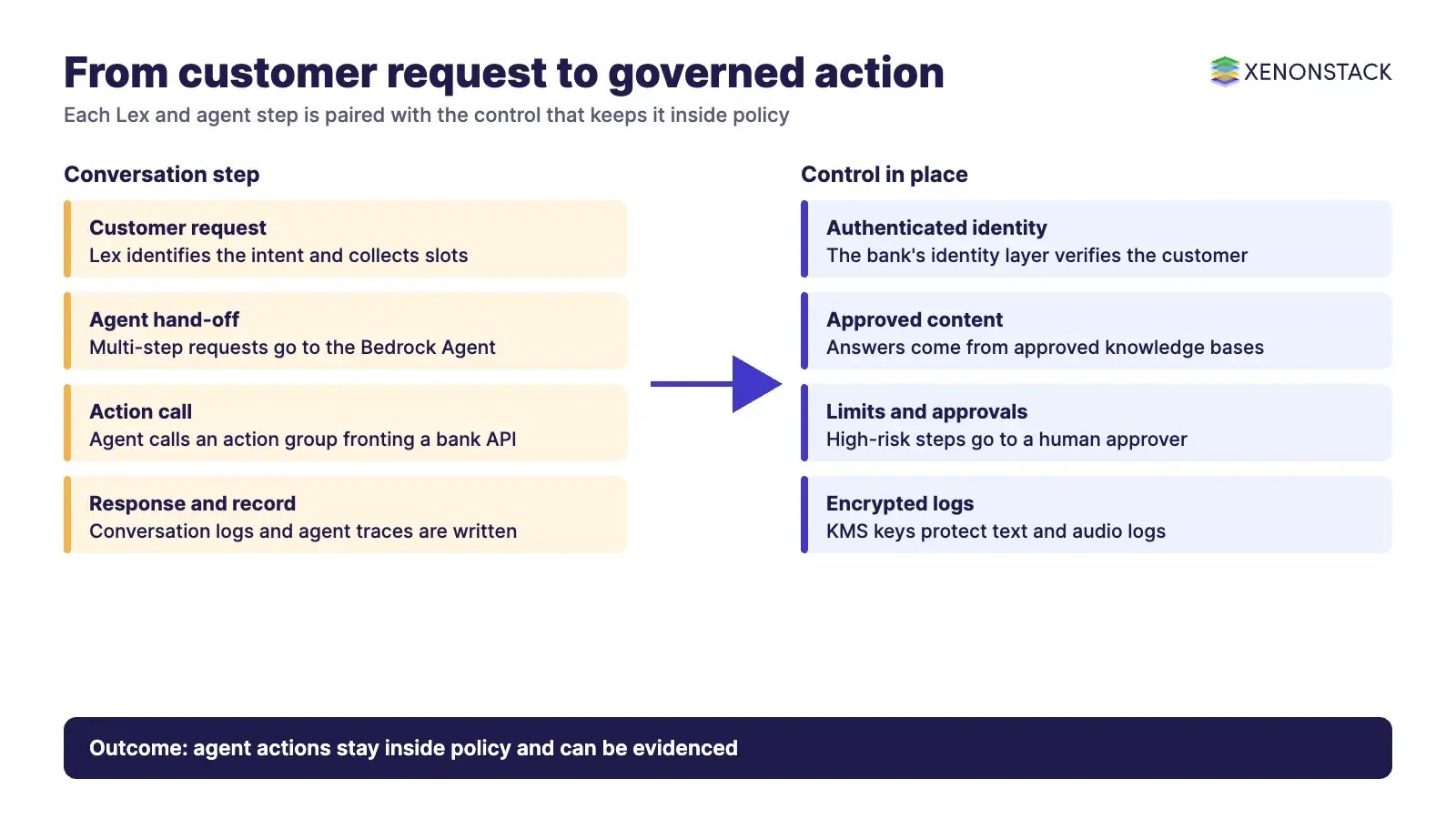
- Channel and identity: the customer reaches the Lex bot through the app, web or voice channel and is authenticated by the bank's own identity layer.
- Intent and slots: Lex classifies the request and collects required details.
- Agent hand-off: open-ended or multi-step requests go to the Bedrock Agent through the agent intent. Simple, high-volume requests stay in standard Lex intents.
- Actions: the agent calls only the actions defined in its action groups, which front the bank's APIs.
- Policy checks: a control layer applies limits and approvals before any action that moves money or changes customer data.
- Logging: conversation logs and agent traces record what happened.
Two limits are worth planning for. AWS notes that AMAZON.BedrockAgentIntent, AMAZON.QnAIntent (without sample utterances) and AMAZON.KendraSearchIntent cannot be used together in the same bot locale. AWS also states that Amazon Bedrock Agents Classic is no longer available for new sign-ups and is in maintenance mode, and points to the Strands Agents SDK with Amazon Bedrock AgentCore for new code-defined agents. Confirm the current option with AWS before you commit a design. See also our customer engagement platform use case for how we approach omnichannel engagement.
Which banking use cases fit, and which need a person?
| Use case | When it fits | Where a person stays in the loop |
|---|---|---|
| Balance, transaction and status enquiries | Read-only, well-defined intents | Failed authentication or customer dispute |
| Loan and credit enquiries | Guiding eligibility questions and document checklists | Any credit decision |
| Card and fraud alerts | Guided steps after a fraud system raises a flag | Confirming or reversing transactions |
| Onboarding support | Explaining steps and collecting documents | Identity verification outcomes |
| Product questions | Knowledge-base answers from approved content | Advice that needs a qualified adviser |
| Fund transfers and profile changes | Only with strong authentication and limits | Above-limit or unusual requests |
Our banking industry page describes AI agents that operate within limits set by the risk team and send high-risk steps to human approvers, which is the pattern the right-hand column reflects. For analytics behind these journeys, see our banking and finance analytics platform.
What security and governance controls does a banking agent need?
The US Consumer Financial Protection Bureau (CFPB) published "Chatbots in consumer finance" on 6 June 2023. It reports that all of the top 10 US commercial banks use chatbots, and it identifies risks that apply directly to agentic designs: inaccurate answers from language models, failure to recognise disputes, "doom loops" with no route to a person, and privacy and security exposure from chat logs. It states that "it is not suitable for chatbots to be the primary customer service vehicle". This is a regulator's observation, not legal advice. Check the rules that apply to your institution with your compliance team.
| Risk | Control to design in | Source for the control |
|---|---|---|
| Wrong or invented answers | Answer from approved knowledge bases; test before release | CFPB report; AWS notes on generative features |
| Customer trapped with no route to a person | Clear hand-off to a human agent | CFPB report |
| Sensitive data in logs | Never place account numbers in free-form fields; encrypt text and audio logs with KMS customer managed keys | Amazon Lex V2 data protection and conversation logs pages |
| Agent acts outside policy | Limit the agent to defined action groups and add approval steps | Amazon Bedrock Agents documentation |
| No evidence of why an action happened | Conversation logs plus agent traces | Lex conversation logs; Bedrock Agents tracing |
AWS describes a shared responsibility model for Lex: AWS secures the infrastructure, and you are responsible for how you use the service, including data sensitivity and applicable laws. Lex conversation logs send text logs to Amazon CloudWatch Logs and audio logs to Amazon S3, and AWS notes they cannot be used with a bot subject to the Children's Online Privacy Protection Act. Use a policy layer such as AgentGRC, which keeps autonomous agent actions inside policy with the audit trail risk teams need, and read our guide to agentic AI risk management for the control framework.
What are the trade-offs, and when should you not use an agent?
- Keep standard Lex intents for high-volume, predictable requests such as balance enquiries. They are easier to test and explain than an agent.
- Do not give an agent write access to payments or customer records until limits, approvals and logging are proven in read-only use.
- Do not make the bot the only channel. The CFPB warns about reduced access to human agents.
- Budget for generative features. AWS says enabling them may incur additional charges, and Lex itself is billed per text or speech request.
- Plan for platform change. AWS has placed Bedrock Agents Classic in maintenance mode, so keep the agent layer behind a clean interface.
How should a bank sequence adoption?
- Rank intents by volume and risk: start with read-only enquiries.
- Build the Lex bot with standard intents and measure how often it fails to understand customers.
- Add a knowledge-base answer path for product questions from approved content.
- Introduce one agent for one multi-step task with a small action group and a human approval step.
- Turn on logging and tracing and review samples with risk and compliance before widening scope.
- Orchestrate and govern at scale. ElixirClaw is an agentic OS platform to build, orchestrate and govern AI agents and automation workflows while keeping humans in control. Where decisions need a defensible record, the ElixirData Audit Agent gathers a decision's history, the policy version in force and the approvals involved.
To map one banking-chatbot decision your agents should make, and the context and policy it depends on, book a Context Workshop. See what happens in the workshop.
Frequently asked questions
What is an agentic banking chatbot?
It is an assistant that plans multi-step tasks and calls approved bank APIs, instead of only returning scripted answers. A person stays in the loop for risky steps.
How does Amazon Lex work with Amazon Bedrock Agents?
According to AWS, AMAZON.BedrockAgentIntent routes a request to a Bedrock Agent or knowledge base. The conversation stays with the agent until it marks the conversation finished, then Lex resumes control.
Does Amazon Lex support voice and text?
Yes. AWS describes Lex as providing ASR and NLU for voice and text conversations, published to mobile apps, web apps and chat services.
What do regulators say about banking chatbots?
The CFPB's 2023 report flags inaccurate answers, unresolved disputes, doom loops and privacy risks, and says chatbots are not suitable as the primary customer service vehicle. Take advice from your compliance team on the rules that apply to you.
How should conversation data be protected?
AWS advises never putting sensitive identifiers such as account numbers into free-form fields, and says Lex text and audio logs can be encrypted with KMS customer managed keys.
Follow XenonStack on LinkedIn: XenonStack on LinkedIn for new guides on agentic AI, data and platform engineering.
Explore the XenonStack platform family: ElixirData · ElixirClaw · ElixirHub · NexaStack · MetaSecure · Neural AI · AgentGRC · AgentSRE · AgentAnalyst · AgentInstruct · AgentRAI · AgentScrum · AgentSearch · AgentForce · AI Aviator · SAIF Aviator · CohortIQ · XenonStack AI · XenonStack UAE