Key takeaway
- A banking and finance analytics platform joins customer, account and risk data into trusted trends and forecasts. See how it works and what to check first.
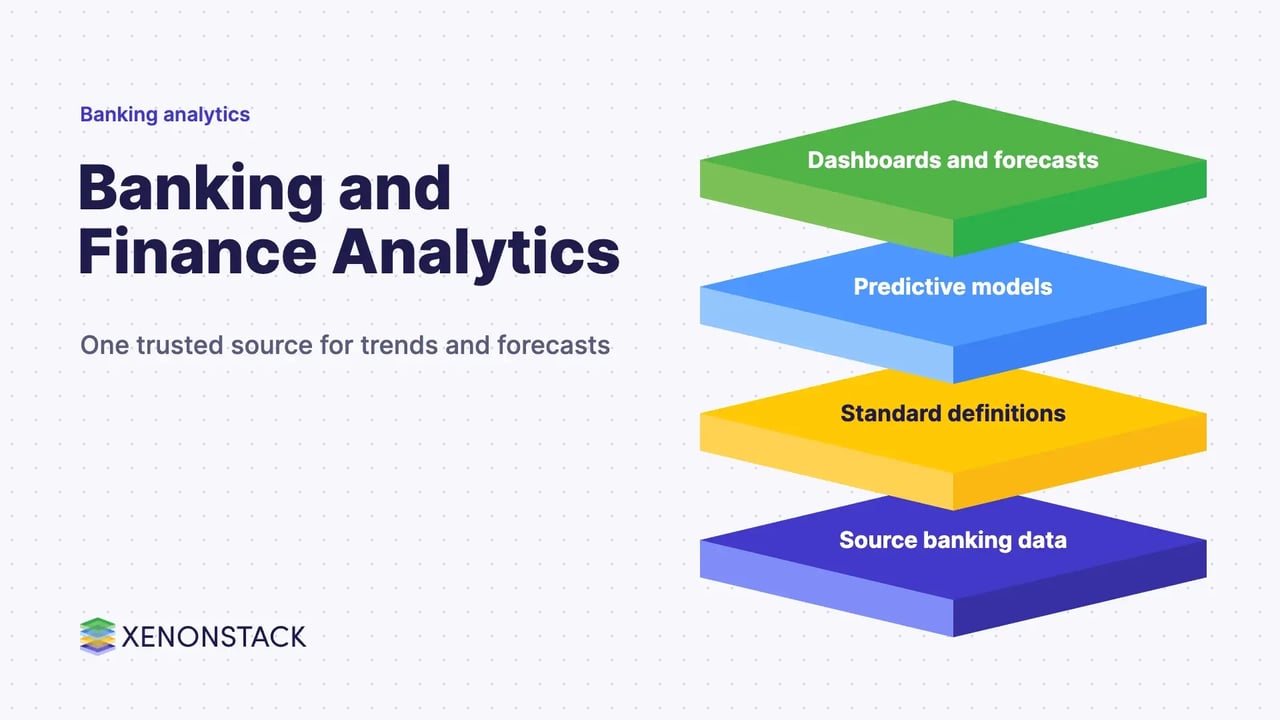
A banking and finance analytics platform is a data foundation that brings customer, account, loan and transaction data together so a bank can track trends, compare periods and forecast outcomes from one trusted source. It combines reporting dashboards with predictive models, so teams see what happened and what is likely to happen next.
This page is for data, risk and business leaders in banks and financial institutions. It explains the problem, how the platform works, where AI agents fit, how it compares with spreadsheet reporting, and what to check before you adopt it.
What problem does a banking analytics platform solve?
Banks hold data in core banking, lending, cards, CRM and risk systems, each with its own definitions. Customers expect consistent service, and leaders expect year-over-year and monthly comparisons they can rely on when deciding on acquisition, retention and lending. When each team builds its own report, the same measure, such as growth or success rate, can show different values in different places.
Regulators look at this too. The Basel Committee's BCBS 239 principles were written after the 2007 crisis showed that banks "were unable to aggregate risk exposures and identify concentrations fully, quickly and accurately." The Committee states that the principles will strengthen banks' risk data aggregation and internal risk reporting.
How does a banking and finance analytics platform work?
The platform follows a repeatable path from source data to a decision.
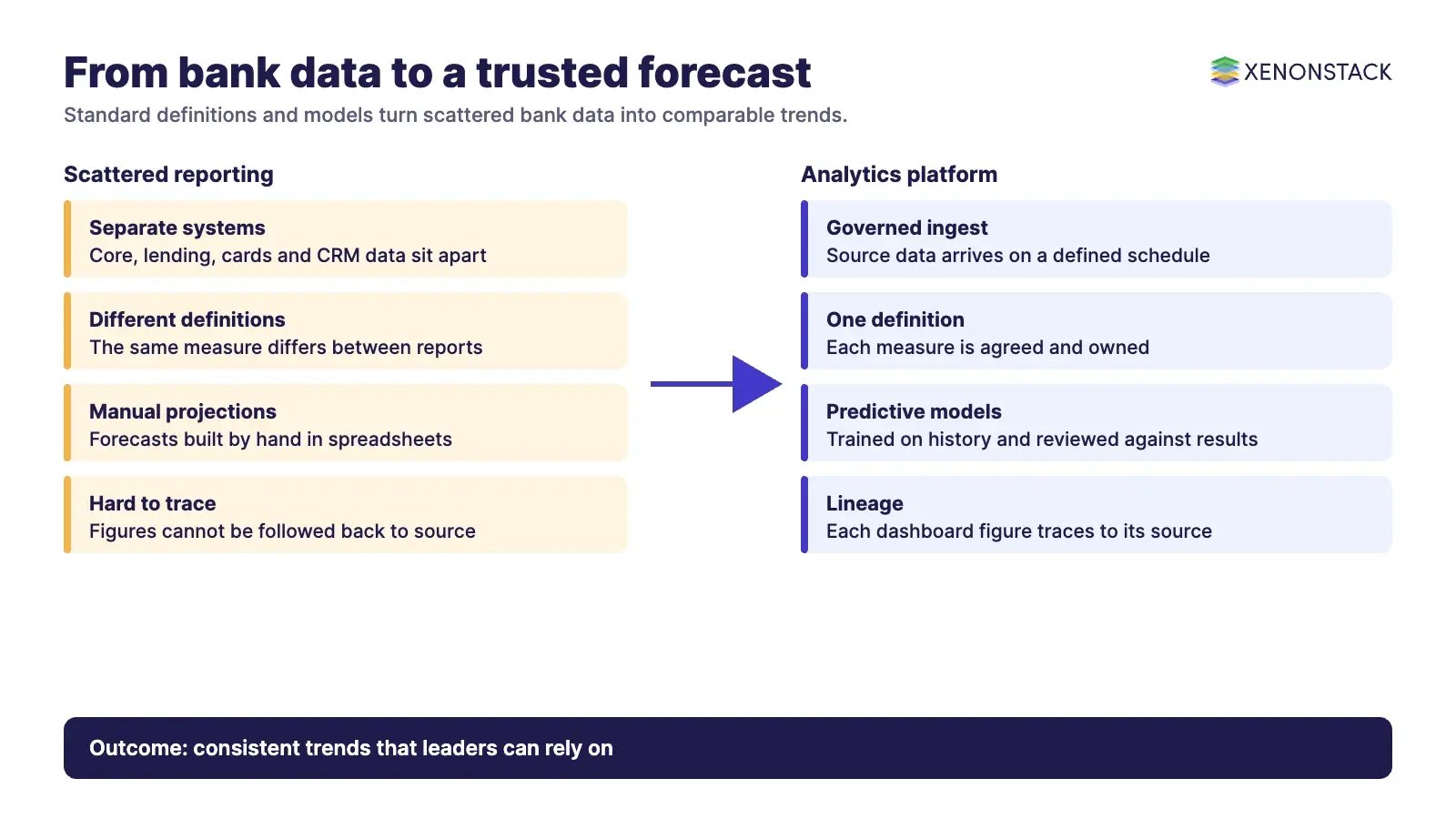
- Ingest: pull data from core, lending, cards and customer systems on a defined schedule or as events arrive.
- Standardise: agree one definition for each measure, such as monthly growth, credit score band or loan amount, and apply it everywhere.
- Model: train predictive models on historical data to estimate trends, risk and customer behaviour.
- Present: show monthly trends, year-over-year comparisons, growth, success rate and total loan amount on dashboards.
- Review: compare predictions with actual results and refine the models.
Dashboards of this kind typically break results down by region, show customer counts and credit score movement over time, and pair account information such as cash balance and accounts receivable with a forecast.
Where do AI agents fit in banking analytics?
An AI agent can sit on top of the platform to answer questions in plain language, prepare a monthly performance summary or flag a trend that departs from its forecast, then hand the finding to a person. Because a model output can drive a business decision, the Federal Reserve's SR 11-7 guidance defines model risk as "the potential for adverse consequences from decisions based on incorrect or misused model outputs and reports." The guidance describes development and use, validation, and governance as the core areas of a sound framework.
For governed context behind such agents, see ElixirData, XenonStack's Context OS. XenonStack also offers a machine learning model demo covering monthly trends, growth and loan amount.
How does a platform differ from spreadsheet reporting?
| Question | Spreadsheet reporting | Analytics platform |
|---|---|---|
| Data source | Extracts copied by each team | Governed, shared data from source systems |
| Definitions | Vary by report author | One agreed definition per measure |
| Forecasting | Manual projections | Predictive models trained on history |
| Freshness | As of the last export | On a defined refresh schedule or near real time |
| Audit trail | Hard to trace | Lineage from report back to source |
The platform does not replace judgement. It makes the numbers consistent so that judgement starts from the same facts.
What should you check before adopting one?
- Which three or four measures leadership reviews every month, and who owns each definition.
- Whether source data can be traced from each dashboard figure, in line with the aggregation and reporting principles your supervisor expects.
- Who validates each predictive model, how often, and who can challenge its results.
- How personal and financial data is protected, including access by role.
- Whether the platform can be extended to AI agents later without rebuilding the data layer.
To map one decision your agents make, and the data and policy it depends on, book a Context Workshop. See what happens in the workshop.
Frequently asked questions
What is a banking analytics platform?
It is a data foundation that combines customer, account and loan data with dashboards and predictive models, so a bank can track trends and forecast from one trusted source.
Why do banks need consistent trend analysis?
Leaders compare monthly and year-over-year results to decide on acquisition, retention and lending, and those comparisons are only useful when every team uses the same definitions.
What does BCBS 239 have to do with analytics?
The Basel Committee's principles aim to strengthen risk data aggregation and internal risk reporting, which depend on the same accurate, traceable data an analytics platform provides.
What is model risk in banking?
The Federal Reserve's SR 11-7 guidance defines it as the potential for adverse consequences from decisions based on incorrect or misused model outputs and reports.
Can AI agents use a banking analytics platform?
Yes. An agent can summarise results or flag unusual trends from the platform's governed data, with a person reviewing the decision.
Ready to put AI agents to work? See an ElixirClaw demo: the agentic OS to build, orchestrate and govern AI agents across your enterprise systems.
Explore the XenonStack platform family: ElixirData · ElixirClaw · ElixirHub · NexaStack · MetaSecure · Neural AI · AgentGRC · AgentSRE · AgentAnalyst · AgentInstruct · AgentRAI · AgentScrum · AgentSearch · AgentForce · AI Aviator · SAIF Aviator · CohortIQ · XenonStack AI · XenonStack UAE