Key takeaway
- Predictive analytics in healthcare uses patient data to forecast events like readmissions. See the platform design, where AI agents fit and what to check.
Predictive analytics in healthcare is the use of data mining, statistics, modelling and machine learning to examine current and historical patient data and forecast what is likely to happen next, such as a readmission, an infection or a spike in demand. It helps providers act earlier and plan resources with evidence.
This page is for healthcare technology, clinical operations and data leaders. It covers the problem, the platform design, where AI agents fit, how real-time analytics compares with retrospective reporting, and what to check before you adopt it.
What problem does predictive analytics solve in healthcare?
Patient journeys span many steps: finding a doctor, checking availability, waiting in a queue, consulting by text, audio or video, getting lab tests, receiving a prescription and ordering medicine. Each step produces data, and without a platform to join it, providers see only fragments. Predictive analytics uses that data for several goals:
- Building better patient profiles and predictive models for precision medicine.
- Supporting telemedicine by recognising patterns, allocating duties and monitoring live data.
- Using real-time data for infection control, so infections can be predicted and prevented.
- Analysing patient data to prevent readmissions and improve pharmaceutical supply chains.
Readmissions carry a financial weight in the United States. The CMS Hospital Readmissions Reduction Program is a Medicare value-based purchasing program that measures excess readmissions for conditions including heart failure, pneumonia and COPD, and applies a payment adjustment of up to 3 percent to Medicare payments.
How does a predictive analytics platform for healthcare work?
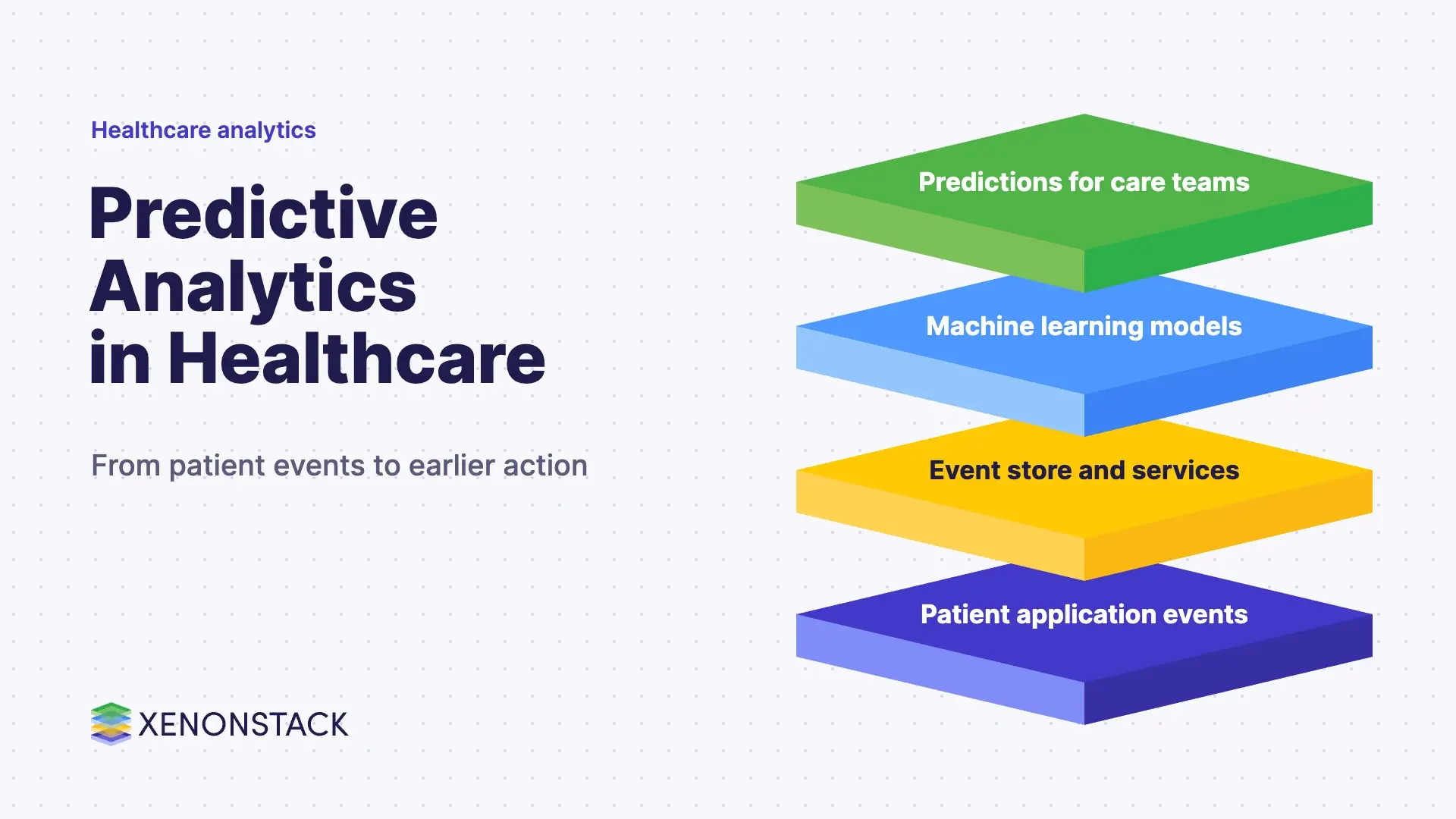
A common design captures events as they happen, processes them, stores them and serves predictions through APIs.
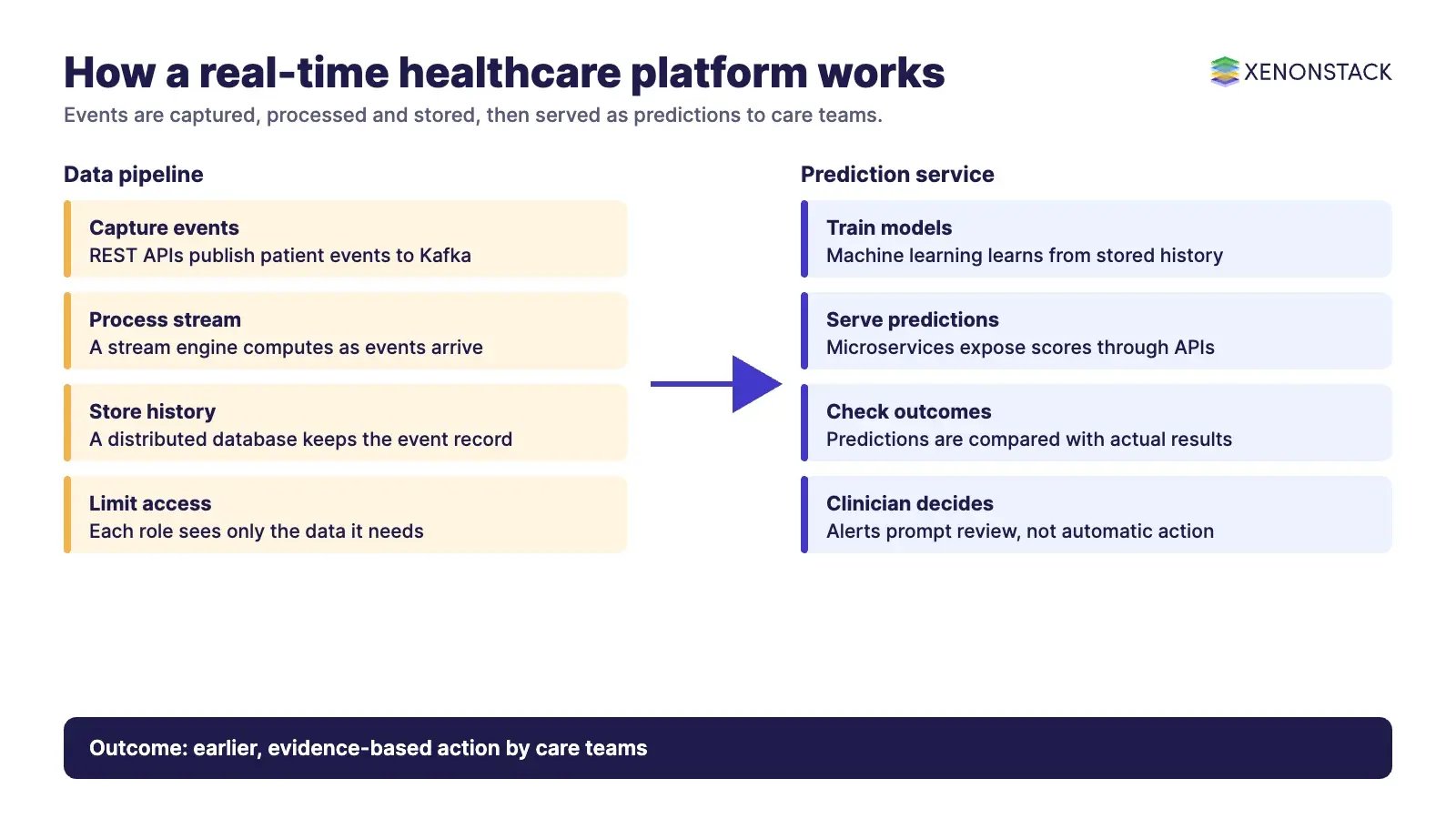
- Capture: REST APIs receive patient and application events and publish them to a messaging platform such as Apache Kafka.
- Process: a stream engine such as Apache Spark computes on the events as they arrive.
- Store: a distributed database such as Cassandra holds the event history.
- Serve: microservices expose predictions to patient and clinician applications, running in containers on Kubernetes.
- Learn: machine learning models train on the stored history and are checked against actual outcomes.
The Apache Kafka introduction says Kafka combines three capabilities: it can "publish (write) and subscribe to (read) streams of events", "store streams of events durably and reliably for as long as you want", and "process streams of events as they occur or retrospectively". One note on tooling: the Apache Spark documentation now calls Spark Streaming "the previous generation of Spark's streaming engine" and recommends Structured Streaming for new pipelines.
Models draw on techniques covered in our guide to machine learning.
How is patient data protected?
In the United States, the HIPAA Privacy Rule covers individually identifiable health information held or transmitted by covered entities and their business associates, such as health plans, clearinghouses and providers. The page states that covered entities must "make reasonable efforts to use, disclose, and request only the minimum amount of protected health information needed". An analytics platform should therefore limit which fields each model and user can see.
Where do AI agents fit in healthcare analytics?
An AI agent can monitor a risk score, prepare a summary for a care team or route an alert to the right person, while clinicians keep the clinical decision. The agent should work only with the data its role permits and leave a record of what it read and recommended. For the AI agents computing platform, see ElixirClaw, XenonStack's AI agents computing platform.
How does real-time analytics differ from retrospective reporting?
| Question | Retrospective reporting | Real-time predictive analytics |
|---|---|---|
| Timing | After the event, in periodic reports | As events arrive, with forecasts |
| Question answered | What happened? | What is likely to happen next? |
| Readmissions | Counted after discharge | Risk flagged before or at discharge |
| Infection control | Investigated after an outbreak | Patterns monitored through networks |
| Engineering | Batch extracts | Streaming pipeline and APIs |
Predictions are probabilities, not diagnoses. Treat them as a prompt for review.
What should you check before adopting one?
- Which single outcome, such as readmission risk, the first model will predict, and who acts on it.
- Whether the data needed is captured consistently across booking, labs and prescriptions.
- How access is limited to the minimum data each role needs.
- How model accuracy is checked against real outcomes, and by whom.
- Whether streaming components are current releases that are still maintained.
To map one decision your agents make, and the data and policy it depends on, book a Context Workshop. See what happens in the workshop.
Frequently asked questions
What is predictive analytics in healthcare?
It is the use of data mining, statistics, modelling and machine learning to forecast future events from current and historical patient data.
How can predictive analytics reduce readmissions?
By analysing patient data, a model can flag patients at higher risk so care teams can act before or at discharge.
What technologies support a real-time healthcare analytics platform?
Common building blocks are a messaging platform such as Kafka, a stream processing engine such as Spark, a distributed database such as Cassandra, and microservices running on Kubernetes.
Does HIPAA apply to analytics platforms?
The HIPAA Privacy Rule covers protected health information held by covered entities and their business associates, so an analytics platform handling that data must follow it.
Can AI agents be used in healthcare analytics?
Yes, for tasks such as summarising risk scores or routing alerts, with clinicians keeping the clinical decision.
Ready to put AI agents to work? See an ElixirClaw demo: the agentic OS to build, orchestrate and govern AI agents across your enterprise systems.
Explore the XenonStack platform family: ElixirData · ElixirClaw · ElixirHub · NexaStack · MetaSecure · Neural AI · AgentGRC · AgentSRE · AgentAnalyst · AgentInstruct · AgentRAI · AgentScrum · AgentSearch · AgentForce · AI Aviator · SAIF Aviator · CohortIQ · XenonStack AI · XenonStack UAE