Key takeaway
- Where agentic AI fits across the SDLC, what the 2025 DORA report found, and the review, security and governance controls enterprises need first.
Agentic AI in software development means AI agents that plan a change, write code, run tests and open a pull request with limited human input, rather than only suggesting the next line. Agentic AI can act at each stage of the software development lifecycle (SDLC), so the question for leaders shifts from "does it help developers" to "which stages can safely run with an agent and who reviews the result".
The evidence so far is encouraging but conditional. The 2025 DORA report found that AI adoption is now linked to higher delivery throughput, and also that AI amplifies the strengths and weaknesses of the team using it. This guide maps agents to SDLC phases, sets out the controls that matter, and says when to hold back.
Where do agents fit in each SDLC phase?
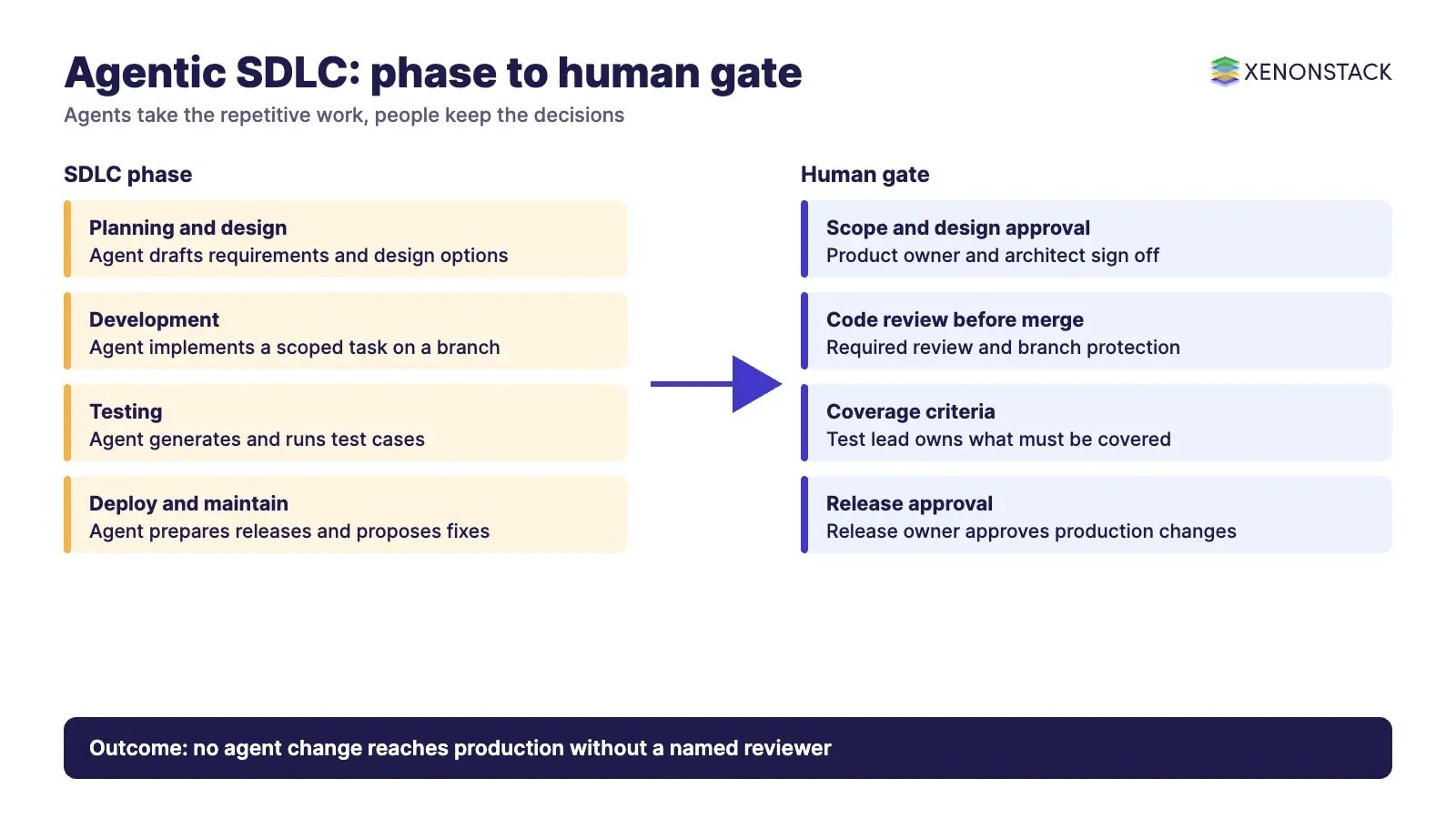
| Phase | What an agent can do | Human gate | Maturity |
|---|---|---|---|
| Planning and requirements | Draft and check requirements from natural language, flag gaps and conflicts | Product owner approves scope | Widely used as an assistant |
| Design | Suggest design patterns and draft design documents from requirements | Architect approves the design | Assistant use, review needed |
| Development | Implement a scoped task on a branch, run tests and linters, open a pull request | Code review before merge | Available in current tools |
| Testing | Generate test cases from specifications, run them and report failures | Test lead owns coverage criteria | Common, quality varies |
| Deployment | Prepare release notes and pipeline changes, check release readiness | Release owner approves production changes | Use with strict approvals |
| Maintenance | Triage defects, propose fixes, update dependencies | Owner reviews every change | Growing, needs guardrails |
The pattern is consistent. Agents take the repetitive work, and a named person keeps the decision on scope, design, merge and release.
What has changed in the last year?
Google's 2025 DORA report, based on a survey of nearly 5,000 technology professionals and published on 23 September 2025, found AI use among software professionals at 90 per cent. Over 80 per cent said AI improved their productivity and 59 per cent reported a positive effect on code quality. Trust was mixed: about 24 per cent trusted AI a great deal or a lot, and 30 per cent trusted it little or not at all. The report describes AI as a mirror and a multiplier, so it helps cohesive organisations and exposes weaknesses in fragmented ones.
On the tooling side, GitHub's Copilot coding agent documentation shows what a production coding agent looks like. It works in a cloud environment, edits files, runs tests and linters, works on one branch at a time and opens one pull request per task. GitHub states that its output can contain security vulnerabilities and that session logs do not replace your own review and testing.
What do enterprises need in place before agents write code?
Our own engineering teams use coding agents for planning and code generation, and the lesson is that the quality of the hand-off decides the quality of the result. Developers prepare context and design documents before assigning work to an agent, and we use skill files to give agents the project conventions. We have also updated our secure SDLC process to account for coding-agent practices. A practical minimum is:
- Written context: requirements, architecture notes and coding standards the agent can read.
- Scoped tasks: one change per task, with clear acceptance tests.
- Test coverage: agents are only as safe as the tests that catch their mistakes.
- Branch protection: no direct pushes to protected branches, and required reviews.
What do governance, security and cost require?
- Code quality and security: run static analysis, dependency checks and secret scanning on every agent pull request, as you would for human code.
- Access: give agents repository-scoped, least-privilege access. No production database access.
- Traceability: keep session logs, prompts and the reviewer's name against each merged change.
- Agent policy: ElixirClaw is an agentic OS platform to build, orchestrate and govern AI agents and automation workflows while keeping humans in control.
- Cost: track model usage and compute per merged pull request, not per developer seat, so you can see value delivered.
- Evaluation: ElixirData's AgentEvaluation describes scoring and benchmarking enterprise AI agents against real workflows, so regressions show up before users see them.
For delivery teams, AgentScrum applies agents to agile delivery, such as sprint planning and blocker tracking.
When should you hold back?
- Test coverage is thin, so nobody would notice a wrong change.
- Requirements are unclear or undocumented, because agents amplify ambiguity.
- The code is safety-critical or regulated and no reviewer has the time to inspect each change.
- Integration with legacy systems is poorly understood and needs careful configuration and compatibility checks.
- Bias, licence and misuse risks in generated code have no named owner.
What adoption sequence works?
- Start with low-risk work: tests, documentation, dependency updates and small defects.
- Write the context documents and agent skill files before widening scope.
- Require pull request review and automated security checks for all agent output.
- Measure lead time, change failure rate and rework, the delivery measures DORA tracks, before and after.
- Extend to feature work only when the first stage shows stable quality.
What will agents handle next?
Expect agents to take more of testing, integration and maintenance as tools mature, with developers moving towards specifying, reviewing and governing. This is a direction, not a guarantee, and DORA's finding that AI exposes weak practices suggests the organisations that benefit most will be those with strong foundations. Related reading: our AI agent infrastructure stack, agentic graph systems and synthetic data generation guides, and our overview of AI agents.
To map one engineering decision your agents should make, and the context and policy it depends on, book a Context Workshop. See what happens in the workshop. ElixirData's Context OS keeps governed context, versioned policy and decision traces in one decision layer above AI agents.
FAQ: agentic AI in software development
What is agentic AI in software development?
It is AI that plans, writes, tests and proposes code changes with limited human input, usually delivered as a pull request that a person reviews.
How is it different from a coding assistant?
An assistant suggests code inside your editor. An agent takes a task, works on a branch, runs tests and returns a pull request.
Is agent-written code safe to ship?
Only after review and testing. GitHub's own documentation says agent output can contain security vulnerabilities and that logs do not replace your review.
What did the 2025 DORA report find?
AI use reached 90 per cent among software professionals and was linked to higher delivery throughput, but the report says AI amplifies existing strengths and weaknesses.
Where should we start?
Start with tests, documentation and dependency updates, with required reviews and automated security checks on every agent pull request.
Follow XenonStack on LinkedIn: XenonStack on LinkedIn for new guides on agentic AI, data and platform engineering.
Explore the XenonStack platform family: ElixirData · ElixirClaw · ElixirHub · NexaStack · MetaSecure · Neural AI · AgentGRC · AgentSRE · AgentAnalyst · AgentInstruct · AgentRAI · AgentScrum · AgentSearch · AgentForce · AI Aviator · SAIF Aviator · CohortIQ · XenonStack AI · XenonStack UAE