Key takeaway
- Agentic AI in sales for enterprise leaders: where AI agents fit first, governance and data controls, rollout steps and trade-offs, with decision tables.
Agentic AI in sales means AI agents that take defined actions in your sales process, such as scoring a lead, drafting and sending a follow-up, or updating the CRM, within limits that people set. It differs from earlier sales automation because the agent plans steps toward a goal and adapts to what it finds, instead of following one fixed rule.
For CROs, CTOs and heads of revenue operations, the question is less whether agents can write emails and more which decisions they may take, on which data, with what audit trail. Gartner predicts that by 2028 at least 15% of work decisions will be made autonomously through agentic AI, up from 0% in 2024, and Gartner also predicts that over 40% of agentic AI projects will be cancelled by the end of 2027. This guide covers where agents fit first, how a multi-agent sales workflow runs, the controls to set, and a rollout sequence. For the marketing side, see our posts on agentic AI in marketing and personalised marketing campaigns.
How does agentic AI in sales differ from sales automation?
| Sales task | Rule-based tools | Agentic approach | Control to keep |
|---|---|---|---|
| Lead qualification | Fixed scoring rules | Agent weighs CRM, marketing and behaviour signals and explains its score | Reps can see and override the score |
| Outreach and follow-up | Static templates and sequences | Agent drafts messages from context and adapts to replies | Approval before sending for new accounts or sensitive segments |
| Pipeline insight | Scheduled reports | Agent queries live CRM data and flags risks | Data access limited by role |
| Forecasting | Rep-entered stages | Agent combines CRM fields with call and email notes | Sales leaders own the final forecast |
| Contact centre assist | Scripts | Agent suggests next actions and drafts notes | Live agent decides what is said |
Which sales jobs should agents take first?
Start where the work is repetitive, the data is already in your systems and a wrong action is cheap to reverse.
| Use case | What the agent does | When it fits | Human control |
|---|---|---|---|
| Lead nurturing | Watches touchpoints and sends relevant follow-ups; escalates when intent signals appear | High inbound volume, slow response times | Rep takes over at escalation |
| Outreach campaigns | Personalises messages by persona and stage | Clean contact data and clear messaging | Approval and send limits |
| Account-based engagement | Consolidates CRM data and maps stakeholders | Complex B2B accounts | Account owner reviews plans |
| Revenue forecasting | Merges CRM data with call transcripts and email | Forecast accuracy is a known pain | Leader signs off |
| Contact centre co-pilot | Surfaces history and next-best actions during calls | Live agents handle sales calls | Agent speaks; AI suggests |
In our own delivery work, a common first request is an agent that follows up with leads over a messaging channel without manual effort, and the common first question from buyers is data security.
How does a multi-agent sales workflow run?
Rather than one large agent, enterprises usually run several specialised agents that hand work to each other under an orchestration layer. A typical set is below.
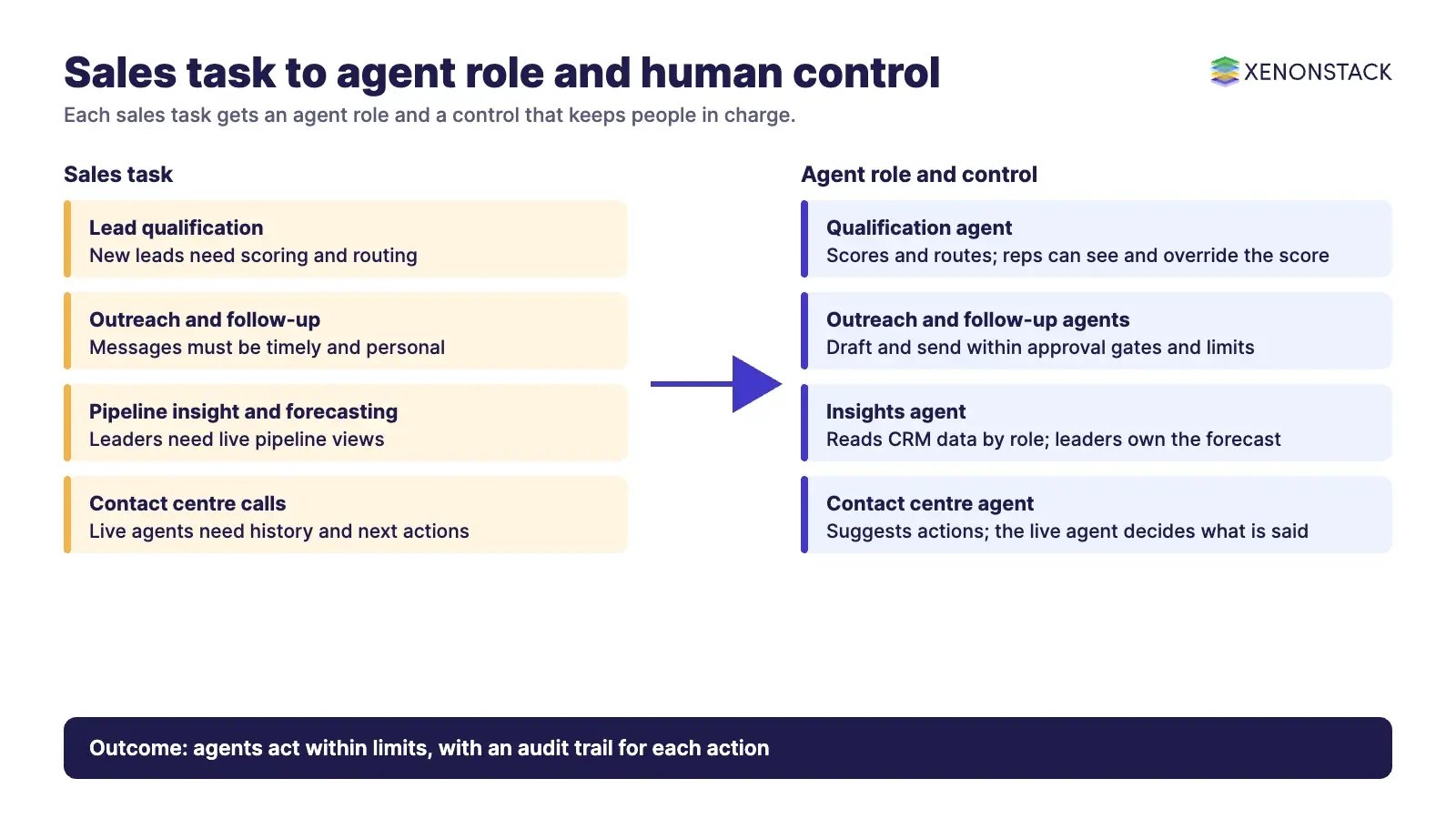
- Lead qualification agent: scores and routes new leads.
- Outreach agent: drafts personalised messages.
- Follow-up agent: keeps timing and context consistent.
- Insights agent: reports on deals and pipeline health.
- Contact centre agent: assists live agents during calls.
The pattern can extend to a sales manager agent, a deal desk agent and a contract-review agent working together on one deal. ElixirClaw is an agentic OS platform to build, orchestrate and govern AI agents and automation workflows while keeping humans in control; its own page describes setting autonomy per agent and action across four levels, with approval gates and an audit trail. For sales and customer-service agents on their own site, see AgentForce, which describes agents that score leads, send tailored outreach and produce forecasts from your data.
What governance and data controls do sales agents need?
| Risk | Control |
|---|---|
| Wrong or off-brand message sent to a customer | Approval gates, message limits and templates for regulated claims |
| Personal data used beyond its purpose | Role-based data access, consent checks and redaction |
| Agent acts outside its authority | Decision boundaries with escalation to a named person |
| No evidence of why an action was taken | Decision traces and an audit trail for every action |
| Integration changes break behaviour | Test environment and staged rollout |
AgentGRC keeps autonomous agent actions inside policy, with the audit trail risk teams need. Rules on outbound messages differ by country, so check consent and marketing rules with legal counsel before automating outreach.
How do industries apply agentic AI in sales?
| Industry | Typical use | What to check first |
|---|---|---|
| Financial services | Client reviews and outreach; see agentic AI in wealth management | Suitability and communication rules |
| Healthcare and devices | Provider follow-ups and documentation support | Claims and privacy rules |
| Manufacturing | Distributor reorder prompts and cross-sell suggestions | Quality of order data |
| Retail and e-commerce | Personalised promotions across channels | Consent and channel preferences |
| Technology and SaaS | Onboarding, health monitoring and expansion triggers | Product usage data access |
What is a sensible rollout sequence?
- Pick one workflow, such as follow-ups on inbound leads, and record today's baseline for response time and conversion.
- Clean the data the agent will read, and decide which fields it may write.
- Set autonomy: draft only, then approve-and-send, then send within limits.
- Connect CRM, email and calendar through governed integrations.
- Run with a small team and review a sample of actions each week.
- Compare against the baseline, then add the next workflow.
When should you not use sales agents yet?
- CRM data is incomplete or inconsistent.
- No one owns approvals or escalation.
- Outbound consent rules for your markets are unclear.
- The sales process itself is not defined, so there is nothing stable to automate.
- Deals are few and high value, where a person-written message matters more than speed.
The future direction is toward agents that act as digital colleagues across sales, marketing and service, but the 2027 cancellation prediction above is a reminder to start narrow and measure.
To map one sales decision your agents should make, and the context and policy it depends on, book a Context Workshop. See what happens in the workshop.
Frequently asked questions about agentic AI in sales
What is agentic AI in sales?
AI agents that take defined actions in the sales process, such as scoring leads or sending follow-ups, within limits that people set.
How is it different from sales automation?
Automation follows fixed rules. Agents plan steps toward a goal and adapt to context, so they need stronger approval and audit controls.
Which sales task should we automate first?
Follow-ups on inbound leads, because the data is in your CRM and mistakes are easy to reverse.
How do we keep agents safe?
Set autonomy levels, require approval for sensitive actions, restrict data by role and keep an audit trail of every action.
Why do some agentic AI projects fail?
Gartner predicts over 40% of agentic AI projects will be cancelled by the end of 2027, so start with one measured workflow.
Follow XenonStack on LinkedIn: XenonStack on LinkedIn for new guides on agentic AI, data and platform engineering.
Explore the XenonStack platform family: ElixirData · ElixirClaw · ElixirHub · NexaStack · MetaSecure · Neural AI · AgentGRC · AgentSRE · AgentAnalyst · AgentInstruct · AgentRAI · AgentScrum · AgentSearch · AgentForce · AI Aviator · SAIF Aviator · CohortIQ · XenonStack AI · XenonStack UAE