Key takeaway
- How agentic AI runs personalised campaigns: data, decision loops, GDPR guardrails, KPIs and a phased adoption plan for enterprise marketing leaders.
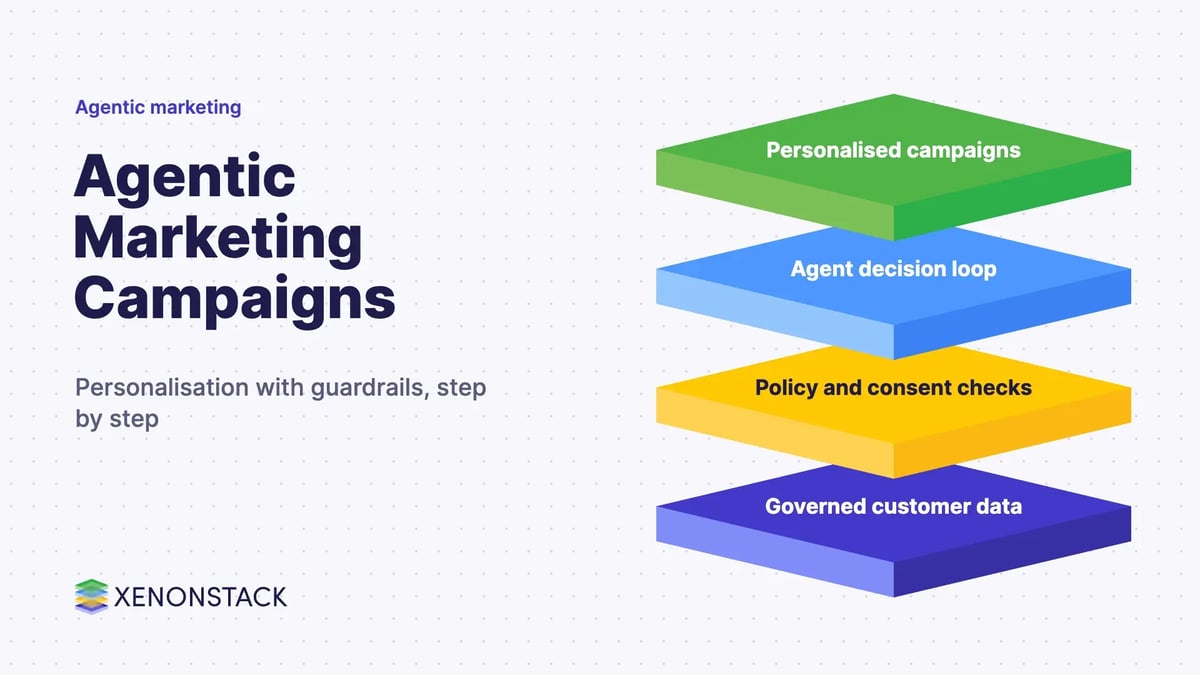
Agentic AI marketing replaces fixed rules and static segments with software agents that read customer signals, choose the next action, test it and learn from the result, inside limits that marketing and compliance leaders set. For enterprises, the practical gain is personalised campaigns that adapt across channels while every decision stays inside consent, brand and budget rules. This guide covers the decision loop, the data it needs, where it fits and where it does not, and how to govern it.
This post looks at campaign orchestration across channels. For the email channel on its own, read our guide to agentic AI for email marketing, and for the wider picture see agentic AI in marketing. Our agentic AI for marketing page shows how we approach the area.
What does agentic AI change in personalised campaigns?
Traditional marketing automation runs a journey a team designed in advance. An agentic system holds a goal, such as retention in a segment or conversion on an offer, and plans the steps itself using tools such as the CRM, the content system and the analytics platform. Expectations are high: McKinsey reported in 2021 that 71% of consumers expect personalised interactions and 76% are frustrated when they do not get them (McKinsey, 12 November 2021). That research is five years old, so treat it as direction, not a current benchmark.
| Area | Rule-based automation | Agentic campaigns |
|---|---|---|
| Segmentation | Fixed segments, refreshed in batches | Segments and individual state updated as signals arrive |
| Next action | Predefined branch in a journey | Agent chooses from approved actions, offers and channels |
| Testing | Manual A/B tests set up by the team | Agent proposes and runs tests within a set budget |
| Control | Rules written in the tool | Policy, consent and approval limits applied to every action |
Which customer data do the agents need?
Personalisation begins with data that the agent is allowed to use. Four types matter, and each needs a recorded purpose and consent status before an agent touches it.
- Behavioural data: clickstreams, browsing history and engagement signals.
- Demographic data: age band, income range, occupation and similar attributes.
- Geographic data: location signals for region-specific offers and timing.
- Psychographic data: interests, values and stated preferences.
Data silos across the CRM, analytics and campaign tools are the usual blocker. The agent needs one governed view of the customer, with the consent flag and source attached to each field. ElixirData Context OS keeps governed context, versioned policy and decision traces in one decision layer above AI agents, which is the layer a marketing agent reads before it acts.
How do predictive models become autonomous actions?
Predictive models have long scored audiences. The change is that an agent acts on the score within limits, then measures what happened. Each model family answers a different campaign question.
| Model type | Campaign question it answers | Typical agent action |
|---|---|---|
| Classification | Which segment, or likelihood to convert or churn? | Assign a journey or retention offer |
| Clustering | Which hidden groups exist in the data? | Propose new segments for human review |
| Time series | When will demand or engagement peak? | Shift send time and budget |
| Outlier detection | Which behaviour is unusual? | Flag for review, pause a trigger |
Cohort analysis supports this step. CohortIQ helps teams understand customer and product cohorts, so decisions reflect how groups behave over time.
How does the agentic campaign loop work?
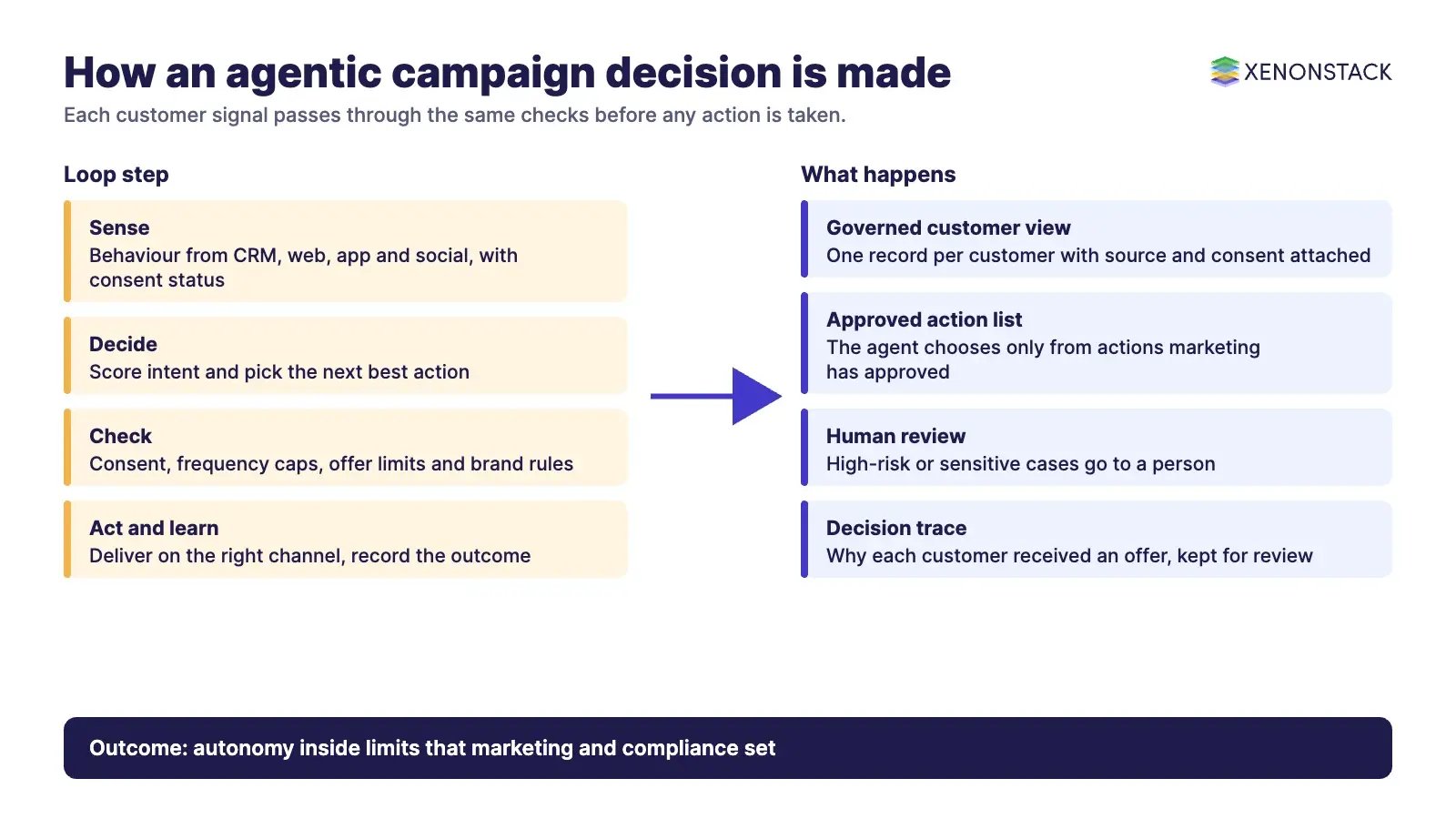
- Sense: collect behaviour from the CRM, web, app and social channels, with consent status.
- Decide: score intent and pick the next best action from an approved list.
- Check: apply policy, such as consent, frequency caps, offer limits and brand rules. Route high-risk actions to a person.
- Act: generate or select content and deliver it on the right channel at the right time.
- Learn: record the outcome and update the model and the test plan.
The Check step is what separates an agentic system from an unsupervised one. Without it, optimisation can drift toward offers, frequency or targeting that the business never approved. ElixirClaw is an agentic OS platform to build, orchestrate and govern AI agents and automation workflows while keeping humans in control.
Where does it fit across industries?
| Sector | Where it fits | Watch-outs |
|---|---|---|
| E-commerce and retail | Recommendations, cross-sell, demand-led pricing and offers | Price fairness and promotion limits need explicit rules |
| Banking and financial services | Tailored product offers, personalised alerts alongside fraud signals | Regulated advice and credit decisions need human review |
| Healthcare and pharma | Appointment reminders, educational content, trial awareness | Health data is sensitive; keep outreach to consented, non-diagnostic content |
| Telecom and media | Churn-risk retention offers, content and bundle recommendations | Offer fairness and contact frequency |
| Travel and hospitality | Context-aware packages, disruption updates, loyalty perks | Real-time data quality for itinerary changes |
The same pattern extends to service and sales teams. Our post on autonomous customer agents covers the service side, and our customer engagement platform case study shows an omnichannel build. AgentForce presents AI agents for sales work and customer service, including personalised outreach.
What do the benefits depend on?
- Personalisation at scale: from segment-level to individual-level messaging, where the data and consent exist.
- Faster decision cycles: agents react to signals within minutes instead of the next campaign review.
- Less wasted spend: tighter targeting and creative testing, measured against a control group.
- Cross-channel consistency: one view of the customer across email, social, mobile and web.
These gains are conditional on clean data, working integrations and a measurement design. We do not quote an average uplift, because published figures vary widely by sector and baseline.
What do GDPR, CCPA and privacy rules mean for autonomous marketing?
Autonomy raises the compliance bar. Under GDPR Article 21, a person can object at any time to processing of their personal data for direct marketing, including profiling linked to it, and once they object the data may no longer be processed for that purpose (Art. 21). Article 22 gives people the right not to be subject to decisions based solely on automated processing, including profiling, that have legal or similarly significant effects, with safeguards that include human intervention and the right to challenge the decision (Art. 22). Most campaign decisions will not meet that threshold, but credit, pricing and eligibility offers might, so ask legal counsel to classify each use case.
In practice this means the agent must read the objection and consent state before every send, keep a decision trace that shows why a customer received an offer, and hand sensitive cases to a person. We have not verified current CCPA automated decision rules for this post, so confirm US state requirements with counsel.
Which KPIs show whether it works?
| KPI | What it shows | Measure against |
|---|---|---|
| Engagement rate | Opens, clicks and interaction depth | Holdout group |
| Conversion uplift | Prospects turned into customers | Previous journey or control |
| Customer lifetime value | Long-term effect of personalised journeys | Cohort comparison |
| Churn reduction | Drop-offs prevented by predictive engagement | Matched cohort |
| Campaign ROI | Revenue added against cost and spend saved | Baseline cost per campaign |
| Time to market | Days from idea to live campaign | Current cycle time |
How should an enterprise adopt it, and when should it not?
- Start with one journey, such as churn retention in one segment, with a holdout group.
- Fix the data and consent layer before adding autonomy.
- Begin in recommend mode: the agent suggests, a marketer approves.
- Move to bounded autonomy for low-risk actions, such as send time and subject lines.
- Scale to more channels once decision traces and KPIs show stable results.
It is a poor fit where customer data is fragmented or consent records are unreliable, where each campaign needs legal sign-off, or where volumes are too small for the agent to learn from. In those cases, fix the foundations or keep rule-based journeys.
What will change in marketing agents next?
Expect generative AI to produce creative variants while agents test and deploy them, and expect marketing agents to share context with sales and service agents so the customer journey is handled end to end. Privacy-preserving personalisation will matter more as regulation tightens. Treat these as direction, not dated forecasts.
To map one personalised campaign decision your agents should make, and the context and policy it depends on, book a Context Workshop. See what happens in the workshop.
Frequently asked questions
How is agentic AI marketing different from marketing automation?
Automation runs journeys designed in advance. Agentic systems pursue a goal, choose from approved actions, test them and learn, inside policy limits.
What data do personalised agentic campaigns need?
Behavioural, demographic, geographic and psychographic data, each with a recorded purpose and consent status, held in one governed view of the customer.
Does GDPR allow autonomous personalisation?
It can, with a lawful basis. People can object to direct marketing profiling under Article 21, and Article 22 limits solely automated decisions with significant effects, so keep consent checks, decision traces and human review for sensitive cases.
Which KPIs should we track?
Engagement rate, conversion uplift, customer lifetime value, churn reduction, campaign ROI and time to market, each against a holdout group or baseline.
Where should we start?
Pick one journey with a holdout group, fix data and consent, run in recommend mode, then allow bounded autonomy for low-risk actions.
Ready to put AI agents to work? Explore ElixirClaw, the agentic OS platform to build, orchestrate and govern AI agents.
Follow XenonStack on LinkedIn: XenonStack on LinkedIn for new guides on agentic AI, data and platform engineering.
Explore the XenonStack platform family: ElixirData · ElixirClaw · ElixirHub · NexaStack · MetaSecure · Neural AI · AgentGRC · AgentSRE · AgentAnalyst · AgentInstruct · AgentRAI · AgentScrum · AgentSearch · AgentForce · AI Aviator · SAIF Aviator · CohortIQ · XenonStack AI · XenonStack UAE