What is your Key focus areas? *
AI Workflow and Operations
Data Management and Operations
AI Governance
Analytics and Insights
Observability
Security Operations
Risk and Compliance
Procurement and Supply Chain
Private Cloud AI
Vision AI

Get Started with your requirements and primary focus, that will help us to make your solution
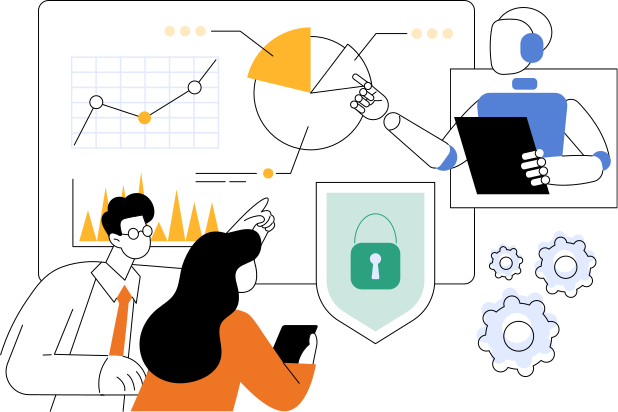
SecOps ReImagined differs from traditional SecOps in several key ways, reflecting a more integrated, automated, and proactive approach to security operations
Traditional SecOps often rely on disparate tools, leading to integration challenges. SecOps Reimagined addresses this by employing unified, integrated platforms that enhance operational efficiency and streamline security processes.
Traditional SecOps may lack advanced automation capabilities. SecOps ReImagined leverages AI and machine learning to proactively detect threats and automate responses, reducing human error and enhancing threat-hunting capabilities.
While traditional SecOps are reactive, focusing on incident detection and response, SecOps Reimagined emphasizes proactive strategies, aiming to prevent threats before they escalate through continuous monitoring and advanced analytics.
Traditional SecOps may operate in silos, limiting collaboration. SecOps Reimagined fosters a security-conscious culture by integrating security practices across IT operations and development, enhancing collaboration and communication among teams.
A strong security strategy requires a comprehensive approach, focusing on risk assessment, threat detection, data protection, user access management, and incident response. By integrating these essential building blocks, businesses can safeguard assets and ensure compliance effectively.
Leveraging automation and orchestration, it swiftly identifies, contains, and resolves threats, reducing business disruptions.
Explore Further

Utilizes AI and machine learning to enhance threat detection accuracy and offer real-time insights into security incidents.
Explore Further
Ensures adherence to regulatory standards, mitigating the risk of fines and reputational harm.
Explore Further
SecOps ReImagined uses advanced analytics to identify potential vulnerabilities before they escalate, enabling proactive measures to reduce risk and prevent security breaches.
Managed Security Services (MSS) provide continuous monitoring and management of security systems, safeguarding data assets from cyber threats and ensuring compliance with industry regulations.
Explore More

Website security involves identifying vulnerabilities, monitoring for threats, and implementing protective measures to defend against attacks like malware, phishing, and data breaches.
Explore More
AI continuously monitors systems for risks before they escalate. It correlates signals across logs, metrics, and traces. This ensures faster detection, fewer incidents, and stronger reliability
 Proactive detection of performance and availability issues
 Root-cause analysis across microservices and environments
 Automated remediation playbooks to reduce MTTR

AI converts camera feeds into instant situational awareness. It detects unusual motion and unsafe behavior in real time. Long hours of video become searchable and summarized instantly
 Real-time detection of suspicious motion or intrusion
 Natural language video search and instant playback
 Smart summaries for audits, investigations, and compliance
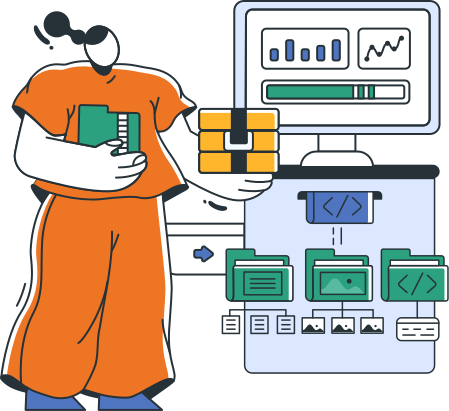
Your data stack becomes intelligent and conversational. Agents surface insights, detect anomalies, and explain trends. Move from dashboards to autonomous, always-on analytics
 Connects to warehouses, lakes, and streaming sources
 Question-answering in natural language
 Continuous monitoring for anomalies and KPI deviations

Agents identify recurring failures and performance issues. They trigger workflows that resolve common problems automatically. Your infrastructure evolves into a self-healing environment
 Automated diagnostics for recurring errors
 Playbook execution: restart services, scale pods, clear queues
 Feedback loop for improving remediation strategies

AI continuously checks controls and compliance posture. It detects misconfigurations and risks before they escalate. Evidence collection becomes automatic and audit-ready
 Continuous control checks across infrastructure and SaaS
 Automated evidence collection for audits
 Risk scoring and prioritized remediation recommendations

Financial and procurement workflows become proactive and insight-driven. Agents monitor spend, vendors, and contracts in real time. Approvals and sourcing decisions become faster and smarter
 Real-time visibility into spend and commitments
 Anomaly detection on invoices and vendor performance
 Intelligent workflows for approvals and sourcing decisions