Key takeaway
- How insurers use big data, link analysis and predictive models to detect claims fraud, speed up claims and price risk, with NiFi and a graph database.
Insurance analytics is the use of predictive modelling, data mining and link analysis on policy, claims and external data to price risk, process claims faster and detect fraud. It lets an insurer find patterns, such as connected claimants, that are hard to see in a single table.
This page is for insurance analytics, claims and fraud teams. It covers the challenges, a fraud detection and pattern analysis solution, where AI agents fit, how approaches compare and what to check before adopting.
What challenges does the insurance industry face with data?
Three challenges stand out: getting more insight from existing data, adding new data sources to existing models, and building a real-time decision analytics platform for predictive and prescriptive analytics. Big data technologies let an insurer modernise its data systems and bring together data from sensors, images, video and other sources, for risk-based pricing, an understanding of customer needs and faster claim processing.
| Analytics area | What it does |
|---|---|
| Actuarial and underwriting | Predictive models find patterns and estimate the likelihood of future events or behaviour |
| Claims | Improves the claim process and detects fraud and provider payment abuse |
| Fraud | Data mining tools track large volumes of transactions to spot patterns of fraudulent ones |
| Customer | Profiling and integrated data support offers and risk-based pricing |
How does fraud detection and pattern analysis work?
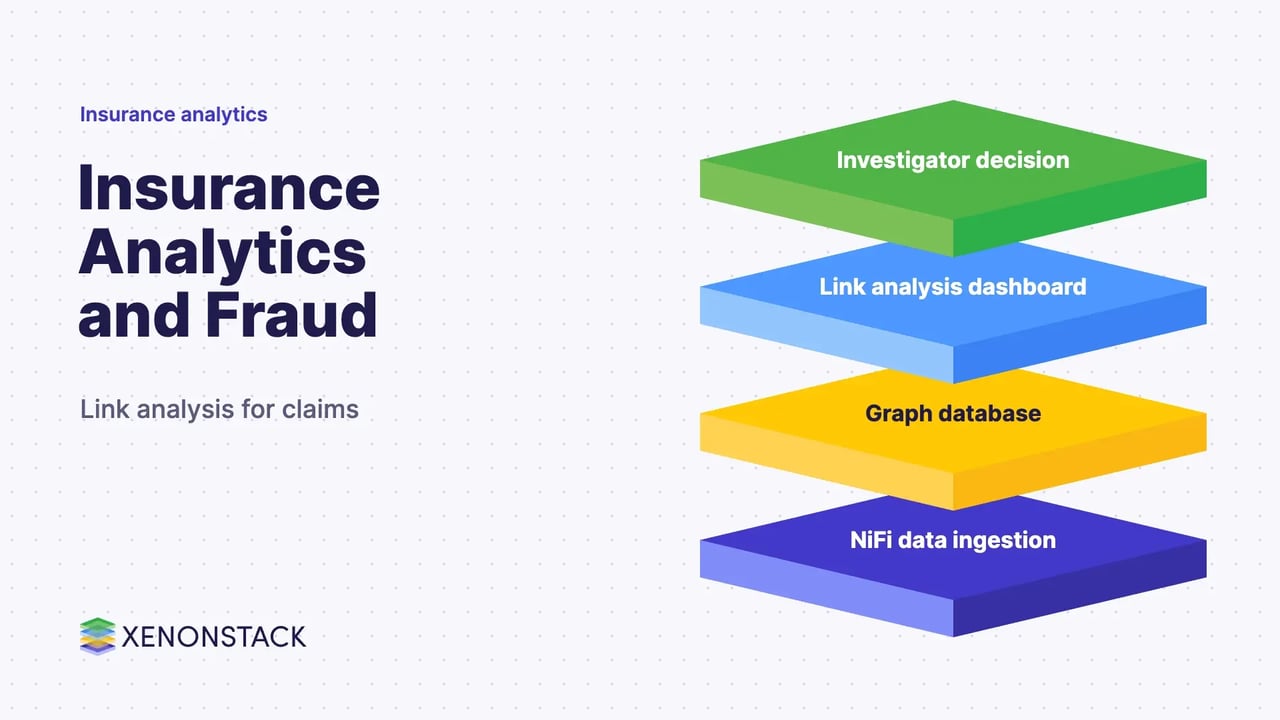
An insurer often holds the data it needs in different formats: PDF files, scanned PDF images, CSV files and SQL Server databases. Apache NiFi is a platform for automating and managing the flow of data between systems, built around FlowFiles, processors that route and transform data, and provenance records of every event. A fraud detection solution can use it as the ingestion layer.
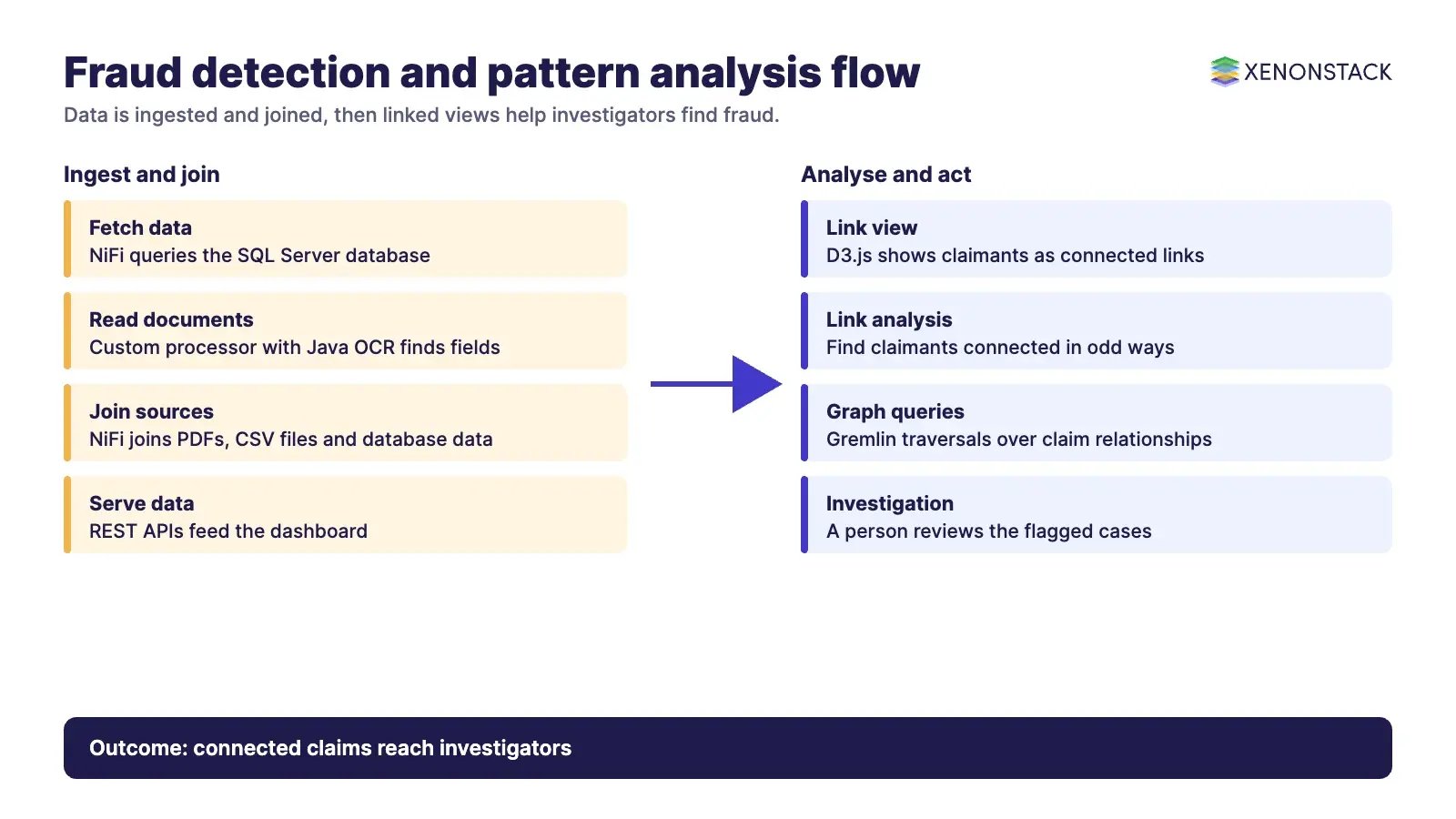
- Use NiFi database query processors to fetch data from the SQL Server database.
- Add a custom NiFi processor with Java OCR to detect fields in scanned documents.
- Join data from the different sources in NiFi.
- Expose the joined data through REST APIs and show it as links on a D3.js dashboard.
- Run link analysis to identify the claimants who are connected in suspicious ways.
Link analysis is where a graph database helps. JanusGraph is an open-source graph database that follows the property graph model and uses the Gremlin traversal language, so connections between claimants, providers and claims can be queried directly. The dashboard needs Python, the Flask framework, JavaScript and D3.js. See also the page on fraud detection.
What does advanced claims analytics cover?
Claim analytics gives insight into claim processing. Real-time tracking supports customer satisfaction, claim scoring improves how claims are assigned and managed, and claim data processing supports loss recovery and a shorter claim cycle. Applications include renewals tracking, identifying fraudulent and useful data, claim forecasting, recovery optimisation, healthcare insurance claims and social network analytics. Connected homes, vehicles and wearables extend the data available for usage-based and health insurance.
Where do AI agents fit in insurance analytics?
Agents can triage new claims, collect the documents a claim needs, run the link analysis query, and send a scored case to a human investigator with the evidence attached. Decisions on a claim should stay with a person, and each step should be logged. ElixirClaw is XenonStack's AI agents computing platform, and ElixirData is its Context OS for data and governance.
How do rule-based checks compare with link analysis?
| Aspect | Single-claim rules | Link analysis |
|---|---|---|
| What it sees | One claim at a time | Connections between claimants, providers and claims |
| Typical finding | A claim that breaks a rule | A group of claims linked by shared details |
| Data needed | One system | Joined data from several sources |
| Best use | First screening | Investigating suspected rings |
What should you check before adopting insurance analytics?
- Data sources: list every format, including scanned documents, and plan how fields will be extracted.
- Data quality: joins across systems fail when identifiers differ, so test the matching.
- Explainability: investigators need to see why a claim was flagged.
- Fairness and privacy: review how personal data is used in profiling.
- Human review: decide who acts on a flag, and keep the final decision with a person.
Insurance fraud is a recognised problem: the FBI describes types such as premium diversion, fee churning, asset diversion, workers' compensation fraud and disaster-related fraud on its insurance fraud page.
To map one decision your agents make, and the data and policy it depends on, book a Context Workshop. See what happens in the workshop.
Frequently asked questions
What is insurance analytics?
It is the use of predictive modelling, data mining and link analysis on insurance data to price risk, process claims faster and detect fraud.
How does link analysis detect insurance fraud?
It joins data from several sources and shows connections between claimants, providers and claims, so groups of related claims can be investigated together.
What is Apache NiFi used for in insurance analytics?
NiFi automates the flow of data between systems. It can fetch data from databases, extract fields from documents and join sources before analysis.
Which data sources do insurers combine?
Typical sources are PDF documents and scanned images, CSV files, SQL databases and, increasingly, sensor, image and video data.
Should AI decide whether a claim is fraudulent?
No. Models and agents can score and prioritise claims, but an investigator should review the evidence and make the decision.
Ready to put AI agents to work? See an ElixirClaw demo: the agentic OS to build, orchestrate and govern AI agents across your enterprise systems.
Explore the XenonStack platform family: ElixirData · ElixirClaw · ElixirHub · NexaStack · MetaSecure · Neural AI · AgentGRC · AgentSRE · AgentAnalyst · AgentInstruct · AgentRAI · AgentScrum · AgentSearch · AgentForce · AI Aviator · SAIF Aviator · CohortIQ · XenonStack AI · XenonStack UAE