Key takeaway
- Credit card fraud detection use case: how a Random Forest model, transaction history and Spark Streaming flag fraud, with the challenges and checks first.
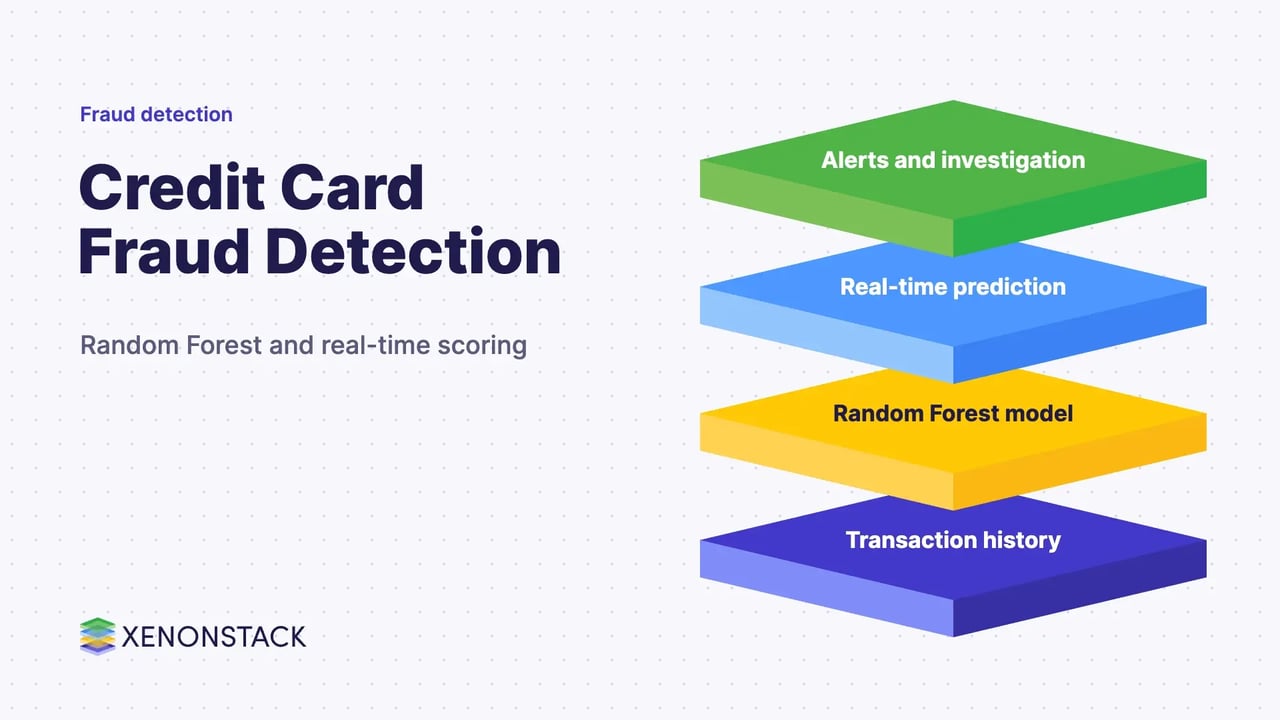
Credit card fraud detection uses machine learning to learn from past transactions and flag suspicious card activity, both online and offline, as it happens. This use case builds a detection system with a Random Forest model, a customer's recent transaction history and real-time scoring on streaming data.
It is written for risk, payments and data engineering leaders who need a practical view of a fraud model. It covers the problem, the method, the steps, where AI agents fit and what to check first.
What is credit card fraud detection?
Online transactions involve the transfer and storage of sensitive data such as financial information, authentication information and passwords, and misuse of that data leads to many kinds of fraud. Credit card fraud is one of the major threats, and it happens both online and offline. Payments by credit card, debit card and net banking are all prone to it. Fraud detection builds a system that flags suspicious transactions so an institution and its cardholders can be protected.
What problem does the system have to solve?
Fraudulent transactions are rare and represent a small fraction of all transactions in an organisation. A model therefore has to learn from a very uneven mix of genuine and fraudulent records, and past card transactions must be analysed against the fraudulent ones. Fraud can take the form of bankruptcy, behavioural, application or theft fraud. Case investigations, customer phone support and damage to an institution's reputation add to its cost.
How does the machine learning solution work?
The fraud detection model follows the Random Forest algorithm. The scikit-learn documentation explains that each tree in a random forest is built from a bootstrap sample of the training set, that a random subset of features is considered at each split, and that these two sources of randomness decrease the variance of the forest, because individual decision trees tend to overfit. In this use case the forest aggregates hundreds of decision trees to avoid overfitting caused by class imbalance. The model analyses at least the last 20 to 50 transactions of a customer to find an underlying pattern, and it is built with Python and machine learning libraries.
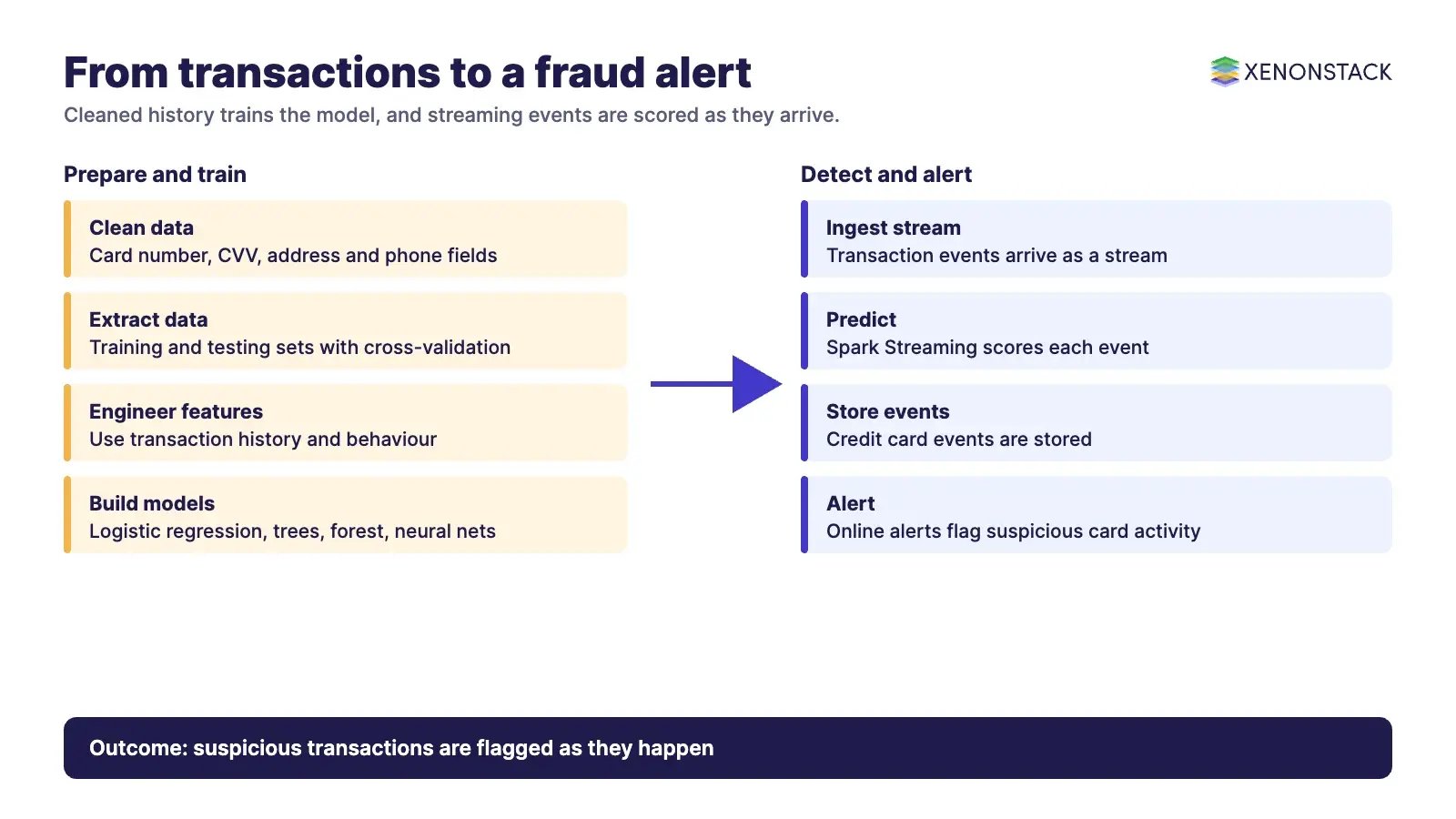
| Step | What happens |
|---|---|
| Data cleaning | Clean card number, CVV, address and phone number fields |
| Data extraction | Prepare training and testing datasets, with cross-validation through predictions |
| Model building | Try logistic regression, decision tree, random forest and neural networks |
| Feature engineering | Derive features from transaction history and behaviour |
| Streaming ingestion | Bring transaction events in as a stream |
| Real-time prediction | Score events with Spark Streaming |
| Event storage | Store credit card events |
Real-time detection needs the time between transactions, the history of transactions and the customer's own transaction behaviour.
How does this compare with manual review?
| Area | Without a model | With the model |
|---|---|---|
| Pattern finding | Analysts review past transactions by hand | The model learns patterns from a customer's recent transactions |
| Rare events | Fraud is a small fraction of volume and easy to miss | Random Forest is used to avoid overfitting under class imbalance |
| Timing | Review after the fact | Real-time prediction on streaming events |
| Alerts | Cardholders find out late | Online alerts can flag suspicious activity on a card |
The benefits named for this use case are online alerts for suspicious card activity and better analytics and predictive forecasts.
Where do AI agents fit in fraud detection?
A model produces a score; someone still has to decide what happens next. An AI agent can gather the transaction history behind a flagged event, check it against the rules the institution has set and prepare a case for an investigator to approve. This is a general pattern, not a feature of the original model. ElixirClaw is XenonStack's AI agents computing platform for building and running such agents.
What should you check before adopting a similar system?
- Measure how rare fraud is in your data and choose a method that copes with class imbalance.
- Decide how much transaction history each prediction needs.
- Confirm you can ingest and score events as a stream, and where events are stored.
- Agree who reviews a flagged transaction and what they can do next.
- Define how the model is evaluated and refreshed as fraud patterns change.
To map one decision your agents make about a flagged transaction, and the data and policy it depends on, book a Context Workshop. See what happens in the workshop.
Frequently asked questions
How does machine learning detect credit card fraud?
A model learns patterns from past genuine and fraudulent transactions and a customer's recent history, then scores new transactions to flag the suspicious ones.
Why use a Random Forest for fraud detection?
A Random Forest combines many decision trees, which reduces the overfitting that individual trees show, a useful property when fraud is a small fraction of all transactions.
Why is fraud detection hard?
Fraudulent transactions are rare compared with genuine ones, so models must handle a very uneven class balance.
What is real-time fraud prediction?
It scores transaction events as they arrive, using streaming ingestion and Spark Streaming, instead of reviewing them after the fact.
Can AI agents help investigators?
They can collect the history behind a flagged transaction and prepare a case, provided the actions they may take are governed and approved by people.
Ready to put AI agents to work? See an ElixirClaw demo: the agentic OS to build, orchestrate and govern AI agents across your enterprise systems.
Explore the XenonStack platform family: ElixirData · ElixirClaw · ElixirHub · NexaStack · MetaSecure · Neural AI · AgentGRC · AgentSRE · AgentAnalyst · AgentInstruct · AgentRAI · AgentScrum · AgentSearch · AgentForce · AI Aviator · SAIF Aviator · CohortIQ · XenonStack AI · XenonStack UAE